
Violence against women
( Sociology Optional)
Violence against women
( Sociology Optional)
Introduction
- Violence against women is defined by the United Nations as "any act of gender-based violence that results in, or is likely to result in, physical, sexual or mental harm or suffering to women, including threats of such acts, coercion or arbitrary deprivation of liberty, whether occurring in public or in private life."
- Women, though an essential and contributory of any society has secondary status throughout the world expect a few societies as an exception.
- Countless women become the victims of various forms of violence due to the secondary status of women in the world in general and in India.
Factors responsible for violence against women
The most basic reason for violence is giving women a socondary status throughout the world. This can be located in two facts, one biological and other cultural:
- Women conceive and become pregnant. The recurrent pregnancy has made them physically weaker sex. This physical weakness has made them dependent on their male counterpart to protect themselves from any external aggression
- Most of the societies are predominantly patrilineal and patrilocal.This gave rise to the view of considering women as Parayadhan or outsider in natal home.
The physical dependence along with economic disinheritation has given rise to various cultural structures, which are responsible for atrocities.
Patriarchal Mindset and Gender Stereotype:
- The patriarchal mindset of the people attempts to imbibe in the child's mind the concept of superiority of one gender over the other. Male domination has been an age-old practice.
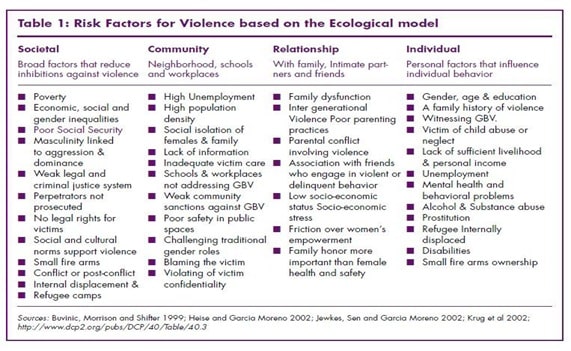
- Violence against women is also an expression of showing male- superiority and also getting status in the peer group.
- Sexually coloured remarks, molestation, eve-teasing etc are seen as an expression of manhood. Women are raped acid is thrown on them if they do not accept the proposal of a man.
Lack of Education:
- This is one of the notable causes of violence in our country. In rural areas, females are not sent to schools even to attain basic education.
- And due to the deprivation of education, they do not understand what is right and wrong.
- Married women do not know their rights and thus considers the abysmal behaviour of their husbands as their fate.
Dowry System:
- Dowry has become a problem in India because of social disorder.
- It is bolstered by tradition, mythology, and religion and is treated cursorily by the legislature, police, and courts.
- The burden of dowry contributes to the view that the birth of a daughter is a calamity, at least economically.
- Girls are discriminated against their natal homes, for example, in health care, amount of food given them, and so on.
- In many cases, if the demand for dowry is not fulfilled, the woman falls prey to violence.
- The demand rises if the girl is educated or is of darker complexion.
- Despite the enactment of The Dowry Prohibition Act 1961, this practice continues. India leads in the number of dowry death cases.
Traditional and Cultural Practices
- The customs like sati and devadasi system are still prevalent in many parts of our country.
- The devadasi is neither a reprehensible figure nor an exotic being.She has been shaped by a socio-cultural context, dominated by patriarchy, caste/ class hierarchy as well as religious superstition.
- The woman has no existence in society without the context of men thus the sati ritual was considered logical to them. Both these practices continue in contemporary India which is highly condemning.
- The women's position downgrades because of such customs and thus making them vulnerable.
Insensitivity of law enforcement machinery
- Women are generally advised to solve any issue on its own and domestic violence is not considered major or a common thing by law enforcers.
- Most of the time women never file a complaint because of the fear of disgrace of them and their family in the society.
- Law is the protector of every individual but it is still inefficient in curbing the problems of women.
Financial Dependence
- Women role is limited to giving birth to child and taking care of them which are not primarily economic role.
- As they do not contribute directly in the economic production in upper caste, they are considered as burden.
- As a result the system of dowry in perverted form. This has given rise to female foeticide and infanticide.
Problems faced by women
- Criminal Violence: Rape, abduction, murder, problem of trafficking against women and children etc.
- Domestic Violence:
- Violence in the Natal Home-- Female foeticide and Infanticide, The Abuse of girl child, Inequality in the household
- Violence in conjugal home-- wife beating, child rape in the family, marital rape, phychological torture through constant abuses etc.
- Social Violence: Refusing to give women in property, forcing a widow to commit sati, harassing daughter in law to bring dowry, discrimination at work place.
Extent of crime against women in India
- According to UNICEF’s ‘’ State of the World Children-2009’’ report, 47% of Indian’ s women aged 20-24 were married before the legal age of 18, rising to 56% in rural areas. The report also showed that 40% of the world’s child marriages occur in India.
- The birth of the girl child was considered inauspicious. In villages as well as in cities, the girl child was killed before or after death.
- In 2011, Government stated India was missing three million girls and there are now 48 less girls per 1000 boys.
- A 1997 report claimed that each year at least 5,000 women in India die due to dowry. In 2011, the National Crime Records Bureau reported 8,618 dowry deaths.
- According to Renuka Chowdhary, former Union Minister of women and Child Development, around 70% of women in India are victims of domestic violence.
- 11,332 women and girls are getting trafficked every year.
- Rape in India has been described by Radha Kumar as one of India’s most common crimes against women.
- The number of acid attacks have been increasing.
Consequences of atrocities on women
- According to world development report (1993), rape and domestic violence account for about 5% of the total desease burden among women in the group of 15-44, physical as well as non-physical.
- This violence leads to high social and economic costs for women, their families and societies. Such violence can:
Health consequences
- Have fatal outcomes like homicide or suicide.
- Lead to injuries, with 42% of women who experience intimate partner violence reporting an injury as a consequence of this violence .
- Lead to unintended pregnancies, induced abortions, gynaecological problems, and sexually transmitted infections, including HIV.
- The findings of Anveshi, Reseatch center in Women's studies in Hyderabad (1995), shows that there is no gender difference in severe mental disorders such as schizophrenia and manic depression, twice as many women than men are afflicted with common mental disorders such as anxieties, phobias, and obsessive compulsive behaviour.
- Violent abuse can result in a range of symptoms known as post- traumatic stress disorders (PTSD).
- Sexual violence, particularly during childhood, can lead to increased smoking, substance use, and risky sexual behaviours. It is also associated with perpetration of violence (for males) and being a victim of violence (for females).
Impact on children
- Children who grow up in families where there is violence may suffer a range of behavioural and emotional disturbances. These can also be associated with perpetrating or experiencing violence later in life.
- Intimate partner violence has also been associated with higher rates of infant and child mortality and morbidity (through, for example diarrhoeal disease or malnutrition and lower immunization rates).
Social and economic costs
- The social and economic costs of intimate partner and sexual violence are enormous and have ripple effects throughout society.
- Women may suffer isolation, inability to work, loss of wages, lack of participation in regular activities and limited ability to care for themselves and their children.