
Types of religious practices
( Sociology Optional)
This topic covers various types of religious practices: animism, monism, pluralism, sects, cults.
3.1 Animism
Introduction
- Animism is the belief that objects, places, and creatures all possess a distinct spiritual essence.
- It has minimal definition of religion as ‘Belief in spiritual beings’.
- Animism perceives spirituality in all things: Animals, plants, rocks, rivers, weather systems etc.
- Animism is used in the anthropology of religion as a term for ‘the belief system of indigenous peoples’.
- It is considered in contrast to the recent development of organized religions.
- Edward Tylor developed animism as an anthropological theory.
Origin of Religious Beliefs
- Origin of religion cannot be traced to single source. The beginning of religion is as old as human consciousness.
- There exist various religious beliefs and practices in pre-modern societies.
- The universality of religion across human societies suggests a deep evolutionary past.
- Tylor quotes religion has evolved through the sequence of Animism, Polytheism, Monotheism.
Thinker’s Perspectives
- Earlier philosophers such as Aristotle and Thomas Aquinas had discussed animism.
- The concept of animism first appeared explicitly in Primitive Culture (1871) by Sir Edward Burnett Tylor. He defined aminism as "the general doctrine of souls and other spiritual beings in general".
- David hume, Max Muller, Giddings claimed that religion is a creation of man which is based on the illusion and fear.
- Herbert Spencer and Tylor argued that religion originated primarily in ghost fear and that Animism lies at the very basis of
- According to Marret, ‘Belief in impersonal power, designated as Mana, which preceded animism, should be regarded as underlying all religion.’
- According to Roberrson Smith, ancient religion consisted primarily of institutions and practices. i.e. rites and ceremonies which are to be regarded as the elementary forms of religion.
- Summer and Keller argued that religion arose in response to definite needs of adjustment to supernatural and imaginary environment. It is an adaptation because of condition accompanying life on earth.
- Durkheim argued, totem is the core out of which religion develops. In his book "Elementary Forms of Religious Life", he concluded that Society itself is the ultimate source of religion, and thus he arrived at sociological explanation of religion. Durkheim equates God with society.
Characteristics of animism
- Animism puts more emphasis on the uniqueness of each individual soul.
- In animist societies, ritual is considered essential to win the favor of the spirits.
- Shamans, also called medicine men or women, serve as mediums between the physical world and the world of spirits.
- Examples of Animism can be seen in forms of Shinto, Hinduism, Buddhism, pantheism, Paganism, and Neopaganism.
- Animists believe everything to be spiritual in nature. However, they do not necessarily see the spiritual nature of everything as being united (monism).
Conclusion
- Animism describes the foundational thread of indigenous peoples’ "spiritual" or "supernatural" perspectives, which holds that natural phenomena have souls or spirits.
- Although it has generally been dismissed in the academic study of religion, it is seen as an obsolete term for describing belief systems of the indigenous people.
3.1.1 Tylor’s theory of animism
Tylor was interested in contemporary indigenous religions as data for building a theory of the original or primitive animism. As per Tylor, the idea of the human soul must have been the elementary religious idea and the model for all other supernatural beings.
Basis of the theory
- Tylor’s theory of animism is derived from the “primitive” inability to distinguish between dreams and waking consciousness.
- When the “primitive” ancestors of humanity dreamed about deceased friends or relatives, they assumed that the dead were still alive in some spiritual form.
- The idea of souls, demons, deities, and any other classes of spiritual beings, are conceptions of similar nature. However, the conceptions of souls are the original ones.
- “The doctrine of souls” or “the doctrine of spiritual beings” constitutes the essence of Tylor’s theory.
Background
- Taylor’s developmental or evolutionst theory championed against the the degradation theory.
- The degradation theory held that the religion of remote peoples could only spread from the centres of high culture, such as early Egypt. The religion becomes “degraded” in the process of transfer.
The theory
- Religion is is based on Religion and cultures move from simpler to more complex forms. Tylor offered no specific explanation for this expansion.
- Religion is evolved from a “doctrine of souls”. It arises from spontaneous reflection upon death, dreams, and apparitions, to a wider “doctrine of spirits”. It eventually expandes to embrace powerful demons and gods.
- There exists a pre-religious stage in the evolution of cultures, and a tribe in that stage might be found.
- To proceed in a systematic study of the problem, he required a “minimum definition of religion” and found it in “the Belief in Spiritual Beings.”
Evaluation
- Tylor seems more balanced in his judgments than later writers who constructed the problem of “minimal religion” in a narrower frame.
- If no people are devoid of such minimal belief, then it can be assumed that all of humanity has passed the threshold into “the religious state of culture.”
Applications
- Tylor showed that animistic beliefs exhibit great variety and often are uniquely suited to the cultures and natural settings in which they are found.
- In Indonesia and Nigeria, representatives of indigenous religions, have sought formal recognition as animists.
- Animism is adopted as a term of self-identification in New Age, neo-pagan, or environmentalist movements.
- Tylor’s most important source was an account of Zulu religion from South Africa. Zulus often saw the shade or shadow of deceased ancestors in dreams.
Counter theories and Later developments
- French sociologist Emile Durkheim, in his The Elementary Forms of the Religious Life (1915), held that religion originated in totemism and society.
- English and German theorists conceived the invention of religion in more pragmatic terms. As per them, to extend the control of nature beyond the limits imposed by the science, people had invented a supernatural power - magic.
- Sir James G. Frazer, in his The Golden Bough (1890–1915), argued that “the magic art” had arisen as a pseudo-science. It has achieved universality before the emergence of religion.
- Bronisław Malinowski pictured the Trobriand islanders in Melanesia as secular in outlook.
3.2 Monism
Introduction
- Monism considers that creation of Cosmos comes from ‘one principle’.
- It is defined as every philosophical system that reduces the multitude and polymorphy of things to one single principle, whether that is matter or spirit or the soul or even volition.
- Monism is the metaphysical view that, all is of one essential essence, substance or energy.
- Monism is to be distinguished from dualism, which holds that ultimately there are two kinds of substance; and from pluralism, which holds that ultimately there are many kinds of substance.
Thinker’s Perspective
- In Hinduism, the term "absolute monism" is used for Advaita Vedanta.
- The term monism was introduced by Christian von Wolff in his work Logic (1728). He attempted to eliminate the dichotomy of body and mind, and explained all phenomena by one unifying principle, or as manifestations of a single substance.
- It was later also applied to the theory of absolute identity set forth by Hegel and Schelling.
- F. Wolff says that everything that happens, there must be some ‘rationale’, that causes it or makes it happen.
- Wolff related Monism to every ontological theory, that reduces the totality of things to matter or correspondingly to spirit.
Characteristics
- Monism reduces things to only one principle, whether that is Matter (materialism), Spirit (spiritualism), Soul, volition (Volitualism) etc.
- Monism denies the variety of physical phenomena.
- Monism is classified as: Ontological, Gnoseological, Biological, Social, Historical, Moral etc.
- In monistic religions, there is no contrast between good and evil. Evil is regarded as a negative principle.
- Evil is not derived from the deity, but from the misuse of the freedom granted to the creatures of the Universe.
- Monism is often seen as partitioned into three different kinds:
- Physicalism or materialism: It holds that only the physical is real, and that the mental can be reduced to the physical.
- Idealism or phenomenalism: It holds the converse.
- Neutral monism: It holds that both the mental and the physical can be reduced to some sort of third substance or energy.
It deals with the mind–body problem. The mind–body problem is a debate concerning the relationship between thought and consciousness in the human mind, and the brain as part of the physical body.
Examples
- Advait philosophy of Hinduism contends that there is no distinction between the disciple and the God. They are one and there is ultimately a single being.
- Sufi saints also stressed upon this concept of a single all powerful.
- Among modern religions, Islam is a monistic religion as its believers deny existence of any other power than one.
- In Sikhism, God is conceived as the Oneness that permeates the entirety of creation and beyond. It is symbolized by the Ik Onkar. Sikhs comply with the concept of Priority Monism.
Conclusion
- The mind–body problem has reemerged in social psychology. Dualism maintains a rigid distinction between the realms of mind and matter. Monism maintains that there is only one unifying reality as in neutral or substance or essence, in terms of which everything can be explained.
- Monism is also still relevant to the philosophy of mind, where various positions are defended.
3.3 Pluralism
Introduction
- Pluralism is a "doctrine of multiplicity," often used in opposition to monism ("doctrine of unity") and dualism ("doctrine of duality").
- Pluralism is a philosophy is the recognition and affirmation of diversity within a population group, which is seen to permit the peaceful coexistence of different interests, convictions, and lifestyles.
- Globalization and migration play a significant role in the pluralization of Western societies.
- Many sociologists argue that modernity and pluralization go hand in hand.
- Auguste Comte, Herbert Spencer, Emile Durkheim, Max Weber, Karl Marx, Georg Simmel, Sigmund Freud,
Cultural Pluralism
- When small groups within a larger society maintain their unique cultural identities, and their values and practices are accepted by society.
- Sometimes, it requires that minority culture remove some aspects of their culture which is incompatible with laws or values of dominant culture.
- Cultural pluralism in USA was developed by Pragmatist philosophers such as William James and John Dewey.
- Often cultural pluralism and multiculturalism are used interchangeably, however, there is one difference. In multiculturalist societies, there is no dominant culture. It is the peaceful coexistence of various small cultures.
Cultural Pluralism in Homogeneous and Heterogeneous societies
- Homogeneous societies like Israel, Japan, South Korea which have only one dominant culture. Hence, they are in lesser need to accommodate other cultures. The lack of cultural pluralism can be observed in homogeneous societies.
- Heterogeneous societieslike USA, India, UK etc. have multiple cultures. Cultural pluralism can be observed here.
- However, cultural pluralism requires not just the existence of different cultures, but also respect for these cultures by the dominant culture.
- Saudi Arabia might be a heterogeneous society but not a culturally plural one.
- Here, migrants bring their culture along with them. The country now has a considerable South Asian diaspora.
- However, their cultures are suppressed and relegated to the private realme., they are not allowed to practice their culture openly.
- India is classic example of cultural pluralism both in letter and spirit.
- Indian society is a synthesis complex cultures, religions, languages, people belonging to different caste and communities.
- Plurality of religions: Hinduism, Jainism, Budhism, Islam, Christianity, etc.
- India is, in fact, a panorama of its own types without a parallel in other continents.
- The urge for unity in diversity has ingrained in our ethos and public discourse.
- In short, India is “the epitome of the world”.
Religious Pluralism
- Religious Pluralism refers to social phenomenon of religious plurality or diversity.
- It has acquired new scope in recent decades, both in Western Europe and USA.
- This religious diversity encompasses not only Christians, Jews, Muslims, but also non-Abrahamic religions such as Hindus, Buddhists, new religious movements, a growing number of non-believers.
- Globalization and migration play a significant role in the pluralization of Western societies.
- Through these processes, modernity has not led to the disappearance of religion, as some theories of secularization predicted, but to a deep plurality.
- Not only do various religions coexist but religion itself undergoes a process of internal pluralization.
- In these ways, many sociologists argue that modernity and pluralization go hand in hand.
- It is one of many forms of pluralism in contemporary globalized world.
- Some other Pluralism include: Ethnic pluralism, Value pluralism, Doctrinal pluralism, Ethical pluralism, Political pluralism.
- Religious pluralism is one of the most important in contemporary society, considering globalization and the role of religions in many conflicts.
- It has its root in political liberalism.
- In Europe, it has played most enduringly in relations among the monotheistic religions: Judaism, Christianity, Islam.
- Today, in the face of mass migration from Muslim regions, questions of political identity and belonging remain bound up with religious affiliation.
Religious Pluralism & Society
Previous Ages
- A rich diversity of religions, lifestyles, and world views.
- However, these were often regionally confined.
Globalized World
- Religious, ethical, or any other ideas can float almost everywhere.
- India presents an opportunity to understand a long and multifaceted heritage of religious diversity.
3.4 Sects and cults
3.4.1 Background
Church-Sect typology
- There is a continuum along which religions fall, ranging from the protest-like orientation of sects to the equilibrium maintaining churches. - Weber and Troeltsch.
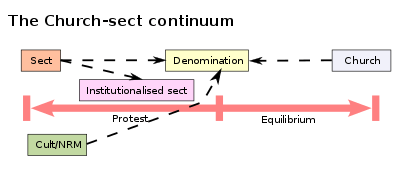
J. Milton Yinger made six-fold classification of religious organization: Universal churches, ecclesia, class church, established sect, sect and cult.
Church
- Church is a large well established religious institution, bureaucratic in its working, which is culmination of the evolution from sect.
- It has defined hierarchy of officials.
- A church identifies with the state.
- It is integrated with the socio-economic structure of society. Eg. Roman Catholic Church in the middle-ages had important social, political and educational functions.
- It recruits from all social strata, but higher status groups are usually overrepresented.
- It often actively guards its monopoly on religious truth. Eg. Roman Catholic church actively stamped out ‘heresy’.
Denomination
- A religious denomination is a subgroup within a religion that operates under a common name, tradition, and identity.
- It is a recognized autonomous branch of the Church.
- Unlike a church, a denomination does not identify with the state. It approves the separation of church and state.
- Like a church, a denomination has a hierarchy of paid officials and bureaucratic structure.
- After the separation of polity from religion, most of the churches now closely resembles a denomination.
- Membership is drawn from all social strata. However, the lower working class is usually less represented.
- Examples of Christian denominations: Eastern Orthodox, Catholic, Protestantism etc.
- The world's largest religious denomination are Catholic Church and Sunni Islam.
- The major denominations in Hinduism include Shaivism, Shaktism, and Vaishnavism.
- Becker (1950) argues that “denominations are sects that have cooled down”.
Sect
- Sect is a newly formed religious group that form to protest elements of their parent religion. - Max weber.
- Sect takes birth in protest and rebellion.
- Its members are usually drawn from the lower classes and the poor.
- In its organisation, the Sect is usually democratic.
- Its relation with the political authority may or may not be smooth.
- Obliteration of distinction between the clergy and the laity is its chief characteristic.
- Some sects lose ‘sectarian characteristics’. They adopt a bureaucratic structure. Jehovahs Witnesses sect.
Cult
- It is a system of religious devotion towards a particular figure or object.
- They are not breakaway group of existing denomination.
- Cults quite often form around an inspirational leader (Charismatic leadership). – Max Weber.
- Their focus is on individual experience, bringing likeminded individuals together.
3.4.2 Sects
- A sect is a subgroup of a religious, political, or philosophical belief system, usually an offshoot of a larger group.
- Sects are newly formed religious groups that form to protest elements of their parent religion. – Max Weber and Ernst Troeltsch (1912).
Different Perspective towards Sects
Church-Sect typology
- There is a continuum along which religions fall, ranging from the protest-like orientation of sects to the equilibrium maintaining churches. - Weber and Troeltsch.
- Max weber says, sect is a newly formed religious group that form to protest elements of their parent religion.
- According to Weber, Sects are most likely to originate within those the marginalized and alienated
- weber terms this as: 'Theodicy of deprivileged'. Theodicy is a religious justification.
- We can find a use here for Durkheim’s concept of sacred and the profane.
- The more religious activities become standardized, the more the “element of sacred” is lost. The religious rituals and belief become mundane parts of the everyday world.
- Groups now break away from the main community, mobilise protest or separatist movements.
- Some sociologists argue that sects are result of wider process of secularization and liberalization of society.
- According to Bryan Wilson they are a result of rapid social change. Sects are more organized form of religion. – Wilson, 'Religion in Sociological Perspective, 1982'
- Urge for change and reinterpretation are at the heart of the sects. - Bryan Wilson.
- Sects are authentic purged, refurbished version of the faith from which they split. – Stark and Bainbridge.
- Some sects exist in tension with co-religious groups of different ethnicities or with the society, rather than the church which the sect originated from. - Fred Kniss
- Its cause is said to be partly in the Christian tradition itself.
- Christianity grew in protest, so does the Sect.
Characteristics of sects
- It is marked by a desire to disassociate from existing social order.
- Sect takes birth in protest and rebellion.
- In its organisation, the sect is usually democratic.
- Obliteration of distinction between the clergy and the laity is its chief characteristic.
- Sects contain an explanation for the disprivilege of the members and promise them a ‘sense of honour’. Weber terms this as: 'Theodicy of deprivileged'.
- It leads to religious exclusivism: It is the doctrine that only one particular belief system is true.
- Sect has a disdain for 'the refined verbal theologians'.
- It is often intolerant toward other religious groups.
- Its relationship with the political authority may or may not be smooth.
- In a multi- religious society, sectarianism can have negative implications.
- Sects are, in Peter Berger’s words, in tension with the larger society and closed against it.
- according to Richard Niebuhr, Sects are necessarily short lived.
- A sect has distinctive religious, political, or philosophical beliefs.
- The principles of sect expanded in modern culture from religion to all organizations.
Examples
- Black Muslims sect in USA in 1960s promised liberation or emancipation to Negros.
- Unemployed Black American joins the Black Muslims. Bryan Wilson sees the rise of Methodism.
Christianity
- Sects of Roman Catholic denomination: the Community of the Lady of All Nations, the Palmarian Catholic Church etc.
- Sects of Protestant denominations: many examples.
Hinduism
- In Hinduism, the word sect does not denote a split or excluded community, but rather an organized tradition. - The Indologist Axel Michaels.
- Major Hindu Sects: Vaishnavism, Shaivism, and Shaktism.
- ISKCON sect has a wide appeal not limited to economically weaker sections alone.
Sikhism
- Nirankaris and Nam-Dharis (Kuka Sikhs) sects emerged in Punjab during the latter part of Ranjit Singh’s reign.
- Akhand Kirtani Jatha, emerged during early 20th century. The members of this group are distinguished by their divergent interpretation.
- Dera Sacha Sauda sect promises a casteless society to the people from rural areas or from depressed castes.
Buddhism
- Theravada or Southern Budhhism (Teaching of the Elders): It is dominant in Sri Lanka and Southeast Asia.
- Theravada is conservative Buddhist tradition, who did not accept the Mahayana sutras into their
- Mahayana or (East Asian or Eastern Buddhism): It is derived from the Chinese Buddhist traditions.
- Vajrayana or Mantrayana: Tantric Buddhism and Indo-Tibetan Buddhism. It is a part of broader category of Mahayana Buddhism instead of a separate tradition.
Islam
- It is divided into three major sects: Sunni Islam, Shia Islam and Ahmadiyya Islam.
- Kharijite and Murijite Islam were two early Islamic sects.
- Each sect developed distinct theology reflecting their own understanding of the Islamic law.
Role of Sects in Multi-Religious Societies
- Wherever people of different religions live in close proximity, religious sectarianism is often found.
- Religious sectarians now exist peacefully side-by-side. Eg. Protestant and Catholic Christians in USA.
- Within Islam, there are conflicts between Sunnis and Shias.
- Some of the possible reasons for sectarian violence include:
- Power struggles,
- Political climate,
- Social climate,
- Cultural climate,
- Economic landscape.
Evaluation
The concepts of Church, denomination, sect and cult are useful for analyzing aspects of religious organization.
However, these concepts must be applied with caution partly because they reflect specifically Christian traditions.
3.4.3 Cult
- It is a system of religious devotion towards a particular figure or object.
- References to the cult of a particular saint are often found. Eg. Catholic saint, Bhakti and Sufi Saints.
- They are not breakaway group of existing denomination.
Different Perspective towards Cults
- The concept of a cult as a sociological classification was introduced in 1932 by American sociologist Howard P. Becker.
- Becker bisected Troeltsch's Church-sect typology: church was split into ecclesia and denomination; and sect into sect and cult.
- In the book The Future of Religion, American sociologists Rodney Stark and William Bainbridge comment that, "in the beginning, all religions are obscure, tiny, deviant cult"
- Cults are based on charismatic leadership. - Max Weber. Followers of Ayn Rand are characterized as a cult. She supported rational and ethical egoism and rejected altruism.
- Sociologist Roy Wallis argued that A cult is characterized by epistemological individualism. e. the cult has no clear locus of final authority beyond the individual.
- Cults are often seen in negative
- However, Psychologist Dick Anthony argued that involvement in cult movements may often have beneficial, rather than harmful effects.
- We can find a use here for Durkheim’s concept of sacred and the profane.
- The more religious activities become standardized, the more the “element of sacred” is lost. The religious rituals and belief become mundane parts of the everyday world.
- Groups now break away from the main community, mobilise protest or separatist movements.
- A political cult is a cult with a primary interest in political action and ideology. “On the Edge: Political Cults”, Tourish and Wohlforth.
Characteristics of Cults
- The cult tends to be short-lived because of the problem of succession. Charisma is not readily transferable.
- It is concerned with a particular personality and is being influenced by their values, ideas, philosophy, etc.
- People do not formally join a cult, but rather follow the prescribed ways of behavior.
- Members are allowed to maintain other religious connection.
- It is the most loosely knit and transient of all religious organizations.
- Cult refers to a new religious movement whose beliefs and practices are considered
Opposition
- In the early 1970s, secular anti-cult movements (ACM) to cults had taken shape.
- These movements argued that people could not alter their lives so drastically by their own free will.
- Brainwashing techniques were used to maintain the loyalty of cult members.
Evaluation
The concepts of Church, denomination, sect and cult are useful for analyzing aspects of religious organization.
However, these concepts must be applied with caution partly because they reflect specifically Christian traditions.