Population Composition
( Sociology Optional)
Population Composition
( Sociology Optional)
Population composition is the description of the characteristics of a group of people in terms of factors such as their age, sex, marital status, education, occupation, and relationship to the head of household.
Elements of Composition
1. Sex Composition
- The number of women and men in a country is an important demographic characteristic.
- The ratio between the number of women and men in the population is called the Sex Ratio. The sex ratio is an important information about the status of women in a country.
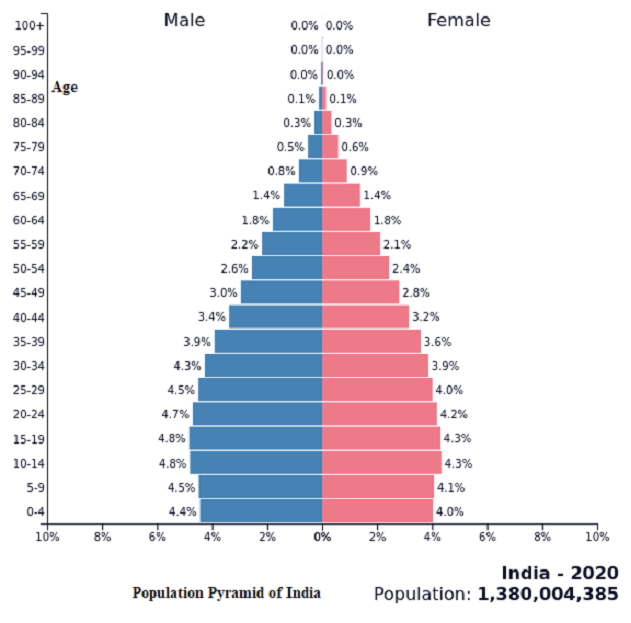
- It can be deducted by the Age-Sex Pyramid of
2. Age Structure
- Age structure represents the number of people of different age groups.
- This is an important indicator of population composition, since a large size of population in the age group of 15- 59 indicates a large working population.
- Age-Sex Pyramid: The age-sex structure of a population refers to the number of females and males in different age groups. A population pyramid is used to show the age-sex structure of the population.
3. Rural Urban Composition
- The division of population into rural and urban is based on the residence.
- This division is necessary because rural and urban life styles differ from each other in terms of their livelihood and social conditions.
4. Literacy
- Proportion of literate population of a country in an indicator of its socio-economic development.
- It reveals the standard of living, social status of females, availability of educational facilities and policies of government.
- Level of economic development is both a cause and consequence of literacy.
- In India, literacy rate denotes the percentage of population above 7 years of age, who is able to read, write and have the ability to do arithmetic calculations with understanding.
5. Occupational Structure
- The working population (i.e. women and men of the age group – 15 to 59) take part in various occupations.
- These occupations range from the primary activities like agriculture, forestry, fishing; to secondary activities like manufacturing and industry; to the tertiary activities like services and communication.
Composition of Indian population
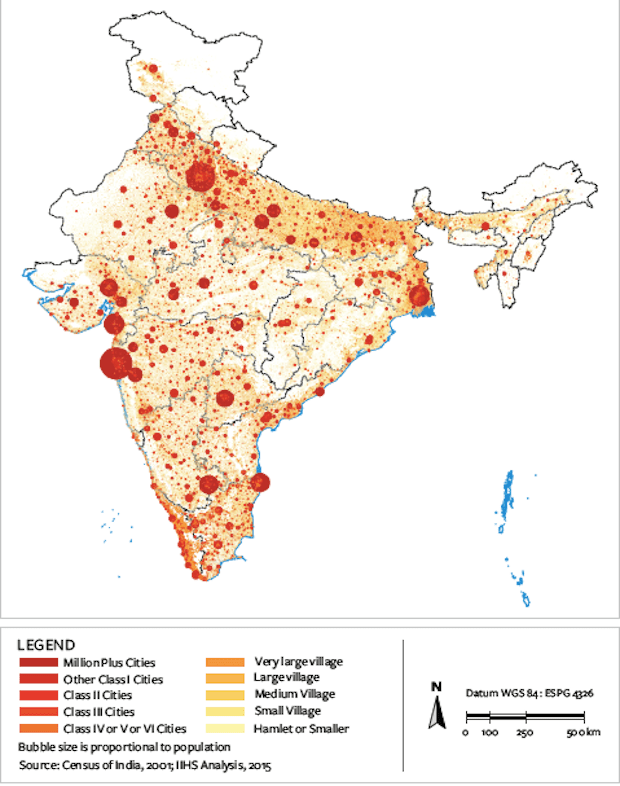
- Population is divided into two parts-rural and urban on the basis of the size and occupation of settlements.
- The rural population consists of small sized settlements scattered over the countryside. Urban population is one that lives in large size settlements i.e. towns and cities.
1. Rural – Urban Composition
- Rural – Urban distribution: 69% & 31.%.
- Level of urbanization increased from 28% in 2001 Census to 31% in 2011 Census. The proportion of rural population declined from 72% to 69%.
- For the first time since Independence, the absolute increase in population is more in urban areas that in rural areas.
2. Linguistic composition
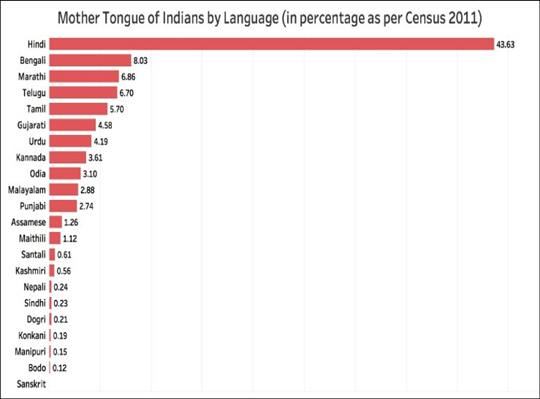
- As per the 2011 census, 43.63 percent of Indians speak Hindi as their mother tongue.
- Bengali, with 8.03 percent speakers, is second in the list, followed by Marathi at 3rd with 6.86 percent speakers, Telugu at 4th with 6.7 percent speakers and Tamil at 5th with 5.7 percent speakers.
3. Religious composition
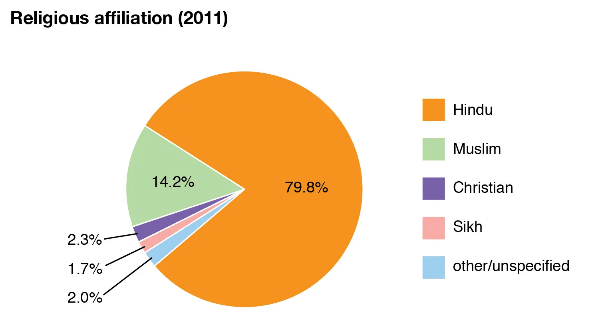
According to the 2011 census,
- 8% of the population of India practices Hinduism,
- 2% adheres to Islam,
- 3% adheres to Christianity,
- 7% adheres to Sikhism, 0
- .7% adheres to Buddhism, and
- 4% adheres to Jainism.
4. Sex Composition
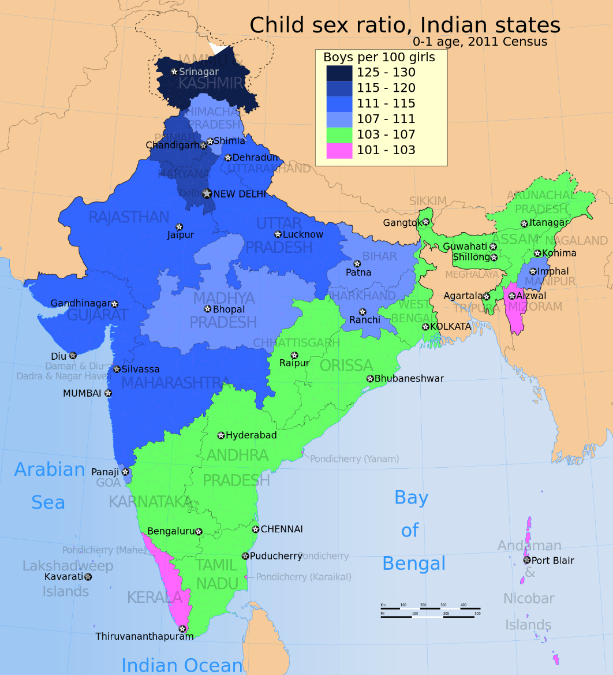
- Total population of India is 1,21,01,93,422 which consists of 62,37,24,248 males and 58,64,69,174 females.
5. Sex Ratio
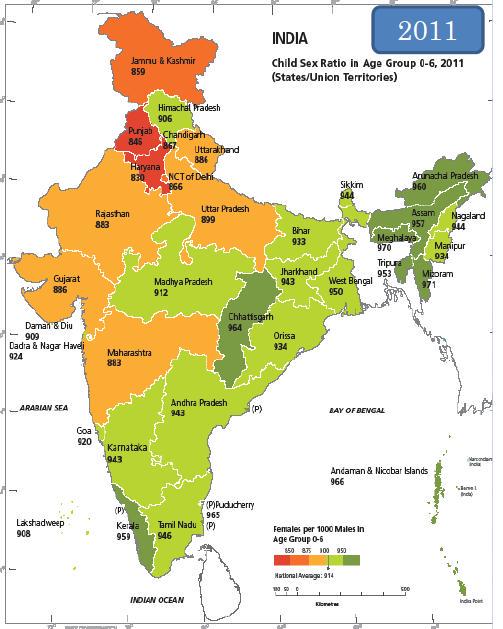
- As per the 2011 census, sex ratio of India was 940 females per 1000 males.
6. Literacy
- As per the 2011 census, literacy rate of India was 74.04% (the details of literacy rate is illustrated in the following map − state-wise).

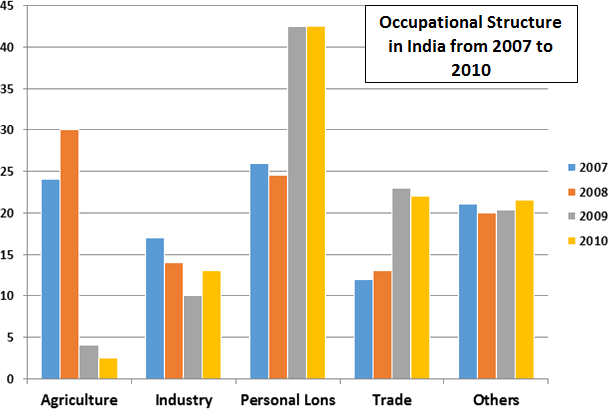
7. Occupational Structure
- Considering the economic status, population can be divided into categories such as main workers, marginal workers, and non-workers.
- As per the census 2011, main workers and marginal workers collectively constitute only about 40% of total population; rest are non-workers.
- About 55 per cent of the total working population are cultivators and agricultural laborers.
- The number of female workers is relatively high in the primary sector.
- The proportion of workers in agricultural sector in India has shown a declining trend over the last few decades. Eg. It declined from 58% in 2001 to 55% in 2011.
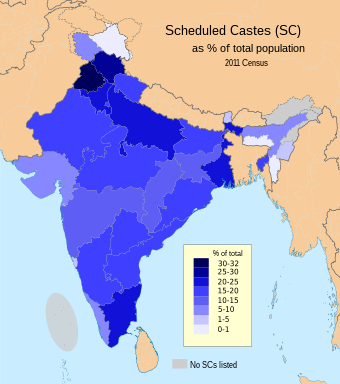
8. Caste structure
It is mainly divided using chaturvarna system.