
Bondage Labour
( Sociology Optional)
Bondage Labour
( Sociology Optional)
Introduction
- Bonded labour is generally described as a type of forced labour and is also known as debt bondage or debt labour. It occurs when a person is forced to use their physical labour to pay off a debt.
- Mostly debt is the root cause of bondage. The workers or dependents or heirs are tied to a particular creditor for a specified or unspecified period until the loan is repaid.
- Bonded labour as per the definition by National Commission on Labour is ‘labour that remains in the bondage for the debt incurred’. It is a relation between a creditor and debtor in highly unequal terms. This form of labour is a product of debt bondage where the dependence and control of labour is through indebtedness.
- Bonded labour has different names in different places in India. Sagri system in Rajasthan, Vetti system and Bhaghela in Andhra, Bandhua in North India, Saurkiya, Kamia, Ramasia and Janaouri in Bihar, Hali and Halpati systems in Gujarat, Feetha in Karnataka, Vet and Begar in Maharashtra and Jetha in MP.
Thinker’s views
- According to the ILO Forced Labour Convention, 1930 (No. 29), forced or compulsory labour is “all work which is exacted under the threat of a penalty, and for which the person has not offered himself or herself voluntarily.”
- The Forced Labour Convention, “Debt bondage is the status or condition arising from a pledge by a debtor of his personal services, and the length and nature of those services are not limited and defined.”
- The International Labour Organisation estimates that around 50% of victims of forced labour in the private economy are affected by debt bondage – around 8 million people worldwide.
- As per Siddharth Kara, there are 18 to 20 million bonded laborers in the world. Bonded laborers work in industries producing goods like frozen shrimp, bricks, tea, coffee, diamonds, marble, and apparel.
- UN Supplementary Convention on the Abolition of Slavery (1956): The term Bonded Labour refers to a worker who rendered service under condition of bondage, arising from economic consideration, notably due to indebtedness through a loan or an advance.
- As per ILO “There exist traditional practices of forced labour, such as slavery and various forms of debt bondage. New forms of forced labour have emerged in recent decades, such as human trafficking, which are also called as “modern-slavery”.
- According to the Bonded Labour System (Abolition) Act (BLSAA), 1976, there are three elements that go into making a labour situation bonded:
- Being under an obligation such as repayment of loan
- Meeting the obligation through unpaid or underpaid labour or service;
- Having no freedom to escape the obligation
Statistics in India
- According to the National Commission on Rural Labour, there are 4 types of bonded labor practices in India.
- Inter-generational bondage
- Loyalty bondage
- Bondage through the allotment of land
- Bondage of the distressed widows.
- Today the International Labour Organisation estimates that around 50% of victims of forced labour in the private economy are affected by debt bondage – around 8 million people worldwide.
Case studies
South Asia
- Although India, Pakistan, and Bangladesh all have laws prohibiting debt bondage, it is estimated by Kara that 84 to 88% of the bonded laborers in the world are in South Asia.
- Figures by the Human Rights Watch are drastically higher. It estimates that 40 million workers, composed mainly of children, are tied to labor through debt bondage in India alone.
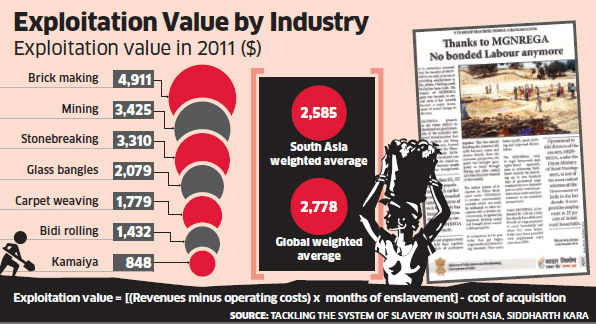
- Brick kilns: Research by Kara estimates there to be between 55,000 and 65,000 brick kiln workers in South Asia with 70% of them in India. Bonded brick kiln laborers, including children, work in harsh and unsafe conditions.
- Rice harvesting: An essential grain to the South Asian diet, rice is harvested throughout India and Nepal in particular. In India, more than 20% of agricultural land is used to grow rice. These workers often work as bonded labours.
Sub-Saharan Africa
- The Global Slavery Index estimates the total number of those enslaved in this region is 6.25 million.
- In countries like Ghana, it is estimated that 85% of people enslaved are tied to bonded labour.
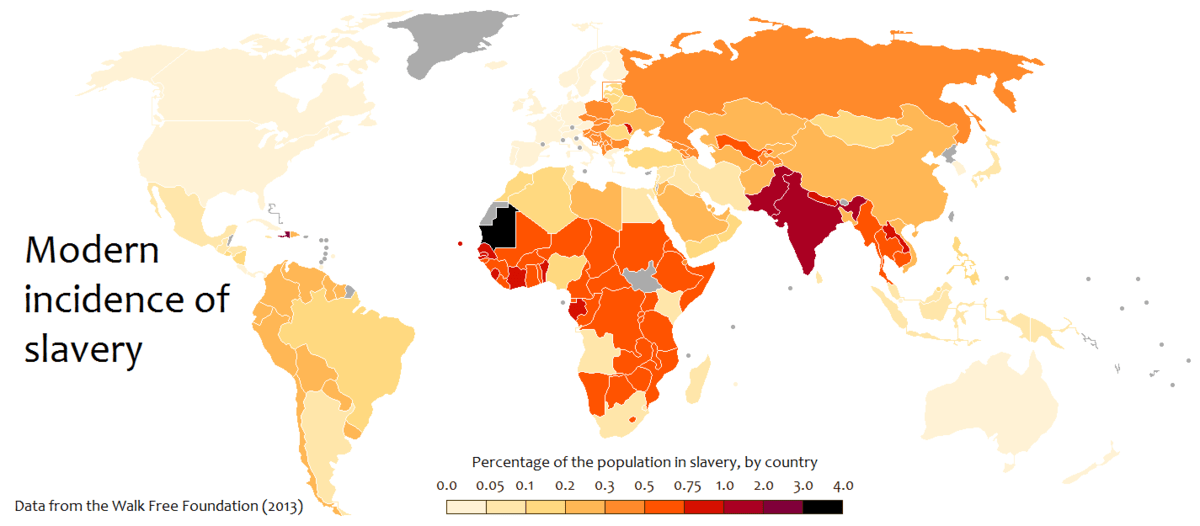
- Mauritania has the highest proportion of slavery and bonded labour in the world, with 20% population enslaved with debt bondage.
Problems of Bondage Labour in India
- Major problem of this system is that it is a system of slavery where a person has no will.
- The two basic features of bonded labor are indebtedness and forced labor.
- People are extremely poor, and they are unable to find the work for their livelihood. The landholdings are not adequate to support their family system. The people are not educated enough.
- Natural calamities and disasters make it more awful.
- The social wrongs like caste-based discrimination and the dowry system have put people into heavy debts.
- Religion references are used to make people convinced about the legitimacy of the upper class and lower class differences. Such customs banned lower class people from owning land.
- The existence of feudalism is heavily responsible for the continuity of bondage in the agrarian system.
- Child labor and sexual exploitation are other miseries of bonded labor.
- All these factors make rural laborers more immature, illiterate and unstable.
Solutions
- The lack of social protection and the need for access to finance are some of the key issues tackled in the project “Reducing Vulnerability to bondage in India through the Promotion of Decent Work ”. It is a joint initiative between the ILO and the Ministry of Labour and Employment.
- By taking a preventative approach, the project’s aim is to reduce the conditions that perpetrate bondage-like conditions by promoting decent work, and by removing possible elements of bondage and coercion in the worker-employer relationship.
- There should be inter-state coordination mechanisms for migrant workers, including workplace improvements, organization and unionization of workers and linking them to social security schemes.
- The smart card health insurance scheme (known locally as RSBY), allows migrant workers to access services without paying cash. They only need to pay 30 rupees for the card.
- The model should be sustainable as it uses locally available resources to break the debt-bondage cycle, promotes rights of workers, and enables their access to services and schemes. The positive results shown in Andhra Pradesh and Odisha have encouraged four more states to come forward and sign similar MoU’s.”
- Rashtriya Swasthya Bima Yojana (RSBY) provides cashless medical treatment for up to five members of a family. The scheme was specially approved for the migrant brick kiln workers in Andhra Pradesh.