
Poverty Alleviation Schemes
( Sociology Optional)
Poverty Alleviation Schemes
( Sociology Optional)
What is poverty
- Although poverty is a phenomenon as old as human history, its significance has changed over time.
- Poverty is the state of one who lacks a usual or socially acceptable amount of money or material possessions.
- Under traditional modes of economic production, widespread poverty had been accepted as inevitable.
- Poverty is said to exist when people lack the means to satisfy their basic needs. In this context, the identification of poor people first requires a determination of what constitutes basic needs.
- Basic needs may be defined as narrowly as “those necessary for survival” or as broadly as “those reflecting the prevailing standard of living in the community.”
- Experts on poverty have broadly used two approaches.
- First is the nutritional approach. Here poverty is measured on the basis of minimum food requirements.
- Second is the relative deprivation approach. Here poverty is seen in terms of relative deprivation of a section of population against the predeveloped sections.
The rural poor can be divided into three main categories:
- those with land,
- those with skills and
- those without land and skills.
Thinkers’ and Institutional views on poverty
- Dandekar and Rath have estimated the calories value (2,250) in terms of 1960-61 prices. They observe that there would be variation in the extent of rural and urban poverty.
- According to Tendulkar, poverty line is in which categorised people earning less than Rs.33 a day as poor. This line is primarily meant to be an indicator for extreme poverty.
- United Nations: Fundamentally, poverty is a denial of choices and opportunities, a violation of human dignity. It means lack of basic capacity to participate effectively in society.
- World Bank: Poverty is pronounced deprivation in well-being, and comprises many dimensions. It includes low incomes and the inability to acquire the basic goods and services necessary for survival with dignity.
- The World Bank estimates that poverty rates are more than three times higher among rural residents compared with those of their urban counterparts: 18.2 percent versus 5.5 percent, respectively.
- The World Bank notes that a vast majority of the global poor live in rural areas and are poorly educated, mostly employed in the agricultural sector, and over half are under 18 years of age.
Poverty and social exclusion
- Social exclusion describes a state in which individuals are unable to participate fully in economic, social, political and cultural life, as well as the process leading to and sustaining such a state.
- It relates to the denial of or absence of resources, opportunities, or rights, which affects participation in society on equal terms with others.
- It affects persons being in a situation where even basic needs for survival are denied or cannot be accessed.
- United Nations: Fundamentally, poverty is exclusion from choices and opportunities. It includes
- exclusion from food and clothe a family
- exclusion from school or clinic
- exclusion from land on which to grow one's food
- exclusion from job to earn one's living
- exclusion from access to credit.
- It means insecurity, powerlessness and exclusion of individuals, households and communities.
- It means susceptibility to violence, and it often implies living in marginal or fragile environments, without access to clean water or sanitation
- As per world bank, exclusion includes:
- Low levels of health and education
- Poor access to clean water and sanitation
- Inadequate physical security
- Lack of voice
- insufficient capacity and opportunity to better one's life
- Poverty and social exclusion continue to pose major challenges to governments across the world.
- It is a global phenomenon which affects all states to different extents and is not confined to the developing world.
Status of Poverty in India- Background
- In the post-independence era, India has achieved commendable success on many fronts.
- In the case of agriculture, from importers at one time, we are now not only net exporters but also one of the largest donors of food in the world.
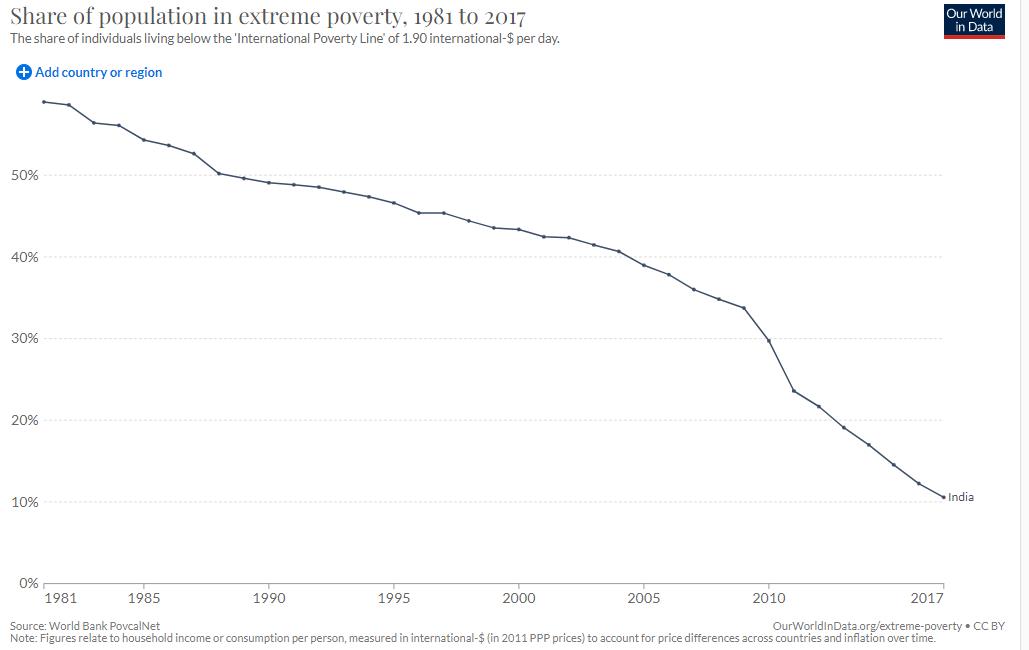
- Despite all this, our country has the largest number of the poor in the world.
- Two-thirds of people in India still live in poverty. 68% of the Indian population lives on less than $2 a day. Over 30% even have less than $1.25 per day.
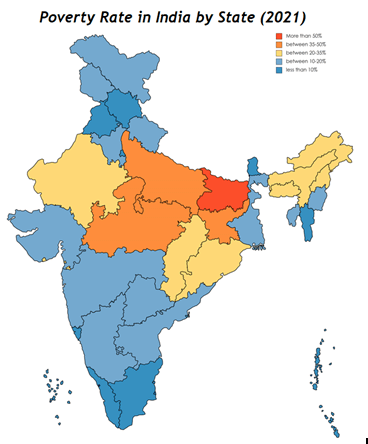
India Poverty Statistics
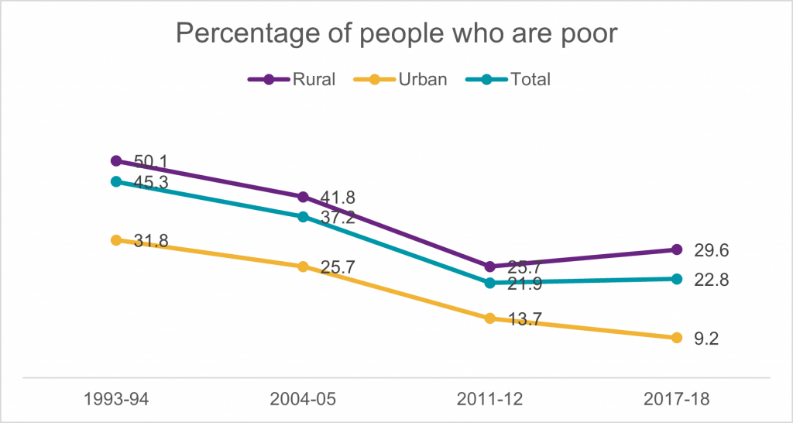
The government's food subsidy programme has blunted the hit on the poor by the Covid-19 induced lockdowns. It has successfully brought down the poverty rate since its introduction in 2013, barring the pandemic-affected 2020-21. – International Monetary Fund (IMF).
Need for development interventions
- About three-fourths of the total population of the country is rural and therefore majority of the poor are in the villages.
- It is why Gandhi Ji repeatedly said that “India lives in villages and the development of the nation cannot be achieved without the development of the villages”.
- The real fruits of independence and democracy, in fact, cannot be enjoyed by the people unless they are freed from the clutches of poverty.
Poverty Alleviation Programmes
- The poverty alleviation programs in India can be categorized based on whether it is targeted either for rural areas or urban areas in the country.
- Most of the programs are designed to target rural poverty as the prevalence of poverty is high in rural areas.
- Targeting poverty is a great challenge in rural areas due to various geographic and infrastructure limitations.
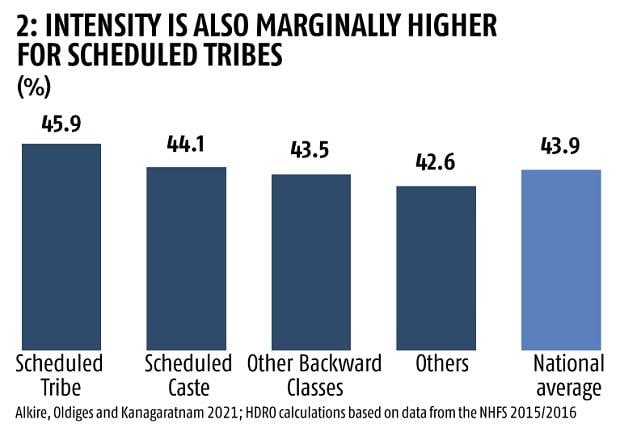
- Poverty is broadly linked with caste structure in India. The working and artisan castes are relatively poor. However, recognising the poverty in upper castes, the government has introduced the EWS concept.
The programs can be mainly grouped into
- Wage employment programs
- Self-employment programs
- Food security programs
- Social security programs
- Urban poverty alleviation programs
- Skill India programs for employment
- The five-year plans immediately after independence tried to focus on poverty alleviation through sectoral programs.
Main programmes
- Jawahar Gram Samriddhi Yojana (JSY)
- National Old Age Pension Scheme (NOAPS)
- Sampoorna Grameen Rozgar Yojana
- National Family Benefit Scheme (NFBS)
- National Maternity Benefit Scheme
- Annapurna
- Integrated Rural Development Program (IRDP)
- Pradhan Mantri Gramin Awaas Yojana
Background in India
- During the initial stages of rural development through the community development program (CDP), a holistic approach to develop agriculture, infrastructure and basic facilities in the villages was adopted.
- It was assumed that as the process of development progresses, it would take care of each category of the rural population.
- During the 1960s, when the CDP was gaining momentum, the country was faced with food crisis. Hence, the entire rural development effort was directed to the development of agriculture.
- These programs emerged with two distinct characteristics:
- Programs for self-employment, mainly focused on those with assets and/or skills. Eg. IRDP (Integrated Rural Development Programme) and its sub-programmes)
- Programs for wage employment, mainly focused on those who did not have any source of income other than their physical labour. Eg. JRY (Jawahar Rojgar Yojana), EAS (Employment Assurance Scheme).
National Rural Employment Guarantee Act (Rural poverty alleviation programme)
The NREGA Act was enacted in 2005 with the objective of providing 100 days of guaranteed in skilled wage employment to each rural household opting for it.
Features:
- Sampoorna Grameen Rozgar Yojana (SGRY) and National Food for Work Programme (NFFWP) have been subsumed in NREGA.
- The focus of the Act is on works relating to water conservation, drought proofing land development, flood control/protection and rural connectivity in terms of all-weather roads.
- Panchayats have a key role in planning, implementation and monitoring of the Act.
- The Act envisages strict Vigilance and Monitoring with Gram Sabha has the power of social audit.
- Local Vigilance and Monitoring Committees are to be set up to ensure the quality of works.
- Provision for due representation in such committees for SC/STs, women has also been made.
- At least 1/3rd of the beneficiaries is to be women.
- The Act also envisages a grievance redressal mechanism and helpline.
Impact of Poverty Alleviation Programmes
- Based on the 55th round of the NSSO estimates, the percentage of people below the poverty line in 1999-2000 has, for the first time fallen below the 30 per cent mark.
- The Rural poverty ratio was 27.1, the urban 23.6 and the overall poverty ratio for the country was 26.1 by 1999-2000.
- The rate of decline in poverty was highest during 1993-94 and 1999-2000, as it fell from 36.0 per cent to 26.1 per cent recording an average annual rate of decline to a little above 1.6 per cent.
- In the field of human development also, there has been favourable trends of improvement. Indicators like health status reflecting in Crude Birth Rate, Crude Death Rate, Infant Mortality Rate (IMR), and Life Expectancy reveal encouraging trends.
- The literacy status, particularly the female literacy, of the rural people too shows an upward trend. Even in the states like Rajasthan, where gender discrimination is high, the literacy levels show upward trends.
- The process of reduction in poverty, however, has not been uniform all over the country. Some states have done exceptionally well, while a few states have not recorded much change in their poverty status.
Reasons for not achieving the desired impact
- Implementation of the programmes was not effective.
- Lack of area specific and integrated planning which was essential to sustain the benefits of the poverty alleviation programmes.
- Most of the income generating schemes provided to the poor families did not match with their capability and hence the beneficiaries were not able to sustain them.
- Lack of supporting infrastructure including marketing facilities.
- Inadequate investment on the beneficiary projects.
- At some places there was poor participation of the people in these programmes.
- Corrupt practices in identifying, selecting and funding the beneficiaries have also had adverse effect on the programmes.