
Green Revolution and Social Change
( Sociology Optional)
Green Revolution and Social Change
( Sociology Optional)
Introduction

Thinker’s view
- As per Ray Offenheiser, the Green Revolution was the emergence of new varieties of crops, specifically wheat and rice varietals, that were able to double if not triple production of those crops in two countries.
- Norman Borlaug, who was the originator of what was a dwarf wheat variety in Mexico, is considered the godfather of the Green Revolution.
- The term "Green Revolution" was first used in 1968 by former USAID director William Gaud. As per him, the goal of the green revolution was to increase the efficiency of agricultural processes, so that the productivity of the crops was increased and could help developing countries to face their growing population’s needs.
The impact of the Green Revolution on indigenous crops of India
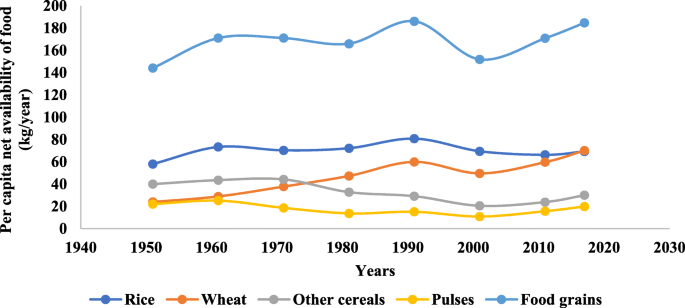
Fig by Journal of Ethnic Foods
Impact of Green Revolution on rural class structure
It has left a significant impact on the social structure and cultural pattern of the rural society of the country as given below
- The traditional patron-client or jajmani system in which agricultural labourers remained bonded with specific land-owning families was replaced by the contract system.
- The farmers inclined in favour of payment in cash instead of kind.
- The Batai system of tenancy was substituted by the lease system.
- Instead of the marginal and small farmers, the medium and large-sized farmers began to lease land.
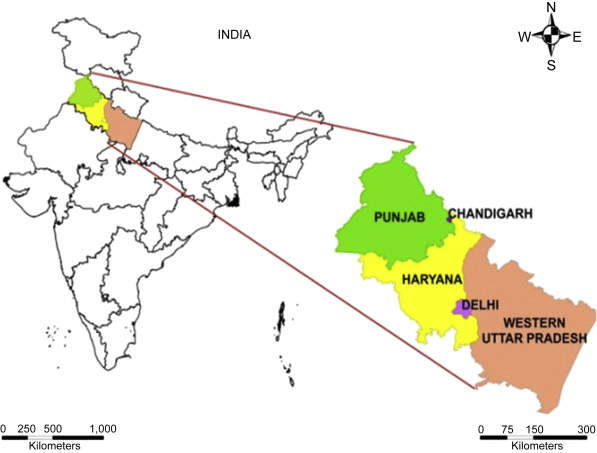
- There was a change in the class structure of the country. The agrarian capitalism induced by it led to the emergence of capitalist farmer class in the states such as Punjab and Haryana. It also created a class of rich peasantry.
- The enhancement in crops productivity and net profit made even small farmers economically sound during the pre-1975 phase of the Green Revolution. This accelerated the process of the breakdown of joint family system.
- The clash of economic interests between the upper caste landowners and the backward and scheduled caste landless agricultural labors assumed communal overtones in some regions.
- The conflict got further aggravated when the upper caste capitalist farmers began to invest their surplus in trade and industry which were until then virtually monopolized by the merchant castes.
- The Green Revolution was also one of the factors in the emergence of a class of educated unemployed in rural areas of India. The members of this class were interested in only white collar jobs and were having no interest in agriculture.
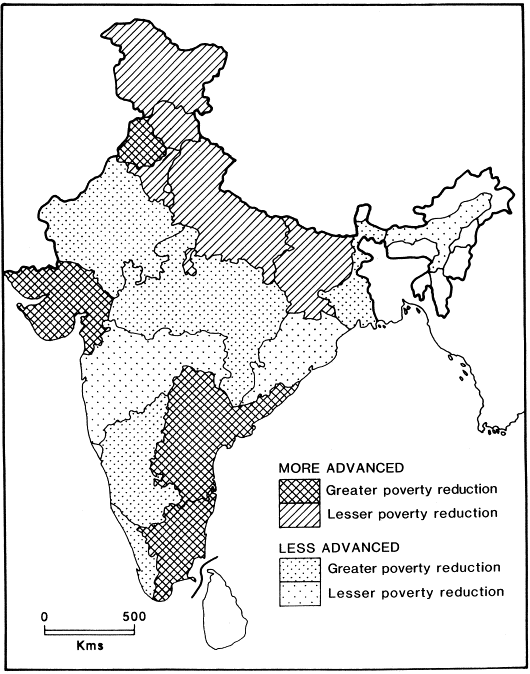
Fig. The green revolution and poverty
Green Revolution and formation of new power elite in rural India
- Participating in the green revolution was not the same to smaller farmers and to the bigger farmers. Large farmers had enough accumulated surplus to invest in the new capital-intensive farming as compared to smaller landowners.
- The small farmers also took to the new technologies. However, as their resources were limited, these technologies ushered in a new set of dependencies.
- One of the manifestations of the growing market orientation of agrarian production was the emergence of a totally new kind of mobilization of surplus producing farmers who demanded a better deal for the agricultural sector.
- These new farmers’ movements emerged almost simultaneously in virtually all the green revolution regions. These movements were led by substantial landowners who had benefited most from the developmental programmes and belonged to the numerically large middle -level caste groups whom Srinivas had called the dominant castes.
- The members of this new social class not only emerged as a dominant group at village level but they also came to dominate regional and state-level politics.
- They had an accumulated surplus that they sought to invest in ever more profitable enterprises.
- Some of them diversified into other economic activities or migrated to urban areas or entered agricultural trade.
- Culturally also this new class differed significantly from both the classical peasants and old landlords.
- As per some scholars, Indian agriculture was still dominated by a semi-feudal mode of production.
- According to this school, landlords and moneylenders continued to dominate the process of agricultural production.
- Peasants and labourers were tied to them through the mechanism of debt that led to forced commercialization of labour and agricultural yield.
- This produced a self-perpetuating stagnant and exploitative agrarian structure that could be described as semi-feudal.
- The internal logic of this system worked against any possibility of agricultural growth or the development of capitalism in Indian agriculture.
Uneven impact of 'Green Revolution' on rural society
Impacts of Green Revolution on India
- The government introduced an intensive development programme named Intensive Area Development Programme (IADP). The production and productivity increased by the application of new varieties of seeds.
- This new 'agricultural strategy' was put into practice for the first time in India in the kharif season of 1966 and was termed High-Yielding Varieties Programme (HYVP).
- It depended crucially on regular and adequate irrigation, fertilizers, High-Yielding Varieties of seeds, pesticides and insecticides.
- Due to the new seeds, tens of millions of extra tonnes of grain a year are being produced.
- The Green Revolution also created formal and informal employment opportunities, not only for agricultural workers but also industrial workers, by creating related facilities such as factories and hydroelectric power stations.
- There was a deceleration in agricultural growth rates in the reform period after registering impressive performance during 1980s.
- The rate of growth of production of food grains fell from 2.9 per cent per annum in 1980s to 2.0 per cent per annum in 1990s and stood at 2.1 per cent per annum in first decade of the present century.
- The period since 1991, therefore, emerges as a kind of watershed at a time when growth in Indian agriculture, resurgent from the middle 1960s, was arrested.
- Causes of Deceleration in Agricultural Growth :
- Significant deceleration in the public and overall investment in agriculture
- Shrinking farm size
- Failure and inadequate to evolve new technologies
- Inadequate irrigation cover
- Unbalanced use of inputs
- Decline in plan outlay
- Weaknesses in credit delivery system
- Interpersonal Inequalities: Large farmers benefited much more from new technology as compared with the small and marginal farmers.
- Larger farmers have continued to make greater absolute gains in income because of lower costs per acre and by reinvesting earnings in non-farm and farm assets.
- It created interpersonal inequalities and differences in real wages of agricultural There is a consensus that the adoption of new technology has reduced labour absorption in agriculture.
- Change in attitude with the new agricultural strategy was observed.
- There was an increase in productivity in these areas.
- It has enhanced the status of agriculture from alow level subsistence activity to a money-making activity.
- The Indian farmer has shown his willingness to accept technical change in the pursuit of profit making.
- The Indian government offered institutionalized subsidies and cheap credit as well as similar other However, this was relatively more accessible to rich farmers than to small and marginal farmers.
- The agricultural development bureaucracy is working at the grass roots with different perceptions.
- Their understanding rarely conformed to the notion of scale-neutrality.
- Their actions reflected a tacit pro-rich policy of rural development.
- The pro-rich peasant bias of the Indian rural development is based on an erroneous assumption that “the green revolution technology is capital intensive, hence it suits rich farmers much better than small and marginal farmers.”
- Because the rich farmer alone has adequate resources to afford that technology of production, and reach to expensive inputs, therefore they are better placed to derive its benefits.
Socio-economic consequences of Green Revolution
- Higher productivity and self-sufficiency of food grains production
- Increases inequality in rural structure
- Displacement of tenant cultivators
- Displacement of Rural-Urban Migration
- Worsen the economic condition of the rural worker and labours
- Commercialization and dependency on urban markets
- Increase regional disparity and inequality
Other Positive Impacts
- Increase in Production and Productivity of Food Grains especially Wheat and Rice due to three factors:
- increase in net area under cultivation
- growing two or more crops in a year on the same piece of land; and
- use of HYV seeds
- Employment Generation: the use of tractor and other modern machines increased the aggregate level of employment by raising cropping intensity, farm productivity and changing cropping
- Public/Private Investment in Agriculture: The most important factor behind the success of green revolution in India is availability of assured irrigation like tube-well technology, tractor & its accessories, electric and diesel pump sets, land levelling & development, etc.
- Land Saving: Due to fast growth of population, urbanization and industrialization, demand for land for nonagricultural purposes has continuously increased. Green revolution is considered land-saving, as it significantly increased the per hectare yield of various agricultural crops.
- Impact on Rural Non-farm Economy: Farmers and agricultural labour comprise a sizeable proportion of rural population, rise in their income due to agricultural development enhances the demand for locally produced goods and services thereby augmenting the employment and income in the non-farm sectors.
Other Negative Impacts
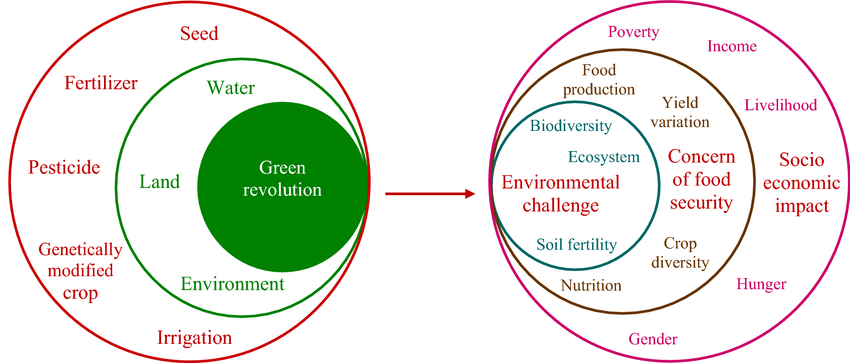
- Decline in Soil Fertility: GR technology has caused deterioration in soil fertility. As per the Working Group Report on ‘Natural Resource Management’, due to absence of reliable advice and soil testing facilities contributes to the indiscriminate and harmful use of chemicals.
- Loss of Biodiversity: The use of HYV seeds displaced indigenous species and agricultural system that had been built up over generations. This has led to loss of biodiversity and agricultural genetic resources.
- Depletion of Groundwater Resources: the exponential growth of tube-wells in these regions has also been the main reason in the rapid decline of groundwater resources.
- Impact on Small and Marginal Farmers: Small and marginal farmers had to purchase costly HYV seeds, fertilizers, and pesticides. For this, they took loans at relatively higher interest rates and consequently fall into ‘debt trap’.
- Over exploitation of ground water by rich farmers.
- Over-capitalization in Agriculture: While the traditional system is on the decline, the emerging practices in agriculture appear to be tending towards more capitalisation in many regions. The new agricultural technology required huge investment in modern farm machines, tractors, pump sets, etc. In most of the cases, it remains
- Widening Disparities: The benefits of the new technology was mainly limited to the few crops, such as wheat, rice, sugarcane and few agriculturally developed regions, having adequate irrigation facilities. Most of the crops and rain-fed agricultural regions did not get sufficient benefits from GR.
- Energy Problems: Another issue related to green revolution technology was its high dependence on fossil fuel energy sources. It is argued that increase in the cost of energy-based agricultural inputs has resulted in an increase in the prices of agricultural products.