
Max Waber: Social Action
( Sociology Optional)
Max Waber: Social Action
( Sociology Optional)
Meaning of Social Action
- The concept of Social Action was extensively discussed by Max Weber in his book “Methodology of Social Sciences.”
- According to Max Weber, a social action is any human behavior to which an individual attaches subjective meaning, and which is oriented toward the behavior of others.
- Sociology, according to Weber, involves interpretative understanding (Verstehen) of social action to explain its causes and effects.
- Social action theory (also called interactionism) emphasizes that society is created through the meanings individuals assign to interactions.
What is Social Action?
An action is considered social when:
- Meaning is Attached by the Actor:
- The action is consciously performed.
- It is motivated by some intention or reason.
- Orientation Toward Others:
- The action considers the presence of others, either physically or mentally.
- It is not an isolated act but oriented to the social context.
Key Elements
- The action must be intentional and meaningful to the individual.
- Must be oriented towards others' behaviors or expectations.
- Must occur within a social context.
- Not all behaviors are social actions—only those with social orientation and meaning qualify.
Examples
- A worker striking for better wages in response to company policies is a social action.
- A student studying to pass an exam is not a social action.
- A student studying to outperform peers or to meet family expectations is a social action, because it’s influenced by others.
- A teacher explaining a concept to students is a social action. But scratching your head alone in a room is not.
PYQs: Max Waber: Social action सामाजिक कार्रवाई
- What is ‘social action’? What is its place in the analytical frameworks of Max Weber and Talcott parsons? (86/60)
- "सामाजिक कार्रवाई" क्या है? मैक्स वेबर और टैलकॉट पार्सन्स के विश्लेषणात्मक ढांचे में इसका स्थान क्या है? (86/60)
- Write short note: Methods of Sociology according to Max Weber. (93/20)
- संक्षिप्त नोट लिखें: मैक्स वेबर के अनुसार समाजशास्त्र के तरीके। (93/20)
- What did Max Weber mean by Interpretative understanding? Why did he believe that to model sociological researches exclusively on strategies and ambitions of natural sciences was a serious mistake? (94/60)
- व्याख्यात्मक समझ से मैक्स वेबर का क्या मतलब था? उनका मानना था कि प्राकृतिक विज्ञान की रणनीतियों और महत्वाकांक्षाओं पर विशेष रूप से समाजशास्त्रीय शोधों को मॉडल करना एक गंभीर गलती थी? (94/60)
- Critically examine Max Weber’s theory of social action and its limitations. (97/60)
- सामाजिक क्रिया के मैक्स वेबर के सिद्धांत और उसकी सीमाओं का समालोचनात्मक परीक्षण करें। (97/60)
- What is the subject-matter of Sociology according to Max Weber? Which major methods did he suggest for social science research? Illustrate your answer with his sociological contributions. (07/60)
- मैक्स वेबर के अनुसार समाजशास्त्र की विषय-वस्तु क्या है? उन्होंने सामाजिक विज्ञान अनुसंधान के लिए किन प्रमुख विधियों का सुझाव दिया? अपने उत्तर को उनके समाजशास्त्रीय योगदानों से स्पष्ट कीजिए। (07/60)
- Which concepts did Weber use to analyse the forms of legitimate domination? (15/10)
- वैध वर्चस्व के रूपों का विश्लेषण करने के लिए वेबर ने किन अवधारणाओं का उपयोग किया था? (15/10)
- Discuss the importance of interpretative understanding of social phenomena and explain its limitations. (19/20)
- सामाजिक घटनाओं की व्याख्यात्मक समझ के महत्व पर चर्चा करें और इसकी सीमाओं की व्याख्या करें। (19/20)
- How does Weber's Verstehen address the objectivity-subjectivity debate in sociology? (UPSC 2025, 10 Marks)
- समाजशास्त्र में वेबर का वर्स्टहेन किस प्रकार से वस्तुनिष्ठता–व्यक्तिपरकता परिचर्चा को सम्बोधित करता है? (UPSC 2025, 10 Marks)
Verstehen (Interpretative Understanding)
- Verstehen means "understanding" in German and is central to Weber’s methodology.
- It involves the need to understand social action from the actor’s point of view, including emotions, values, and intentions.
- Contrasts with positivism, which relies on objective data; instead, Verstehen values qualitative, empathetic insight.
- It is a core principle of interpretive sociology, contrasting with positivist approaches that focus only on observable facts.
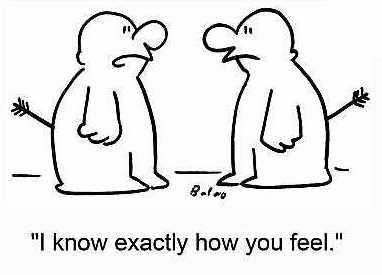
Steps in Verstehen:
- Reconstruct the Actor’s Choices & Constraints: Understand what options and limitations the actor had.
- Get on the Same Wavelength:
- Understand the actor’s language, appearance, and behavior.
- Build rapport without bias.
- Maintain Objectivity:
- Show detached interest, not personal involvement.
- Avoid value judgments.
Example: A sociologist studying a religious ritual must understand it from the participant’s perspective without judging it.
Types of Verstehen
Aktuelles Verstehen (Direct Observational Understanding)
- Involves observing actions and interpreting visible behavior.
- Focuses on the what of the action.
Erklärendes Verstehen (Explanatory or Empathetic Understanding)
- Requires deep interpretation of the intentions, values, and motives behind the action.
- Focuses on the why of the action.
Is Verstehen the Only Method?
- No. Weber also suggested tools like:
- Ideal Types: Conceptual models to compare real-world actions.
- Plurality of Causes: Recognizing that multiple causes can lead to the same social phenomenon.
Criticisms of Verstehen
- Subjectivity: Critics argue that Verstehen relies too much on the researcher’s interpretation, which may lead to bias.
- Lack of Scientific Rigor: Seen as less empirical and objective than positivist methods.
- Difficult to Verify: Understanding internal motivations cannot be directly tested or measured.
- Limited in Large-Scale Studies: More suitable for micro-level interactions than macro-structural analysis.
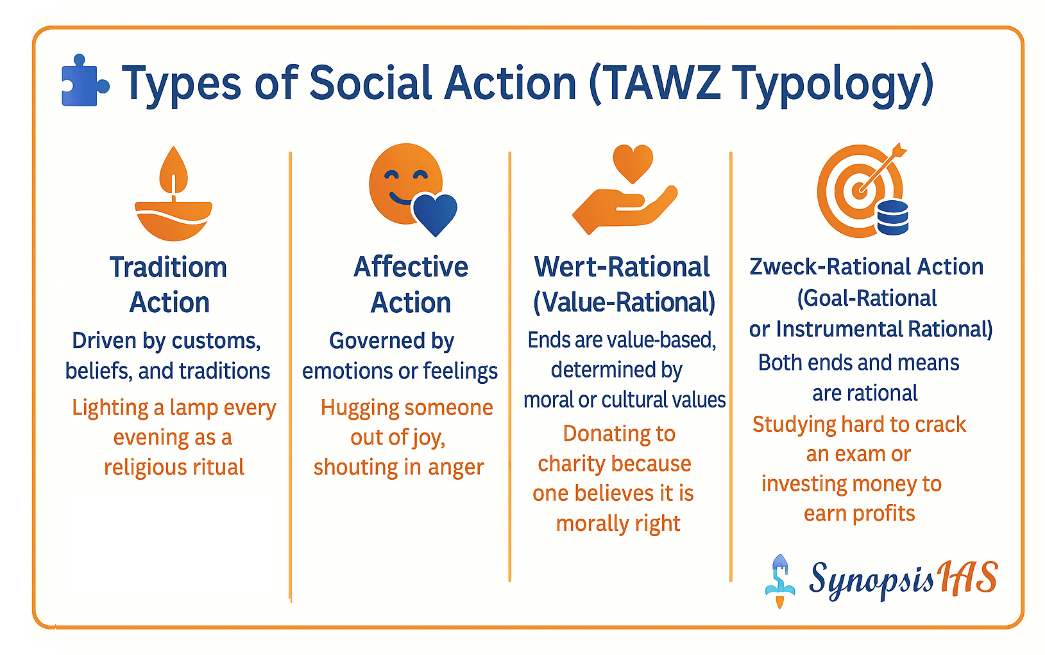
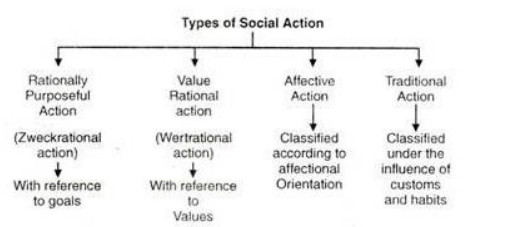
Types of Social Actions (TAWZ Typology)
1. Traditional Action
- Driven by customs, beliefs, and traditions.
- The actor does not question the action; it's passed down.
Characteristics:
- Adherence to customs: Actions are dictated by social norms or traditions.
- No critical evaluation: Little or no reflection on the action’s purpose; it’s simply part of cultural or social practice.
- Guided by norms: Decision-making is influenced by the adherence to established practices.
Example: Lighting a lamp every evening as a religious ritual.
2. Affective Action
- Governed by emotions or feelings.
- Least conscious or rational; highly spontaneous.
Characteristics:
- Emotion-driven: Focus is on personal feelings.
- Impulsive or spontaneous: Decisions are made without a calculated analysis of consequences.
- Common in personal relationships or emotional experiences.
Example: Hugging someone out of joy, shouting in anger.
3. Wert-Rational Action (Value-Rational Action)
- Ends are value-based, determined by moral or cultural values.
- Means are rational and planned.
Characteristics:
- Principled: The focus is on the value of the action itself rather than its results.
- Moral or cultural beliefs guide behavior.
- The end is important as long as it aligns with ethical or societal norms.
Example: Donating to charity because one believes it is morally right.
4. Zweck-Rational Action (Instrumental Rational Action or Goal-Rational Action)
- Both ends and means are rational.
- Focused on efficiency and results, guided by personal goals.
Characteristics:
- Efficiency-driven: Focus is on achieving the goal using the most rational approach.
- Goal-oriented: The outcome drives the action, not emotions or values.
- Common in modern capitalist societies, where productivity and effectiveness are prioritized.
Example: Studying hard to crack an exam or investing money to earn profits.
5. Actual Social Action: A Mix of Types
- In reality, social actions often blend the characteristics of these four ideal types, making them more complex. For instance, a person may act out of emotion (Affective), but with a sense of moral obligation (Value Rational), while considering the effectiveness of their action (Instrumental Rational).
- Example: A person may donate money (Value Rational) to a charity they believe in, but do so rationally (Instrumental Rational) after analyzing the charity's effectiveness, and perhaps out of a sense of emotional satisfaction (Affective) from helping others.
Characteristics of Social Action
- Meaning-Based Interactions: Social action refers to behavior guided by meaning and directed toward others. It is not just physical behavior, but intentional and meaningful.
- Micro to Macro Perspective: Begins with individual-level analysis (micro) to understand larger social patterns (macro), linking personal behavior to societal structure.
- Goal-Oriented Behavior: Individuals act with specific intentions or objectives, especially in organized environments like institutions or bureaucracies.
- Role of Norms and Responsibilities: Social institutions provide rules and responsibilities that shape and regulate people's behavior within society.
- Subjective Meaning: An action qualifies as social only when the actor assigns a subjective meaning to it, which guides their behavior.
- Influence of Others: Social actions are inherently relational—they are shaped by the presence and expectations of others.
- Connection to Social Movements: When individual actions align with collective goals, they can contribute to social change and the rise of movements.
- Essential for Social Life: Without shared meanings and coordinated actions, social cohesion and order would break down.
- Dynamic and Contextual: Social action is fluid, shaped by past experiences, present situations, and future expectations.
- Requires Social Presence: Action assumes or involves the awareness of others, making it inherently social.
- Not Performed in Isolation: Emerges through interaction, not in a vacuum. It is the outcome of social processes.
Stages of Social Action:
Rational-purposeful stage:
- Actions in this stage are guided by reason and discrimination.
- Pursuit of goals is based on rational choices and consciousness of ends or goals.
Valuational stage:
- Religious and ethical actions fall under this category.
- Actions in this stage are based on values and beliefs.
Emotional stage:
- Emotional reactions to the actions of others are seen in this stage.
- Expressions of love, hatred, sympathy, compassion, or pity in response to others' behavior are prevalent.
Traditional stage:
- Characterized by long-standing customs, traditions, and usages.
- Actions in this stage are guided by customs and traditions that have been passed down over time.
Criticisms of Weber’s Social Action
- Subjectivity: The theory is seen as too focused on personal meaning, making it prone to bias and lacking objectivity.
- Limited empirical basis: Critics argue it lacks scientific rigor and cannot be easily tested or verified.
- Overemphasis on agency: Weber gives more importance to individual choices than to the influence of social structures.
- Weak predictive power: It is more descriptive and less effective in predicting social behavior.
- Ethnocentric bias: Some believe it reflects a Western viewpoint, limiting its global applicability.
Strengths of Weber’s Social Action
- Meaning-centered approach: Focuses on the subjective meaning behind human actions, offering deeper insights into motivation.
- Recognition of agency: Highlights how individual decisions and actions shape social life.
- Cultural and historical sensitivity: Emphasizes that actions are shaped by context, not universal rules.
- Relevance to social change: Helps explain how individuals and groups drive transformation in society.
- Theoretical influence: Has shaped fields like symbolic interactionism, and is often combined with other theories for broader understanding.
Applications of Social Action Theory
- Sociology: Helps analyze how people navigate norms, values, and institutions.
- Organizational Studies: Useful in understanding decision-making and interaction in workplaces.
- Political Science: Assists in analyzing the motivations of political actors, such as voters and leaders.
- Social Change: Useful for exploring how individual actions spark societal shifts.
Conclusion
- Social Action Theory is not simply about copying or imitating behavior, it involves more than just replication and imitation.
- Max Weber views social action as a subjective form of thinking and acting that can influence others.
- Weber's theory of social action has inspired future generations of sociologists despite its limitations.