
Population Size
( Sociology Optional)
Population Size
( Sociology Optional)
- The American Naturalist S Wright, in his "The Evolution of Dominance" (1929) views that “the population size is the number of individual organisms in a population.”
- Effective population size: It is the number of individuals that effectively participates in reproduction and breeding. Generally, it is considerably lesser than the actual census size.
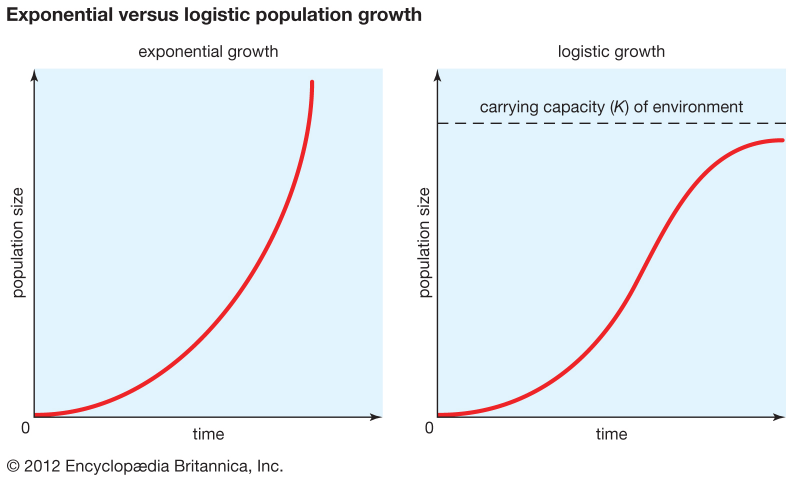
- The stable period or equilibrium in the population size occurs after a period of the transition of decline and rise. See the following figure.

Laws governing the population size
- Finite population principle: As per the Limits to growth and the Hardy-Weinberg Equilibrium, “Infinite population size will always be violated; this means that some degree of genetic drift is always occurring.”
- Overpopulation: It indicate any case in which the population of any species exceed the carrying capacity of its ecological niche.
- Darwin’s theory of biological evolution: The population size grows or declines naturally, by a process of evolution, based on the principle of ‘survival of the fittest’. It is based on the individual's ability to compete, survive, and reproduce.
- Mutation: It is a change in the DNA of an organism. Mutations can introduce new alleles into a population. It increases the population's genetic variation and chances of survival.
- Critical mutation rate: It limits the number of mutations that can exist within a self-replicating molecule before genetic information is destroyed in later generations.
- Population bottlenecks: It occur when population size reduces for a short period of time, decreasing the genetic diversity in the population.
- Genetic drift (allelic drift or the Wright effect): It is a mechanism of evolution, which is the change in the frequency of an existing gene variant in a population due to random chance.
- Example of genetic drift: Consider a population of rabbits with brown fur and white fur, with white fur being the dominant allele. Due to genetic drift, only the brown population might remain, and all the whites eliminated.
- Founder effect: It occurs when few individuals from a larger population establish a new population and also decreases the genetic diversity. It was given by Ernst Mayr.
Optimum population size
- Please explain the optimum population theory.

Theory on population size
These are already explained in the previous section.
- Malthus’ theory on population growth.
- Demographic transition theory.
- Marx’ theory on population.
- Optimum population theory.
- The Limits to Growth.
Population size in India
- India is the second most populous country in the world after China. At the time of independence, the country’s population was 342 million. The number has multiplied three-fold in five decades. India’s population has jumped to 1.21 billion, according to 2011 census.
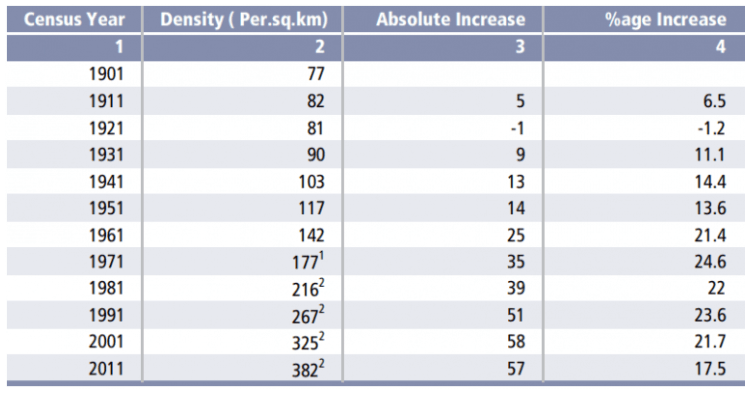
- India’s population is 17.5% of the world population, while the area of India is just 2.4% of the total area of the world. The population density in India is 382 persons per sq km.
- India has more than 6 lakh villages while there are around 7,000 towns and urban centres. Out of a total population of 121 crores, the rural population accounts for 69% and urban population 31%.
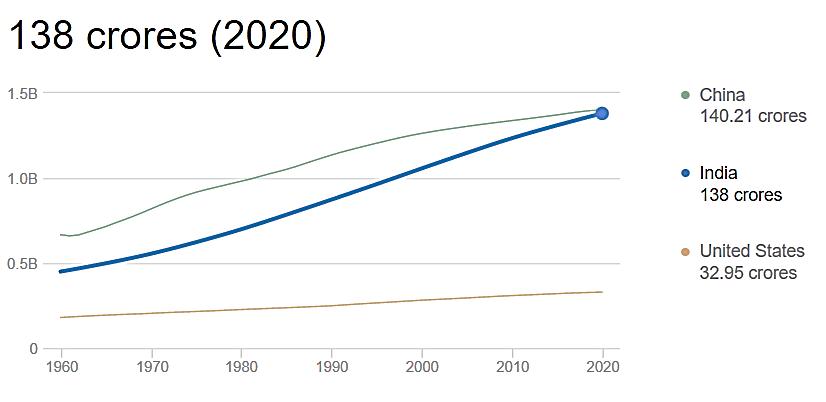
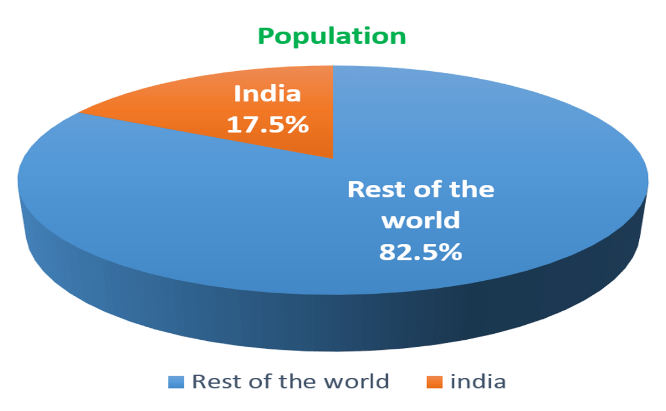
Table: population Growth in India, 1901 – 2011
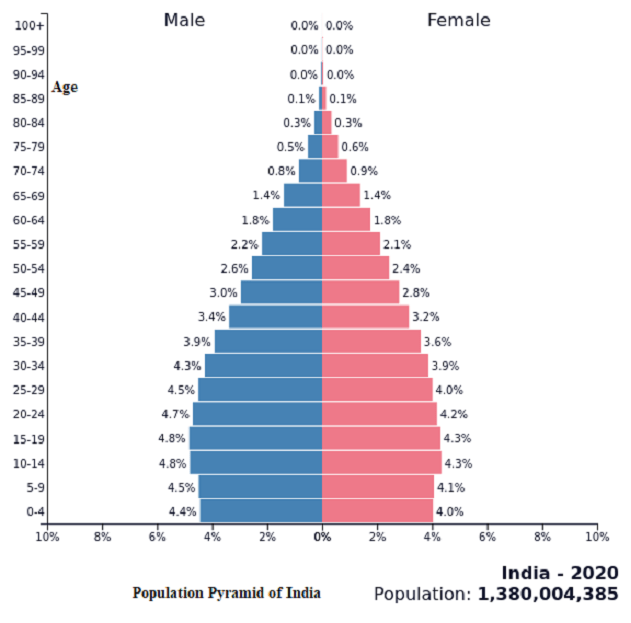
The population size of different age groups can be measured by the population pyramid of India.
Salient features
- Population density is too large for area.
- There is overwhelming proportion of rural population.
- There is declining proportion of women.
- There is high percentage of non-workers.
- The age structure is Lop-sided.
- There is a large ethnic diversity.