
QUALITATIVE AND QUANTITATIVE METHODS
( Sociology Optional)
Qualitative Methods vs. Quantitative Methods in Sociology
|
Aspect |
Qualitative Methods |
Quantitative Methods |
|
Definition |
Methods focusing on understanding meaning, context, and experience |
Methods focusing on measuring and analyzing numerical data |
|
Nature |
Descriptive, exploratory, interpretive |
Statistical, measurable, objective |
|
Data Type |
Non-numerical (texts, interviews, observations) |
Numerical (surveys, experiments, statistics) |
|
Purpose |
To understand why and how social phenomena occur |
To identify patterns, test hypotheses, and establish correlations |
|
Tools/Techniques |
Interviews, focus groups, ethnography, case studies |
Surveys, questionnaires, structured observations, census data |
|
Sample Size |
Small, non-representative |
Large, representative |
|
Analysis |
Thematic or content analysis |
Statistical analysis |
|
Flexibility |
Open-ended, adaptable |
Structured and standardized |
|
Thinkers/Users |
Max Weber (Verstehen), Clifford Geertz |
Emile Durkheim (social facts), Auguste Comte |
|
Outcome |
Deep understanding of social meaning |
Generalizable and comparable results |
PYQs: Qualitative and Quantitative Methods
- Differentiate between the qualitative and quantitative methods in Research. (12/20)
- अनुसंधान में गुणात्मक और मात्रात्मक विधियों के बीच अंतर स्पष्ट कीजिए। (12/20)
- Analyse the limitations of quantitative method in social research. (13/20)
- सामाजिक अनुसंधान में मात्रात्मक विधि की सीमाओं का विश्लेषण करें। (13/20)
- Analyze the importance of qualitative method in social research. (16/10)
- सामाजिक अनुसंधान में गुणात्मक विधि के महत्व का विश्लेषण करें। (16/10)
- Examine epistemological foundations of qualitative methods of social research. (17/10)
- सामाजिक अनुसंधान के गुणात्मक विधियों के ज्ञानमीमांसीय आधारों का परीक्षण कीजिए। (17/10)
- Distinguish between quantitative and qualitative techniques of data collection with suitable examples from Indian society. (18/10)
- भारतीय समाज के उपयुक्त उदाहरणों के साथ डेटा संग्रह की मात्रात्मक और गुणात्मक तकनीकों के बीच अंतर करें। (18/10)
- Bring out the significance of Ethnography in social research. (19/20)
- सामाजिक अनुसंधान में नृवंशविज्ञान के महत्व को बाहर लाएं। (19/20)
- Do you think ethnomethodology helps us in getting reliable and valid data? Justify your answer. (2021/10 marks)
- क्या आपको लगता है कि नृजातीय-पद्धतिशास्त्र, विश्वसनीय और वैध डेटा (आंकड़े) प्राप्त करने में हमारी मदद करता है? आपने जवाब का औचित्य साबित कीजिए । (2021/10 अंक)
- How do qualitative and quantitative methods supplement each other in sociological enquiry? (2021/20 marks)
- गुणात्मक और मात्रात्मक तरीके समाजशास्त्रीय जांच में एक-दूसरे को कैसे पूरक करते हैं? (2021/20 अंक)
- What are the different dimensions of qualitative method? Do you think that qualitative method helps to gain a deeper sociological insight? Give reasons for your answer. UPSC 2023, 20 Marks
- गुणात्मक विधि के विभिन्न आयाम क्या हैं? क्या आप ऐसा सोचते हैं कि गुणात्मक विधि सघन समाजशास्त्रीय अंतर्दृष्टि प्राप्त करने में सहायता करती है? तर्कसम्मत उत्तर दीजिए। USPC 2023, 20 Marks
- What is the distinctiveness of the feminist method of social research? Comment. UPSC 2023, 10 Marks
- सामानिक अनुसंधान की नारीवादी विधि की विशिष्टता क्या है? टिप्पणी कीजिए। USPC 2023, 10 Marks
- How do you view and assess the increasing trend of digital ethnography and use of visual culture in sociological research? (2024/20 Marks)
- समाजशास्त्रीय अनुसंधान में डिजिटल एथनोग्राफी एवं दृश्य संस्कृति के उपयोग की बढ़ती प्रवृत्ति को आप कैसे देखते एवं आँकते हैं? (2024/20 Marks)
- What do you understand by 'mixed method'? Discuss its strengths and limitations in social research. (2024/20 Marks)
- 'मिश्रित पद्धति' से आप क्या समझते हैं? सामाजिक अनुसंधान में इसके गुर्णा एवं सीमाओं की चर्चा कीजिए। (2024/20 Marks)
QUALITATIVE METHODS
Introduction
- Qualitative research is a type of social science research that collects and works with non-numerical data and that seeks to interpret meaning from these data that help understand social life through the study of targeted populations or places.
- Qualitative research relies on data obtained by the researcher from first-hand observation, interviews, questionnaires (on which participants write descriptively), focus groups, participant-observation, recordings made in natural settings, documents, and artifacts.
- Qualitative research methods have been used in sociology, anthropology, political science, psychology, social work, and educational research.
- Qualitative researchers study individuals' understanding of their social reality.
- Qualitative data can be collected using a variety of methods such as Interview, focus group, observation, document analysis.
Thinkers’ perspective
- Cresswell (1998) defined “qualitative research is an inquiry process of understanding based on distinct methodological traditions of inquiry. The researcher builds a complex holistic picture, analyses words, reports detailed views of informants and conducts the study in a natural setting".
- Fraenkel (2007) defined qualitative research as research studies that investigate the quality of relationships, activities, situations, or materials.
- The intent of qualitative research is not to generalize the conclusion about an entire group of people (e.g., Filipinos or Asians), but to develop an in-depth explanation of a phenomenon.
Characteristics of Qualitative Methods
According to Bogdan and Biklen, as cited in Fraenkel and Wallen (2006), the characteristics of qualitative research are as follows:
- The direct source of data is the natural setting and the researcher is the key instrument in qualitative research.
- Researchers go directly to the particular setting of interest to observe and collect the needed data.
- Data collected are in the form of words or illustrations rather than numbers.
- The kinds of data collected may include, but not limited to, audio recordings, diaries, field notes, memorandums, official records, personal comments, photographs, textbook passages, transcripts of interview, videotapes, and anything else that convey actual words or actions of people.
- Qualitative research is concerned with process as well as product. The primary interest of a qualitative researcher is on how things happen and on people’s interaction with one another.
- Analysis of data is taken It starts with the specific concepts of the respondents to draw out general idea or theory. To do this, a considerable amount of time is spent in collecting data before the important questions are considered.
- Qualitative research deals with how people make sense out of their lives. The perspective of the subjects of a study is a major concern.
Types of Qualitative Methods
These have been categorized by Creswell (1998) in the context of their forms, terminologies and focus as under:
- Biographical study
- Phenomenological study
- Grounded Theory study
- Ethnography
- Case study
Biographical Studies
- Biographical study is the study of an individual and his or her experiences as narrated to the researcher or found in different sources.
- The focus of biography remains on telling and inscribing the stories of others. It explores history of life e.g. accounts of major achievements of life.
- There are different connotations linked with biographical study viz., individual biographies, autobiography, life history, oral history.
- The biographical method as a research approach to understand larger groupings was used as sociological material by Florian Znaniecki and William Isaac Thomas in the 1920s. After their work, the biographical approach was considered amongst the dominant research approaches in empirical social research.
- The biographical research approach formed an important foundation for the development of the Chicago School, which later influenced the symbolic interactionism and the work of sociologists such as Robert E. Park, Ernest W. Burgess, and George Herbert Mead.
- In the context of qualitative researches, the biographical research is to be seen as a case-reconstructive approach. The decision to reconstruct cases is in itself an approach to the field rather than a specific research method. Biographical research does not use a single method for data analysis. The most commonly used methods for data construction in biographical research is the biographical interview.
- A fundamental problem exists regarding the differences between the levels of the experienced life history and the narrated life story.
- The question of the construction of meaning leads to the questions of the subjectively intended and the objective meaning.
Phenomenological Study
- Phenomenological study's focus is on describing the meaning of live experiences for several individuals about a concept or the phenomenon.
- The researcher explores the structures of consciousness in human experiences.
- Pure phenomenological research seeks essentially to describe rather than explain, and to start from a perspective free from hypotheses or preconceptions. – Husserl, 1970.
- Phenomenological methods bring out the experiences and perceptions of individuals from their own perspectives. Hence, these challenge structural or normative assumptions.
- Methods used: interviews, conversations, participant observation, action research, focus meetings and analysis of personal texts.
Grounded Theory Study
- Through the grounded theory method, a theory is generated in the context of a phenomenon being studied.
- Hence, the researcher goes beyond one step ahead of understanding the complexities of processes involved in a situation.
- methods of data collection: participatory observations, continuous visits to the field, interviews with participants, in-depth observations of activities etc.
- Model and theory building: The researcher develops and interrelates categories of information and writes theoretical propositions or hypotheses.
Significance
- It provides explicit, sequential guidelines for conducting qualitative research.
- It offers specific strategies for handling the analytic phases of inquiry.
- It provides ways to streamline and integrate data collection and analysis and
- It legitimizes qualitative research as scientific inquiry.
Criticisms
- Thomas and James point to the lack of congruence of grounded theory methods with open and creative interpretation, which ought to be the hallmark of qualitative inquiry.
- It sometimes has a quasi-objective focus, emphasizing hypotheses, variables, reliability, and replicability. This multi-faceted focus leads to contradictory findings.
- It offers a complex methodology and confusing terminology, rather than providing a practical orientation to research and data analysis.
- Some grounded theory researchers have produced poorly explained theories.
- The researcher may be biased and ignore important questions under consideration.
Ethnographic Research
- Ethnography is the science of 'ethnos', that is, people or culture. Some social scientists use the terms social anthropology, cultural anthropology or ethnology for it.
- Ethnography has been seen as the science of cultural description, and interpretation of a cultural or social group or system, the study of cultures with the purpose of understanding them from the native point of view, entering a setting with the purpose of doing field research by using ethnography.
- This method involves prolonged observation of events where the researcher becomes a part and parcel of the day-today lives of the people.
- One to one interviews with the members of group corroborated with participant observation can form the base of such a method.
- The researcher makes use of ethnography to study the meanings of behaviour, language and interactions of the culture sharing group.
Features of ethnographic research
- It employs holistic approach; it studies cultures and interprets life in a cultural context.
- It is conducted in natural settings and entails a total 'sinking' in the field of study.
- Understands culture from within, and captures it as external to, and independent of, the researcher: in other words as a natural phenomenon.
- Constructs culture through in-depth studies and the meanings of the participants.
- Aims at an analysis of life-worlds.
- Stresses subjectivity.
- In the area of feminism, ethnography becomes a powerful methodological-tool that aims at first, documenting the lives and activities of women;- second, understanding the experience of women from their own point of view; and third, conceptualizing women's behavior as an- expression of social contexts.
Methodology in ethnographic research.
- The methods applied in ethnographic research are two types, descriptive and critical.
- Critical ethnography research is common in social sciences. It analyses critically the interconnections between social practices and overarching macro-cultural principles. If-the research employs a positivistic paradigm, the purpose of the-ethnographic research may be to describe, explain and categorise social events, whereas if it is in an interpretive paradigm it may aim at Understanding the dynamics of a socio-cultural system as well as of how people interpret their world.
- In critical studies, ethnographic research aims to emancipate, empower and liberate people.
- In general, the overall design of ethnographic research falls within a parameters of field research.
- ethnographers use field work of many kinds, for instance, personal participant observation, interviews, document analysis, filming and recording. This is often assumed to entail a rejection of positivist thinking and research.
Strengths:
- Holistic perspectives
- Use of socio-cultural context as the explaining source
- High degree of flexibility
- Capacity to identify contradictions and consistencies
- High quality of the researcher-participant relationship
- Closeness of the participants
- High external validity
- High sensitkiity.to subtle nuances of meaning and significance
- Capacity for longitudinal study: studying issues over time
Weaknesses:
- Inability to provide evidence supporting causality
- Inability to ensure validity and reliability
- Lack of replication
- Inability to ensure objectivity
- No free access to the field, or to personal and subjective information that constitute the basis of the study
- Difficulty with going native, which often affects studies and leads to problems.
- Distortion of the natural setting by the very presence of the researcher
Case Study
- A case study involves in-depth research of a particular event, incident or phenomena where a community or a group of people are directly involved or affected.
- A case study is a holistic method that enables us to get an all-round perspective on a single incidence or event.
- Social scientists, in their study of human behavior, strive to obtain a fundamentally real and enlightened record of personal experiences.
- These would reveal in concrete detail a man's inner strivings, motivations that drive him to action, the forces that direct him to adopt a certain pattern of behaviors, and to live according to a certain scheme and philosophy of life.
- A comprehensive study of a social unit is called a case study.
- Case study method is a form of qualitative analysis wherein careful and complete observations are made. There are efforts to study each aspect of the concerning unit in minute details. Finally, from the generated case data, generalizations and inferences are drawn.
- More about case studies, is explained in the tools of data collection.
Steps of conducting Qualitative study
- Identifying Problems and Research Questions: At the first stage the researcher identifies a problem and puts in open-ended and non-directional queries.
- Design of the study: At this stage the researcher develops an open sketch of sampling, tools and techniques to be adopted, sources of data etc.
- Data collection process: data sources include in-depth interviews, focus groups, standardized interviews, Record keeping, Qualitative observation and artifacts such as books or works of art.
- Analysis of data and reporting:
-
- Review of data and representing data by case, by subject and by themes in the form of description, diagrams, tables and graphs.
- Initial codification and categorization and further minimizing categories.
- Frequent appearance of codes, development of categories, development of analytical frame-work for theorization.
Advantages of Qualitative method
- The use of open-ended questions gives participants the opportunity to respond in their own words, rather than forcing them to choose from fixed responses, as quantitative methods do.
- Open-ended questions have the ability to evoke responses that are:
- Meaningful and culturally salient to the participant
- Unanticipated by the researcher
- Rich and explanatory in nature
- It helps to understand attitudes. It can provide insights that are specific to an industry. It allows creativity to be a driving force.
- It focuses on gaining as much data as possible from a relatively small sample size. This type of data often has a higher level of accuracy and authenticity than any other form of data offered.
- It is a more flexible approach than quantitative research since it enables participants to express themselves while providing data.
Limitations of qualitative research
- Popper made clear that observation is always selective, based on past research and the investigators' goals and motives and that preconception less research is impossible.
- The qualitative study requires a labour-intensive analysis process such as categorization, recoding, etc. - Elo and Kyngas, 2008
- Different conclusions are derived based on the same information depending on the personal characteristics of the researcher. – Maxwell, 2005.
- Qualitative research is a little complex to explain the difference in the quality and quantity of information obtained from different respondents and arriving at non-consistent conclusions. – Barbour, 2000.
- The major drawback associated with qualitative cultural analysis is that this process is time-consuming. The second potential problem with qualitative research is that a particular problem could go unnoticed. – Bowen, 2006.
Distinction Between Qualitative and Quantitative methods
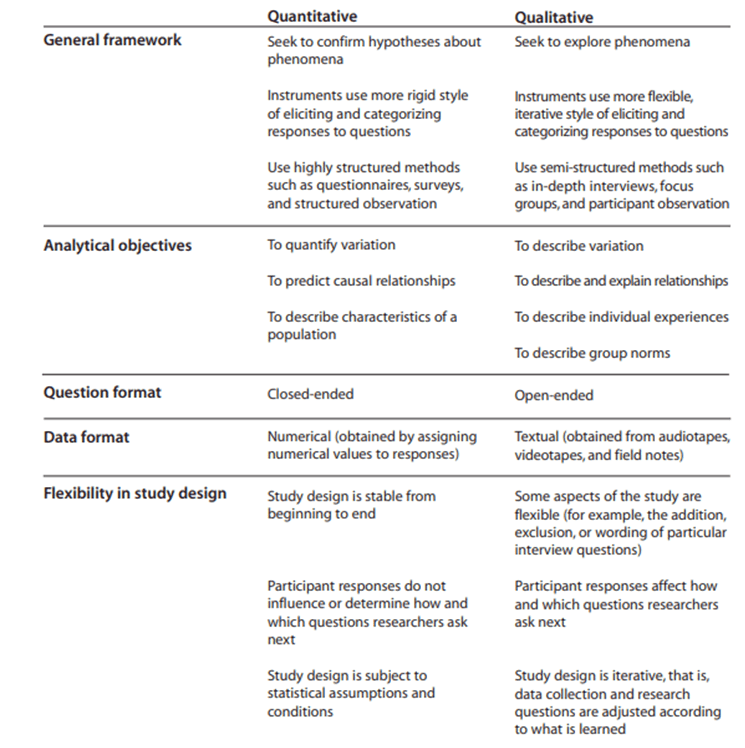
QUANTITATIVE METHODS
Introduction
- Quantitative research is a research strategy that focuses on quantifying the collection and analysis of data.
- It is formed from a deductive approach where emphasis is placed on the testing of theory, shaped by empiricist and positivist philosophies.
- The objective of quantitative research is to develop and employ mathematical models, theories, and hypotheses pertaining to phenomena.
- Quantitative research is widely used in psychology, economics, demography, sociology, marketing, community health, health & human development, gender studies, and political science. However, it is less frequent in sociology and history.
Thinker’s perspective
- Quantitative research methods explain an issue or phenomenon through gathering data in numerical form and analyzing with the aid of mathematical methods and statistics. – Aliaga and Gunderson (2002)
- Quantitative research involves the collection of data, so that information can be quantified and subjected to statistical treatment, to support or refute alternative knowledge claims. - Leedy and Ormrod.
- Quantitative research starts with a statement of a problem, generating of hypothesis or research question, reviewing related literature, and a quantitative analysis of data. –
- Quantitative research employs strategies of inquiry such as experiments and surveys, and collect data on predetermined instruments that yield statistical data. –
Characteristics of quantitative method
- Clearly defined research questions: Based on the research problem, the researcher frames clearly defined research questions and the answers to these questions are sought objectively.
- Representative sample: The researcher selects a sample from a specified population from which data is aimed to be collected. These samples are representative of the population, so that the results achieved can be generalised to the population.
- Manipulation/ control of variables: As mentioned before, the quantitative research deals with variables and as per the requirement, the researcher manipulates (for example, increases or decreases) and even controls the extraneous/controlled variables that can affect the research study.
- Structured and standardised tools used for data collection: Quantitative research deals with numbers and the data is collected with the help of structured or standardised research instruments. The data is analysed with help of empirical evidences. The data are collected in form of numbers, and statistics, often arranged in tables, charts, figures, or other non-textual forms.
- It is reliable and valid: Since the study is done under controlled observations involving scientific investigations, they can be replicated or repeated and provide similar results. The quantitative research is high on reliability. Further, as quantitative research involves the use of standard and structured instruments (which are variable specific), they are valid as well.
- Generalisability: Since the quantitative research is done in a well- planned manner and are highly reliable as well as valid, the results obtained through the method can be generalised and can also be used to effectively predict results and infer causal relationships.
Types of Quantitative Research
According to Sukamolson, (2007) “there are several types of quantitative research. It can be classified as
- Survey research
- Correlational research
- Experimental research and
- Causal-comparative research
Survey Research
- According to Merriam-Webster Dictionary survey means to look over the desired phenomena, and to examine a condition, situation, or value-appraise.
- Sukamolson, (2007) describe survey as a form of quantitative research that is concerned with ‘sampling questionnaire, questionnaire design, questionnaire administration’ for the sake of gathering information from the group/population under study, and then make analysis to order to better understand their behavior/characteristics.
- Kerlinger (1973) sees survey research as social scientific research that focuses on people, the vital facts about people, and their beliefs, opinions, attitudes, motivations and behavior.
Kraemer (1991) outline three basic tenets in survey research, namely,
- Survey is used to describe quantitatively a sectional aspect of a given populations which involves studying the relationship,
- In survey research method, data are obtained from people,
- Survey sample: a part of population which is later used to generalize the whole population.
Benefits of survey research
- Cost-effectiveness
- Generalizability
- Reliability
- Versatility
Drawbacks to survey research
- Inflexibility
- Lack of depth
Correlational Research
- It is a quantitative methodology used to determine whether, and to what degree, a relationship exists between two or more variables within a population (or a sample).
- The degree of relationships is expressed by correlation coefficients.
- Leedy & Ormrod (2010) remark that correlation method of research deals with the creating relationship amid two or more variables in the same population.
- Correlational research is a type of non-experimental research
- A researcher measures two variables, understands and assesses the statistical relationship between them with no influence from any extraneous variable.
- Researchers collect data for this research through observation and archivable data.
Types of correlational research:
- Positive correlation: A positive relationship between two variables is when an increase in one variable leads to a rise in the other variable. A decrease in one variable will see a reduction in the other variable.
- Negative correlation: A negative correlation is quite literally the opposite of a positive relationship. If there is an increase in one variable, the second variable will show a decrease and vice versa.
- No correlation: In this third type, there is no correlation between the two variables. A change in one variable may not necessarily see a difference in the other variable.
Experimental research
- Aronson defined experimental method as “the method in which the researcher randomly assigns participants to different conditions; and ensures that these conditions are identical except for the independent variables”.
The main characteristics of experimental method are:
- It involves a systematic procedure including definition of the problem, research design, data collection and interpretation.
- There is manipulation of one or more independent variables to study its effect on dependent variables.
- The study is carried out under controlled conditions. Thus, there is not much interference of extraneous variables.
- It has high internal validity. It can be said that the changes in dependent variables are as a result of independent variables and not extraneous variables).
- It has lower external validity (as the study is carried out under controlled conditions, the results as such cannot be generalised to other situations).
- Sample can be selected using randomization.
Advantages
- It provides researchers with a high level of control.
- There is no limit to the subject matter or industry involved.
- Experimental research provides conclusions that are specific.
- The results of experimental research can be duplicated.
- Natural settings can be replicated with faster speeds.
- Experimental research allows cause and effect to be determined.
- It can be combined with other research methods.
Disadvantages
- Results are highly subjective due to the possibility of human error.
- Experimental research can create situations that are not realistic.
- It is a time-consuming process.
- There may be ethical or practical problems with variable control.
- Experimental research does not provide an actual explanation.
- Extraneous variables cannot always be controlled.
- Participants can be influenced by their current situation.
- Manipulating variables isn’t necessarily an objective standpoint.
- Human responses in experimental research can be difficult to measure.
Non-experimental research
- In non- experimental research, the researcher cannot manipulate the independent variables, also because independent variable(s) may have already occurred.
- It can also be used in exploratory researches (for example, a study to explore how efficiently child can be nurtured by single mothers).
Characteristics of non-experimental research
- The independent variable cannot be manipulated.
- There is low control.
- Randomisation cannot be used.
- External validity is high.
- Internal validity is low.
Field Studies:
- In this the researcher does not manipulate any variable(s), and research is carried out in natural settings.
- The data can be collected through face-to-face interviews, surveys, or direct observation. The data collected is specific to a particular issue/problem.
- The advantages of field studies are that, they can be used in studies where manipulation of independent variables is not possible. It is also useful in areas where manipulation of independent variables are not ethical.
- The disadvantages of this method are that, there are possibilities of ethical challenges (like, deception) involved in the study; there are more chances of sampling bias and there may be influence of extraneous variables in the study.
Characteristics of field studies are:
- The researcher cannot manipulate the independent variables.
- The study is carried out in naturalistic setting.
- Internal validity is low.
- External validity is high.
- Randomisation is not possible.
Causal-comparative research
- The researcher attempts to determine the cause, or reason, for pre-existing differences in groups of individuals.
- A comparative research method analyzes phenomena, and then put them together to find the points of differentiation and similarity. – Mokhtarian Pour, 2016.
- A comparative perspective exposes weaknesses in research design and helps a researcher improve the quality of research. – Holt & Turner, 1970.
- It discovers cause and effect relationships, poses no ethical issues, can be studied in the past and it avoids artificiality.
Drawbacks:
- It is more difficult, more costly, and more time consuming than research that is not comparative.
- Comparative researcher can rarely use random sampling. Sufficient information is not available for all.
- It can apply the theory to make only limited generalizations.
Steps of Quantitative Research
- Theory formation
- Hypothesis deducted from theory
- Research design
- Operationalising concepts
- selection of a research site or sites
- Selection of respondents
- Data collection
- Processing data
- Data analysis
- Findings and conclusions
- Writing up Findings
Advantages of Quantitative method
- It provides an opportunity to collect data from a larger sample and helps in conducting broader study as well as generalisation of results to a larger population.
- It helps the researcher to attain reliable, valid, accurate and objective results.
- It provides an opportunity to replicate and design similar studies.
- It provides an opportunity to conduct experiment under controled environment and thus minimises error variance.
- It uses close ended and structured questions which provide responses free from personal biases.
Limitations of Quantitative method
- Researchers face problems to control the environment where the respondents provide answers to the questions in the survey. – Baxter, 2008.
- This type of research is planned carefully in order to ensure complete randomization and correct designation of control groups. – Morgan, 1980.
- Statistical analysis is based on scientific discipline and hence difficult for non-mathematicians.
- Successful statistical confirmation of result is very tough. Hypothesis is proven only with few experiments, and it is generalized for a larger scope. – Ong, 2003.
- Quantitative research method involves structured questionnaire with close ended questions.
- It leads to limited outcomes outlined in the research proposal.
- So the results cannot always represent the actual occurring, in a generalised form.
- Also, the respondents have limited options of responses, based on the selection made by the researcher.
- Despite of applying appropriate sampling plan representation of the subjects is dependent on the probability distribution of observed data. This may lead to miscalculation of probability distribution and lead to falsity in proposition.