
Karl Marx: Class Struggle
( Sociology Optional)
Introduction

- According to Marx, the history of all existing society has been the history of class struggle.
- All historical society is characterized by the dominant and dependent classes.
- As the property-owning class owns the means of production, it exploits the propertyless class, which results in class struggle.
- The history of all hitherto existing society is the history of class struggles.g. Free people and slave, lord and serf, worker and owner, or in a word, oppressor and oppressed. As the oppressed class openly fights or create an open revolution, it either leads to a revolutionary reconstitution of society or to the common ruin of the oppressor classes.” – Karl Marx and Friedrich Engels in Communist Manifesto.
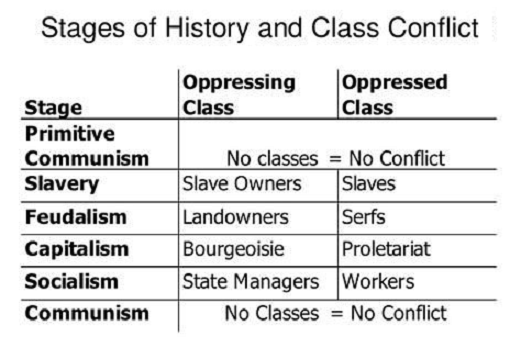
- The class struggle starts as soon as the stage of primitive communism ends. It exists in the slavery system, feudalism, and capitalism. Ultimately it paves the way for revolution and seeks for establishment of communism.
- Karl Marx and Friedrich Engels have continually referred to the "materialistic inversion" of the Hegelian dialectics.
PYQs: Class Struggle
- Explain Karl Marx's conception of class-antagonism. How have the functionalists reacted to his views? (01/60)
- कार्ल मार्क्स की वर्ग-विरोध की अवधारणा की व्याख्या कीजिए । कार्यात्मकतावादियों ने उनके विचारों पर कैसे प्रतिक्रिया व्यक्त की है? (01/60)
- Write short note: Class-in-itself and class-for-itself. (03/20)
- संक्षिप्त टिप्पणी लिखिए : स्वयं-में-वर्ग और स्वयं के लिए वर्ग । (03/20)
- Short note: Class struggle as conceived by Karl Marx. (05/20)
- संक्षिप्त टिप्पणी लिखिए : कार्ल मार्क्स द्वारा वर्ग संघर्ष की कल्पना । (05/20)
- Explain Karl Marx’s analysis of capitalistic mode of production and class-struggle. What are the intellectual reactions to his views? (07/60)
- उत्पादन के पूंजीवादी तरीके और वर्ग-संघर्ष के बारे में कार्ल मार्क्स के विश्लेषण की व्याख्या कीजिए। उनके विचारों के प्रति बौद्धिक प्रतिक्रियाएं क्या हैं? (07/60)
- Examine Karl Marx’s views on ‘class-in-itself’ and ‘class-for-itself’ with reference to proletarians. (10/30)
- सर्वहारा के संदर्भ में स्वयं-में-वर्ग और स्वयं के लिए वर्ग पर कार्ल मार्क्स के विचारों का परिक्षण कीजिए । (10/30)
- In Marxian classification of Society, feudal and slave societies are very important. How are they different from each other? (12/20)
- समाज के मार्क्सवादी वर्गीकरण में, सामंती और दास समाज बहुत महत्वपूर्ण हैं। वे एक-दूसरे से अलग कैसे हैं? (12/20)
- According to Marx, capitalism transforms even the personal relationships between men and women. Critically examine with illustrations from the contemporary Indian context. (14/10)
- मार्क्स के अनुसार, पूंजीवाद पुरुषों और महिलाओं के बीच व्यक्तिगत संबंधों को भी रूपांतरित करता है। समसामयिक भारतीय संदर्भ से दृष्टांतों के साथ समालोचनात्मक परीक्षण कीजिए । (14/10)
Aspects and Elements
- Historical Materialism and Class Formation:
- Marx's theory of historical materialism posits that class struggle is not a fixed or eternal condition but rather a product of historical development.
- Change in the modes of production leads to the emergence of distinct social classes and class conflicts.
- Each historical epoch has its own dominant class, and the struggle between classes occurs within the framework of the prevailing mode of production.
- Example: Feudalism to Capitalism
- During this transition, the bourgeoisie (capitalist class) emerged as the dominant class, replacing the feudal aristocracy. This transformation was driven by changes in economic systems, particularly the rise of industrialization.
- Bourgeoisie vs. Proletariat
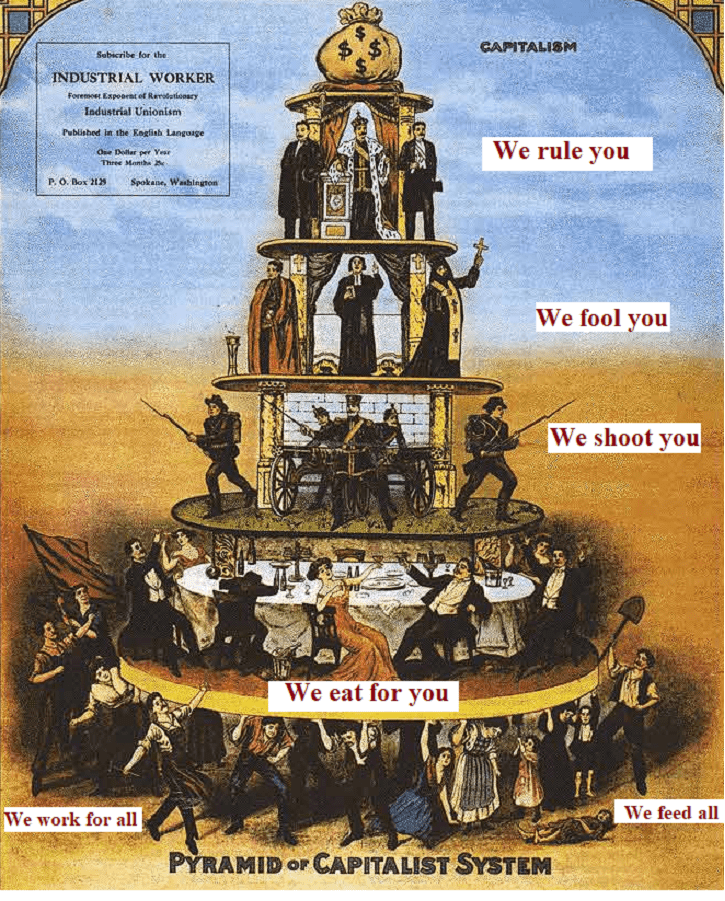
- The central focus of class struggle in Marxism is the conflict between the bourgeoisie (capitalist class) and the proletariat (working class).
- The bourgeoisie owns and controls the means of production, such as factories and capital, while the proletariat consists of those who sell their labor to the bourgeoisie in exchange for wages.
- The interests of the bourgeoisie lie in maximizing profits and maintaining their dominance, while the proletariat seeks fair wages, better working conditions, and eventually the abolition of the capitalist system.
- Example: The Industrial Revolution
- There was a significant class struggle between the bourgeoisie factory owners and the proletariat workers. Exploitative working conditions, low wages, and long hours led to widespread protests, strikes, and labor movements, demanding better treatment and rights for workers.
- Dialectical Materialism
- Marx's dialectical materialism, a philosophical framework, provides a method to understand and analyze class struggle.
- Dialectics refers to the interplay between opposing forces and contradictions, which leads to new developments and social change.
- Materialism emphasizes the importance of material conditions, such as the means of production, in shaping society and driving class conflicts.
- Example: Contradictions of Capitalism
- Marx argued that capitalism contains inherent contradictions that generate class struggle. For instance, the drive for profit leads to the exploitation of workers, creating tension between the bourgeoisie and proletariat. Over time, these contradictions intensify, potentially leading to social unrest and revolutionary change.
- Revolution and Socialism
- Marx believed that the ultimate outcome of class struggle would be a proletarian revolution, in which the working class would overthrow the bourgeoisie and establish a socialist society.
- Socialism aims to eliminate class distinctions and the exploitation of labor, with the means of production being collectively owned and controlled by the workers.
- Example: Russian Revolution, 1917
- It serves as an example of a proletarian revolution influenced by Marxist ideas. The working class, led by the Bolshevik Party, overthrew the bourgeoisie-dominated Tsarist regime, establishing the Soviet Union. This revolution aimed to create a socialist society that would abolish class distinctions and prioritize the needs of the proletariat.
Criticism
- Simplistic and Reductionist Analysis: Critics argue that Marx's theory oversimplifies complex social relations, reducing them to a binary struggle between the proletariat and the bourgeoisie.
- Neglect of Non-Class Factors: Marx's theory neglects other significant factors such as race, gender, ethnicity, and culture that contribute to social inequality and power dynamics.
- Economic Determinism: Critics accuse Marx's theory of economic determinism, disregarding the influence of cultural, political, and ideological factors on social dynamics.
- Lack of Historical Validity: Some argue that Marx's theory does not adequately reflect the complexity and diversity of historical societies and may not apply universally.
- Utopianism and Violence: Marx's theory is associated with utopianism and the potential justification of violence in achieving revolutionary change.
- Lack of Individual Agency: Critics contend that Marx's theory downplays the role of individual agency and emphasizes social structures.
Thinkers’ Views on Karl Marx's Class Struggle
- Max Weber:
- Acknowledged economic factors in class struggle, but emphasized that class divisions are not solely determined by economics.
- Introduced the concept of social stratification, including economic class, social status, and power as determinants of inequality.
- Emile Durkheim:
- Recognized social classes but focused on social cohesion and shared values in maintaining social order.
- Argued that class struggle arises from a lack of social integration and moral regulation.
- Georg Simmel:
- Viewed class struggle as a complex interaction between individual actions and societal structures.
- Emphasized the role of money as a symbol of power and highlighted tensions arising from social interactions between classes.
- Pierre Bourdieu:
- Introduced the concept of cultural capital in perpetuating social inequalities.
- Highlighted the significance of cultural and symbolic resources, such as education and taste, in class struggle.
- Erik Olin Wright:
- Developed the "social class approach" expanding on Marx's theory.
- Recognized multiple dimensions of class, including exploitation, control over assets, and occupational location.
- Argued that class struggle involves conflicts not only between capitalists and workers but also within the working class itself.
- Antonio Gramsci:
- Gramsci built upon Marx's ideas by introducing the concept of hegemony.
- He argued that ruling classes maintain their dominance not only through economic coercion but also through cultural and ideological means.
- Gramsci emphasized the significance of cultural hegemony in shaping the consent and compliance of subordinate classes.
Indian Thinkers’ Views on Karl Marx's Class Struggle
- Dr. B.R. Ambedkar:
- He critiqued Marx's class struggle theory for being primarily focused on economic class divisions and overlooking the significance of caste-based hierarchies in Indian society.
- Ambedkar argued that class struggle in India is intrinsically linked to the caste system, and the marginalized castes are the ones primarily oppressed and in conflict with the upper castes.
- He argued that the caste system perpetuates social and economic inequality, leading to the exploitation of the lower castes by the upper castes. Ambedkar saw the struggle against caste oppression as a form of class struggle.
- M.N. Srinivas:
- N. Srinivas examined the intersection of caste and class in Indian society.
- He acknowledged Marx's theory of class struggle but argued that the Indian context required an understanding of the complex interplay between caste, class, and power.
- Srinivas emphasized the dominant role of caste in shaping social relations and the allocation of resources, alongside economic class divisions.
- D.D. Kosambi:
- He applied Marx's theory of class struggle to analyze the social and economic structures of ancient India.
- Kosambi explored the relationship between agrarian systems, class divisions, and the exploitation of labor in ancient Indian societies.
- His work highlighted the historical continuity of class struggle, tracing it back to pre-colonial times.
- G.S. Ghurye:
- He recognized the importance of Marx's class struggle theory but modified it to suit the Indian context.
- Ghurye argued that class divisions in India are influenced by factors such as religion, caste, and kinship ties, apart from the economic terms.
- Ranajit Guha:
- Ranajit Guha explored the concept of "subalternity" and its relation to class struggle in colonial India.
- He argues to expand the understanding of class struggle by including the perspectives and agency of subaltern groups.
- Guha highlighted the experiences and struggles of marginalized groups, particularly peasants and tribal communities, who were often excluded from mainstream Marxist narratives.
Class-in-itself and Class-for-itself
Comparison
|
Aspect |
Class-in-itself (Klasse an sich) |
Class-for-itself (Klasse für sich) |
|
Definition |
Group with shared economic/social conditions but lacking consciousness |
Group aware of its shared interests and capable of collective action |
|
Basis of Identity |
Defined by external, objective factors like labor and economic role |
Defined by self-awareness and internalized class consciousness |
|
Class Consciousness |
Lacking or minimal |
Present and actively developed |
|
Action |
Passive; no organized effort toward change |
Active; collective efforts for political/social change |
|
Organization |
Disorganized; exists as a social category |
Organized; unites for common goals and mobilizes |
|
Role in Marxist Theory |
Starting point of class formation |
Crucial for revolutionary change; leads to proletariat revolution |
|
Marx’s View |
Proletariat must evolve from this stage |
Necessary for overthrowing capitalism and achieving communism |
|
Example |
Workers facing exploitation but unaware of common cause |
Workers forming unions, striking, demanding structural change |
|
Nature |
Static and unconscious |
Dynamic and self-aware |
|
Essence |
Represents potential for unity |
Represents actualization of collective power |
1. Class-in-itself
- Class-in-itself refers to a group of people who share similar social or economic characteristics and have a common identity but are not yet conscious of their shared interests or their potential for collective action.
- This class is defined primarily by external factors, such as economic conditions, and the individuals within it may not be aware of their shared identity or have a collective consciousness.
- The class-in-itself is essentially an objective, static entity that exists independently of individual consciousness or awareness.
Characteristics:
- Lack of awareness: The individuals within the class are not fully aware of their collective identity or the social forces that shape their common experiences.
- Passive existence: They exist as a social category but do not actively unite or mobilize for specific goals or causes.
Example: The working class in a society can be considered a class-in-itself when individual workers have similar labor conditions, economic struggles, and shared experiences but have not yet formed a strong sense of class consciousness or organized for collective bargaining or activism.
2. Class-for-itself
- Class-for-itself represents a stage where the members of a particular class become aware of their shared identity, interests, and potential power as a collective unit. It denotes a higher level of consciousness and active participation.
Characteristics:
- Consciousness: The individuals in the class are aware of their common interests, social position, and the potential for collective action.
- Organized action: They come together to advance their shared interests and strive for societal change through collective organization and activism.
3. Marxist Perspective
- Relevance: The concepts of class-in-itself and class-for-itself are essential components of Marxist theory, as they relate to the understanding of class struggle and the potential for revolutionary change.
- Marxist view: Karl Marx believed that society is divided into classes, and for meaningful social change to occur, the proletariat (working class) must transition from being a class-in-itself to a class-for-itself, leading to a revolution that overthrows the capitalist system.
- Example: According to Marx's theory, when the working class becomes aware of its exploitation by the capitalist class and organizes to challenge the existing power structures, it can potentially lead to a proletarian revolution, ultimately leading to a communist society.
Conclusion
Class-in-itself and class-for-itself describe different stages of class awareness and organization. Class-in-itself denotes a group with shared characteristics but lacking full consciousness, while class-for-itself signifies a class that is aware of its identity and actively strives for collective change.