
Theories of Population
( Sociology Optional)
These theories are necessary to understand the population dynamics and its growth.
Although these theories are not directly part of the sociology optional syllabus, you should use the crux of these theories while writing the answers in sociology.
Malthusian Theory
- The Malthusian essay on the principle of population is a landmark in the history of population studies.
- It argues that “there is tendency of the population to grow faster in relation to its means of subsistence.”
- It has led to human misery and placed several obstacles in the path of human progress.

Neo-Malthusian Theory
- Neo-Malthusians maintain that although the gloomy predictions of Malthus may have been pre-mature, they are basically correct.
- It stressed on birth control methods. It also identified the working class with the problem of overpopulation.
- The overcrowded industrial slums were identified as sites of moral degeneration.
- According to Anti Malthusians, world's resources are adequate for a much larger population. Exploitation not over population is the basic cause of world hunger.

Marxian Theory of Population
- As per Marx, the core of history is “a change in modes of production” in any civilization.
- The population does not grow as a result of fertility, but solely as a result of the
- Capitalists incorporate labor into production.
- To maximize the profit and surplus production, the capitalists install the labor-saving machines.
- As a result, unemployment expands, wages fall, and poverty rises.
- Hence, the poor strive to grow the population via reproduction so that the next generation can assist them to produce more money.
- However, as sophisticated technology and excess laborers develop, the surplus population and unemployment situation worsens. This is the root of all evil.

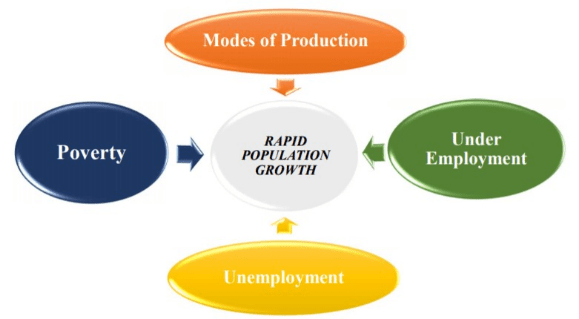
- He concluded that the main causes of the surplus population were nothing more than capitalists' exploitative policies.
- Marx proposed that the fall of capitalism is the only means for population control.
- Marx believed that in a socialist society, reproductive behavior would develop into total harmony between the individual and the society. The distributive justice and governmental control over resources may alleviate the food issue.
- As a result, his theory is a socio-economic model of population control.
Demographic Transition theory
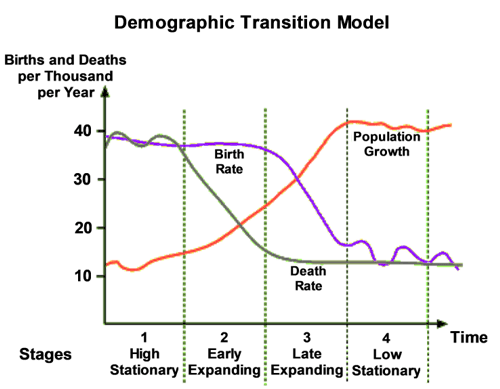
As per Frank Notestein and Warren Thompson, every country passes through four stages of population growth. A fifth phase is also proposed by C.P Blacker.
|
Stage |
Fertility |
Mortality |
Society |
|
High stationary phase |
High birth rate |
High death rate |
Pre-industrial |
|
Early expanding phase |
High birth rate |
high but declining death rate. |
Transition stage |
|
Late Expanding phase |
Declining birth rate |
rapidly declining death rate. |
Industrial |
|
Low stationary phase |
Low birth rate |
Low death rate. |
Post-industrial |
|
Declining phase |
Low birth rate |
Low death rate, and an excess of deaths over births. |
|
Optimum population theory
- The optimum theory of population was propounded by Edwin Cannan in his book Wealth published in 1924.
- Robbins defines it as “the optimum population which just makes the maximum returns possible is the optimum population or the best possible population.”
- According to Cannan population must grow upto certain desired level after which further growth is harmful.
- Carr-Saunders defines it as “optimum population produces maximum economic welfare.”
- According to Dalton, “Optimum population is that which gives the maximum income per head.”

Assumptions of the theory
- With the growth of population, the ratio between total population and working population remains unchanged.
- The hours of work and production per head of working population will remain constant.
- A time may come when a country’s population will increase with that of the available natural resources.
Weaknesses
- There is no evidence of optimum level.
- Impossible to measure optimum level.
- Correct measurement of per capita income not possible.
- It neglects the distributional aspect of increase in per capita income.
- Optimum level is not fixed but oscillating.
- It neglects social and institutional conditions.
- It has no place in state policies.
- It does not explain determinants of population growth.
The Limits to Growth
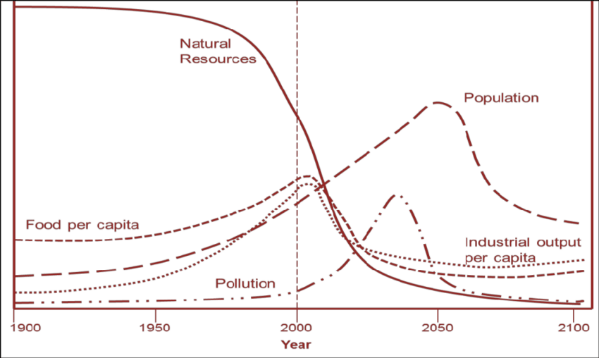
- Commissioned by the Club of Rome, this report was published in 1972. It used the World3 computer model to simulate the consequence of interactions between the earth and human systems. The model was based on the book ‘World Dynamics’ by Jay Forrester of MIT.
- The report's authors are Donella H. Meadows, Dennis L. Meadows, Jorgen Randers, and William Behrens.
Assumptions
- There are limited resources available on earth.
- The agricultural land is limited.
- The earth has a limited capacity to feed the pollution.
- The technology and innovation change productivity.
- There is rise in pollution, which degrades the quality of life.
The report
- There are limited resources with a finite supply. The carrying capacity of the earth is limited.
- The nature has set a limit, beyond which the development is not possible.
- Without substantial changes in resource consumption, there will be a rather sudden and uncontrollable decline by the year 2100 in both population and industrial capacity.
Criticisms
- Food security can be ensured with new innovations.
- The alternative minerals and resources can be developed through innovation.
Evaluation
- As per The Club of Rome, the message of this report still holds today: “The earth’s limited and interlocking resources probably cannot support present rates of economic and population growth much beyond the year 2100, even with advanced technology.”