
Industrialisation
( Sociology Optional)
Introduction
Industrialisation is a process by which the center of gravity of the economy shifts from agriculture to industry.
Industrialisation involves two things:
- Adoption of technologically with superior techniques of production that help to transform basic raw materials and intermediate goods into manufactured goods.
- Application of modern techniques of management and organisation like economic calculations, accountancy and management techniques, etc.
Arguments for Industrialisation
Productivity of Labour due to:
- the existence of greater capital intensity,
- continuity of production,
- greater specialisation and division of labour,
- less dependence on natural factors,
- a greater possibility of internal-external economies in the manufacturing sector.
Employment Generation:
- With increase in productivity in the industrial sector, it will be possible to create more employment opportunities
- Attracting labour from less productive occupations.
- it will increase the purchasing power and aggregate consumption
Mobilisation of Surplus:
- A major constraint on development in a Developing Economy is the lack of adequate resources to finance the required needs.
- It is result of two inter-related factors: (a) the absolute size of resources, national output and saving in a Developing Economy is low, and (b) it is not possible to mobilise the surpluses.
Industrial Development in India
- India is one of the pioneers of industrialisation in the Third World, with a modern infrastructure — all-weather roads, railways, irrigation etc., Its foundation was laid during the British Rule.
- Indian industries reflect India’s comparative advantage in terms of low wages, availability of raw material and edge in manufacturing
Dimensions of Industrial Growth
Early Growth Phase: Till 1965-66:
- The Second Plan introduced an industrial revolution, especially in acquiring basic industrial muscle.
- The high rates of industrial growth witnessed during the third plan were due to emphasis on industrialisation in economic policies, the heavy industry-oriented strategy of industrialisation, substantial investments, growing demands for a variety of new products etc.
- This period of growth has been named the period of “industrial growth with regulation”
Slowdown Phase: Decade of 1970s:
- Industrial growth slowed down after the Third Plan. Not only industry stagnated during this period, ‘a blatantly elite-oriented production structure’ came into existence.
- The major reasons for this slow growth were periodic shocks that the economy had received in the form of wars in 1965 and 1971, the oil crisis in 1973, and the droughts in 1965 and 1966.
Revival During the 1980s
- Industrial growth rate moved up due to Liberalisation of industrial policy. The process began in early 1980s, and caught up since 1985.
- Public investment played a crucial role in determining the growth of Indian industry.
- Investment in the private corporate manufacturing sector increased significantly.
Recession During 1991-94:
- Industrial production suffered a setback due to both supply and demand factors.
- On the supply side, the important factors were import compression, rise in the cost of imports due to the cash margin requirement and the downward adjustment of the exchange value of the rupee and the tight monetary policy.
- On the demand side, the important factors were a perceptible fall in effective demand due to inflationary pressure, reduction in public expenditure, and strict fiscal discipline.
- All of these factors are interlinked.
Revival and Subsequent Slowdown 1994-2002:
- The slowdown in the rate of industrial growth during 1991-94 turned out to be only transitional, an immediate fallout of the stabilisation measures initiated by the government for the macro-economic adjustment of the economy.
- Factors:
- Increased government expenditure/ public investment. Development expenditure reduces infrastructure bottlenecks.
- The excise and customs duty cuts
- Growth in export volumes since 1993-94
Pattern of Industrialisation
The pattern of industrialisation can be studied under two heads:
- Functional pattern of industries, and
- Ownership pattern of industries.
Functional Pattern of Industries
Various industries can be divided into four groups, viz., (i) Basic industries, (ii) Capital Goods Industries, (iii) Intermediate goods industries, and (iv) Consumer goods industries.
Various phases relating to the compound rates of growth in different industries can be observed:
- The First Phase (Till Mid-1960s): the rate of growth of industries, had picked up very fast. A major contribution in this direction was made by the basic and capital goods industries. The pattern of industrialisation that evolved during the period had shown two features: i) A rapid growth of basic and capital goods industries, ii) A slow growth of consumer goods industries.
- The Second Phase (1965-75): the rate of industrial growth, began to trigger off. The growth of basic and capital goods industries was slower than in the past and also slower than even the meagre average growth in industrial output; where growth was moderately high, a majority of the industries belonged either directly or indirectly to ‘elite-oriented consumption goods’ sector.
- The Third Phase (1975-90): During this phase, the industrial growth was fairly diversified; growth rates in all the different segments picked up. Basic goods industries maintained a consistently fairly high rate of growth, as did the capital goods and intermediate goods industries.
- The Fourth Phase (1990s and Beyond): During the 1990s, while the relative contributions of basic and capital goods sectors declined, there was a rise in those of intermediate and consumer goods sectors. It was due to the import of trade liberalisation that enabled the corporate sector to make financial gains through ‘other income’, as also the lack of competitiveness requiring industrial restructuring and modernisation of technologies in a number of industries.
Ownership Pattern of Industries
It was realised by the framers of the industrial strategy, which relied heavily upon basic and capital goods industries, that for its success, the State would have to bear the entrepreneurial function itself. Its rationale was explained by the following factors:
- In the years that followed the First Plan and, thereafter, the public sector in India expanded very fast, so much so that it began to account for almost as much as two-thirds of the net domestic capital formation in the economy. However, the net domestic capital formation in the public sector began to slowdown after the Third Plan.
- These trends get reflected in the structure of ownership and organisation that has emerged over the years. Thus, beginning practically with a clean slate, the public sector, around the mid-1990s, saw its share going up to 4.7 per cent in total number of factories, 27.4 per cent in employment, 55.0 per cent in productive capital, 25.5 per cent in value of output etc. It would be observed, however, that government’s, share in output, value added and employment is substantially smaller.
Industrialization and class divide in India
- The Industrial Revolution created a new middle class along with the working class. Those in the middle class owned and operated the new factories, mines, and railroads, among other industries. Their lifestyle was much more comfortable than that of the industrial working class.
- When farm families moved to the new industrial cities, they became workers in mines or factories. They faced tough working conditions in uncomfortable
- The Industrial Revolution created new middle class, i.e bourgeoisie, whose members came from a variety of backgrounds.
- Some were merchants who invested their growing profits in factories.
- Others were inventors or skilled artisans who developed new technologies.
- Some rose from "rags to riches," a pattern that the age greatly admired.
- The new middle class took pride in their hard work and their determination to "get ahead." Only a few had sympathy for the poor.
- Women of the middle class did not leave the home to work but instead focused their energy on raising their children. This contrasted with the wealthy, who had maidservants to look after their children, and the working class, whose children were a part of the workforce.
Effect of industrialization on family structure
Some of the major changes that occurred in the family patterns after industrialization are as follows:
- Decline of Extended Family System
- Changing Authority Pattern
- Changing Status of Women
- Changing Economic Functions
- Free Choice of Mate Selection
- Decline in Family Size
- Changing Attitudes towards Sex and Marriage
- Declining Trend in Non-essential Functions
Effect of service sector on youth and women
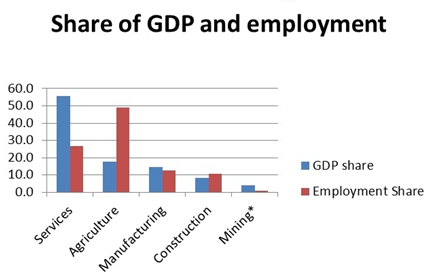
- Manufacturing has become much more capital- and skill-intensive, with greatly diminished potential to absorb large amounts of labor from the countryside.
- Already, services contribute the bulk of GDP in developing countries, even in low-income countries where agriculture has traditionally played a big part.
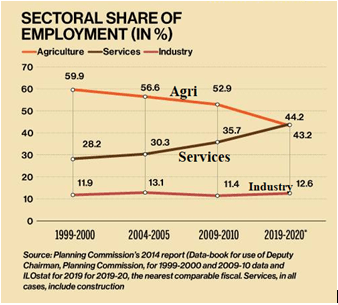
- Young workers who leave the farm for the cities are increasingly absorbed into urban services jobs instead of manufacturing. It creates an open system of mobility, and helps them to rise up in the social mobility.
- In addition, international trade in services has tended to expand more rapidly than trade in goods. This has led to globalization, westernization and modernization.
- There was significant and positive impact of female illiteracy rate, GPP Growth rate, and industrial share on the female labour force participation.
- However, there is negative impact of female unemployment on female labour force participation on the female labour force participation.
- There is negative but significant impact of industrial share on the female force labour participation.
- There was an emphasize on the participation and economic development of female population in the service sector.
Effect of industrialization on the society in general
- People move to new industrial cities.
- New social classes
- The industrial middle class those who benefited most from the industrial revolution were the entrepreneurs who set it in motion.
- The industrial working class living in vast numbers of poor struggled to survive in foul-smelling slums. They packed into tiny rooms in tenements, or multistory buildings divided into apartments. These tenements had no running water, only community pumps.
- Workers stage futile
- Factory workers face harsh conditions in mines and factories.
Evaluation and Conclusion
- The early industrial age brought terrible hardships. In time, however, reformers pressed for laws to improve working conditions.
- Labor unions won the right to bargain with employers for better wages, hours, and working conditions. Eventually working class men gained the right to vote, which gave them political power.
- Despite the social problems created by the Industrial Revolution-low pay, dismal living conditions the Industrial Age did have some positive effects.
- As demand for mass-produced goods grew, new factories opened, which in turn created more jobs.
- Wages rose so that workers had enough left after paying rent and buying food to buy a newspaper or visit a music hall. As the cost of railroad travel fell, people could visit family in other towns. Horizons widened and opportunities increased.