
Sex Ratio
( Sociology Optional)
Sex Ratio
( Sociology Optional)
Introduction
- Amartya Sen in late 1980s estimated that there 'are about 100 millions missing women' in the - world referring to the magnitude of female survival disadvantage due to unequal treatment in the intra household allocation of survival-related commodities.
- The Indian population has shown a persistent, deficit of women since the first census conducted in the British provinces in 1881. The deficit has increased progressively and the sex ratio of the population has declined from 972 in 1901 to 940 in 2011 with minor ups and downs between 1901 to 2011.
Thinker’s views
- Arbuthnot proposed a probabilistic version of the design argument, claiming that it is intelligent design, not chance, that provides the better explanation of why slightly more boys than girls are born each year. Bernoulli rejected Arbuthnot’s argument.
- Fisher's principle explains that population sex ratio in sexually reproducing organisms is maintained at 1 : 1 owing to negative frequency-dependent selection, such that individuals of the rare sex realize greater reproductive opportunity than individuals of the more common sex until equilibrium is reached.
- Williams (1966) argued that the sex ratios found in nature provide the opportunity to test hypotheses of group selection against hypotheses of individual selection.
- Hamilton (1967) constructed a model that generalizes Fisher’s approach and represents the effects of both group and individual selection.
Sex Ratio in India in 100 years
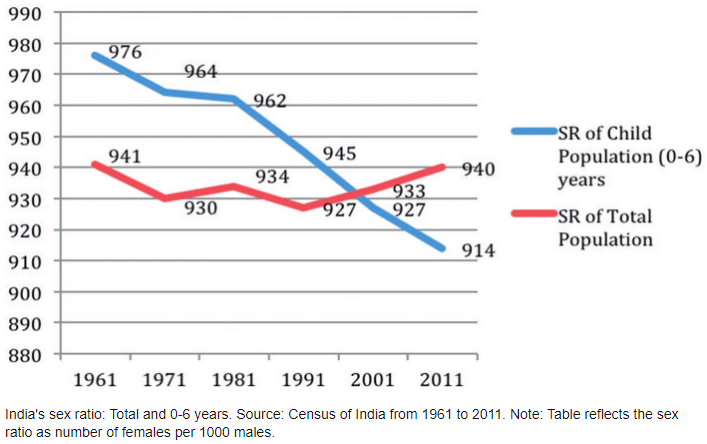
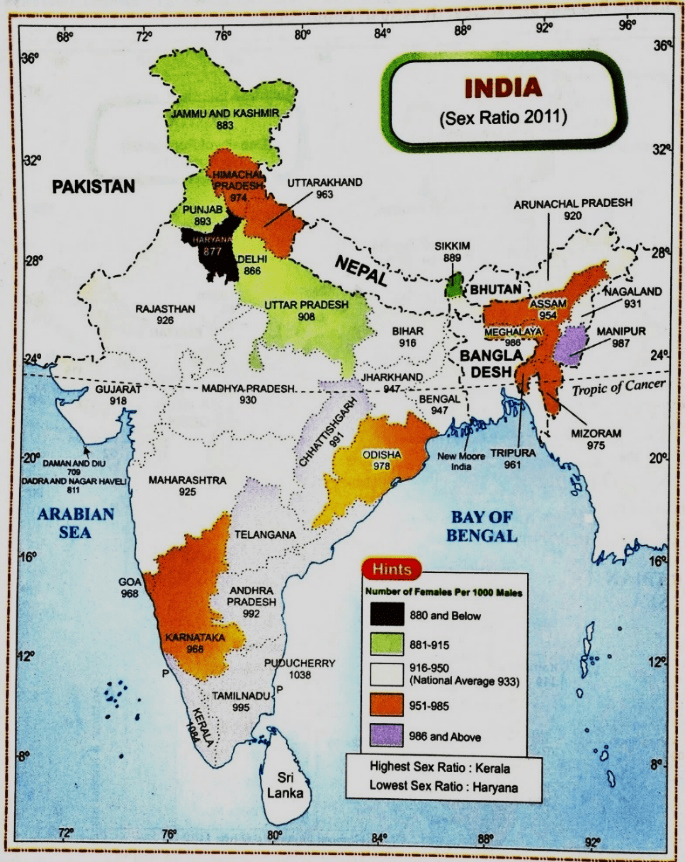
Trend of declining sex ratio
- Sex Ratio at Birth – 882 (2002-04) Girls to 1000 boys at birth
- Child sex ratio - 927 ( Census 2001) Girls to 1000 boys in 0-6 age group
- Population sex ratio Females to 1000 males in general population– 933 ( Census 2001)
Causes of declining sex ratio
- Pre Natal-Sex Determination: Increased availability of advanced technologies, especially ultrasonography (USG), has been the single most important factor responsible for decrease in sex ratios and increase in female feticides.
- Facilities of sex determination through "clinic next door" are now conveniently available with the families willing to dish out any amount that is demanded of them.
- The sex of a fetus can be determined at 13 – 14 weeks of pregnancy by trans-vaginal sonography and by 14-16 weeks through abdominal ultrasound.
- These methods have rendered early sex determination inexpensive, feasible and easily accessible.
- Patriarchal societies: In matriarchal societies in the north-eastern states of India, women control land holding and have a better say in matters related to family, economy, and society. This has resulted in a slight preference for daughters in states like Meghalaya.
- Poverty and lack of education: It has long been argued that improvement in literacy rates and socioeconomic development amongst women could change the adverse sex ratio for the better.
- However, it has been observed that educated mothers in Punjab are more prone to discriminate against their daughters than the uneducated ones.
- Also, the prevalence of prenatal sex determination is more widespread among the economically well-off because availing of such services is determined by one's ability to pay.
- Thus, the rich agriculturalists living in the rural areas of Punjab, Haryana and Gujarat and the urban elite living in the metropolis of Delhi tend to avail of sex-selective abortion.
- Status of women: The most important factor responsible for decreasing child sex ratio is the low status of Indian women coupled with traditional gender bias. The needs with regards to health, nutrition and education of a girl child have been neglected.
- Gender discrimination: The bias against females in India is grounded in cultural, economic, and religious roots.
- Sons are expected to work in the fields, provide greater income and look after parents in old age.
- In this way sons are looked upon as a type of insurance. In addition, in a patriarchal society sons are responsible for "preservation" of the family name.
- Also, as per Hindu belief, lighting the funeral pyre by a son is considered necessary for salvation of the spirit.
- In north India, girls currently constitute about 60% of the unwanted births. The elimination of unwanted fertility has the potential to raise the sex ratio at birth to 130 boys per 100 girls.
- Gender discrimination manifests itself in the form of delay in seeking medical care, seeking care from less qualified doctors and spending lesser money on medicines when a daughter is sick.
- The extreme disappointment of a mother as a result of a daughter's birth can adversely affect her ability to breastfeed the girl child, which leads to poor nutritional status.
- It is no wonder that the prevalence of malnutrition and stunting is higher in girls than boys.
- Dowry: The evil practice of dowry is widely prevalent in India. As a result, daughters are considered to be an economic liability. The dowry system is more rigid in the northern states of India.
- Women have little control over economic resources and the best way for a young north Indian bride to gain domestic power mainly comes from her ability to produce children, in particular, sons.
- Most often in south Indian communities, marriages are not exogamous and married daughters usually stay close socially and geographically to their original family.
- In the Muslim community, paying of high dowry is not a prevalent practice.
- Also, consanguineous marriages are highly prevalent, and women are entitled to a portion of parental Inheritance.
Effects of low sex ratio on women
Women don't benefit in spite of being scarce. There is a shortage of women in a region precisely, because women are undervalued and therefore aborted in large numbers. The effects of the shortage of women depend on the existing status of women in the society.
- Trafficking and kidnapping of girls and women increases dramatically.
- Cases of rape and molestation go up.
- Women and girls from regions where the sex ratio is normal are 'imported' as brides.
- They find it hard to adjust to a male dominated, restrictive atmosphere.
- In many cases the women are treated like slave labour.
- While in India brides are being imported from other regions, in countries like China, they are being imported from countries like Burma.
- In South Korea, another country where women are in short supply, men in search of brides often go to Vietnam.
- Countries like Cuba and Venezuela are also suffering from the disease of gender selective abortions.
- In India there are reports of wives are abandoned or passed on to someone else as they come from different cultural background.
- Cases of polygamy (without the woman's consent) increase.
- Suicide rates of young women go up.
- Fewer women go out to work.
- Very young girls are pushed into marriage...there is an increase in child marriages. This leads to less women being educated and health problems as children are born to very young girls.
- There is a bad effect on men, but mostly the poorer men.
- Unfortunately, if they are unemployed, they may never get wives. Hence, the crime against women increases.
- Interestingly, in a situation where there is an excess of women, it's the poor and not very good-looking women who find it difficult to get husbands.
- One good effect is that the imported brides usually come from poor families and the evil of dowry (where brides' families have to shell out a lot of money to purchase a groom - endemic in certain parts of India) is done away with.
- Crime rates go up as it is young males who commit the maximum crimes. The only crime that women commit as often as men is when it comes to filicide that of murder of children by parents.
Solutions
Changing mindset
- Social Mobilization and use of Community based approaches
- Involve elected representatives
- Multi-pronged advocacy – youth, celebrities, religious leaders, medicos, media
- Consistency –volume and intensity of efforts
- Advocacy and messaging –not to perpetuate misconceptions – Access to legal abortion – Value of women not only for marriage and child-bearing – Less women means more violence not higher status
Changing Economic Value of Women
- Monthly deposits in accounts for daughters – Till girl is 18 yrs. – Mother to access the account
- Special incentives to industries employing 2/3 women employees
- Special benefits and priority in all schemes for female headed households
- Higher Old age pension for parents with only daughters
- Income –tax exemption to all women – consider in stages, perhaps start with single daughters!
- Reduced fee/exemption for any new property if registered in name of daughter/wife/mother
Implementation of Act
- Use local data, SRB not 0-6 years
- Annual or bi-annual SRB surveys a must
- Need to work with courts, lawyers, Judiciary
- Regular monitoring and audit of records etc.
Government Law and policies
Pre-conception and Pre-natal diagnostic techniques (prohibition of sex selection) Act , 1994
- Advertising the service is illegal
- Communicating sex of child is illegal
- Regulates use of ultrasound, other technology
- Non-maintenance of records illegal
Schemes
- Beti Bachao, Beti Padhao
- Sukanya Samriddhi Account
- The Girl Child Protection Scheme
- Aapki Beti, Humari Beti