
Slums and Deprivation
( Sociology Optional)
Slums and Deprivation
( Sociology Optional)
Introduction
- A slumis a highly populated urban residential area consisting of densely packed housing units of weak build quality and often associated with poverty.
- The infrastructure in slums is often deteriorated or incomplete, and they are primarily inhabited by impoverished people. They are the chief sources of crime and delinquency, of illness and death from diseases.
- Examples: packed multistoried chawls of Mumbai, Harlem and East side in New York, black belt of Chicago, east end of London.
Historical Background
- Before the 19th century, rich and poor lived in the same regions, with the wealthy living on the high streets, and the poor in the service streets behind them. But in the 19th century, wealthy and upper-middle-class people began to move out to the central cities, leaving poorer residents behind.
- After the industrial revolution, the poor were needed to work in urban factories. It was then the modern slum began to grow.
- The low wages permitted no decent quarters. And rapidly increasing industry multiplied the number of urban masses.
- Housing has to be provided and the tenements of the working class were made of poor material, rooms were small and low, baths were omitted, toilet facilities and water outlets had to be shared by several people.
Thinkers Perspective
- Friedrich Engels described the British neighborhoods or slums as "cattle-sheds for human beings".
- In Life in London (1821) Pierce Egan defined slum to mean "low, unfrequent parts of the town".
- In 1850, Cardinal Wiseman described the Devil's Acre area in Westminster, London as:
- Close under the Abbey of Westminster there lie concealed labyrinths of lanes and potty and alleys and slums, nests of ignorance, vice, depravity, and crime, as well as of squalor, wretchedness, and disease; whose atmosphere is typhus, whose ventilation is cholera; in which swarms of huge and almost countless population, nominally at least, Catholic; haunts of filth, which no sewage committee can reach – dark corners, which no lighting board can brighten.
- As per Wratten (1995), urban poverty and deprivation is often characterized by residential crowding, exposure to environmental hazards, and social fragmentation and exclusion all components of a cluster of conditions frequently referred to with the catch-all term of “slum dwelling.
- As per Montgomery (2009), proliferation of informal settlements and the development of new, smaller cities without access to water and sanitation, garbage collection or security of tenure.
Demographic profile of slums in India
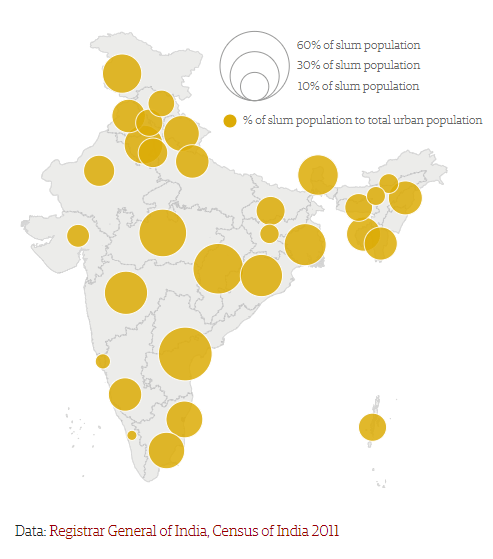
- According to 2001 census, there are 40.3 million persons living in slums in 607 towns/cities, and they account for 22.58 per cent of the population of these cities.
- SCs constitute most of the slum population in India.
- Most of the slum population is engaged in informal organization of work.
- The life expectancy of people living in the slums is low. Eg. For Dharavi, it is about 40 years.
- India's largest and Asia's second-largest Slum is Dharavi, which is located in the middle of Mumbai. It spreads in 230 hectares that has more than 5 lakh population.
- Neza in Mexico is the largest Slum in the world.
- As per NSSO 2012 report:
- There are 33,510 slums in India.
- 4 % of the urban population lives in slum areas.
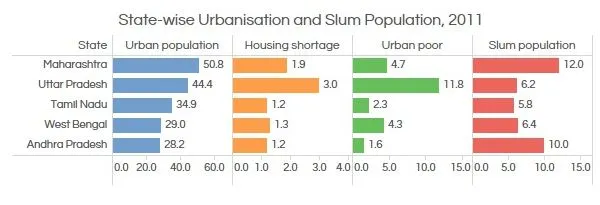
- The highest slum area is in Maharashtra.
Characteristics and Slum related Problems
- Apathy and Social Isolation: Sociologically, it is reflected in poor sanitation and health practices, deviant behavior and attributes of apathy and social isolations. People who live in slums are isolated from the general power structure and are regarded as inferiors.
- Housing conditions: Slums have commonly been defined as those portions of cities in which housing is crowded, neglected deteriorated and often obsolete
- Overcrowding and congestion: A slum may be an area which is overcrowded with buildings or a building overcrowded with people or both. F. Whyte (1943) in sociological study, Street Corner Society stressed upon the importance of overcrowding for measuring slum conditions. Some slum areas like in Delhi, have 40 lakhs people per square mile.
- Neighborhood facilities: A poor slum is invariably associated with poor facilities and community services like, schools are of poor quality and other public facilities like Streets and sidewalks are often insufficient. Shortage of water, electricity and sanitary facility are common in most of the slums.
- Poor Sanitation and Health: Slums are generally been dirty and unclean places resulted in high rates death and disease slum areas where overcrowding and presence of rats and other pest complicate the problem of health and sanitation.
- Deviant Behavior: A high incidence of deviant behavior- crime, juvenile delinquency, prostitution, drunkenness, drug usage, mental disorder, suicide, ill legitimacy and family maladjustments have long been associated with slum living.
- The Culture of the Slum- a way of life: This way of life is passed from generation to generation with its own rationale, structure ad defense mechanism, which provides the means to continue in spite of difficulties and deprivation.
- Vulnerability to natural and man-made hazards: Slums are often placed among the places vulnerable to natural disasters such as landslides and floods.
- Unemployment and informal economy: Due to lack of skills and education as well as competitive job markets, many slum dwellers face high rates of unemployment
- Violence: Various types of violence like murder, rape, human trafficking etc are prevalent .Slum crime rate correlates with insufficient law enforcementand inadequate public policing.
- Infectious diseases and epidemics: Slum dwellers usually experience a high rate of disease. Diseases that have been reported in slums include cholera, HIV/AIDS, measles, malaria, dengue, typhoid, drug resistant tuberculosis, and other epidemics.
- Child malnutrition: Child malnutritionis more common in slums than in non-slum areas. Children suffer from third-degree malnutrition, the most severe level,
- Other non-communicable diseases: A multitude of non-contagious diseases also impact health for slum residents. Examples of prevalent non-infectious diseases include: cardiovascular disease, diabetes, chronic respiratory disease, neurological disorders, and mental illness.
Causes of Slums development
- The partition of India led to the formation of large-scale slums in the Delhi and Kolkata regions.
- Slum areas were formed in most of the cities due to unplanned urban development. Slums are a by-product of unplanned urbanization.
- Uncontrolled rural-urban migration leads to a lack of basic infrastructure like land and house in the city. Hence, the poor living in the city are forced to live in slums as they do not have enough money to pay rent.
- Due to the growing informal economy, people's jobs have become insecure.
- The demand-supply gap for urban infrastructure (mainly houses and land) widened after liberalization, privatization, globalization (LPG) reforms. Due to this slum settlements have increased further.
- LPG reforms have not provided equal benefits to all people and have widened the gap between the rich and the poor.
- Due to poor urban governance, paucity of resources, widespread corruption, unplanned urban infrastructure, etc., slums spread but do not develop.
- Rural–urban migration
- Urbanization
- Poor house planning
- Colonialism and segregation
- Poor infrastructure, social exclusion and economic stagnation
- Informal economy
- Poverty
- Politics
- Social conflicts
- Natural disasters
Slum and literacy
- As per 2001 census, the overall disparity between slum and non-slum areas is 8 per cent but this figure is not uniform across the states.
- Some of the educationally backward states like Uttar Pradesh and Madhya Pradesh do not show much differences in levels of literacy between slum and non-slums.
- Similarly, Tamil Nadu where the level of literacy is high does not have area specific disparity in literacy.
- On the other hand, Chandigarh, Delhi, Gujarat, Rajasthan and Karnataka experience very high disparity in literacy for slum areas. Interestingly, Kerala also show significant disparity in spite of the fact that she has very high literacy level.
- Slum and female literacy: Similar to other indicators of human development index, gender disparity has been found in slum areas also. The female literacy in slum areas is 10 per cent lower than the female literacy in non-slum areas. But this gap is not uniform.
Urban Sprawl or Encroachment
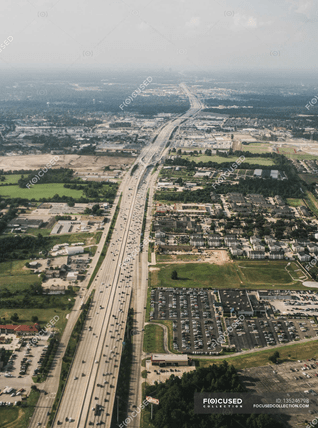
- Urban sprawl or urban encroachment is the unrestricted growth in urban areas of settlements and transport links over large expanses of land, with little concern for urban planning.
- It is a term to describe the unplanned extension of relatively low density urban land use into the fringe areas.
- These are not necessarily slums. In fact, the quality of life is better in these areas as compared to the central city.
- The wealthier classes and immigrants are constantly moving to the more pleasant suburbs where they can build larger houses.
- Historically, suburbs have grown first along major roads leading to the towns as ‘ribbon settlements’.
- The towns grow continuously and finally merge to form an almost continuous urban growth, called conurbation.
- Farmers in such areas may suffer negative externalities through the impact of neighbours on their land uses.
- Urban planners are particularly concerned to reduce sprawl. E.g. by green belt.
Examples
- Delhi-Chandigarh, Delhi-Dehradun, Delhi-Agra, Delhi-Jaipur, Delhi-Rohtak and Delhi-Moradabad sprawls are quite conspicuous.
- Mumbai-Pune,
- Ahmedabad-Vadodra,
- Kolkata-Asansol
- Chennai-Coimbatore.
Approaches to the Slum Problems
- New York City is believed to have created the United States' first slum, named the Five Points in 1825, as it evolved into a large urban settlement.
- Gita Dewan Verma (2000) has highlighted this issue in her work “slumming India”. She argues that the real problem is not the pervasive urban squalor that offends us all, but rather the moral and intellectual bankruptcy that sustains it.
- She states that for the urban poor minimal ‘landless’ options- outreach services instead of Hospitals, street education instead of proper schools, slum upgrading in the place of housing-all have become very fashionable.
- They are also one-way streets. Once all urban land is lost to less essential, more glamorous uses there will be no turning the slumming clock back.
The approach to the problems of the city slums through urban community development involves the following elements:
- Creation of a sense of social cohesion on a neighborhood basis and strengthening of group interrelationship.
- Encouragement and stimulation of self-help, through the initiative of the individuals in the community.
- Stimulation by outside agencies where initiative for self-help is lacking.
- Reliance upon persuasion rather than upon compulsion to produce change through the efforts of people.
- Identification and development of local leadership.
- Development of civic consciousness and acceptance of civic responsibilities.
- Use of professional and technical assistance to support the efforts of the people involved.
- Coordination of city services to meet neighborhood needs and problems.
- Provisions of training in democratic procedures that may results in decentralization of some government functions.
Countermeasures
Slum removal:
- This strategy simply sought to remove slums.
- This strategy for dealing with slums is rooted in the fact that slums typically start illegally on someone else's land property, and they are not recognized by the state.
- But slum removal by force tend to ignore the social problems that cause slums.
- The poor children as well as working adults of a city's informal economy need a place to live.
- Slum clearance removes the slum, but it does not remove the causes that create and maintain the slum.
Slum relocation:
- Slum relocation strategies rely on removing the slums and relocating the slum poor to free semi-rural peripheries of cities, sometimes in free housing.
- This strategy ignores several dimensions of a slum life. Also sees slum as merely a place where the poor lives.
- In reality, slums are often integrated with every aspect of a slum resident's life, including sources of employment, distance from work, and social life.
- Slum relocation that displaces the poor from opportunities to earn a livelihood, generates economic insecurity in the poor
Slum upgrading:
- Slum upgrading is largely a government controlled, funded and run process, rather than a competitive market driven process.
- Some governments have begun to approach slums as a possible opportunity to urban development by slum upgrading.
- The approach seeks to upgrade the slum with basic infrastructure such as sanitation, safe drinking water, safe electricity distribution, paved roads, rain water drainage system, and bus/metro stops.
- The assumption behind this approach is that if slums are given basic services and tenure security – that is, the slum will not be destroyed and slum residents will not be evicted, then the residents will rebuild their own housing, engage their slum community to live better, and over time attract investment from government organizations and businesses.
Urban infrastructure development and public housing:
- Urban infrastructure such as reliable high speed mass transit system, motorways/interstates, and public housing projects have been cited as responsible for the disappearance of major slums in the United States and Europe from the 1960s through 1970s.
- However, slum relocation in the name of urban development is being done and criticized for uprooting communities without consultation or consideration of ongoing livelihood.
- For example, the Sabarmati Riverfront Project, a recreational development in Ahmedabad, India, forcefully relocated over 19,000 families from shacks along the river to 13 public housing complexes that were an average of 9 km away from the family's original dwelling.
Slum development programmes
- The National Slum Development Program (NSDP) was launched in 1996. The objective of the program is slum upgrading through the provision of physical amenities, community infrastructure, health care and social amenities.
- Valmiki Ambedkar Awas Yojna (VAMBAY), initiated in 2001, was designed to address housing deficits for the urban poor. Its goal is to achieve ‘Cities without Slums' by providing or upgrading shelter for people living below the poverty line in urban slums including members of Economically Weaker Sections (EWS) who do not possess adequate shelter.
- Urban Ashraya Housing Program is a Karnataka Government scheme. It provides housing to those urban residents who are homeless.
- Mythri Housing Scheme of Kerala targets the urban slums. Kudumbhashree, a poverty eradication program implemented by the Kerala government, undertook the targeting for this program.
- Bhavanashree Housing Program provides upto fifteen years loans to needy urban households. For it, the Community Development Societies have negotiated bulk loans from financial institutions.
- Pune Municipality Sanitation Project: In this major sanitation initiative, 10,000 toilet seats were provided. For a city with a slum population of 600,000, this has huge significance.
- Swatch Bharat Abhiyan: A National City Sanitation Project is its integral component. Its major fund allocation is dedicated to the construction of housing sanitation and community sanitation facilities.
Conclusion
- Slums in cities are the worst form of struggle for the teaming masses of people who cannot afford anything better. It is a remarkable, dilapidated, fragile structures which house a hogh density of population.
- Recent years have seen a dramatic growth in the number of slums as urban populations have increased in developing countries. Nearly a billion people worldwide live in slums, and some project the figure may grow to 2 billion by 2030 if governments and the global community ignore slums and continue current urban policies.
- To achieve the goal of "cities without slums", the UN claims that governments must undertake vigorous urban planning, city management, infrastructure development, slum upgrading and poverty reduction.