
Religion
( Sociology Optional)
Religion
( Sociology Optional)
Introduction
- Religion is a social-cultural system of designated behaviors and practices, morals, worldviews, texts, sanctified places, ethics, or organizations; that relates humanity to supernatural or spiritual elements.
- In simple terms, it is “Binding to set of beliefs, faith and ethic”.
- All societies have value systems. Such a value system is termed as a religion when it involves system of formal or informal worship and faith in the sacred and divine.
- Religion knows neither frontiers nor geographical barriers except for tribal religions.
- Sociologists are concerned with the social aspects of religions. It includes theories of religion, various types of religious practices like animism, monism, pluralism, sects, cults, various religious concepts in modern society like magic and science, secularization, religious revivalism, fundamentalism, communalism, problems of religious minorities etc.
- In Geography, religion is a critical element to understand “the man and environment relationship”.
- Geographers are concerned with the interaction between religion and the landscape; and distribution across the earth’s surface.
- Religion is one of the five central themes of Tuan’s Humanism.
- Religion, like language, is a symbol of group identity and a cultural rallying point.
Thinkers’ perspective
Classical Thinkers
- Friedrich Schleiermacher defined religion as “the feeling of absolute dependence”.
- Hegel defined religion as "the Divine Spirit becoming conscious of Himself through the finite spirit."
- Edward Burnett Tylor defined religion as "the belief in spiritual beings".
- In his book The Varieties of Religious Experience, the psychologist William James defined religion as "what human feels, acts, and experiences in solitude, for whatever they may consider the divine".
- Emile Durkheim defined religion as “a unified system of beliefs and practices relative to sacred things, which unite a group into one single moral community called a church.”
- Sacred things are not, however, limited to gods or spirits. It can be a symbol, holy place, rock, a tree, a spring, a pebble, a piece of wood, a house. In a word, anything can be sacred.
- Durkheim equates God with society. As per him, when you worship God, you are worshipping your own society.
- N. Srinivas in his study of a Coorg village observes that the festivals of village deities include a village-dance, collective hunt, and a dinner for the entire village. The collective dinner is called 'urome' (village-harmony).
Modern Western Thinkers
- “Religion is opium of masses”. – Karl Marx. "
- The anthropologist Clifford James Geertz defined religion “as a system of symbols which can establish powerful moods and motivations in human with a realistic feel.”
- Antoine Vergote emphasized the cultural reality of religion. He defined it as the entirety of the linguistic expressions, emotions, actions and signs that refer to a supernatural being.
- Peter Mandaville and Paul James defined religion as a relatively bounded system of beliefs, symbols and practices that addresses the nature of existence.
Main characteristics of religion
- Sacred things: These are not limited to gods or spirits. It can be a symbol, holy place, rock, a tree, a spring, a pebble, a piece of wood, a house. In a word, anything can be sacred.
- Traditionalism: sacrifices, festivals, funerary services, matrimonial services, meditation, prayer, music, art, dance or other aspects of human culture.
- Myths and Faith: Traditionally, faith, in addition to reason, has been considered a source of religious beliefs.
- sacred writings and symbolic stories: explaining the origin of life, the universe, and other things.
- Sacred actions (rituals), sermons, commemoration or worship of deities.
- Supernatural powers: spiritual elements, incarnations etc.
- Concept of
Political ideologies and religion
- The non-religious values like Marxism also affect the man and environment relationship.
- Political ideologies have a quasi-religious role. Eg. Communism, Political parties, party leaders etc.
- Political ideologies have many of the elements same as a religion. E.g. a set of beliefs, ethical standards, revered leaders, and a body of literature.
- Adherents of political ideologies may display an almost religious zeal in their desire to proselytize (covert non-believers).
- In state religion, religion and political structures are intertwined.
- Buddhism has been the state religion in Myanmar, Laos and Thailand, Islamic Republic of Pakistan and Islamic Republic of Iran.
Religion and ‘man and environment’ relationship
- Different religions have different ideas about cosmogony – origin of the universe, and man and environment relationship.
- Meaning, values, and definition of resources differ across religions.
- The impact of religion upon landscape and resource management is quite significant.
- The economic impact of religion is enormous. People of different faith and ethnicity living in the same environment are utilizing their resources differently.
- Failure to fully exploit the natural resources of the earth is considered a violation of Biblical teachings.
- Contrary to this, animistic religions do not attempt to transform the environment. Resources are the God’s powers. Only a few people on earth can harness these powers for beneficial purposes, such as medicine.
- The Christians consider natural disasters to be preventable as punishment for human sins.
- Ethnic and tribal religions are more likely to accept environmental hazards as natural and unavoidable.
- The food habits, clothing, shelter and higher needs of people are closely influenced by religious beliefs. For example, restrictions on food and drink.
- The occupational assignment in the Hindu caste system is religiously supported.
Religion and Rostov Model of growth
Religious belief, orthodoxy and conservativism are indicators of socio-economic development. Religion also grows in stages, which are similar to Rostove’s stages of growth.
- Stage 1: Animism, and Monism.
- Stage 2 and 3: Mainstream religions.
- Stage 4 and 5: Transition towards secularism and religion-less society. (Atheists and agnostics)
Religious Patriarchy
- Sylvia Walby in her 'Theorizing Patriarchy, 1990' defines Patriarchy as: 'a system of social structures and practices in which men dominate and oppress women'.
- Historically men have been considered as breadwinners and women as housekeeper and raise children. This arrangement used to be considered as 'natural'.
- Uma Chakravorty says, Brahminical traditions glorify obedient women as 'Pativrata' and hence put a veil on gender discrimination.
- While her status on one hand is of Devi in scriptures, she is given treatment of Bina Das calls it as 'Devi dichotomy'.
- Religious organisations are mainly male dominated even though women participate in religion more than men. Orthodox Judaism and Catholicism forbid women from becoming priests.
- Karen Armstrong says that exclusion of women from the priesthood is evidence of marginalisation.
- Women's participation in religion is restricted. Holm (1994) describes these restrictions as the devaluation of women in religion. Eg. Women are not allowed to preach or read from sacred texts. In many religions, menstruating women are not allowed to enter the sacred places or to touch the sacred texts.
- Simone de Beauvoir (1953) said, ‘Religion is oppressive to women and used by men to control women.’
- Sacred texts largely feature the doings of male gods. Prophets are usually written and interpreted by men.
- Women tend to have fewer religious rights than men, as: Divorce, Dress codes etc.
- However, patriarchal system is gradually breaking down under the impact of new civilization and culture.
- As hold of religion weakens, accompanying notions like 'Streedharma', 'Pativrata' and so on are also
- In present times, due to increasing secularism, religion is no longer a patriarchal tool.
- Also, Postmodernists say that religion has no meaning to individuals anymore.
Diffusion of religion
Religion diffuses in the same manner as the language does. Please refer previous topic. It diffuses through:
- Religious expeditions
- Proselytizing activities
- Migration
- Colonisation
Religious regions
Evaluation
- The food habits,
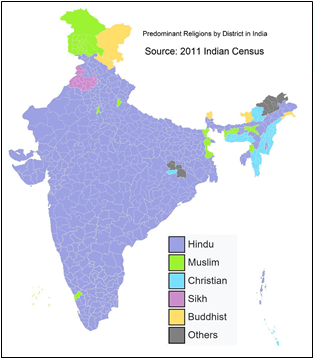
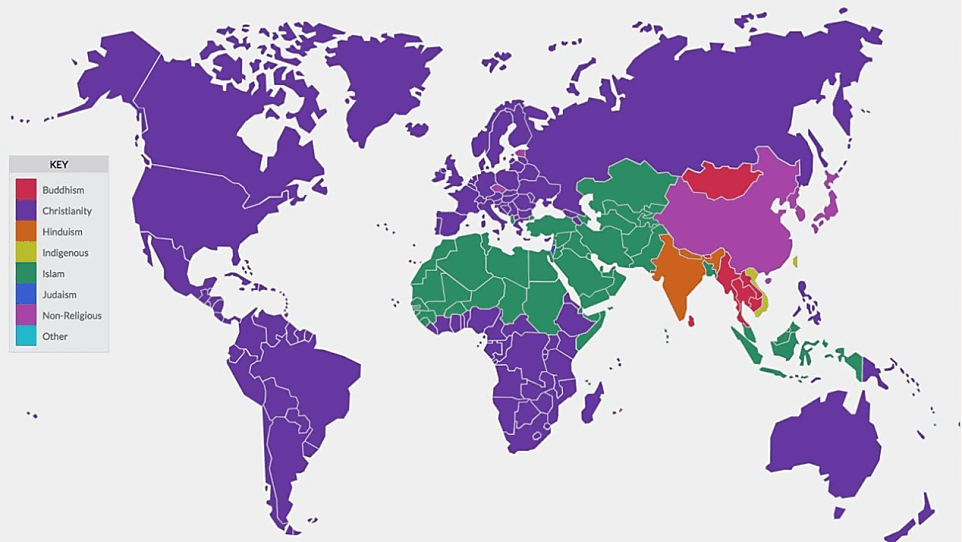
- clothing, shelter and higher needs of people are closely influenced by religious beliefs. For example, restrictions on food and drink. The occupational assignment in the Hindu caste system is religiously supported.
- In state religion, religion and political structures are intertwined. Buddhism has been the state religion in Myanmar, Laos and Thailand, Islamic Republic of Pakistan and Islamic Republic of Iran.
- Geographers are concerned with the interaction between religion and the landscape; and distribution across the earth’s surface. Religious content may be derived from events in the physical environment. Religious belief orthodoxy and conservativism may be taken as the indicators of cultural and socio-economic development.
- The impact of religion upon landscape and resource management is quite significant. The economic impact of religion is enormous and people of different faith and ethnicity living in the same environment are utilizing their resources differently.
1.1 Classification of Religion
- There are an approx. 10,000 religions worldwide.
- About 84% of the world's population is affiliated with Christianity, Islam, Hinduism, Buddhism, or some form of folk religion.
- The religiously unaffiliated group includes those who do not identify with any particular religion, atheists, and agnostics.
- While the religiously unaffiliated have grown globally, many of the religiously unaffiliated still have various religious beliefs.
Theological or historical classifications
- Monotheistic and polytheistic: This classification is, however, not spatially or regionally relevant.
- On the basis of areas of origin: For example, Eastern versus Western, or African, Far Eastern and Indian.
Monotheism
- It is a general term for religions that confess and worship to only one God.
- Unity or oneness of the divine is an important topic in Egyptian, Babylonian, Indian, Greek, and other polytheistic traditions.
Polytheism
- This concept means “Many gods!” or “No exclusion of other gods!”
- Polytheistic religions include a concept of divine unity.
Difference between Monotheism and Polytheism
- Polytheism is always the older or “primary” and Monotheism the newer or “secondary” type of religion.
- Monotheism is self-description, Polytheism is construction of the other.
Totemism
- As per Durkheim, it is the most-simple form of religion.
- He chose to study totemism as practiced by aborigines of Central Australia.
- Members of the clan believe themselves to have descended from some common ancestor as an animal, plant or even some non-living object. The “common ancestor” is the “totemic object”.
- It is linked with social organisation of clans. It is the totemic object that gives the clan its name and identity.
Atheist
- Every society also has nonbelievers, such as Atheists.
- They do not believe in a divine being, who hold that ultimate reality (such as God) is unknowable.
- While typically not an organized group, atheists and agnostics represent a significant portion of the population.
Positive Religion
- Positive Religion refers to the "scientific religion" or religion of humanity. -Auguste Comte.
- Comte's ‘religion of humanity’ is based upon morality and religion and not upon belief in a divine force.
- Comte believed a society based on positivist principles needs positive religion.
- Comte claimed that “the new positivist order would have love as its principle, order as its basis and programme as its aim.”
Geographical classifications
The theological or historical classifications are not very useful for geographers. Geographers are mainly concerned with the diffusion and spatial distribution of religions.
Geographers generally classify religions into following:
Universalizing Religions
- They claim applicability to all human beings.
- They seek to transmit their beliefs through missionary work and conversion.
- Membership is open to anyone. No one is excluded because of nationality, ethnicity, or previous religious belief.
- These include Christianity, Islam and Buddhism.
Ethnic Religions
- These have strong territorial and cultural group identification.
- Someone can become a member by birth or by adoption, but not by simple declaration of faith.
- These religions, usually, do not proselytize.
- Examples – Judaism, Hinduism and Japanese Shintoism.
Tribals or Traditional Religions (animism)
- The belief of tribal religion is also known as
- Their rituals are aimed at solving day to day problems of life.
- Followers of animism believe that life exists in all objects, from rocks and trees to lakes and mountains.
- Objects of worship are things of nature such as trees, rivers, mountain, sun, moon and earth.
- These are special forms of ethnic religions.
- They are distinguished by small size. They have a unique identity with localized culture groups.
- Shamanism is a form of tribal religion that involves community acceptance of a Shaman, and in work of magic.
- Shamanism means you have a priest who connects to the spirit world. Animism means the belief in nature spirits.
Folk religion or popular religion
- It consists of various forms and expressions of religion, which are outside the official doctrine and practices of established religions.
- “these are the religions which occur in small, local communities which does not adhere to the norms of large systems”. - John Bowker. "
- These include oral traditions such as tales, proverbs etc. or the folk-cultural dimensions of religion.