
Sociology Optional Redefined Syllabus for UPSC | Download PDF
( Sociology Optional)
Click here for Sociology Optional Redefined Syllabus.
- Rationale: Redefine the Syllabus to make it Rational, Easy and Short
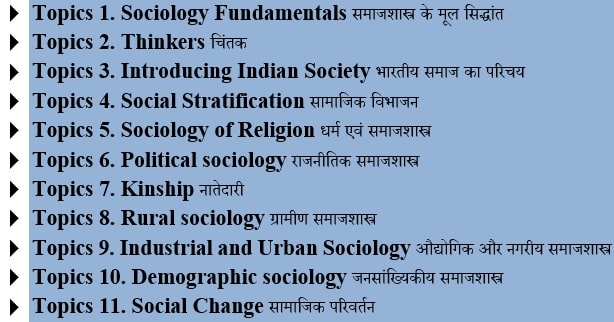
- 11 Similar Units instead of 25: The syllabus is redefined in 11 Topics, taking similar units from paper 1 and paper 2.
- Download Sociology Optional Unsolved PYQs PDF: The questions are segregated under headings, and subheadings in a redefined syllabus.
The Redefined Syllabus Headings are shown in the image below. For detailed list, please scroll down:
Topics 1. Sociology Fundamentals समाजशास्त्र के मूल सिद्धांत
Unit 1. Sociology - The Discipline: समाजशास्त्र – विद्याशाखा
(a) Modernity and social changes in Europe and emergence of Sociology. यूरोप में आधुनिकता एवं सामाजिक परिवर्तन और समाजशास्त्र का आविर्भाव ।
(b) Scope of the subject and comparison with other social sciences. समाजशास्त्र का विषय-क्षेत्र एवं अन्य सामाजिक विज्ञानों से इसकी तुलना।
(c) Sociology and common sense. समाजशास्त्र एवं सामान्य बोध।
Unit 2. Sociology as Science: समाजशास्त्र विज्ञान के रूप में:
(a) Science, scientific method, and critique. विज्ञान, वैज्ञानिक पद्धति एवं समीक्षा।
(b) Major theoretical strands of research methodology. अनुसंधान क्रिया विधि के प्रमुख सैद्धांतिक तत्व।
(c) Positivism and its critique. प्रत्यक्षवाद एवं इसकी समीक्षा।
(d) Fact value and objectivity. तथ्य मूल्य एवं उद्देश्यपरकता ।
(e) Non-positivist methodologies. अ-प्रत्यक्षवादी क्रियाविधियां।
Unit 3. Research Methods and Analysis: अनुसंधान पद्धतियां एवं विश्लेषण:
(a) Qualitative and quantitative methods. गुणात्मक एवं मात्रात्मक पद्धतियां ।
(b) Techniques of data collection. दत्त संग्रहण की तकनीक।
(c) Variables, sampling, hypothesis, reliability, and validity. परिवर्त, प्रतिचयन, प्राक्कल्पना, विश्वसनीयता एवं वैधता।
Topics 2. Thinkers चिंतक
Unit 4. Sociological Thinkers: समाजशास्त्री चिंतक:
(a) Karl Marx– Historical materialism, mode of production, alienation, class struggle. कार्ल मार्क्स-ऐतिहासिक भौतिकवाद, उत्पादन विधि, वि संबंधन, वर्ग संघर्ष।
(b) Emile Durkheim– Division of labour, social fact, suicide, religion and society. (Moved to Sociology of Religion) इमाईल दुखीम-श्रम विभाजन, सामाजिक तथ्य, आत्महत्या, धर्म एवं समाज।
(c) Max Weber– Social action, ideal types, authority, bureaucracy, (Moved to Political Sociology) protestant ethic and the spirit of capitalism. (Moved to Sociology of Religion) मैक्स वेबर-सामाजिक क्रिया, आदर्श प्रारूप, सत्ता, अधिकारीतंत्र, प्रोटेस्टेंट नीति शास्त्र और पूंजीवाद की भावना।
(d) Talcolt Parsons– Social system, pattern variables. तालकॉट पार्सन्स-सामाजिक व्यवस्था, प्रतिरूप परिवर्त।
(e) Robert K. Merton– Latent and manifest functions, conformity and deviance, reference groups. राबर्ट के मर्टन-अव्यक्त तथा अभिव्यक्त प्रकार्य अनुरूपता एवं विसामान्यता, संदर्भ समूह।
(f) Mead – Self and identity. मीड-आत्म एवं तादात्म्य।
Topics 3. Introducing Indian Society भारतीय समाज का परिचय
Unit 11. Perspectives on the Study of Indian Society: भारतीय समाज के अध्ययन के परिप्रेक्ष्य
(a) Indology (G.S. Ghure). भारतीय विद्या (जी एस धुर्ये)
(b) Structural functionalism (M. N. Srinivas). संरचनात्मक प्रकार्यवाद (एम. एन. श्रीनिवास)
(c) Marxist sociology (A. R. Desai). मार्क्सवादी समाजशास्त्र (ए.आर. देसाई)
Unit 12. Impact of colonial rule on Indian society: भारतीय समाज पर औपनिवेशिक शासन का प्रभाव
(a) Social background of Indian nationalism. भारतीय राष्ट्रवाद की सामाजिक पृष्ठभूमि
(b) Modernization of Indian tradition. भारतीय परंपरा का आधुनिकीकरण
(c) Protests and movements during the colonial period. औपनिवेशिककाल के दौरान विरोध एवं आंदोलन
(d) Social reforms. सामाजिक सुधार
Topics 4. Social Stratification सामाजिक विभाजन
Unit 5. Stratification and Mobility: स्तरीकरण एवं गतिशीलता:
(a) Concepts- equality, inequality, hierarchy, exclusion, poverty, and deprivation. Poverty, deprivation, and inequalities (Unit 25). संकल्पनाएँ- समानता, असमानता, अधिक्रम, अपवर्जन, गरीबी एवं वंचन, गरीबी, वंचन एवं असमानता। (विषय 25)।
(b) Theories of social stratification- Structural functionalist theory, Marxist theory, Weberian theory. सामाजिक स्तरीकरण के सिद्धांत- संरचनात्मक प्रकार्यवादी सिद्धांत, मार्क्सवादी सिद्धांत वेबर का सिद्धांत।
(c) Dimensions- Social stratification of class, status groups, gender, ethnicity, and race. आयाम- वर्ग, स्थिति समूहों, लिंग, नृजातीयता एवं प्रजाति का सामाजिक स्तरीकरण।
(d) Social mobility- open and closed systems, types of mobility, sources and causes of mobility. सामाजिक गतिशीलता- खुली एवं बंद व्यवस्थाएँ, गतिशीलता के प्रकार, गतिशीलता के स्रोत एवं कारण।
Unit 14. Caste System: जाति व्यवस्था:
(a) Perspectives on the study of caste systems: G. S. Ghurye, M. N. Srinivas, Louis Dumont, Andre Beteille. जाति व्यवस्था के अध्ययन के परिप्रेक्ष्य (जीएस धुर्ये, एम.एन. श्रीनिवास, लुईदयूमां, आंद्रे बेतेय)
(b) Features of caste system. Caste conflicts (Unit 25). जाति व्यवस्था के अभिलक्षण। जाति संघर्ष (विषय 25)।
(c) Untouchability-forms and perspectives. अस्पृश्यता-रूप एवं परिप्रेक्ष्य।
Unit 15. Tribal Communities in India: भारत में जनजातीय समुदाय:
(a) Definitional problems. परिभाषात्मक समस्याएं।
(b) Geographical spread. भौगोलिक विस्तार ।
(c) Colonial policies and tribes. औपनिवेशिक नीतियां और जनजातियां।
(d) Issues of integration and autonomy. एकीकरण एवं स्वायत्तता के मुद्दे।
Unit 16. Social Classes in India: भारत में सामाजिक वर्ग:
(a) Agrarian class structure. कृषिक वर्ग संरचना।
(b) Industrial class structure. औद्योगिक वर्ग संरचना।
(c) Middle classes in India. भारत में मध्यम वर्ग।
Topics 5. Sociology of Religion धर्म एवं समाजशास्त्र
Unit 8. Religion and Society: धर्म एवं समाज:
(a) Sociological theories of religion. धर्म के समाजशास्त्रीय सिद्धांत।
Emile Durkheim– religion and society. Max Weber– protestant ethic and the spirit of capitalism (Unit 4). एमिल दुर्खीम- धर्म और समाज। मैक्स वेबर - प्रोटेस्टेंट नीतिशास्त्र और पूंजीवाद की भावना (विषय 4)।
(b) Types of religious practices: animism, monism, pluralism, sects, cults. धार्मिक क्रम के प्रकार: जीववाद, एकतत्त्ववाद, बहुतत्त्ववाद, पंथ, उपासना, पद्धतियाँ।
(c) Religion in modern society: religion and science, secularization, Secularization (Unit 22), religious revivalism, religious revivalism, communalism (Unit 25), fundamentalism. आधुनिक समाज में धर्म: धर्म एवं विज्ञान, धर्म निरपेक्षीकरण, धर्म निरपेक्षीकरण (विषय 22), धार्मिक पुनः प्रवर्तनवाद, धार्मिक पुनः प्रवर्तनवाद, संप्रदायवाद (विषय 25), मूलतत्त्ववाद।
Unit 18. Religion and Society: धर्म और समाज:
(a) Religious communities in India. भारत में धार्मिक समुदाय।
(b) Problems of religious minorities. धार्मिक अल्पसंख्यकों की समस्याएं।
Topics 6. Political sociology राजनीतिक समाजशास्त्र
Unit 7. Politics and Society: राजनीति एवं समाज:
(a) Sociological theories of power. सत्ता के समाजशास्त्रीय सिद्धांत।
(b) Power elite, bureaucracy, pressure groups and political parties. सत्ता प्रव्रजन, अधिकारीतंत्र, दबाव समूह, राजनैतिक दल।
Social and political elite, pressure groups, political parties. (All in Unit 22 b).
सामाजिक और राजनीतिक प्रव्रजन, दबाव समूह, राजनैतिक दल।
Max Weber–authority, bureaucracy (Unit 4), मैक्स वेबर- सत्ता, अधिकारीतंत्र (विषय 4).
(c) Nation, state, citizenship, democracy, civil society, ideology. राष्ट्र, राज्य, नागरिकता, लोकतंत्र, सिविल समाज, विचारधारा।
Nation, citizenship, democracy राष्ट्र, नागरिकता, लोकतंत्र. (All in Unit 22 a).
(d) Protest, agitation, social movements, collective action, revolution. विरोध, आंदोलन, सामाजिक आंदोलन, सामूहिक क्रिया, क्रांति।
Unit 22. Politics and Society: राजनीति एवं समाज:
(a) Nation, democracy, and citizenship. राष्ट्र, लोकतंत्र और नागरिकता। (Moved to 7a)
(b) Political parties, pressure groups, social and political elite. राजनैतिक दल, दबाव समूह, सामाजिक एवं राजनैतिक प्रव्रजन|(Moved to 7b)
(c) Regionalism and decentralization of power. क्षेत्रीयतावाद एवं सत्ता का विकेंद्रीकरण।
(d) Secularization. (Moved to Sociology of Religion) धर्म निरपेक्षीकरण । (धर्म के समाजशास्त्र में ले जाया गया है)
Topics 7. Kinship नातेदारी
Unit 9. Systems of Kinship: नातेदारी की व्यवस्थाएँ:
(a) Family, household, marriage. Family and marriage in India (Unit 17), Household dimensions of the family (Unit 17). परिवार, गृहस्थी, विवाह । भारत में परिवार और विवाह (विषय 17), परिवार घरेलू आयाम (विषय 17)।
(b) Types and forms of family. परिवार के प्रकार और रूप।
(c) Lineage and descent. Lineage and descent in India (Unit 17). वंश एवं वंशानुक्रम । भारत में वंश एवं वंशानुक्रम (विषय 17)।
(d) Patriarchy and sexual division of labour. Patriarchy, and sexual division of labour (Unit 17) पितृतंत्र एवं श्रम का लिंगाधारित विभाजन । पितृतंत्र एवं श्रम का लिंगाधारित विभाजन (विषय 17)।
(e) Contemporary trends. समसामयिक प्रवृत्तियाँ।
Unit 17. Systems of Kinship in India: भारत में नातेदारी की व्यवस्थाएँ:
(a) Lineage and descent in India. भारत में वंश एवं वंशानुक्रम।
(b) Types of kinship systems. नातेदारी व्यवस्थाओं के प्रकार।
(c) Family and marriage in India. भारत में परिवार एवं विवाह।
(d) Household dimensions of the family. परिवार घरेलू आयाम।
(a) Patriarchy, entitlements and sexual division of labour. पितृतंत्र, हकदारी एवं श्रम का लिंगाधारित विभाजन।
Topics 8. Rural sociology ग्रामीण समाजशास्त्र
Unit 13. Rural and Agrarian Social Structure: ग्रामीण एवं कृषिक सामाजिक संरचना:
(a) The idea of Indian village and village studies. भारतीय ग्राम का विचार एवं ग्राम अध्ययन।
(b) Agrarian social structure - evolution of land tenure system, land reforms. कृषिक सामाजिक संरचना- पट्टेदारी प्रणाली का विकास, भूमि सुधार।
Unit 20. Rural and Agrarian Transformation in India: भारत में ग्रामीण एवं कृषिक रूपांतरण:
(a) Programmes of rural development, Community Development Programme, cooperatives, poverty alleviation schemes. ग्रामीण विकास कार्यक्रम, समुदाय विकास कार्यक्रम, सहकारी संस्थाएँ, गरीबी उन्मूलन योजनाएँ ।
(b) Green revolution and social change. हरित क्रांति एवं सामाजिक परिवर्तन।
(c) Changing modes of production in Indian agriculture. भारतीय कृषि में उत्पादन की बदलती विधियाँ।
(d) Problems of rural labour, bondage, migration. ग्रामीण मज़दूर, बंधुआ एवं प्रवासन की समस्याएँ ।
Topics 9. Industrial and Urban Sociology औद्योगिक और नगरीय समाजशास्त्र
Unit 6. Works and Economic Life: कार्य एवं आर्थिक जीवन:
(a) Social organization of work in different types of society- slave society, feudal society, industrial /capitalist society. विभिन्न प्रकार के समाजों में कार्य का सामाजिक संगठन- दास समाज सामंती समाज, औद्योगिक/पूंजीवादी समाज ।
(b) Formal and informal organization of work. कार्य का औपचारिक एवं अनौपचारिक संगठन।
(c) Labour and society. श्रम एवं समाज।
Unit 21. Industrialization and Urbanisation in India: भारत में औद्योगिकीकरण एवं नगरीकरण:
(a) Evolution of modern industry in India. भारत में आधुनिक उद्योग का विकास।
(b) Growth of urban settlements in India. भारत में नगरीय बस्तियों की वृद्धि।
(c) Working class: structure, growth, class mobilization. श्रमिक वर्ग: संरचना, वृद्घि, वर्ग संघठन ।
(d) Informal sector, child labour. अनौपचारिक क्षेत्रक, बालश्रमिक
(e) Slums and deprivation in urban areas. नगरी क्षेत्र में गंदी बस्ती एवं वंचन।
Topics 10. Demographic sociology जनसांख्यिकीय समाजशास्त्र
Unit 24. Population Dynamics: जनसंख्या गतिकी:
(a) Population size, growth, composition, and distribution. जनसंख्या आकार, वृद्धि, संघटन, एवं वितरण।
(b) Components of population growth: birth, death, migration. जनसंख्या वृद्धि के घटक: जन्म, मृत्यु, प्रवासन।
(c) Population Policy and family planning. जनसंख्या नीति और परिवार नियोजन।
(d) Emerging issues: ageing, sex ratios, child and infant mortality, reproductive health. उभरते हुए मुद्दे: काल प्रभावन, लिंग अनुपात, बाल एवं शिशु मृत्यु दर, जनन स्वास्थ्य।
Topics 11. Social Change सामाजिक परिवर्तन
Unit 10. Social Change in Modern Society:
(a) Sociological theories of social change. सामाजिक परिवर्तन के समाजशास्त्रीय सिद्धांत।
(b) Development and dependency. विकास एवं पराश्रितता ।
(c) Agents of social change. सामाजिक परिवर्तन के कारक।
(b) Education and social change. Education & social change (Unit 19). शिक्षा एवं सामाजिक परिवर्तन (विषय 19) ।
(c) Science, technology, and social change. विज्ञान, प्रौद्योगिकी और सामाजिक परिवर्तन ।
Unit 19. Visions of Social Change in India: सामाजिक परिवर्तन की दृष्टियाँ
(a) Idea of development planning and mixed economy. विकास आयोजना एवं मिश्रित अर्थव्यवस्था का विचार
(b) Constitution, law, and social change. संविधान विधि एवं सामाजिक परिवर्तन
(c) Education and social change. (Unit 10) शिक्षा एवं सामाजिक परिवर्तन
Unit 23. Social Movements in Modern India: सामाजिक आंदोलन
(a) Peasants and farmers movements. कृषक एवं किसान आंदोलन
(b) Women’s movement. महिला आंदोलन
(c) Backward classes & Dalit movements. पिछड़ा वर्ग एवं दलित वर्ग आंदोलन
(d) Environmental movements. पर्यावरण आन्दोलन।
(e) Ethnicity and Identity movements. Ethnic conflicts (Unit 25). नृजातीयता एवं अभिज्ञान आन्दोलन. नृजातीय द्वंद्व (Unit 25).
Unit 25. Challenges of Social Transformation: सामाजिक रूपांतरण की चुनौतियाँ:
(a) Crisis of development: displacement, environmental problems and sustainability. विकास का संकट: विस्थापन, पर्यावरणीय समस्याएं एवं संपोषणीयता
(b) Poverty, deprivation and inequalities. (Moved to Stratification) गरीबी, वंचन एवं असमानताएं। (स्तरीकरण में स्थानांतरित)
(c) Violence against women. स्त्रियों के प्रति हिंसा
(d) Caste conflicts. (Moved to Social Stratification) जाति द्वंद्व।
(e) Ethnic conflicts (Unit 23), communalism, religious revivalism. (Topic 5) नृजातीय द्वंद्व, सांप्रदायिकता, धार्मिक पुनः प्रवर्तनवाद।
(f) Illiteracy and disparities in education. निरक्षरता एवं शिक्षा में असमानताएं।