
Symmetry
( Zoology Optional)
Symmetry
( Zoology Optional)
- UPSC. Define body symmetry. Give its types with examples. (UPSC 2019, 8 Marks )
- UPSC. Symmetry in non-chordates. (UPSC 2009, 20 Marks )
- UPSC. Various types of symmetry found in animal kingdom, with suitable examples. (UPSC 2007, 20 Marks )
- UPSC. What is meant by symmetry? Write about different types of symmetry in animals. (UPSC 2022, 10 Marks )

Introduction to Symmetry in Zoology:
Symmetry is a fundamental concept in zoology that refers to the balanced arrangement of body parts in an organism. Symmetry can be observed at various levels, ranging from the overall body plan to the microscopic level of cells and tissues. Different types of symmetry, such as radial symmetry and bilateral symmetry, are found in the animal kingdom.
Perspectives:
- Ernst Haeckel: Haeckel, a prominent zoologist, proposed the concept of bilateral symmetry, which is the most common form of symmetry in animals. He believed that bilateral symmetry evolved as a result of adaptation to a mobile lifestyle.
- Carl Linnaeus: Linnaeus, the father of modern taxonomy, recognized the significance of symmetry in his classification system. He used the presence or absence of symmetry as one of the criteria to differentiate between different animal groups.
- Richard Dawkins: Dawkins, an evolutionary biologist, discussed the role of symmetry in sexual selection. He argued that animals with symmetrical traits are perceived as more attractive by potential mates, as symmetry is an indicator of genetic quality and developmental stability.
Types of Symmetry in Animals:
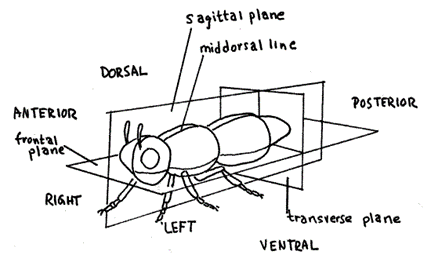
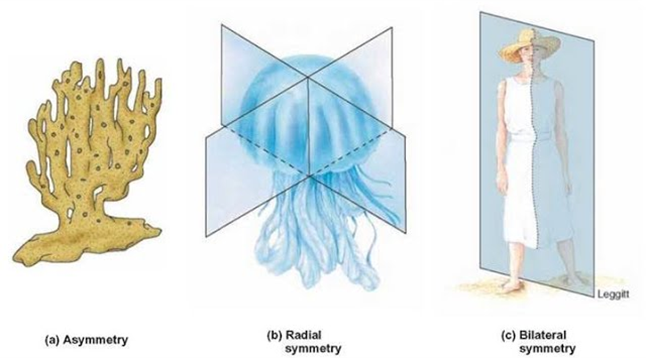
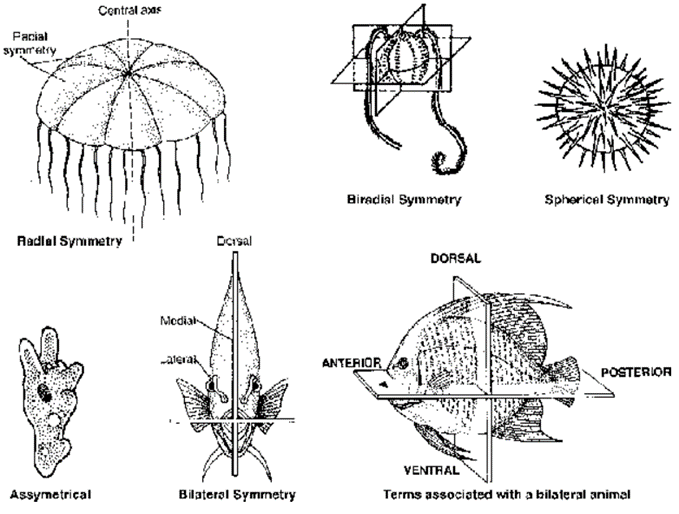
- Bilateral symmetry: This is the most common type of symmetry, where an animal can be divided into two equal halves along a single plane. Examples include humans, dogs, and butterflies.
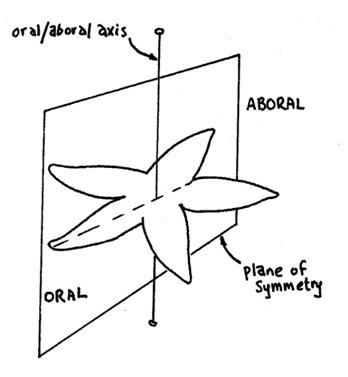
- Radial symmetry: In this type, an animal can be divided into multiple equal halves along multiple planes passing through a central axis. Examples include starfish, jellyfish, and sea anemones.
- Spherical symmetry: Some animals exhibit symmetry in all directions, such as a sphere. Examples include some microscopic organisms like diatoms and radiolarians.
- Asymmetry: Some animals lack any symmetry, with irregular shapes and body plans. Examples include sponges and some sea slugs.
- Biradial symmetry: This is a combination of bilateral and radial symmetry, where an animal has two planes of symmetry intersecting at a central axis. Examples include ctenophores or comb jellies.
- Spiral symmetry: Certain animals exhibit a spiral arrangement of body parts, where the body can be divided into equal halves along a spiral plane. Examples include some snails and marine worms.
- Oblique symmetry: This type of symmetry is seen in animals with a diagonal division of body parts, resulting in unequal halves. Examples include some flatworms and nematodes.
- Reflective symmetry: This type of symmetry occurs when an animal has a mirror image arrangement of body parts on either side of a central plane. Examples include butterflies and beetles.
Evolutionary Significance of Symmetry:
- Efficient movement: Symmetry allows animals to move more efficiently by distributing their body weight evenly, reducing the energy required for locomotion.
- Improved sensory perception: Symmetry helps animals to have a balanced sensory perception, as sensory organs are evenly distributed on both sides of the body.
- Enhanced predator avoidance: Symmetry allows animals to quickly detect and respond to predators from all directions, increasing their chances of survival.
- Efficient feeding: Symmetry facilitates efficient feeding by allowing animals to grasp and manipulate their food with balanced body parts.
- Improved reproductive success: Symmetry is often associated with good health and genetic fitness, making symmetrical individuals more attractive to potential mates.
- Phylogenetic relationships: The study of symmetry patterns in different animal groups helps in understanding their evolutionary relationships and common ancestry.
Symmetry and Body Plans:
- Body plan organization: Symmetry plays a crucial role in determining the overall organization of an animal's body plan, including the arrangement of organs and body segments.
- Complexity and specialization: Symmetry allows for the development of complex body structures and specialized functions, as different body parts can be arranged in a coordinated manner.
- Segmentation: Symmetry is closely linked to the development of segmented body plans, where repeated units are arranged symmetrically along the body axis.
- Functional differentiation: Symmetry helps in the differentiation of body regions with specific functions, such as sensory organs in the head region of bilaterally symmetrical animals.
- Developmental processes: Symmetry influences the developmental processes that shape an animal's body plan, including cell division, tissue differentiation, and organ formation.
- Evolutionary constraints: Symmetry imposes certain constraints on the evolution of body plans, as changes in symmetry may require significant modifications in the overall organization of an animal's body.
- Adaptation to ecological niches: Different types of symmetry are associated with specific ecological niches, allowing animals to adapt to different environments and lifestyles.
Symmetry and locomotion:
- Bilateral symmetry: Animals with bilateral symmetry, such as humans, have a distinct left and right side that are mirror images of each other. This symmetry allows for efficient locomotion in a forward direction.
- Radial symmetry: Animals with radial symmetry, such as jellyfish, have body parts arranged around a central axis. This symmetry allows for movement in any direction, as the body can be oriented in different ways.
- Asymmetry: Some animals, like sponges, lack any symmetry. Asymmetrical animals often have a sessile lifestyle and do not require extensive locomotion.
- Symmetry and swimming: Bilateral symmetry is advantageous for swimming animals as it allows for streamlined movement through the water. The symmetrical body shape reduces drag and enables efficient propulsion.
- Symmetry and crawling: Bilateral symmetry is also beneficial for crawling animals, as it provides stability and balance during movement. The symmetrical body plan allows for coordinated limb movements.
- Symmetry and burrowing: Animals that burrow, such as earthworms, often have bilateral symmetry. This symmetry aids in efficient movement through the soil, as the body can be flexed and extended in a coordinated manner.
- Symmetry and flying: Many flying animals, such as birds and insects, exhibit bilateral symmetry. This symmetry allows for streamlined flight and precise control of wing movements.
Symmetry and feeding strategies:
- Bilateral symmetry and predation: Animals with bilateral symmetry often have specialized feeding structures, such as jaws or beaks, that allow them to capture and consume prey efficiently.
- Radial symmetry and filter feeding: Radially symmetrical animals, like sea anemones, often use their tentacles to capture small organisms from the water. The radial symmetry allows for equal access to prey from any direction.
- Asymmetry and filter feeding: Some asymmetrical animals, like sponges, are filter feeders. They use specialized structures to filter food particles from the water, taking advantage of their sessile lifestyle.
- Symmetry and herbivory: Bilateral symmetry is common in herbivorous animals, as it allows for efficient grazing on vegetation. The symmetrical body plan aids in reaching and manipulating plant material.
- Symmetry and scavenging: Animals that scavenge for food, such as vultures, often exhibit bilateral symmetry. This symmetry allows for efficient movement and access to carcasses.
- Symmetry and nectar feeding: Many animals that feed on nectar, such as hummingbirds and butterflies, have bilateral symmetry. This symmetry aids in precise positioning of their mouthparts to access floral resources.
- Symmetry and suction feeding: Bilateral symmetry is advantageous for animals that employ suction feeding, such as fish. The symmetrical body plan allows for coordinated movements of the mouth and jaws to create a suction force.
Symmetry and Animal Behavior:
- Behavioral symmetry: Animals often exhibit symmetrical behaviors, such as balanced movements or equal use of both sides of their body.
- Symmetry in mate selection: Many animals, especially birds, are attracted to mates with symmetrical physical features, as it is often an indicator of good health and genetic fitness.
- Symmetry in predator-prey interactions: Symmetry can play a role in predator-prey interactions, as animals with symmetrical body patterns may be better camouflaged or have more efficient hunting strategies.
- Symmetry and social behavior: Some animals, like primates, display symmetrical behaviors during social interactions, such as reciprocal grooming or equal sharing of resources.
- Symmetry and territoriality: Symmetry can influence territorial behavior in animals, as individuals may defend symmetrical areas more vigorously, perceiving them as more valuable.
- Symmetry and communication: Animals may use symmetrical body postures or movements as a form of communication, conveying specific messages to conspecifics.
- Symmetry and foraging behavior: Symmetry can affect an animal's foraging behavior, as they may preferentially choose symmetrical food sources or use symmetrical search patterns.
- Symmetry and navigation: Some animals, like bees, use symmetrical landmarks or patterns to navigate their environment, enhancing their spatial orientation abilities.
Symmetry and Developmental Biology:
- Bilateral symmetry: The most common form of symmetry in animals is bilateral symmetry, where the body can be divided into two equal halves along a central axis.
- Symmetry in embryonic development: During embryogenesis, animals with bilateral symmetry undergo a process called gastrulation, which establishes the body plan and symmetry.
- Symmetry and cell differentiation: The establishment of symmetry during development is crucial for proper cell differentiation and the formation of specialized tissues and organs.
- Symmetry and body segmentation: Bilateral symmetry often correlates with body segmentation, where repeated units are organized symmetrically along the body axis.
- Symmetry and organ placement: The establishment of symmetry during development ensures proper placement and alignment of organs, facilitating their coordinated function.
- Symmetry and neural development: Symmetry plays a role in the development of the nervous system, as it influences the formation of neural pathways and connectivity.
- Symmetry and limb development: Bilateral symmetry is essential for the development of paired appendages, such as limbs, ensuring their proper formation and positioning.
Conclusion:
Symmetry is a fundamental aspect of zoology that influences an organism's structure, function, and ecological interactions. The different types of symmetry found in the animal kingdom, including radial, bilateral, asymmetrical, spherical, and spiral symmetry, reflect the diverse evolutionary paths and adaptations of organisms.