
Status of Hemichordata
( Zoology Optional)
- UPSC. Compare the tornaria larva of Balanoglossus with bipinnaria larva of echinoderm. Give reasons for including Hemichordata as a distinct phylum of invertebrates. (UPSC 2012, 30 Marks )
- UPSC. Describe the peculiarities and affinities of Onychophorans and Hemichordates and comment on the status of these animals. (UPSC 2001, 60 Marks )
- UPSC. Describe the salient features of phylum Hemichordata. Classify the phylum up to classes giving their characteristics and suitable examples. (UPSC 2005, 60 Marks )
Introduction
Hemichordata, a phylum of marine deuterostomes, is often considered a bridge between invertebrates and vertebrates. Bateson (1885) first recognized their chordate-like features, while Romer highlighted their evolutionary significance. Comprising classes like Enteropneusta and Pterobranchia, they exhibit characteristics such as a stomochord and pharyngeal slits. Recent studies emphasize their role in understanding chordate evolution, with ongoing research into their genetic and developmental pathways.



Introduction to Hemichordata:
Hemichordata is a phylum within the animal kingdom that includes a diverse group of marine organisms. They are often referred to as "half-chordates" due to their similarities with both chordates and invertebrates. Hemichordates exhibit unique characteristics and play important ecological roles in marine ecosystems.
Examples of Hemichordata:
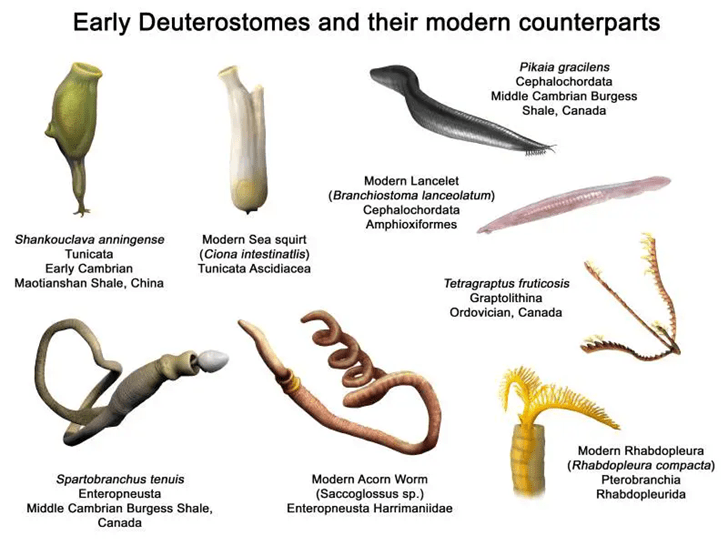
- Acorn worms (Enteropneusta): These are the most well-known group of hemichordates. They are typically found in marine sediments and play important roles in nutrient cycling. Examples include the acorn worm Saccoglossus kowalevskii and the giant acorn worm Balanoglossus gigas.
- Pterobranchs (Pterobranchia): These are a less-studied group of hemichordates that live in colonies attached to substrates such as rocks or shells. They are filter feeders and have a unique feeding apparatus called a lophophore. Examples include the pterobranch Rhabdopleura compacta and the genus Cephalodiscus.
- Ptychoderidae: This family of acorn worms is known for their ability to regenerate body parts. They have been studied for their regenerative capabilities and their potential applications in regenerative medicine.
- Harrimaniidae: This family of acorn worms is found in deep-sea environments and has adaptations to survive in extreme conditions, such as high pressure and low temperatures.
- Glossobalanus: This genus of acorn worms is known for its unique feeding behavior, where it burrows into the sediment and extends its proboscis to capture prey.
- Rhabdopleura: This genus of pterobranchs forms colonies that resemble tiny tubes and is found in various marine habitats worldwide.
Morphology and Anatomy of Hemichordata:
- Body structure: Hemichordates have a cylindrical body with three main regions - proboscis, collar, and trunk.
- Proboscis: The proboscis is a muscular and extensible structure used for feeding and burrowing.
- Collar: The collar region contains the mouth and gill slits, which are used for respiration and filter-feeding.
- Trunk: The trunk is the largest region and contains the digestive system, reproductive organs, and a nerve cord.
- Nervous system: Hemichordates have a dorsal nerve cord that runs along the length of the body, connecting to a nerve ring in the collar region.
- Coelom: They possess a well-developed coelom, a fluid-filled body cavity that provides support and houses internal organs.
- Pharynx: Hemichordates have a muscular pharynx that connects the mouth to the digestive system and aids in feeding.
- Ciliary structures: They possess cilia on the gill slits and other surfaces, which help in locomotion and feeding.
Reproduction of Hemichordata:
- Sexual reproduction: Most hemichordates reproduce sexually, with separate male and female individuals.
- External fertilization: Eggs and sperm are released into the water, where fertilization occurs externally.
- Larval stage: Hemichordates have a planktonic larval stage called a tornaria, which undergoes metamorphosis into the adult form.
- Asexual reproduction: Some species of hemichordates can also reproduce asexually through budding or fragmentation.
- Reproductive organs: Male hemichordates have testes, while females have ovaries, and the gametes are produced in these organs.
Diversity and Classification of Hemichordata:
- Classes: Hemichordates are classified into two main classes - Enteropneusta (acorn worms) and Pterobranchia (pterobranchs).
- Enteropneusta: This class includes the majority of hemichordate species, characterized by a long proboscis and a burrowing lifestyle.
- Pterobranchia: Pterobranchs are small, colonial hemichordates that live in tubes and filter-feed using tentacles.
- Body size: Hemichordates exhibit a wide range of body sizes, from a few millimeters in pterobranchs to several meters in some acorn worms.
- Habitat: Hemichordates are found in various marine environments, including shallow coastal waters, deep-sea trenches, and coral reefs.
- Feeding strategies: Hemichordates employ different feeding strategies, including filter-feeding, deposit-feeding, and scavenging.
- Evolutionary relationships: Hemichordates are considered to be closely related to echinoderms (such as starfish and sea urchins) and chordates (including vertebrates).
- Fossil record: Fossil evidence suggests that hemichordates have a long evolutionary history, with some species dating back to the Cambrian period.
Ecological and Habitat Considerations:
- Marine habitat: Hemichordates are exclusively marine organisms found in various marine environments such as shallow coastal waters, deep-sea trenches, and even hydrothermal vents.
- Benthic lifestyle: Most hemichordates are benthic, meaning they live on or in the ocean floor, either burrowing in sediment or attaching themselves to hard substrates.
- Depth range: They can be found at various depths, from intertidal zones to abyssal depths, depending on the species.
- Symbiotic relationships: Some hemichordates form symbiotic relationships with other organisms, such as living in association with coral reefs or forming mutualistic relationships with bacteria.
- Adaptations to habitat: Hemichordates have evolved various adaptations to their habitat, such as specialized structures for attachment, locomotion, and feeding.
Feeding and Digestive System of Hemichordata:
- Pharyngeal slits: Hemichordates possess pharyngeal slits, which are used for filter feeding and gas exchange.
- Proboscis: They have a muscular proboscis that can be everted to capture and manipulate food particles.
- Mucus net: Some hemichordates produce mucus nets to trap suspended particles, which are then transported to the mouth for ingestion.
- Stomochord: Hemichordates have a unique structure called the stomochord, which is involved in the transport of food from the mouth to the digestive system.
- Digestive tract: They possess a complete digestive tract, consisting of a mouth, pharynx, esophagus, intestine, and anus.
- Enzymatic digestion: Hemichordates secrete digestive enzymes to break down food particles into smaller molecules that can be absorbed.
Nervous System and Sensory Organs of Hemichordata:
- Nerve cord: Hemichordates possess a dorsal nerve cord that runs along the length of their body, connecting various sensory and motor structures.
- Ganglia: They have ganglia, or clusters of nerve cell bodies, which serve as integration centers for sensory information.
- Sensory structures: Hemichordates have various sensory structures, including ciliated pits, statocysts for balance, and chemosensory organs.
- Ocelli: Some hemichordates have ocelli, which are simple light-sensitive organs that detect changes in light intensity.
- Nervous system complexity: The nervous system of hemichordates is relatively simple compared to other chordates, but it still allows for coordination of sensory input and motor output.
- Nerve ring: Hemichordates possess a nerve ring around the pharynx, which integrates sensory information and coordinates feeding movements.
Conclusion
Hemichordata, a phylum bridging invertebrates and vertebrates, remains under-researched, with many species yet to be discovered. Simpson (2010) highlights their evolutionary significance, noting their role in understanding chordate origins. Conservation efforts are crucial as habitat loss threatens their diversity. Future research should focus on molecular studies to unravel their phylogenetic mysteries. As Dr. Barnes suggests, "Understanding Hemichordata is key to unlocking the secrets of early vertebrate evolution." Enhanced funding and global collaboration are essential for advancing this field.