Types of Metamorphism
Types of Metamorphism
Introduction
- Several approaches to classifying metamorphic processes. One approach is to classify metamorphism on the basis of the principal agent or process involved.
- It depends upon the agents of metamorphism how it is acting on the rock to metamorphosed.
- Thermal metamorphism results when heat transfer is the dominant agent (such as near plutons).
- Dynamic metamorphism occurs when deviatoric stress results in deformation and recrystallization.
- Dynamo-thermal metamorphism results when temperature and stresses are combined, as in orogenic belts.
- To these three classic types, we can add metasomatism because fluid-enhanced infiltration and alteration is a process distinct from the above three.
- Based on the IUGS/SCMR recommendations, we have the following classification.
Contact Metamorphism
- Contact metamorphism occurs adjacent to igneous intrusions, principally as a result of the thermal (and possibly metasomatic) effects of hot magma intruding cooler shallow rocks. Rocks surrounding a pluton are typically called country rocks, or host rocks.
- Contact metamorphism can occur wherever igneous activity does, and, although probably most common at plate boundaries, it is not restricted to any particular setting.
- The metamorphism occurs when the reaction is occurs between the country rocks and igneous intrusion.
- This is the effect of the hot magma intruding cooler shallow rocks.
- The metamorphism is active in plate boundaries.
- The metamorphism occurs at high temperature and over a wide range of pressures.
- There is the formation of contact aureole of metamorphosed rock in the country rocks surrounding a pluton.
- Rocks form such as
- Contact metamorphic effects are generally most dramatic when plutons intrude to shallow epizonal levels due to the substantial thermal contrast between the melt and the shallow country rocks.
- In the intermediate- depth mesozone, plutons cool more slowly and thus maintain metamorphic temperatures for a longer time, so the contact aureole may be wider.
- The country rocks are probably already metamorphic, however, so the contact effects may not be as easy to distinguish.
- In the deep catazone, the temperature of the country rocks may not differ much from that of the melts, and contact effects may be minor to insignificant.
- If the country rocks are permeable and sufficient fluid is available, convection of the fluid (driven by thermal gradients) will help cool the magma body but will also transfer heat and matter farther from the contact, extending the aureole.
- Contact metamorphic rocks are commonly affected by substantial metasomatism associated with these fluids.
- Metasomatism is most evident in situations in which the chemical composition of the country rock differs considerably from that of the melt.
- This is particularly evident in carbonate metasediments. As hot, acidic, silica-rich waters are driven from the pluton into the country rocks they react with the carbonates, producing a variety of calc–silicate minerals in a rock type called a skarn or tactite.
- a granofels (or hornfels if hard,
- compact, and displaying conchoidal fracture).
- A granofels (or hornfels if hard, compact, and displaying conchoidal fracture).

Fig: Contact metamorphism


Pyro metamorphism
- It is a minor type of contact metamorphism characterized by very high temperatures at very low pressures, generated by a volcanic or sub-volcanic body.
- Polymetamorphism involves the overprint of one metamorphic event on one or more older events, and need not be restricted to any particular types of metamorphism.
- It is most typically developed in xenoliths enclosed in such bodies, but may also occur at country rock contacts.
- Pyrometamorphism is typically accompanied by varying degrees of partial melting.
Poly-metamorphism
- It involves the overprint of one metamorphic event on one or more older events, and need not be restricted to any particular types of metamorphism.
Regional Metamorphism
- Regional metamorphism affects a large body of rock, and thus covers a great lateral extent (typically tens of kilometres or more).
- It is subclassified into:
- Orogenic metamorphism
- Burial metamorphism
- Ocean-floor metamorphism.
Orogenic metamorphism
- It is the type of metamorphism associated with convergent plate margins and mountain building.
- It also occurs during the development of island arcs, continental arcs, and continental collision zones.
- This metamorphism is responsible for the formation of foliation (slates, phyllites, schists, gneisses, etc.)
- Orogenic metamorphism is dynamo-thermal, involving one or more episodes of orogeny with combined elevated geothermal gradients and deformation (deviatoric stress).
- Orogenic–metamorphic episodes may be due to variations in plate motion continental collision, ridge subduction, or post-orogenic collapse.
- Orogeny involving continental collision involves the interaction of an active continental margin with a continental mass having a “passive” margin and an apron of sediments extending from the continental shelf.
- Such collisions usually produce even more complex structural, magmatic, and metamorphic patterns.
- The metamorphism described above isn’t considered to be contact metamorphism because it develops regionally, and the pattern of metamorphic grade does not relate directly to the proximity of the igneous contacts.
- In other words, the metamorphism in these situations is not caused by the intrusions.
- Rather, both the metamorphism and the intrusions are produced by a largescale thermal and tectonic disturbance.
Regional contact metamorphism
- Contact metamorphism may develop locally within regional terranes.
- In many cases intrusive rocks are plentiful and closely spaced, so that it is difficult or impossible to distinguish regional metamorphism from overlapping contact aureoles.
- Such metamorphism is regional contact metamorphism.
Burial metamorphism
- It is a term coined by Coombs (1961) for low-grade metamorphism that occurs in sedimentary basins due to burial by successive layers.
- Minerals produced are zeolites.
- Another type was proposed later called hydrothermal metamorphism, caused by hot H2O-rich fluids and usually involving metasomatism.
- Hydrothermal metamorphism is a difficult type of metamorphism to constrain because hydrothermal processes generally play some role in most of the other types of metamorphism.
- Burial metamorphism occurs in areas that have not experienced significant deformation or orogeny.
- It is thus restricted to large, relatively undisturbed sedimentary piles away from active plate margins.
- Bengal Fan, which has the form of a sedimentary wedge is an example.

Fig. Burial metamorphism
Ocean-floor metamorphism
- The term was coined by Miyashiro et al. (1971).
- This metamorphism affects the oceanic crust near ocean ridge spreading centers (divergent plate boundaries)
- The metamorphic rocks exhibit considerable metasomatic alteration, notably loss of Ca and Si and gain of Mg and Na in most cases.
- These changes can be correlated with exchange between basalt and hot seawater.
- The intensity of metamorphism varies extensively on the local scale, and probably relates to the distribution of pervasive fractures that act as fluid conduits.
- Seawater penetrates down these fracture systems, where it becomes heated and leaches metals and silica from the hot basalts.
- The hot water circulates convectively back upward, exchanging components with the rocks with which it comes in contact.
- Ocean-floor metamorphism may therefore be considered another example of hydrothermal metamorphism.
- Such alteration occurs quickly, most of it very near the ridge where magmatism and heat is concentrated.
- If so, this type of metamorphism, although regional in the sense that affected rocks are eventually spread to virtually all of the oceanic crust, is actually more localized because the process itself may be restricted largely to the near-axial regions of the ridges. Some prefer the term ocean-ridge metamorphism.
- Metamorphic alteration varies from incipiently altered basalts to highly altered chlorite–quartz rocks.
- Alteration of feldspars and mafics also produces chlorite, calcite, epidote, prehnite, zeolites, and other low-temperature hydrous products.
- The altered rock, called a spilite, usually has many inherited textures of the basalt, including vesicles and pillow structures.
- The incipient stages may be produced across a broader expanse of the ocean basin than at just the ridges.
- The highly altered chlorite–quartz rocks have a distinctive high-Mg, low-Ca composition that is unlike that of any other known sedimentary or igneous rock.
- These rocks are a prime candidate for the protolith of the unusual cordierite–anthophyllite metamorphic rocks found at higher grades of metamorphism in some orogenic areas.

Hydrothermal Metamorphism
- This metamorphism arises when hot chemically active water is react with the surrounding country rocks.
- The metamorphism takes place at low pressure and low temperature regions.
- The metamorphism is also responsible for the formation of many types of economic deposits such as gold, platinum and silver.

Hydrothermal Metamorphism
Fault-Zone and Impact Metamorphism
- Fault-zone and impact metamorphism occur in areas experiencing relatively high rates of deformation and subsequent strain with only minor thermal recrystallization effects.
- Both fault-zone and impact metamorphism correlate with dynamic metamorphism,
Fault-Zone Metamorphism
- The metamorphism occur in regions having relatively high rates of deformation and succeeding high shear strain with only minor thermal recrystallization effects.
- Mainly occurs in the regions consist of numerous faults.
- Fault-zone metamorphism occurs in areas of high shear stress. The IUGS/SCMR uses the term dislocation metamorphism, and others have used shear-zone metamorphism instead.
- Strain of the lattice in a mineral grain raises the energy of that grain, and promotes recrystallization back to an unstrained lattice state.
- If the strain rate is high enough, and the temperature low enough, minerals may be broken, bent, or crushed without much accompanying recrystallization.
- This process is known as cataclasis, and occurs at impacts and in the very shallow portions of fault zones where rocks behave in a brittle fashion.
- Common products of this metamorphism in shallow fault zones:
- Fault breccias: a broken and crushed filling in fault zones.
- fault gouge: a clayey alteration of breccia resulting from interaction with groundwater that permeates down along the porous fault plane.
- With increased depth, faults gradually change from brittle fractures to wider shear zones involving a combination of cataclasis and recrystallization.
- Intense localized shear produces a fine-grained foliated flint-like rock called mylonite.
- Under a particular set of P-T-stress conditions, different minerals respond to strain in different ways.
- Thus at shallow levels quartz may deform in a brittle fashion, whereas associated calcite is ductile.

Fault-Zone Metamorphism
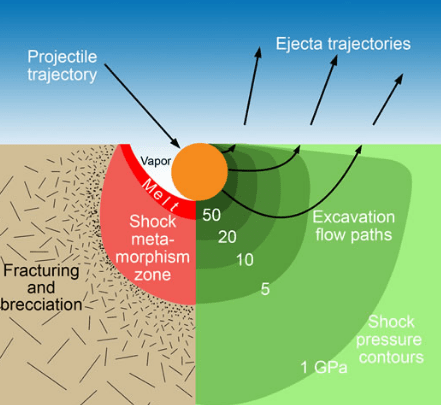
Impact or Shock metamorphism
- Impact metamorphism occurs at meteorite (or other bolide) impact craters.
- Ultra high pressure condition is generated due to this metamorphism.
- Formation of SiO2 polymorphs such as coesite and stishovite.
The progressive nature of metamorphism
- The term prograde refers to an increase in metamorphic grade with time as a rock is subjected to gradually more severe metamorphic conditions.
- Prograde metamorphism refers to the changes in a rock that accompany increasing metamorphic grade.
- Retrograde refers to decreasing grade as a body of rock cools and recovers from a metamorphic or igneous event, and retrograde metamorphism describes any accompanying changes.
- Progressive metamorphism expresses the idealized view that a rock at a high metamorphic grade progressed through a sequence of mineral assemblages as it passed through all of the mineral changes necessary to maintain equilibrium with increasing temperature and pressure, rather than hopping directly from an unmetamorphosed rock to the metamorphic rock that we find today.
- Strong evidence for the progressive nature of metamorphic rocks comes from textural studies in which metastable relics of lower-grade minerals are found only partly reacted to the higher-grade mineral assemblage. Thus the prograde reaction did not run to completion, perhaps for kinetic reasons.
- The zonal distribution of metamorphic rock types preserved in a geographic sequence of increased metamorphic grade suggests that each rock preserves the conditions of the maximum metamorphic grade (temperature) experienced by that rock during metamorphism.
- It follows that retrograde metamorphism is of only minor significance, and is usually detectable by observing textures, such as the incipient replacement of high-grade minerals by low-grade ones at their rims.
- Prograde metamorphic reactions are generally endothermic (they consume heat), and the heat supplied to progressive metamorphic rocks should quickly drive the reactions, particularly the common dehydration and decarbonation reactions that have large volume and enthalpy changes.
- Retrograde reactions are exothermic, and there is little force to drive them as the rocks cool, nor is a fluid available to facilitate the requisite elemental redistribution.
- Rehydration and re-carbonation requires infiltration of metamorphic fluids back into rocks from which they have been released. This is not as easy as driving them out in the first place.
- Although the mineralogy and texture of metamorphic rocks typically reflects the maximum grade attained, the composition of the minerals may not always do so.
- The technique of geothermobarometry uses the temperature (and in some cases pressure) dependence of metamorphic reactions between coexisting minerals to estimate the T and P conditions of metamorphism.
- Although the mineralogy and texture of metamorphic rocks typically reflects the maximum grade attained, the composition of the minerals may not always do so.
- The technique of geothermobarometry uses the temperature (and in some cases pressure) dependence of metamorphic reactions between coexisting minerals to estimate the T and P conditions of metamorphism.
Types of protolith
- The initial chemical composition of a rock profoundly affects the mineralogy of its metamorphic offspring.
- When we study metamorphic rocks, it is important to keep the “parental” rock type in mind.
- From a metamorphic point of view, the chemical composition of the protolith is the most important clue toward deducing the parent.
- We can group the common types of sedimentary and igneous rocks into six broad compositionally based groups:
- Ultramafic rocks: Mantle rocks, komatiites, and cumulates. Very high Mg, Fe, Ni, and Cr.
- Mafic rocks: Basalts, gabbros, and some graywackes. High Fe, Mg, and Ca.
- Shales and mudstones (or pelitic rocks): The most common sediment. Fine grained clastic clays, muds, and silts deposited in stable platforms or offshore wedges. High Al, K, and Si.
- Carbonates (or calcareous rocks): Mostly sedimentary limestones and dolostones. High Ca, Mg, and CO2. Impure carbonates (marls) may contain sand or shale components.
- Quartz rocks: Cherts are oceanic, and sands are moderately high-energy continental clastics. Nearly pure SiO2.
- Quartzo-feldspathic rocks: Arkose or granitoid and rhyolitic rocks. High Si, Na, K, and Al.
- One gradational rock type that is fairly common is a sand–shale mixture (called psammitic).
Some examples of metamorphism
- The goal of practicing metamorphic petrology is to understand the physical conditions (temperature, pressure, Xrock, Xfluid, etc.) and processes involved in metamorphism, including recrystallization, formation of metamorphic minerals, deformation, and metasomatism.
Orogenic Regional Metamorphism of the Scottish Highlands
- George Barrow made one of the first systematic studies of the variation in rock types and mineral assemblages with progressive metamorphism.
- Metamorphism and deformation in the south-eastern Highlands of Scotland occurred during the Caledonian orogeny, which reached its maximum intensity about 500 Ma ago.
- It was intense, and the rocks were folded and thrust into a series of nappes.
- Barrow noted significant and systematic mineralogical changes in the pelitic rocks (originally shales).
- He found that he could subdivide the area into a series of metamorphic zones each based on the appearance of a new mineral in the metamorphosed pelitic rocks as metamorphic grade increased.
- The new mineral that characterizes any particular zone is termed an index mineral. The sequence of zones are:
- Chlorite zone.
- Biotite zone.
- Garnet zone.
- Staurolite zone.
- Kyanite zone.
- Sillimanite zone

- This sequence of mineral zones has been recognized in other orogenic belts in the world, the zones are commonly referred to as the Barrovian zones.
- The P-T conditions represented are also referred to as Barrovian-type metamorphism, then, was intended to indicate a line in the field of constant metamorphic grade.
- An isograd represents the first appearance of a particular metamorphic index mineral in the field as one progresses up metamorphic grade.
- When one crosses an isograd, such as the biotite isograd, one enters the biotite zone.
- Zones thus have the same name as the isograd that forms its low-grade boundary.
- The Barrovian sequence of zones has been recognized in orogenic terranes worldwide. It serves as a good way of comparing the metamorphic grade from one area to another.
- Subdividing metamorphic assemblages into broader categories called metamorphic facies is another way to do this.
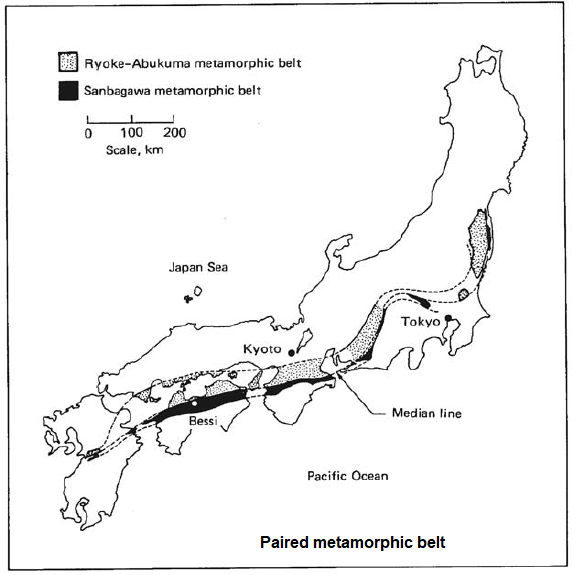
Paired Orogenic Metamorphic Belts of Japan
- A pair of parallel metamorphic belts are exposed parallel to the active subduction zone.
- These belts have different metamorphic signatures but are of the same age, suggesting that they developed together.
- The northwestern belt (“inner” belt,) is the Ryoke (or Abukuma) Belt.
- It is a low P/T type of regional orogenic metamorphism.
- The dominant rocks are meta-pelitic sediments, and isograds up to the sillimanite zone have been mapped.
- Outer belt, called the Sanbagawa Belt.
- This belt is composed of late Paleozoic volcanic/sedimentary filling with the metamorphic grade increasing toward the northwest.
- It is of a high-pressure/ low-temperature nature compared to the Ryoke belt.
- Only the garnet zone is reached in the pelitic rocks.
- Basic rocks are more common than in the Ryoke belt and glaucophane is developed.
- The presence of glaucophane is characteristic of most high-pressure/low temperature metamorphics and imparts a distinct blue color to the rocks. As a result, the rocks are commonly called blueschists.
- The two belts are separated along their whole length by a major fault zone called the Median Line.
- The paired nature of the Ryoke–Sanbagawa belts and suggested that the occurrence of coeval metamorphic belts, an outer, high- P/T belt, and an inner, lower-P/T belt ought to be a common occurrence in a number of subduction zones, either contemporary or ancient (Figure 6).
- He called these paired metamorphic belts and proposed several examples in addition to Japan.
- Paired belts may be separated by 100 to 200 km of less-metamorphosed and less-deformed material (the “arc–trench gap”) or closely juxtaposed.