
Agents of Metamorphism
Agents of Metamorphism
Introduction
- The process of metamorphism occurs when the rock is exposed to various physical or chemical environments and the metamorphosed rock is totally different from its parent rock.
- The reacting phases in a rock are solids (minerals and amorphous solids such as glass, organics, etc.) and commonly a pore fluid, including the dissolved material in that fluid.
- The various factors or agents which initiates and affects the metamorphism in a rock are-
- Temperature
- Pressure
- Pore fluids and the nature of the fluid phase, and
- State of stress.
Temperature
- The most common cause of metamorphism is changes in temperature.
- Geothermal gradient is the relationship between temperatures with depth.
- Continental geotherm in the depth range of the typical mid- to lower continental crust is considerably lower than the oceanic one. The main reason for this is due to the large thickness of the continental crust.
- High temperature causes promotes recrystallization, which generally results in increased grain size. The reason is fine aggregates tend to coalesce into larger grains.
- Increase in temperature is responsible for devolatilization reactions (usually dehydration or decarbonation reactions).
- In the 10-40 km depth range of continental crust the continental geotherm is significantly lower than the oceanic one.
- Increasing temperature has several effects on sedimentary or volcanic rocks.
- First, increasing temperature promotes recrystallization, which generally results in increased grain size.
- This effect is particularly true for fine-grained rocks, especially in a static environment because shear stresses typically act to reduce grain size.
- Clays, tuffs, fine-grained clastic sediments, and some chemical precipitates are composed of very small grains.
- Increasing temperature will eventually overcome kinetic barriers to recrystallization, and these fine aggregates tend to coalesce into larger grains.
- Theoretically a single huge grain of each mineral present is the most stable configuration for a rock, but there are limits to the extent to which constituents can migrate by diffusion to growing grains.
- Second, rocks being heated may eventually reach a temperature at which a particular mineral is no longer stable or a group of minerals is no longer stable together.
- When the physical conditions are outside the stability range of some mineral assemblage, a reaction will take place that consumes unstable mineral(s) and produces new minerals that are stable under the newly achieved conditions.
- A number of different types of reactions involving minerals may occur with increasing temperature.
- Among the most common are devolatilization reactions (usually dehydration or decarbonation reactions).
- As a general rule, volatile- bearing minerals (such as hydrous minerals and carbonates) tend to lose their volatiles as temperature rises.
- The more volatiles a mineral contains, the more susceptible it is to thermal decomposition.
- Very hydrous minerals, such as clay minerals, zeolites, chlorite, or serpentine, thus characterize diagenesis or low grades of metamorphism, and they are typically the first to dehydrate as temperature rises.
- All volatile-bearing minerals have an upper temperature stability limit, and very high grades of metamorphism are typically characterized by a volatile-free mineral assemblage.
- A third effect of increased temperature is that it overcomes kinetic barriers that might otherwise preclude the attainment of equilibrium.
- Low temperatures disequilibrium may thus be common, and we may find metastable materials or associations of minerals that would otherwise be unstable together.
- At higher temperatures, however, reaction and diffusion rates increase to the extent that equilibrium is much more likely.
Pressure
- Rocks are generally metamorphosed at depth within the Earth where temperatures are high.
- This cannot happen, of course, unless pressure increases also.
- The increase in pressure with depth is due to the weight of overlying rocks, and is called lithostatic pressure (also called confining pressure).
- The lithostatic pressure is equal in all directions and applied on the rocks which cause their formation.
- It is responsible for the change in the rock’s shape and finally deformation.
- Deviatoric Stress: The pressure is unequal in all the directions and cause the rock to deform. It has been classified into-
- The maximum principal stress
- An intermediate principal stress
- Minimum principal stress.
- It occurs most commonly in orogenic belts, extending rifts, or in shear zones (i.e., generally at or near plate boundaries).
- The relationship between depth and temperature is the geothermal gradient.
- Metamorphic grade is a convenient term that is commonly used to express the general increase in degree of metamorphism without specifying the exact relationship between temperature and pressure.
- We may thus refer to “high-grade” rocks or “low-grade” rocks from any area.
- There are pressure limits to the stability of minerals and mineral associations, just as there are temperature limits.
- Rocks experiencing changes in metamorphic grade along a high-pressure P-T path, can thus be expected to have different metamorphic mineral assemblages than rocks that follow a low-pressure P-T path.
- Temperature is the most important metamorphic agent in most cases.
- Pressure acts as a modifier.
- Temperature can increase along any number of pressure-varied paths.
- Along some of these paths pressure may be low, favouring the formation of low-density metamorphic minerals as temperature rises.
- Alternatively, pressure may be high, and dense minerals tend to occur instead.
- Lithostatic pressure is generally considered to be equal in all directions (hydrostatic), we assume this to be the case for many metamorphic environments.
- If not, and the pressure in one direction were significantly greater than in another direction, the rock would yield until the motion offset the pressure difference.
- Such deformation occurs when the pressure differential exceeds a material’s strength, rocks under lithostatic conditions, regardless of the pressure, will not change shape (i.e., deform).
- Pressure may cause a volume loss, but it will be uniform in all directions. This volume loss is facilitated by the formation of low volume (high-density) minerals, which is why high-pressure metamorphism favours dense minerals.
Deviatoric Stress
- Only when the pressure is unequal in various directions will a rock be deformed. Unequal pressure is usually called deviatoric stress (whereas lithostatic pressure is uniform stress).
- We can envision deviatoric stress as being resolvable into three mutually perpendicular stress (σ) components: σ1 is the maximum principal stress, σ2is an intermediate principal stress, and σ3 is the minimum principal stress.
- Deviatoric stress may be maintained as long as the application of the differential continues to be applied and keeps pace with any tendency of the rock to yield.
- The yielding of the rock is deformation, or strain.
- Stress, then, is an applied force acting on a rock (over a particular cross-sectional area), and strain is the response of the rock to an applied stress.
- Deviatoric stress affects the textures and structures in rocks but not the equilibrium mineral assemblage.
- Deformation may thus have a catalytic effect and eliminate metastable mineral associations in favour of stable ones.
- Deformation cannot, however, change the nature of the stable state itself.
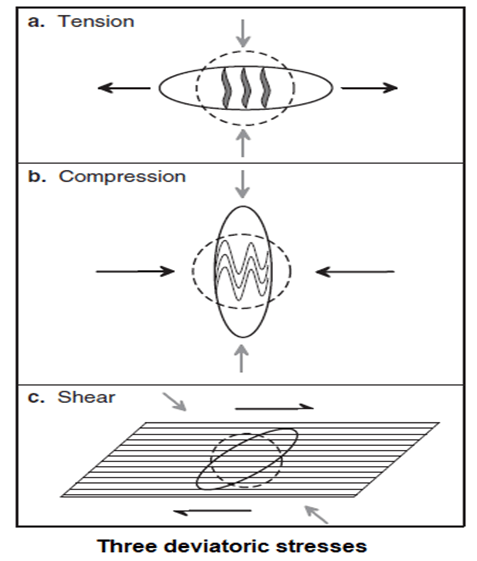
- Deviatoric stresses can be lumped into three principal conceptual types: tension, compression, and shear.
- In tension σ3 is negative, and the resulting strain is extension, or pulling apart.
- Tension can occur only at shallow depths, and the response is largely brittle faulting.
- A common result is the development of tension fractures,
- In compression one stress direction (σ1) is dominant, which may cause folding or a more homogeneous deformation called flattening.
- Existing minerals with a platy or elongated shape may be rotated during either folding or flattening.
- The platy minerals tend to become aligned normal to the principal compression direction.
- The general term for a planar texture or structure is called foliation.
- The term has no genetic implications and may include sedimentary bedding or igneous layering, etc.
- Any elongated minerals, such as amphiboles, in a rock experiencing this type of deformation will either rotate or grow so that their maximum elongation is parallel to the longest axis of the deformed ellipsoid.
- Lineation is the non-genetic term that refers to such a parallel alignment of elongated features.
- Shear is an alternative response to compression in which motion occurs along a set of planes at an angle to σ1, like pushing the top of a deck of cards.
Metamorphic Fluids
- When the rocks are metamorphosed they consist of intergranular fluid phase during their formation.
- Intergranular fluids such as water, hydrothermal fluid, residual magma fluids are responsible for the metamorphism.
- We use the term fluid to avoid specifying the exact physical nature of the phase.
- At low pressures, the fluid is either a liquid or a gas, but at pressures and temperatures above the critical point of water there is no difference between liquid and gas.
- Under conditions beyond the critical point (realized in most metamorphic regions) the non-solid phase is called a supercritical fluid. Some direct evidence comes from fluid inclusions.
- Other evidence for metamorphic intergranular fluids comes from theoretical considerations, such as the need for some H2O or CO2 pressure in order to stabilize observed hydrous and/or carbonate minerals in metamorphic rocks at the temperatures of metamorphism.
- Without such a fluid, these minerals would quickly devolatilize and disappear.
- In shallow porous rocks the fluid forms a continuous network extending to the Earth’s surface.
- The lithostatic pressure is exerted by the weight of the overlying minerals in mutual contact and is equal to ρminerals gh.
- The intergranular fluid is independently open to the surface, so the hydrostatic fluid pressure at the same depth is ρwater gh. Because water is less dense that the minerals Pfluid < Plith.
- Another common process pressure solution. the free energy of the mineral at the stressed mutual contacts is higher than it is adjacent to the pore spaces.
- The overall free energy of the system can thus be lowered by dissolving the mineral at the contacts and re-precipitating it in the pores.
- This also reduces the volume of the pore spaces and raises Pfluid until it reaches Plith.
- Intergranular metamorphic fluids are usually dominated by H2O, but CO2 may also be present in some rocks.
- When the fluid is composed of several volatile components, Pfluid indicates the total fluid pressure, which is the sum of the partial pressures of each volatile component (Pfluid = pH2O +pco2 +….).
- The motion of fluids may transport various chemical species over considerable distances.
- This is particularly true for fluids released by crystallizing plutons into the adjacent country rocks.
- If the physical or chemical nature of the rocks through which fluids pass differ markedly from that of the fluid entering, the fluid may exchange material with the new host rocks.
- When substantial chemical change accompanies metamorphism the process is called metasomatism.
- Metasomatism may involve fluid transport, or diffusion of constituents through minerals or intergranular fluids.
- We conclude that metamorphism commonly approximates an isochemical process, meaning that little is added, transported, or removed during metamorphism (except for volatiles like H2O and CO2, much of which escapes from heated and compressed sediments).
- Because it is impossible to measure the amount of fluid that was once present in rocks (or has infiltrated through), and because we expect the fluid phase to be relatively mobile, we ignore the volatile components when we say that a metamorphic rock was produced “isochemically.”
- Metamorphism is a response to changes in external parameters, and that in nature there are gradients in temperature, pressure, and fluid composition.
- As a result, we can expect there to be a zonation in the mineral assemblages constituting the rocks that equilibrate across an expanse of these gradients.