
Introduction to Metamorphism
Introduction to Metamorphism
- The Greek meaning of word Metamorphism comes from “change of form.”
- It is the changes in a rock’s mineralogy, texture, and/or composition that occur predominantly in the solid state under conditions between those of digenesis and large-scale melting.
- Digenesis stops where the metamorphism to be the dominant process taking place throughout most of the Earth’s crust and mantle.
- When rocks or melts are transported or exposed to conditions unlike those under which they initially formed, they react in response to those new conditions broad range of conditions (representing igneous crystallization and surficial weathering) is the realm of metamorphism.
- Metamorphism refers to changes in a rock’s mineralogy, texture, and/or composition that occur predominantly in the solid state under conditions between those of diagenesis and large-scale melting.
- Given that weathering and diagenesis occur only in the thin uppermost veneer of sediments and that melting is an exceptional process with respect to normal geotherms, we may expect metamorphism to be the dominant process taking place throughout most of the Earth’s crust and mantle.
The limits of Metamorphism
- At the low end, the processes involved in weathering and diagenesis are largely the same as those that occur in metamorphism.
- Diagenesis comprises all of the chemical, physical, and biological changes that a sediment undergoes during and after lithification in the near surface environment.
- the temperature at which recrystallization or new mineral formation takes place depends strongly on the initial material (called protolith).
- Because mineral transformations may occur at practically any point following deposition and burial, we must decide on some type of standard, however arbitrary, to distinguish metamorphism from diagenesis.
- There is a general consensus that metamorphism begins in the range of 100 to 150 for the more unstable types of protolith and may be marked by the formation of minerals such as laumontite, analcime, heulandite, carpholite, paragonite, prehnite, pumpellyite, lawsonite, glaucophane, or stilpnomelane.
- At the high-temperature end, we encounter similar problems in distinguishing metamorphic and igneous processes.
- The pressure limits of metamorphism are also fairly broad. At low pressures, an abnormally high geothermal gradient may be required to heat rocks sufficiently to initiate metamorphism.
- Substantially metamorphosed rocks can be generated near the contact of shallow intrusions very near the Earth’s surface.
- At the high-pressure end, solid rocks extend through the mantle and occur again in the solid inner core.
- With the above reservations in mind, the IUGS proposed the following definition of metamorphism:
- Metamorphism: a process involving changes in the mineral content/composition and/or microstructure of a rock, dominantly in the solid state. This process is mainly due to an adjustment of the rock to physical conditions that differ from those under which the rock originally formed and that also differ from the physical conditions normally occurring at the surface of the Earth and in the zone of diagenesis. The process may coexist with partial melting and may also involve changes in the bulk chemical composition of the rock.
- Other conventional boundaries of metamorphic petrology are that it does not generally include the study of coal, petroleum, or ore deposits. These fields are left to specialists even though the processes involved in their evolution are typically of a metamorphic nature.
Classification of Metamorphic Rocks
Metamorphic rocks are classified on the basis of texture and composition (either mineralogical or chemical).

Foliated and lineated rocks
- Foliation and lineation refer to planar and linear fabric elements, respectively, in a rock and have no genetic connotations.
- Some high-strain rocks may also be foliated, but, these are treated separately.
- Foliations in non-high-strain rocks are caused by orogeny and regional metamorphism, and the type of foliation varies with metamorphic grade.
In order of increasing grade, they are:
- Cleavage. the property of a rock to split along a regular set of subparallel, closely spaced planes. consider cleavage to be any type of foliation in which the aligned platy phyllosilicates are too fine grained to see individually with the unaided eye.
- Schistosity. A preferred orientation (DPO) of inequaint mineral grains or grain aggregates produced by metamorphic processes. Aligned minerals are coarse grained enough to see with the unaided eye.
- Gneissose structure. Either a poorly developed schistosity or segregation into layers by metamorphic processes. generally coarse grained.
Rock names that follow from these textures:
- Slate. compact, very fine-grained, metamorphic rock with a well-developed cleavage.
- Phyllite. A rock with a schistosity in which very fine phyllosilicates (sericite/phengite and/or chlorite), although rarely coarse enough to see unaided, impart a silky sheen to the foliation surface.
- Schist. A metamorphic rock exhibiting a schistosity.
- Gneiss. A metamorphic rock displaying gneissose structure. Gneisses are typically layered with alternating felsic and darker mineral layers.

Non-foliated and non-lineated rocks
- Granofels: A granular medium- to coarse-grained granoblastic metamorphic rock with little or no foliation or lineation.
- Granofels(ic) texture is then a texture characterized by a lack of preferred orientation.
- Hornfels is a type of granofels that is typically very fine grained and compact, and it occurs in contact aureoles.
Specific metamorphic rock types
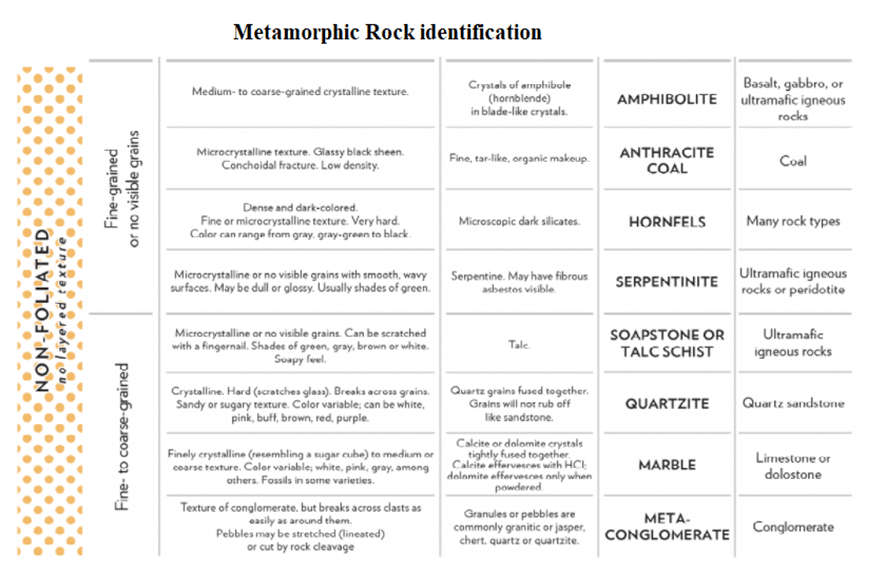
- It is also proper to name a metamorphic rock by adding the prefix meta- to a term that indicates the protolith, such as metapelite, meta-ironstone, etc.
- Marble: A metamorphic rock composed predominantly of calcite or dolomite. The protolith is typically limestone or dolostone.
- Quartzite: A metamorphic rock composed predominantly of quartz. The protolith is typically sandstone.
- Greenschist/greenstone: A low-grade metamorphic rock that typically contains chlorite, actinolite, epidote, and albite.
- Such a rock is called greenschist if foliated and greenstone if not. The protolith is either a mafic igneous rock or graywacke.
- Amphibolite: A metamorphic rock dominated by hornblende plagioclase.
- Serpentinite: An ultramafic rock metamorphosed at low grade.
- Blueschist: A blue-amphibole-bearing metamorphosed mafic igneous rock or mafic graywacke. Glaucophane is the most common blue amphibole.
- Eclogite: A green and red metamorphic rock that contains clinopyroxene and garnet. The protolith is typically basaltic.
- Calc-silicate rock (granofels or schist): A rock composed of various Ca-Mg-Fe-Al silicate minerals, protolith is typically a limestone or dolostone with silica.
- Skarn: A calc-silicate rock formed by contact metamorphism and silica metasomatism from a pluton into an adjacent carbonate rock.
- Granulite: A high-grade rock of pelitic, mafic, or quartzo-feldspathic parentage that is predominantly composed of OH-free minerals.
- Migmatite: A composite silicate rock that is heterogeneous on the 1- to 10- cm scale, commonly having a dark gneissic matrix (melanosome) and lighter felsic portions (leucosome).
Additional modifying terms
- The main purpose of naming a rock is to impart information about the nature of the rock to others.
- So, we can add modifying terms.
- For example, if we want to emphasize some structural aspect of the rock, we may add terms such as lineated, layered, banded, or folded.
- Porphyroblastic means that a metamorphic rock has one or more metamorphic minerals that grew much larger than the others.
- Each individual crystal is a porphyroblast. E.g., kyanite porphyroblast schist.
- Some gneisses have large eye-shaped grains (commonly feldspar) that are derived from preexisting large crystals by shear.
- Individual grains of this sort are called auge and plural is augen. An augen gneiss is a gneiss with augen structure.
- Two common prefixes that pertain to protolith are the terms ortho- and para-. Ortho- indicates an igneous parent, and para- indicates a sedimentary parent.
High-strain rocks
- To name a high-strain rock, one must determine whether the rock is cohesive or whether it falls apart and then estimate the relative proportions of large clasts versus fine matrix.
- A rock without cohesion is either a fault breccia or fault gouge.
- Cohesive rocks are further distinguished by being either foliated or non-foliated.
- Non-foliated cohesive rocks are either microbreccias (< 70% clasts) or cataclasites (>70% clasts).
- Foliated cohesive rocks are mylonites and are subdivided.
- Virtually all high-strain processes involve grain size reduction.
- The degree of recrystallization in the matrix is not a factor unless it is very advanced.
- The prefix blasto- is then added, meaning that the mylonitic texture is still apparent but largely inherited from an earlier high-strain event. The prefix blasto- is usually restricted to foliated.
- In extreme cases of high-strain deformation, thin, anastomosing seams of glassy rock, known as pseudotachylite are generated. The glass is attributed to melting due to frictional heat.
- The term cataclasis, refers to a process of mechanical crushing and granulation of a rock and its mineral constituents.
- Impact rocks are a separate category of high-strain rocks and do not really lend themselves to classification.
- Impacts are catastrophic events, producing shock waves and raising the temperature at impact to thousands of degrees, melting (and even vaporizing) some minerals.
- The rocks can all be called impactites.
- All impactites are breccias and have characteristic field settings and textural features, such as shocked crystals (highly deformed lattices) and amorphous glassy phases.
- High-pressure silica polymorphs, such as coesite and stishovite, may be present.