
Sedimentary Facies and Provenance
Sedimentary Facies and Provenance
11.1 Sedimentary Facies
Introduction
- Sedimentary facies are bodies of sediment that are recognizably distinct from adjacent sediments that resulted from different depositional environments.
- In geology, a facies is a body of rock with specified characteristics, which can be any observable attribute of rocks and the changes that may occur in those attributes over a geographic area.
- It is the sum total characteristics of a rock including its chemical, physical, and biological features that distinguishes it from adjacent rock.
- Specified characteristics include the overall appearance, composition, or condition of formation.
- The term facies was introduced by the Swiss geologist Amanz Gressly in 1838 and was part of his significant contribution to the foundations of modern stratigraphy.
Types
- Terrigenous facies: resulting from the accumulation of particles eroded from older rocks and transported to the depositional site.
- Biogenic facies: representing accumulations of whole or fragmented shells and other hard parts of organisms.
- Chemical facies: representing inorganic precipitation of material from solution.
- Lithofacies: Facies based on petrological characters (such as grain size and mineralogy) are called Lithofacies. Ex.- Grey limestone rock
- Biofacies: Facies based on fossil content are called Biofacies. Ex.- Echinoid and crinoids
- Ichnofacies: A study that focuses on the trace fossils in the rock would be a description of the Ichnofacies. Ex.- Burrows and tracks
- Each facies has a three-dimensional configuration and may in time shift its position.
Lithofacies

- Each lithofacies represents an individual depositional event. Lithofacies may be grouped into lithofacies associations or assemblages, which are characteristic of particular depositional environments.
- These assemblages form the basis for defining lithofacies models; they commonly are cyclic.
- These units may be single beds a few millimeters thick or a succession of beds tens to hundreds of meters thick.
- For example, a river deposit may consist of decimeter-thick beds of a conglomerate lithofacies interbedded with a cross-bedded sandstone facies.
- A biofacies is defined on the basis of fossil components, including either body fossils or trace fossils. The term biofacies is normally used in the sense of an assemblage of such components.
- The biofacies terms used to describe the fill of many major early Paleozoic basins. Commonly, this may be divided into units hundreds of meters thick comprising a shelly biofacies, containing such fossils as brachiopods and trilobites, and a graptolitic biofacies.
The concept of Sedimentary Facies
- Fluctuations in sea level are caused by things such as changes in the size of the polar ice caps, due to climatic changes.
- Melting of ice caps leads to sea level rise (transgression) - it has been calculated that complete melting of the Antarctic Ice Sheet would cause a sea level rise of 60 - 70 meters (200 feet).
- Growth of ice caps leads to drop in sea level (regression) - calculations show that sea level was as much as 100 meters (300 feet) lower than at present at the height of the last Ice Age glaciation.
- Much of the Continental Shelf area would have been exposed and dry.
- Rate of sea floor spreading - during times of rapid sea floor spreading and submarine volcanism, the ocean ridge system is enlarged by the addition of lava, displacing water onto the edges of the continents (transgression).
- Localized subsidence or uplift of the land: In the 8000 - 10,000 years since the melting of the last glacial ice sheet over North America, parts of Canada have risen due to isostatic uplift by up to 300 meters.
- Lithostratigraphy and lithofacies analysis are two contrasting approaches to the study of sedimentary rocks.
- The first is the traditional descriptive approach. The second is based on detailed facies descriptions, which provide the basis for the genetic study of sediments using facies models.
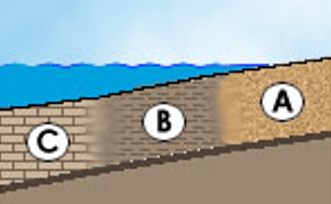
In this figure,
- A = Sandstone facies (beach environment)
- B = Shale facies (offshore marine environment)
- C = Limestone facies (far from sources of terrigenous input)
- Each depositional environment grades laterally into other environments. It is known as facies change when dealing with the rock record.
Sedimentary (litho) facies
- Lithostratigraphic Units (time independent)
- Defined by sum total of (relevant) rock properties
- Reflects processes during genesis and may include
- Lithology
- Sedimentary Structures
- Fossils
- Bedding style and geometry (on various scales)
- Paleo-sediment transport indicators
Walther's Law of Facies
- The vertical succession of facies reflects lateral changes in environment. Conversely, it states that when a depositional environment "migrates" laterally, sediments of one depositional environment come to lie on top of another.
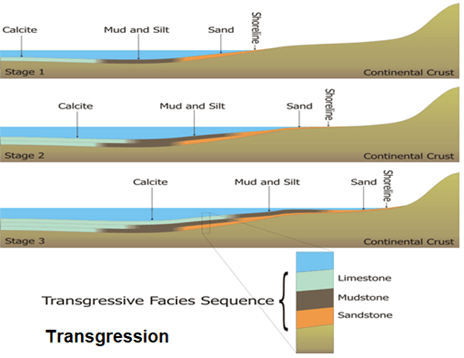
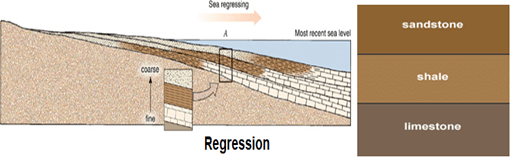
- A classic example of this law is the vertical stratigraphic succession that typifies marine transgressions and regressions.
- It was proposed by the geologist Johannes Walther (1860-1937).
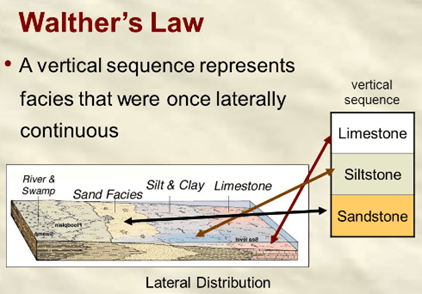
Transgressive sequence
- Deeper water facies overlie shallow water facies.
- A "deepening upward" sequence.
Regressive sequence
- Shallow water facies overlie deeper water facies.
- A "shallowing upward" sequence.
Facies Analysis
- The facies concept is not just a convenient means of describing rocks and grouping sedimentary rocks seen in the field, it also forms the basis for facies analysis.
- By interpreting the sediment in terms of the physical, chemical and ecological conditions at the time of deposition it becomes possible to reconstruct paleo-environments, i.e. environments of the past.
- So, from the presence of symmetrical ripple structures in a fine sandstone it can be deduced that the bed was formed under shallow water with wind over the surface of the water creating waves that stirred the sand to form symmetrical wave ripples.
- The ‘shallow water’ interpretation is made because wave ripples do not form in deep water but the presence of ripples alone does not indicate whether the water was in a lake, lagoon or shallow-marine shelf environment.
- The facies should therefore be referred to as ‘symmetrically rippled sandstone’ or perhaps ‘wave rippled sandstone’, but not ‘lacustrine sandstone’ because further information is required before that interpretation can be made.

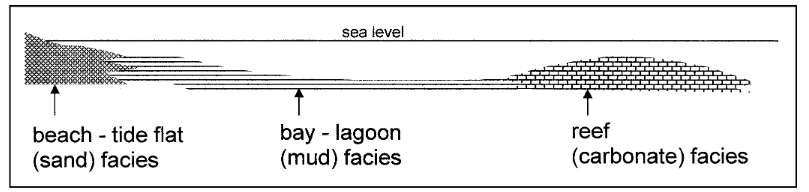
- Beach and tide flat facies (combined).
- A marine or near-shore portion of a continental shelf, and
- An offshore carbonate platform or reef.
- The beach and tide flat facies sediments are mostly sand, the bay facies is mostly mud, and the reef facies is mostly shells and corals which are made of carbonate minerals.
- If these sediments are buried and lithified into sedimentary rocks, the beach sands turn into sandstone, the bay mud turns into shale, and the reef sediments turn into limestone.
11.2 Sediment provenance
Introduction
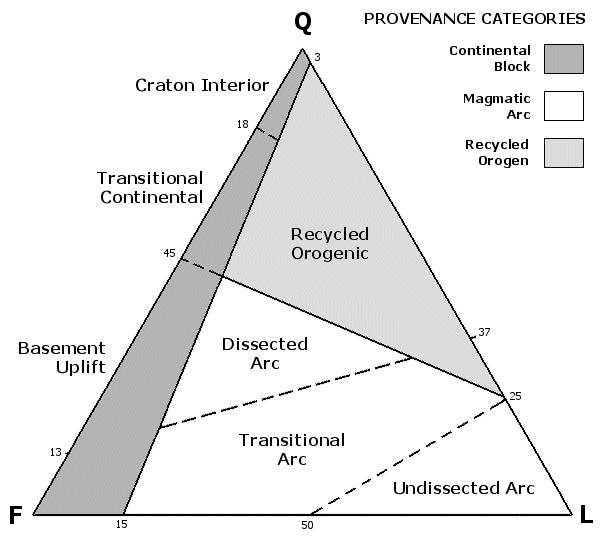
- Provenance is the place of origin or earliest known history of something. In sedimentary petrology, the term provenance deals with the question where sediments originate from.
- Sediment provenance refers to the application of compositional analyses to determine the origin of sediments.
- This is often used in conjunction with the study of exhumation histories, interpretation of drainage networks and their evolution, and forward-modelling of paleo-earth systems.
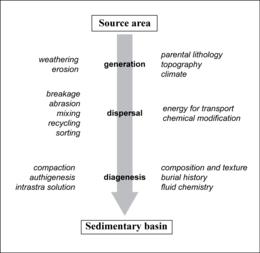
- The ultimate goal of provenance studies is to investigate the characteristics of a source area by analyzing the composition and texture of sediments.
- The rocks are subjected to transition during the rock cycle between the three main rock types: sedimentary, metamorphic, and igneous rocks. Rocks exposed to the surface are sooner or later broken down into sediments. Sediments are expected to be able to provide evidence of the erosional history of their parent source rocks. The purpose of provenance study is to restore the tectonic, paleo-geographic and paleo-climatic history.
Aspects
The studies of provenance involve the following aspects-
- The sources of the particles that make up the rocks,
- The erosion and transport mechanisms that moved the particles from source areas to depositional sites,
- The depositional setting and depositional processes responsible for sedimentation of the particles (the depositional environment), and
- The physical and chemical conditions of the burial environment and diagenetic changes that occur in siliciclastic sediment during burial and uplift".
Aspects
The studies of provenance involve the following aspects-
- The sources of the particles that make up the rocks,
- The erosion and transport mechanisms that moved the particles from source areas to depositional sites,
- The depositional setting and depositional processes responsible for sedimentation of the particles (the depositional environment), and
- The physical and chemical conditions of the burial environment and diagenetic changes that occur in siliciclastic sediment during burial and uplift".