Sedimentary structures and their significance
PYQs: Sedimentary structures and their significance
- What are sedimentary structures? Describe the sedimentary structures produced on top of the bedding plane. (IFS 2021, 15 Marks)
- Describe the genesis of any four sedimentary structures which have significance for palaeocurrent analysis. (2021/10 marks)
- Give a brief account of primary sedimentary structures and discuss their significance. (IFS 2020)
- What are ripple marks? Describe the different types of ripple marks and their geological significance.10-2019
- Illustrate with neat sketches primary sedimentary structures to sands from bed load transport. How such structures can be used for interpretation of depositional environments? (2018)
- Discuss with suitable diagrams- Types of sedimentary structures and their significance (2011)
- Enumerate and explain the formation of different types of sedimentary structures. Write an account on their significance. (2007)
- Describe the sedimentary structures & their significance (2006)
- In about 150 words, Describe the clastic sedimentary structures. (2006)
- Write on the following in about 150 words: Biogenic sedimentary structures. (2005)
- In about 150 words, answer: Sedimentary structures and their significance (2003)
- Explain: Primary sedimentary structures (2001)
- Describe important sedimentary structures and textures and their depositional significance. (1988)
- With neat sketches, describe the primary depositional sedimentary structures, with emphasis on their application in determining paleocurrent directions.
Introduction
- Sedimentary structures are large-scale features of sedimentary rocks, which show variety of significant geometries produced by the physical, chemical and biological processes, operating on sediments during and after their deposition. (Pettijohn, 1957; Potter and Pettijohn, 1964)
- They can be used to understand the sedimentary processes. E.g. fluid flow, sediment gravity flow, soft sediment deformation and biogenic activity. (Potter and Pettijohn, 1964; Brush, 1965).
- Sedimentary structures are tools for interpreting sediment transport mechanisms, paleocurrent flow directions, relative water depth and relative current velocity. (Pettijohn, 1957; Krumbein and Sloss, 1963; Brush, 1965; Reineck and Singh, 1980).
Formation of Sedimentary Structures
- A wide variety of structures are formed by physical, chemical, and biological processes during or shortly after deposition.
- Sedimentary structures include all kinds of features formed at the time of deposition.
- Sediments and sedimentary rocks are characterized by bedding, which occurs when layers of sediment, with different particle sizes are deposited on top of each other.
- Sedimentary structures are abundant in siliciclastic sedimentary rocks, but they occur also in non-siliciclastic sedimentary rocks such as limestones and evaporites. (Boggs, 2006)
Classification of Sedimentary Structures
(a) Primary sedimentary structures: These occur in clastic sediments, and produced by the same processes that caused deposition (currents, etc.).
- Pre-depositional sedimentary structures: Sole marks, Tool Marks, Flute Marks, Groove Marks.
- Syn-depositional (intrabed) structures: Bedding and lamination, Graded Bedding, Cross-Bedding, Ripples and Cross-Lamination, Flaser, lenticular and wavy beddings, Imbrication.
- Post-depositional sedimentary structures: Ball and Pillow structure, Load casts, Dish structure, Convolute bedding
- Miscellaneous structures: Rain Prints, Desiccation Cracks.
(b) Secondary sedimentary structures: These are caused by post-depositional processes, including biogenic, chemical, and mechanical disruption of sediment.
- Chemical sedimentary structures: Stylolites, Concretionary structures.
- Biogenic sedimentary structures: Stromatolites, Burrows and Borings, Casts and moulds.
Pre-depositional sedimentary structures
They were formed before the deposition of the overlying bed. They occur on surfaces between beds.
Sole marks
- Sole marks are sedimentary structures found on the bases of certain strata, that indicate small-scale (usually on the order of centimeters) grooves or irregularities.
- This usually occurs at the interface of two differing lithologies and/or grain sizes.


Tool marks
- Tool marks are a type of sole marking formed by grooves left in a bed by things like sticks being dragged along by a current.
- The average direction of these can be assumed to be the flow direction, though it is bidirectional, so it could be either way along the mark.

Flute marks
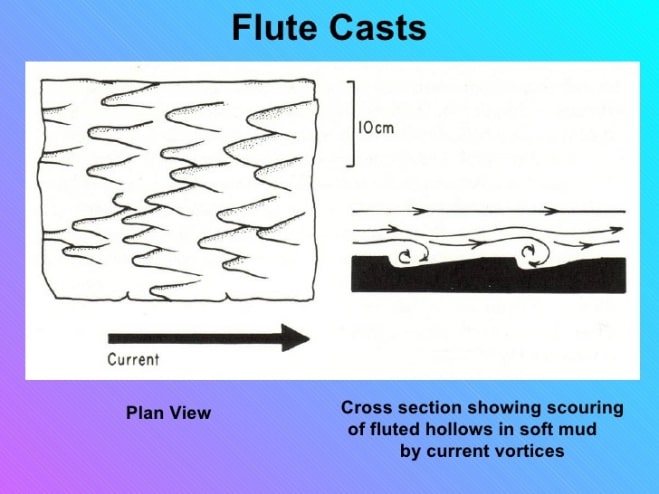
- A tongue-shaped scour cut into mud by a turbulent flow of water.
- The tongue is deepest at the up-current end and the flute can thus be used as a paleocurrent indicator.
- The rounded part of the flute is at the up current end. The flared end points are down current. Flutes are about 1-5 cm wide and 5-20 cm long.
- Flute marks are made by strong eddies (vortices) in the current. These scour the underlying mud deeply at first, but then weaken and widen as they move on down current.
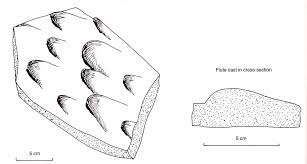
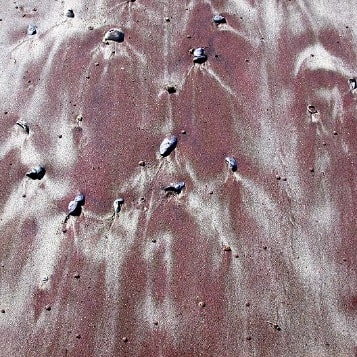
Fig: Flute marks
Groove marks
- Groove casts are straight parallel ridges that are raised a few millimeters from the bedding surface.
- These, like flutes, tend to be cut into mud and overlain by sand. They are long, thin, straight erosional marks.
- They are seldom more than a few millimeters deep or wide, but they may continue uninterrupted for a meter of more.
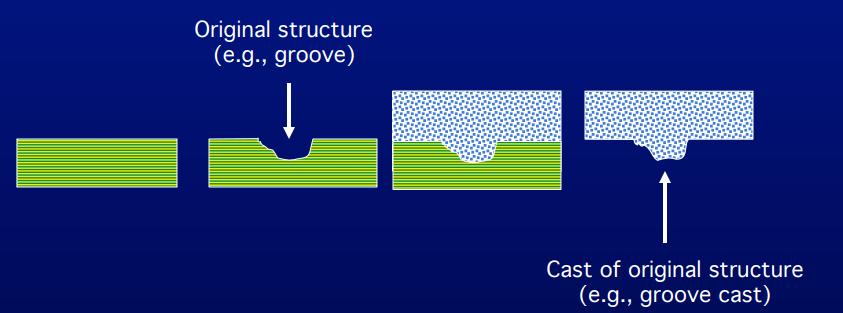
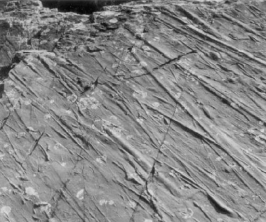
Fig: Groove marks under siliciclastic turbidity
Syn-depositional (Intrabed) Structures
- Syndepositional structures are those actually formed during sedimentation.
- They are therefore, essentially constructional structures that are present within sedimentary beds.
Bedding and lamination
- Bedding forms as a direct consequence of Steno's law of lateral continuity, that holds that a unit of sediment will extend laterally to the physical margins of the basin it is filling.
- Bedding is thicker than 1 cm.
- Bedding is due to vertical differences in lithology, grain size, or, more rarely, grain shape, packing, or orientation.
- Lamination is a small-scale sequence of fine layers (laminae; singular: lamina) that occurs in sedimentary rocks.
- Laminae are normally smaller and less pronounced than bedding.
- Lamination is often regarded as planar structures one centimeter or less in thickness, whereas bedding layers are greater than one centimeter.
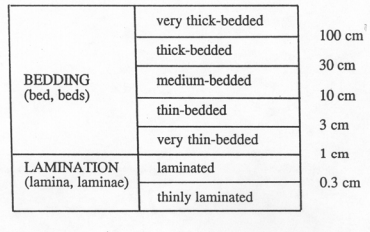
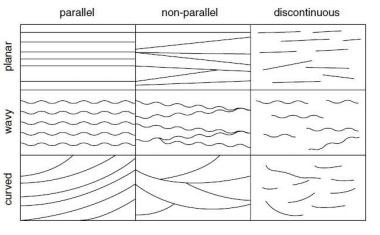
Fig.: Different types of bedding and laminations

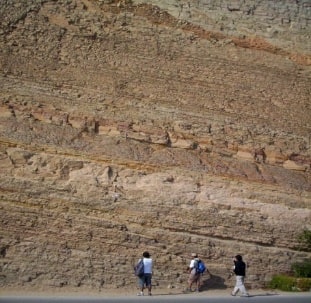
Fig: Bedding planes
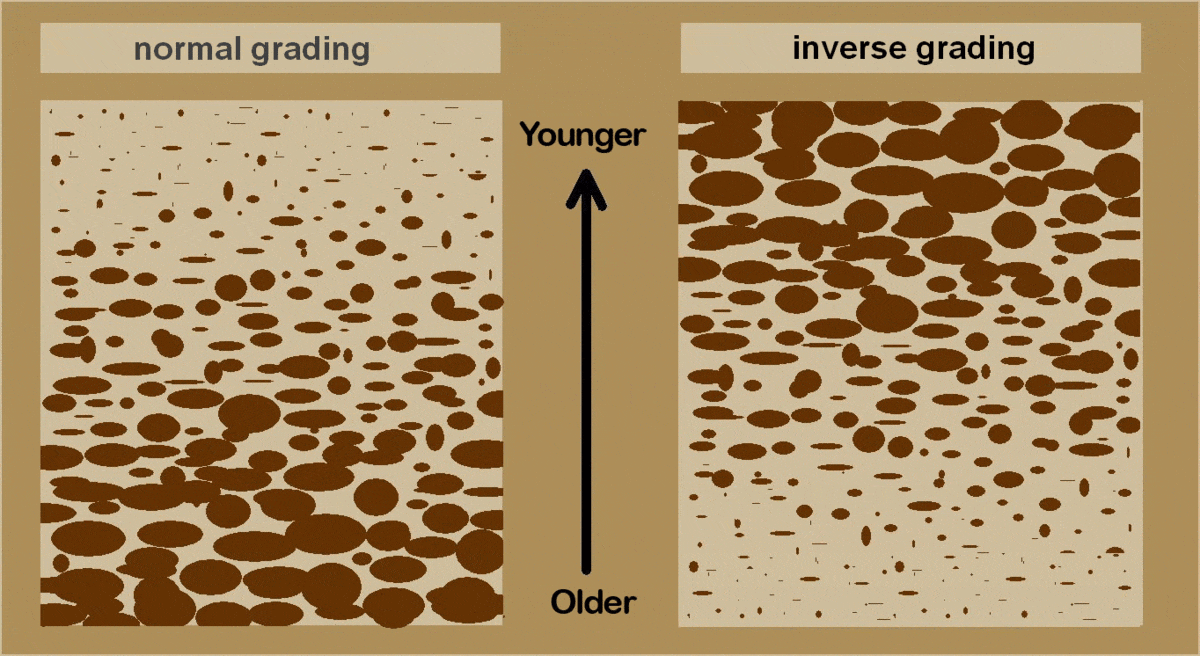
Graded Bedding
- Characterized by a systematic change in grain or clast size from one side of the bed to the other.
- Some beds have their largest particles at the base and gradually move toward the smallest ones at the top. Such beds are said to be normally graded.
- More rarely, others show the opposite pattern (small at base, coarse at top) and are said to be reversely graded.
Cross Bedding
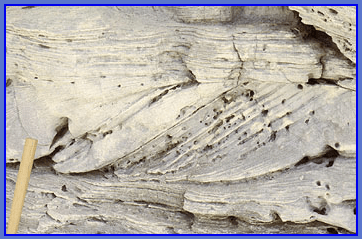
- Cross-beds are the groups of inclined layers, and the sloping layers are known as cross strata.
- Cross bedding forms on a sloping surface such as ripple marks and dunes, and allows us to interpret that the depositional environment was water or wind.
- Cross-bedding is widespread in three common sedimentary environments: rivers, tide-dominated coastal and marine settings.

Ripples and Cross-Lamination
Ripple Marks
- Ripple Marks are produced by flowing water or wave action, analogous to cross-bedding only on a smaller scale (individual layers are at most a few cm thick).
- Current ripple marks, unidirectional ripples, or asymmetrical ripple marks are asymmetrical in profile, with a gentle up-current slope and a steeper down-current slope.
- The down-current slope is the angle of repose, which depends on the shape of the sediment.
- These commonly form in fluvial and aeolian depositional environments, and are a signifier of the lower part of the Lower Flow Regime.
- Ripple marks are formed in sandy bottoms by oscillation waves, in which only the wave form advances rapidly, the actual water-particle motion consisting of almost closed vertical orbits that migrate landward only very slowly.
- Symmetrical ripples, also called oscillation or vortex ripples, are commonly produced in shallow water by the orbital motion of waves. In plain view they are markedly sub parallel, but occasionally bifurcate.
- Asymmetric ripples, by contrast to symmetric ones, show a clearly differentiated low angle stoss side and steep-angle lee side.

Fig: Ripple marks

Fig: Symmetrical ripple marks

Fig: Asymmetrical ripple marks
Cross lamination structures
- Cross lamination structures are commonly present in granular sedimentary rocks that consists of tabular, irregularly lenticular, or wedge-shaped bodies lying essentially parallel to the general stratification.
- These show a pronounced laminated structure in which the laminae are steeply inclined to the general bedding.

Fig: Climbing ripple cross lamination
Heterolithic bedding: Flaser, lenticular and wavy beddings
- The three main types of heterolithic bedding are flaser, wavy, and lenticular.
- Heterolithic bedding is a sedimentary structure made up of interbedded deposits of sand and mud.
- Heterolithic bedding forms in response to alternations in sediment supply and tidal velocity.
- The rippled sand layer is formed during high tidal currents, while the mud is deposited during slack tide periods.


Flaser beddings
- Flaser beds are a sedimentary, bi-directional, bedding pattern created when a sediment is exposed to intermittent flows, leading to alternating sand and mud layers.
- Flaser bedding is where cross-laminated sand contains mud streaks, usually in the ripple troughs.
- These are commonly forms in relatively high energy environments like sand flats, fluctuating flows (start/stop currents), and sand ripples. However, sometimes they are also created in turbiditic sediments reworked by contour currents (Rebesco, 2014).
- While flaser beds typically form in tidal environments, they can also form in fluvial conditions - on point bars or in ephemeral streams.
- Troughs of ripples are filled with mud during quieter flow periods.
- In contrast to Lenticular bedding which consists of large quantities of mud relative to sand, Flaser bedding is dominated by sand with small amounts of mud interspersed.
Wavy Bedding
- If mud and sand deposits are equal, wavy bedding is produced.
- Wavy bedding is commonly forms in environments that alternate frequently from higher to lower energies (mixed flats).
- It usually follows the alternating concave-convex nature of the ripples creating a wavy appearance.
- In wavy bedding the ripples are laterally discontinuous.
- Wavy bedding marks the boundary between flaser and lenticular bedding.
Lenticular Bedding
- Lenticular bedding displays alternating layers of mud and sand.
- The sand formations display a 'lens-like' shape, which gives the pattern the name – lenticular (lens like).
- They are commonly found in low-energy environments.
- Lenticular beddings are used to show evidence of tidal rhythm, tidal currents and tidal slack in a particular environment.
- In contrast to Lenticular bedding which consists of large quantities of mud relative to sand, Flaser bedding is dominated by sand with small amounts of mud interspersed.
- Formed during periods of slack water, mud suspended in the water is deposited on top of small formations of sand once the water's velocity has reached zero.[1][2]
|
Flaser beddings |
Wavy Bedding |
Lenticular Bedding |
|
Fluctuating flows (start/stop currents) |
Fluctuating flows (start/stop currents) |
Fluctuating flows (start/stop currents) |
|
More sand than mud. |
Equal amounts of sand and mud |
Less sand than mud. |
|
Sand ripples dominate.
|
Alternating layers of sand ripples and mud. |
Incomplete sand ripples completely covered with mud. |
|
Relatively strong currents favor sand deposits. |
Currents alternate between a relatively strong current followed by a calm period. Such environment does not favor sand or mud deposits. |
Calm environment favors mud deposits. There are calm periods with a few short strong currents. |
Imbrication
- Imbrication commonly occurs in water-lain gravels and conglomerates, and is characterized by discoid (flat) clasts consistently dipping upstream.
- An imbricate structure consists of a series of overlapping rock slices separated by steeply inclined subparallel reverse faults and bounded above and below by major low-angle thrust surfaces.


Post-depositional Sedimentary Structures
- These only form after sediment has been laid down.
Ball and Pillow structure
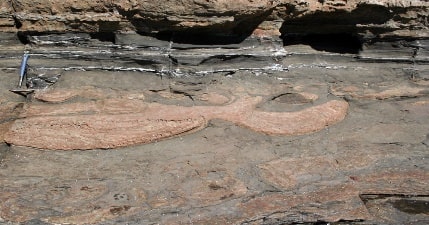
- As a result of loading, a bed, usually of sand, can sink into an underlying mud and break up into discrete masses, forming the so-called ball-and-pillow structure.
- Ball-and-pillow structures are masses of clastic sediment that take the form of isolated pillows or protruding ball structures.
- These soft-sediment deformations are usually found at the base of sandstone beds that are interbedded with mudstone.
- Ball-and-pillow deformations are a result of a physical shock that has been applied to unconsolidated sediment.
- Distinctive features of ball-and-pillow structure include: the pseudonodules are commonly contorted into spiral or zig zag shapes; there may be very little matrix between the pseudonodules; and some ball-and-pillow horizons are consistently underlain by convolute stratification and overlain by dish structure.

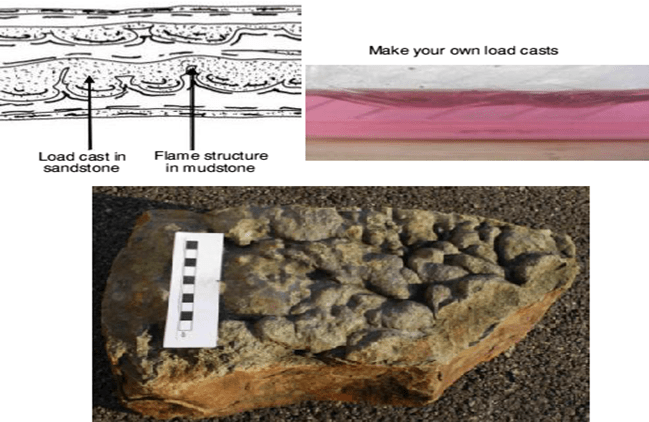
Load casts
- Load casts are bulges, lumps, and lobes that can form on the bedding planes that separate the layers of sedimentary rocks.
- The lumps "hang down" from the upper layer into the lower layer, and typically form with fairly equal spacing.
- Sole marking generally preserved on the lower side of the sand layer overlying the mud layer
- Often associated with turbidities with a thin layer of coarser sediment on the top.
- Can also be defined as a bulbous depression formed on the base of a bed of sediment.
- Developed by the differential sinking of the sediment, while still soft, into less dense sediment below.
- These features form during soft-sediment deformation shortly after sediment burial, before the sediments lithify.
- They can be created when a denser layer of sediment is deposited on top of a less-dense sediment.

Dish structure
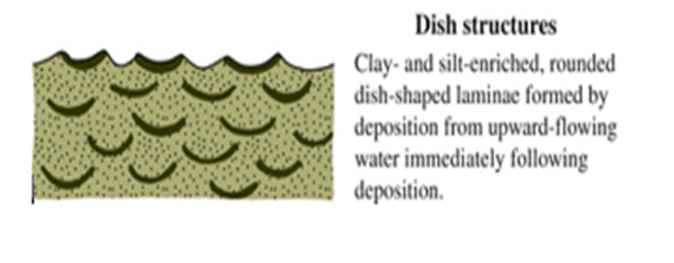
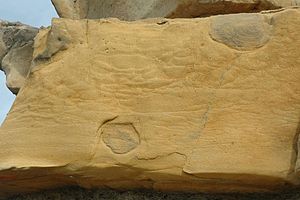
- These consist of concave-up laminae, generally a few centimeters across, which may be separated by structureless zones (the pillars).
- Dish structures and dish-and-pillar structures are formed by the lateral and upward passage of water through sediment.
- Dish structures are most commonly found in turbidities and other types of clastic deposits that result from subaqueous sediment gravity flows.
- Dish structure occurs in laterally extensive sheets. The medium in which the structure forms is usually coarse silt, but it also appears in all grades of sand.
Convolute bedding
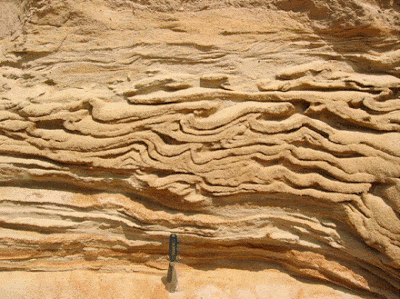
- Convolute bedding forms when complex folding and crumpling of beds or laminations occur.
- This type of deformation is found in fine or silty sands, and is usually confined to one rock layer.
- Convolute lamination is a common fold structure within turbidite beds, attributed to the deformation of sediment during or soon after deposition of the host bed.
- Convolute lamination occurs in intervals 2 to 10 cm thick, spanning the top of the very fine sand Bouma C division through the D division of interlaminated silt and clay.
- Convolute bedding occurs in both marine and nonmarine sediments of many environmental types.
- Convolutions are a fossil record of the forces (current action, loading, sudden regular releases of pressure) acting on a laminated bed during sedimentation. In addition to their origin and characteristics, their directional significance is also discussed.


Miscellaneous Structures
Rain Prints
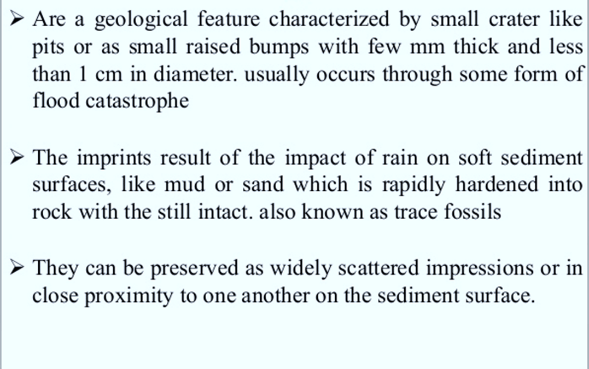
- Rain prints occur within siltstones and clay stones, and where such beds are overlain by very fine sandstones.
- In plan view, rain prints are circular or ovate if due to windblown rain.
- They are typically gregarious and closely spaced. Raised ridges are present around each print. Individual craters range from 2 to 10 mm in diameter.

Desiccation Cracks
- Desiccation structures originate as shrinkage cracks formed by the evaporation of water from the surface of clay-rich sediment.
- Previously called mud cracks, they are of subaerial origin, and are caused by the slow drying-out of muddy sediments which have been exposed to the action of sun and wind.
- The volume decrease that results from this loss of fluid gives rise to tensile stresses distributed equally in all directions within the bedding plane, that are relieved by the formation of a characteristic pattern of open polygonal cracks on the surface of the sediment.
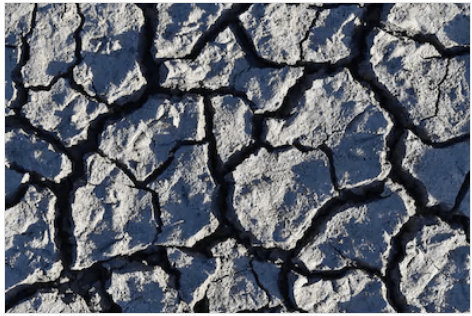
Fig.: Cracks in dry muds
Chemical Sedimentary Structures
Stylolites
- Stylolites are rough surfaces, formed by localized rock dissolution, and prevalent in carbonates and other sedimentary rocks.
- Stylolite, secondary (chemical) sedimentary structure consisting of a series of relatively small, alternating, interlocked, toothlike columns of stone; it is common in limestone, marble, and similar rock.
- The individual columns never appear singly but occur as a succession of interpenetrations that in cross section make a zigzag suture across the face of the stone.
- Stylolites are ubiquitous geo-patterns observed in rocks in the upper crust, from geological reservoirs in sedimentary rocks to deformation zones, in folds, faults, and shear zones.
- These rough surfaces play a major role in the dissolution of rocks around stressed contacts, the transport of dissolved material and the precipitation in surrounding pores.
- The presence of stylolites, with various amounts of clays along the interface, may control fluid flow in sedimentary formations.
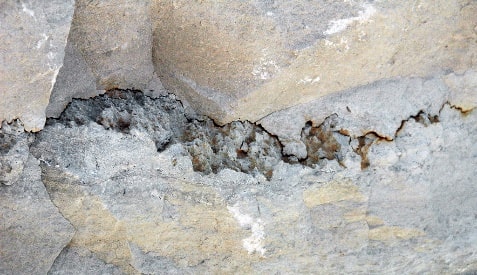
Fig.: Stylolite formation in limestone
Concretionary structures
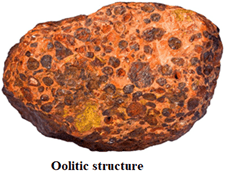
- Concretions consist of round or irregular masses of more resistant rock formed as a result of cement precipitating around a core material, usually a fossil or grain of a different composition.
- Oolitic Structures: Oolites are small (0.1-1mm), concentrically layered, spherical grains composed of primary carbonate materials or replacement phases.
- Pisolitic Structures: Individual size of a concretion is like that of a pea nut. Limestone and Bauxite shows both structures.

Biogenic Sedimentary Structures
Stromatolites
- Stromatolites are layered bio-chemical accretionary structures formed in shallow water by the trapping, binding and cementation of sedimentary grains by biofilms (microbial mats) of microorganisms, especially cyanobacteria.
- Stromatolites are very common in Precambrian carbonate successions, but they also occur in many Phanerozoic limestones, particularly those of peritidal origin.

Burrows and Borings
- The burrowing, boring, feeding, and locomotion activities of organisms can produce a variety of trails, depressions, and open burrows and borings in mud or semi consolidated sediment bottoms.
- Filling of these depressions and burrows with sediment of a different type or with different packing creates structures that may be either positive-relief features, such as trails on the base of overlying beds, or features that show up as burrow or bore fillings on the tops of the underlying mud bed.
- Burrows and borings commonly extend down into beds; therefore, these structures are not exclusively bedding-plane structures.
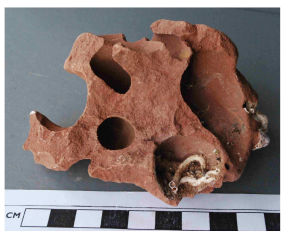
Fig.: Burrows and Borings
Casts and molds
- Any depression formed on the bottom of a body of water may become a mold for any sediment that later gets deposited into the depression. The body of sediment that takes on the shape of the mold is referred to as a cast.
- Most molds and casts do not contain the actual remains of an organism. Shells, bone, and wood often form as molds or casts. Some trace fossils (ichnofossils), such as tracks and burrows can form as casts or molds.