
Petrography and Depositional Environment of Sedimentary Rocks
Petrography and Depositional Environment of Sedimentary Rocks
PYQs: Petrography and depositional environment
- Discuss the depositional environment for carbonate rocks. (IFS 2021, 8 Marks)
- What are conglomerates? Describe their classification and geological significance. 20-2019
- Write explanatory notes on the following: (a) Petrography and Petrogenesis of Alkaline rocks. Give suitable Indian examples. (b) Migmatites: Their typos, petrographic characters and petrogenesis (2007)
- Write explanatory note: Ultramafic rocks in Ophiolite sequence. their petrography and petrogenesis. (2004)
- Write explanatory notes on the following: Give classification and describe petrography and petrogenesis of charnockites (2002)
- Write explanatory notes on the following: Petrography of feldspathic sandstones (2002)
- Describe briefly the following: Petrography and Petrogenesis of Charnockites of South India. (2001)
Introduction
- A depositional environment is a specific type of place in which sediments are deposited, such as a stream channel, a lake, or the bottom of the deep ocean. They are sometimes called sedimentary environments.
- The branch of science concerned with the composition and properties of rocks.
- Petrography is the most effective way of knowing the mineralogical and other constituents of the carbonate rocks.
(a) Clastic Sedimentary rocks
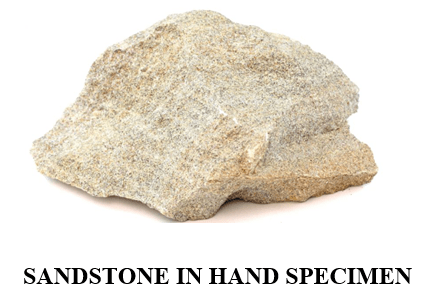
Sandstone
- Sandstone is a sedimentary rock composed of sand-size grains of mineral, rock, or organic material.
- It also contains a cementing material that binds the sand grains together and may contain a matrix of silt- or clay-size particles that occupy the spaces between the sand grains.
- Sand-size particles range in size from 1/16 millimeter to 2 millimeters in diameter. Sandstones are rocks composed primarily of sand-size grains.
- Most sandstone is composed of quartz or feldspar (both silicates) because they are the most resistant minerals to weathering processes at the Earth's surface.
- Mineral content - a sandstone consisting of more than 25% feldspar clasts is termed arkose; a sandstone consisting of more than 90% quartz clasts is called quartzose
- Clasts - dominantly quartz and feldspar (orthoclase, plagioclase) with lithic clasts and varying minor amounts of other minerals.
- Formation- Sandstone forms when sand layers are buried under sediments. Ground water that moves through the sand layers carries dissolved mineralized matter which precipitates over time to bind individual sand grains into solid rock. The most common binding agents are quartz, calcite, and iron oxides.
- Color- The color of sandstone is highly variable.The most common mineral in most sandstones is quartz which is colorless if pure. Hence, pure quartzose sandstone tends to be light-colored
- However, these sand grains are often covered with very fine-grained hematitic pigment which gives variable shade of reddish color to the rock. The cement is usually responsible for the color of sandstone although the main coloring agent may sometimes make up less than 1% of the rocks volume.
- This is a common situation with red beds to which vivid red color is given by a small amounts of iron oxide (mostly hematite).
- Sandstones that contain lots of rock fragments (lithic sandstones) are often dark-colored. Such sandstones are known as greywacke.
Depositional environment
- The environment where it is deposited is crucial in determining the characteristics of the resulting sandstone, which, in finer detail, include its grain size, sorting, and composition and, in more general detail, include the rock geometry and sedimentary structures.
- Principal environments of deposition may be split between terrestrial and marine, as illustrated by the following broad groupings:
- Terrestrial environments
- Rivers (levees, point bars, channel sands)
- Alluvial fans
- Glacial outwash
- Lakes
- Deserts (sand dunes and ergs)
- Marine environments
- Deltas
- Beach and shoreface sands
- Tidal flats
- Offshore bars and sand waves
- Storm deposits (tempestites)
- Turbidites (submarine channels and fans)

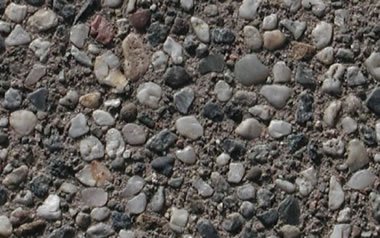
Conglomerate
- Coarse-grained clastic sedimentary rock that is composed of a substantial fraction of rounded to subangular gravel-size clasts, e.g., granules, pebbles, cobbles, and boulders, larger than 2 mm (0.079 in) in diameter.
- Conglomerates form by the consolidation and lithification of gravel.
- Color-matrix usually grey, brown or yellow, clasts variable (depending on material)
- Grain Size-Matrix mostly fine grained (< 2 mm), components 2-256 mm
- Minerals matrix: carbonatic, mostly calcitic, containing feldspar, quartz, mica, clasts variable.
- Conglomerates can be subdivided according to their average grain size into granule conglomerate (clast size 2-4 mm) pebble conglomerate (clast size 4-64 mm), cobble conglomerate (clast size 64-256 mm) and boulder conglomerate (clast size above 256 mm)
Deposition
- The composition of clasts in conglomerate deposits can be a function of sorting (Boggs, 1969). Some parent rocks break down to yield a wide range clasts of different sizes, whereas others break down to smaller clasts of the same size (Pettijohn, 1975).
- Less durable fragments such as shale clasts tend to break into smaller sizes and become more rounded during transport whereas more durable fragments such as chert, metaquartzite and resistant igneous fragments will tend to form relatively bigger grains and are less rounded (Boggs, 1992).
- Conglomerates can be found in different sedimentary environments: fluvial, alluvial, glacial, marine (deepwater (turbidites), shallow marine), talus (slopes).
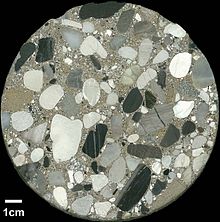
THIN SECTION OF CONGLOMERATE
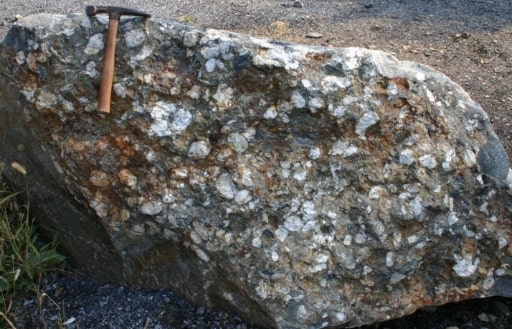
CONGLOMERATE
Shale
- Shale is a fine-grained, clastic sedimentary rock, composed of mud that is a mix of flakes of clay minerals and tiny fragments (silt-sized particles) of other minerals, especially quartz and calcite.
- Shale is characterized by breaks along thin laminae or parallel layering or bedding less than one centimeter in thickness, called
- Shale is the most abundant of the sedimentary rocks, accounting for roughly 70 % of this rock type in the crust of the Earth.
- Shales are typically composed of clay minerals and quartz grain, and are typically gray.
- Addition of variable amounts of minor constituents alters the color of the rock. Black shale results from the presence of greater than one percent carbonaceous material and indicates a reducing environment.
- Black shale can also be referred to as black metal.
- Red, brown and green colors are indicative of ferric oxide (hematite – reds), iron hydroxide (goethite – browns and limonite – yellow), or micaceous minerals (chlorite, biotite and illite – greens).
Depositional
- In terms of origin, most shale rock's constituent minerals are-
Allogenic – clasts of rocks and minerals are brought into sedimentary basins, in which the shales are formed, from external sources (predominantly as detritic terrigenous material derived from rock weathering on land). Common allogenic constituents are: quartz, feldspars, mica, heavy minerals.
- Shales are often found with layers of sandstone or limestone. They typically form in environments where muds, silts, and other sediments were deposited by gentle transporting currents and became compacted, as, for example, the deep-ocean floor, basins of shallow seas, river floodplains, and playas. Most shales occur in extensive sheets several metres thick, though some develop in lenticular formations.
- Shale forms in an environment that consists of calm water: for example, water near the shores of large lakes or continental shelves at sea edges. The calmness of the water allows suspended particles like clay to eventually sink and settle in the bottom of the lake or sea.
Autigenic – formed by sediment precipitation from water or changes occurring in deposited sediments or rocks (diagenesis – e.g. cementation, recrystallisation). Carbonates are the most common autigenic minerals.
- Moreover, shale rocks may contain calcareous, silicious or phosphatic remains of animal skeletons.
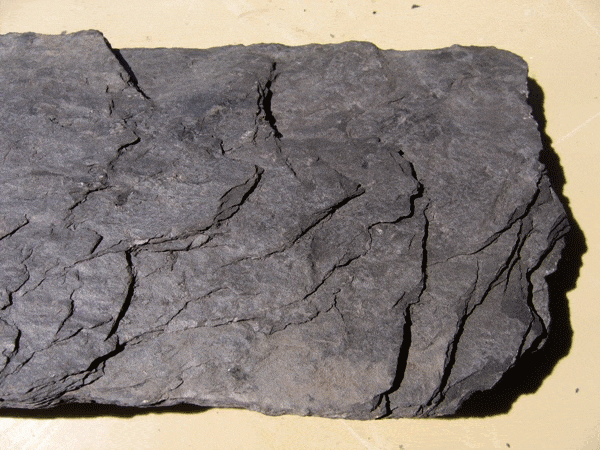
Fig. Shale
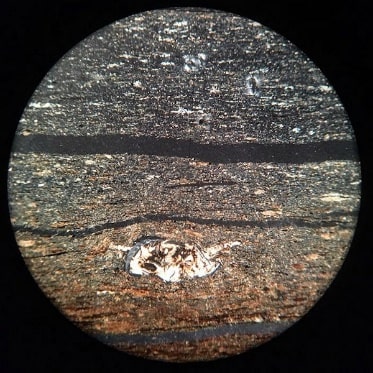
Fig. Thin section of fossileferous shale
(b) Non-clastic Sedimentary rocks
Limestone
- Limestone is a carbonate sedimentary rock that is often composed of the skeletal fragments of marine organisms such as coral, foraminifera, and molluscs. Its major materials are the minerals calcite and aragonite, which are different crystal forms of calcium carbonate (CaCO3).
- A closely related rock is dolomite, which contains a high percentage of the mineral dolomite, CaMg(CO3)2
- Most limestones have a granular texture. Their constituent grains range in size from 0.001 mm (0.00004 inch) to visible particles. In many cases, the grains are microscopic fragments of fossil animal shells.
- It may contain considerable amounts of magnesium carbonate (dolomite) as well; minor constituents also commonly present include clay, iron carbonate, feldspar, pyrite, and quartz.
- About 10% of sedimentary rocks are limestones. The solubility of limestone in water and weak acid solutions leads to karst landscapes, in which water erodes the limestone over thousands to millions of years. Most cave systems are through limestone bedrock.
Deposition
- It forms predominantly on the sea floor where material rich in calcium carbonate ('calcareous' material) accumulates. This calcareous material may be organic, chemical or detrital in origin.
- Diagenesis is the process by which soft sediments turn to rock.
- Limestones originate as soft lime muds, shells and other fragments of the organisms living in the water. When these sediments are buried under others, they are compacted, the water is squeezed out of pore spaces and, in some cases, mineral grains are physically reorganized or chemically changed by the pressure.
- Later, mineralised waters percolate through and minerals precipitate into the pore spaces, cementing everything together to form a rock.
- Chemical precipitation is an important method by which limestone form.
- The warm, shallow waters of the Bahamas and the Red Sea, for example, are saturated with CaCO3. Gentle water currents constantly wash grains of sand and shell fragments backwards and forwards.
- As the grains roll around, they act as nuclei for the precipitation of aragonite, which builds up in concentric layers to form small spheres (called ooids).
- Some limestones are made of, or incorporate fragments of, pre-existing limestones (detritus).
- In shallow waters, fringing reefs, barrier reefs, atolls and limestone shorelines are eroded by the sea. The resultant sediment is transported by currents and deposited on the flanks of the reefs and in sheltered lagoons.
- Where currents are very gentle, lime muds settle around larger fragments and eventually cement them together.
- Where currents are stronger, the lime mud may be washed away to leave only the larger grains, pieces of reef and, perhaps, banks of shells. Later, diagenesis takes place to form the rock we know as limestone.

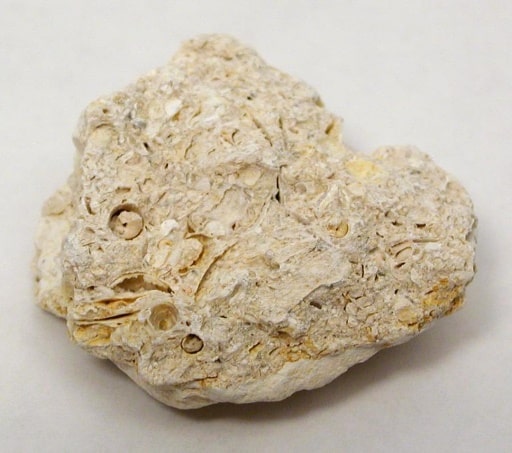
FOSSILIFEROUS LIMESTONE
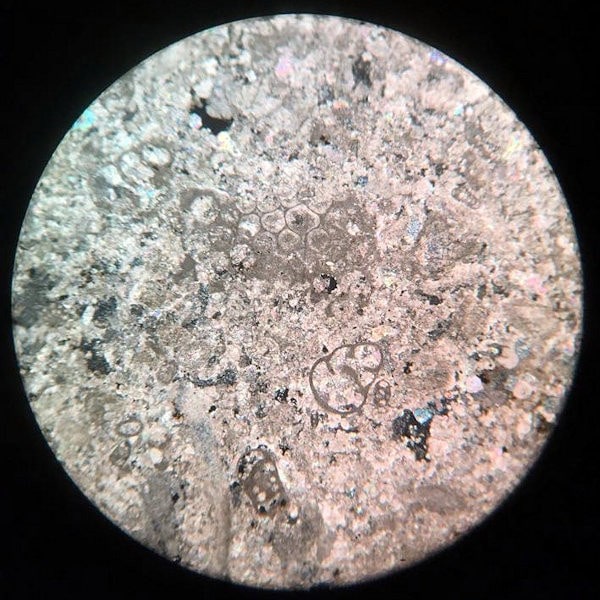
THIN SECTION OF LIMESTONE
Rock salt
- Rock salt = composed of the mineral halite (salt); formed by evaporation.
- Halite forms isometric
- The mineral is typically colorless or white, but may also be light blue, dark blue, purple, pink, red, orange, yellow or gray depending on inclusion of other materials, impurities, and structural or isotopic abnormalities in the crystals.
- Rock Salt is a chemical sedimentary rock that forms from the evaporation of ocean or saline lake waters.
- It is also known by the mineral name "halite." It is rarely found at Earth's surface, except in areas of very arid climate.
- It is often mined for use in the chemical industry or for use as a winter highway treatment. Some halite is processed for use as a seasoning for food.
Deposition
- Halite= NaCl
- Halite occurs in vast beds of sedimentary evaporite minerals that result from the drying up of enclosed lakes, playas, and seas. Salt beds may be hundreds of meters thick and underlie broad areas.
- Salt domes are vertical diapirs or pipe-like masses of salt that have been essentially "squeezed up" from underlying salt beds by mobilization due to the weight of overlying rock. Salt domes contain anhydrite, gypsum, and native sulfur, in addition to halite and sylvite.
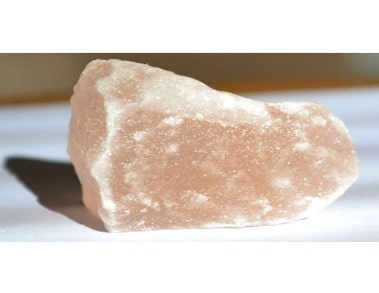
Halite
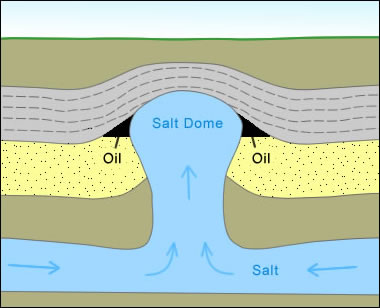
Salt Domes
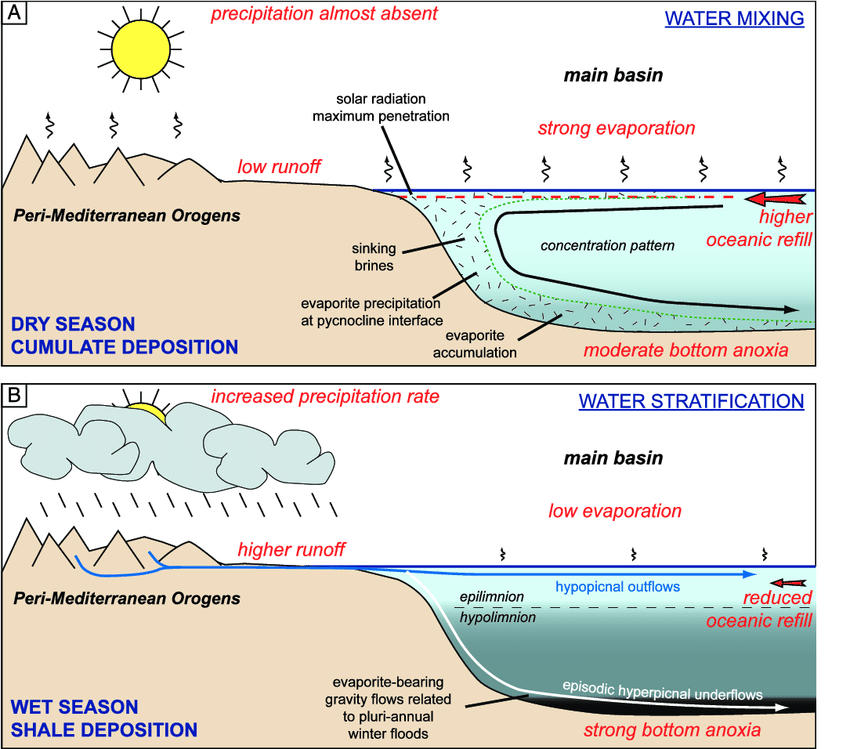
Depositional environment of evaporites