
Other Biogenic Sedimentary Rocks
Other Biogenic Sedimentary Rocks
- Biogenic deposits: (1) siliceous sediment and chert; (2) phosphate sediment and phosphatic rock; and (3) organic-rich materials such as coal and oil, which are concentrated in sediments and sedimentary rocks.
Chert and Siliceous Sediment
- Chert is a fine-grained, hard sedimentary rock composed of cryptocrystalline fibrous chalcedony, lesser amounts of microcrystalline and cryptocrystalline quartz, and amorphous silica. It is the product of organic or inorganic precipitation.
- Two major types of cherts are found in the geologic record: bedded (primary) cherts and nodular (replacement) cherts. Each exhibits a distinctive suite of physical characteristics, has its own mode of origin, and occurs within a distinctive lithological and tectonic setting.
Bedded Cherts
- Most bedded chert is produced when silica-rich organic oozes deposited on the deep seafloor are recrystallized. Bedded cherts occur as individual bands, layers, or laminae that range in thickness from a few millimeters up to several meters.
- Internal sedimentary structures are rare. Many bedded cherts occur as part of assemblages of oceanic crustal rocks and associated deep-sea sediments (ophiolite sequences).

- Two categories of bedded chert are recognized based on the presence or absence of fossils.
- Bedded fossiliferous cherts contain the more or less obvious remains of such siliceous organisms as diatoms, radiolarians, and sponge spicules. They are obviously biogenic and form when siliceous oozes recrystallize.
- Non-fossiliferous bedded cherts contain no visible skeletal remains. Most are probably siliceous oozes so extensively altered that all fossils have been destroyed.
Nodular Cherts
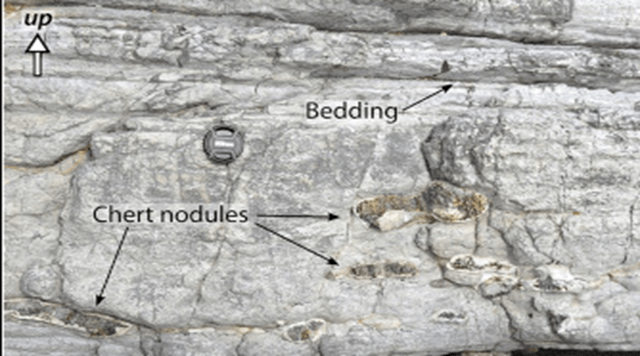
- Nodular (also called secondary, or replacement) cherts occur as fist-shaped, spherical, subspherical, and ovoidal masses of opal, chalcedony, and quartz (Fig. 13.2A) disseminated mainly in shallow-water limestone and dolostone.
- Nodules vary in size from a few millimeters (pea-sized) to a few centimeters.
- Individual nodules are often linked together, forming roughly planar bands that create anastomosing networks and lenses of chert.
- Nodular cherts are clearly of diagenetic origin.
- They form when silica originally deposited in one place dissolves, migrates, and reprecipitates elsewhere, replacing older material.
- The dissolved silica is derived from a variety of sources: detrital quartz grains that the wind transported onto carbonate banks, sponge spicules, and microplankton skeletons.
Phosphorites
Phosphate Geochemistry
- Sedimentary phosphate deposits (phosphorites), on the other hand, are very rare.
- They are characterized by an abnormally high concentration of P205 (20% or more).
- This translates into a phosphate mineral content of roughly 50%. Phosphate in sedimentary rocks occurs as a variety of minerals, but fluorapatite, Ca5(P04)3F, is the principal species.
- Hydroxyapatite, Ca5(P04)30H, is the primary mineral in vertebrate bones and teeth.
- In most sedimentary rocks, the minor phosphate typically occurs as detrital clasts of the mineral apatite, as organic fecal matter (coprolites), or as transported bone fragments, all disseminated within limestone, sandstone, or mudrock.
- Phosphate is derived either directly from hydrothermal veins or by chemical decomposition of such phosphate minerals as fluorapatite in igneous and metamorphic rocks.
- It occurs as ions and as particulate matter adsorbed on organic detritus.
- Phosphate is essential for organisms because it is an integral component of RNA and DNA, the compounds that enable organisms to replicate genetically.
- This critical nutrient regulates organic productivity.
- There are three principal types of phosphorite deposits:
- Concentrations of nodular phosphorite lie scattered on the floor of some modern outer continental shelves.
- Placer concentrations of transported and reworked organic clasts (bone beds) occur rarely.
- A third type of phosphorite, also extremely rare, is produced by a diagenetic process known as phosphatization. Phosphate-rich fluids leached from guano (fecal matter of birds or bats) are concentrated and reprecipitated in limestone.
Origin of Modern and Ancient Phosphorites
- Modern phosphorite nodules are now concentrated in a few shallow shoals along the outer fringe of continental shelves.
- Water depth ranges from 40 to 300 m, and the overall rate of sedimentation is low. Phosphorite minerals occur in gelatinous to solid irregular masses, in spherical clumps, and as slab-shaped chunks.
- They range in size from bodies a few centimeters in diameter to meter-sized blocks.
- Coprolites and fish bones are intimately associated with these masses; many contain clusters of phosphate-enriched pellets or ooidlike particles.
- Relict organic remains suggest that replacement is common.
- These curious deposits are apparently generated where cold, nutrient-rich ocean water wells up onto warmer shallow water in shelf areas.
- The abrupt influx of nutrients leads to extremely high organic productivity at the base of the food chain.
- Initial bursts of phytoplanktonic activity propagated up the food chain produce large volumes of organic material (waste and remains).
- Whenever organic productivity exceeds the rate of decomposition, oxygen deficiency results and further decay of phosphate-rich remains ceases.
- Ocean water upwelling, heightened organic productivity, and the existence of oxygen-deficient zones blooming) are common across the shallow, midlatitude Phosphorite is not precipitated directly from seawater but forms in a thin surficial zone of phosphatization developed on the surface of the seafloor.
- Bacterial decay attacks previously precipitated pellets, bones, and coprolites, releasing free phosphate that replaces pre-existing sediment.
- Bottom-hugging currents further concentrate phosphaterich constituents and winnow away nonphosphatic materials.
- Bone beds are placer concentrations of organic skeletons from which other sediment has been removed.
- Sediments containing bones, coprolites, and other organic materials are reworked, and the organic remains are concentrated as current lag deposits.
- The selective dissolution of some phosphate and its recrystallization as cement slightly acid setting) produce solid phosphorite that replaces mudrock and limestone. Under exceptional circumstances (geographic isolation is most important), flourishing communities of birds and/ or bats confined to islands and peninsulas or caves generate meters-thick piles of layered guano.
- Leaching of this excrement concentrates calcium phosphate as an almost insoluble residue.
- Groundwater circulating downward through this material replaces underlying mudrock or carbonate with phosphate.