
Petrography and Petrogenesis of Basic Rock Groups
Petrography and Petrogenesis of Basic Rock Groups
Basic Rock Groups
- Basic rocks are the rocks that are about 45 to 55% silica (mostly mafic minerals plus plagioclase feldspar and/or feldspathoid minerals), e.g. basalt.
Basalts
- They are the most abundant and widely distributed terrestrial volcanic rock with restricted chemical and mineralogical compositions.

- They are generated by relatively simple petrogenetic processes and derived from a source which remained more or less uniform over a large span of time.
- Basalts are generally recognised as fine grained or hypocrystalline mafic volcanic rocks that are essentially composed of calcic plagioclase (commonly labradorite) and pyroxene (usually augite ± pigeonite) along with subordinate amounts of iron-titanium oxide minerals ± glass.
- A silica saturated or slightly over saturated basalt often leads to an acidic differentiate, an undersaturated one will produce foid bearing ultimate product and a relatively alumina rich basalt may produce proportionally a large volume of felsic rocks.
- Basalts may grade to andesites through basaltic andesites with increase in silica.

Basalt magma types
- The existence of different types of basalts have been recognised largely on the basis of their associations or geologic setting.
- Both subalkaline and alkaline types were recognised, each having characteristic differentiation products.
- Kennedy (1933) considered each to be primary magmas and named them tholeiite (for subalkaline type) and olivine basalt (for alkaline type) which were trapped respectively from two distinct subcontinental layers.
- Tholeiite was later redefined as one which is relatively silica saturated (characterised by reaction rim around olivine) whereas alkali olivine basalt is relatively silica undersaturated.
- A corresponding chemico-mineralogical distinction is the presence of normative hypersthene in the former and normative nepheline and olivine in the latter.
- Kuno (1960) related different basalt magma types to pressure effect (i.e. depth of origin) and his model includes three primary magmas, namely tholeiite, high alumina basalt and alkali olivine basalt.
- He demonstrated the magma types to be manifested across the island arcs, being controlled by increasing depth of the site of magma generation along the Benioff seismic zone.
- If the generated basalt ascends directly to the surface from the site of magma generation and undergoes low pressure differentiation, then tholeiite and its derivatives will be produced.
- On the other hand, if the magma adjusts its composition deep within the mantle (i.e., resides for high pressure equilibration) then an alkali olivine basalt is generated.
- According to O'Hara (1968) basaltic magmas invariably suffers fractional crystallisation on their way towards surface and thus all basaltic magmas are derivative rather than primary.
- Therefore, the depth (vis-a-vis pressure) at which the magma is equilibrated becomes critical in controlling Its composition.
- There has developed another approach of classifying basaltic magmas based on their tectonic setting, particularly keeping in view the concept of plate tectonics.
- The basalts have distinctive distribution features as they occur (i) in the ocean islands (ii) on continental platforms, (iii) on ocean floor and along mid-oceanic ridges (iv) along island arcs and active continental margins.
- This distribution pattern can be related to distinctive tectonic setting in terms of plate behaviour.
- The basalts may be formed within plate as in the ocean Islands and continental platforms, erupted along mid-oceanic ridges marking sites of plate divergence and along island arcs or active continental margins where the plates converge.
- The mid-oceanic ridge basalts (MORB) are uniformly tholeiitic with very low contents of K. Ba, P. Sr, Zr. Ti, Th, U etc.
- Ocean floor basalts (OFB) are somewhat modified ridge basalts. Island arc basalts may range from tholeiltic to alkalic.
- Ocean island basalts vary widely from tholeiite to strongly alkalic types.
- Within plates, continental flood basalts (CFB) are dominantly tholeiite with subordinate alkalic basalts.
- Such grouping is not rigid.
- Plate distension d associated magmatism may take place in continental region and almost an oceanic environment may be simulated on a continental plate (oceanisation of continent) e.g., in back arc basins.
- Mantle plumes, which play a vital role in basalt magmatism, may penetrate both the oceanic plate, as manifested in ocean islands and continental plate, controlling rift zone magmatism.
- Thus, there may be transition in tectonic environment in course of magmatism in a basaltic province.
Basalt tetrahedron
- Importance of representing the principal magma types in terms of a simple basalt system is recognised and the concept of a basalt tetrahedron is introduced.
- the phases in the system diopside (Di) - forsterite (Fo) - nepheline (Ne) - quartz (Qz) contain the principal components of all the major and common minerals in basalt.
- They define the end members of the quarternary system.
- The tetrahedron is dissected by two planes, namely Di-Ab-En plane and Di-Ab-Fo plane.
- the former (Cpx-Pl-Opx) is designated plane of silica saturation and the latter (Cpx-PI-Ol), the critical plane of silica undersaturation.
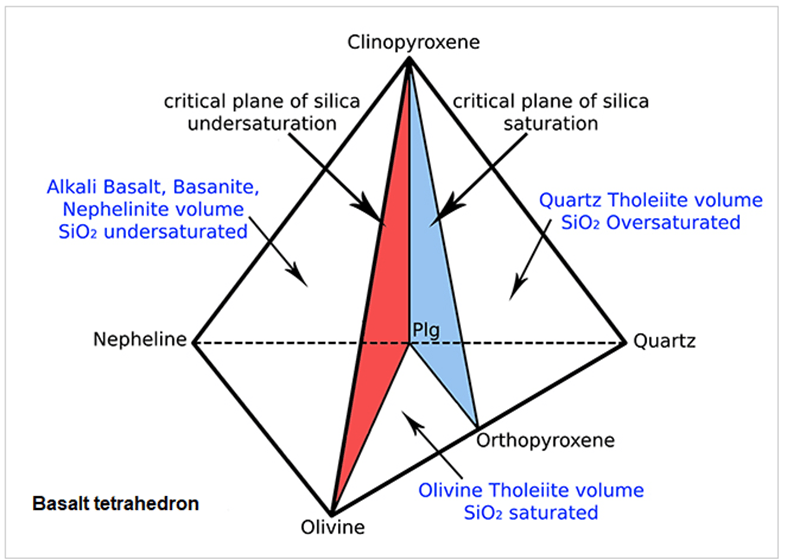
- The two planes mentioned earlier divide the basalts into five unique groups on the basis of normative components namely:
- Tholeiite (oversaturated): Characterised by normative quartz + hypersthene.
- Tholeiite (saturated): Characterised by normative hypersthene (but no quartz), thus confined to the plane of saturation Cpx-Pl-Opx.
- Olivine tholeiite (undersaturated): Characterised by normative olivine and hypersthene thus included within the compartment Cpx-Pl-Ol-Opx,
- Olivine basalt (undersaturated): Characterised by normative olivine (but no hypersthene) thus restricted on the critical plane of undersaturation.
- Alkali olivine- basalt (strongly undersaturated): Characterised by normative olivine and nepheline, thus included within the chamber Cpx-Pl- Ol-Ne.
- It can be observed that Groups 1 and 2 as above, can be classed as subalkaline basalts which may be either tholeiite or calc-alkali basalts. They are widely manifested in continental flood basalt provinces and volcanic arcs.
- Rocks of group 5 and 4 are respectively alkali basalts and those affiliated to alkali basalts.
- Strongly alkaline basalts e.g., nephelinites of group 5 characterise many ocean islands. Majority of MORB and OFB are olivine tholetites.
- The basalts of group 3, limited by two critical planes viz., Cpx-PI-Opx and Cpx-Pl-Ol are often described as transitional basalts.
Tholeiite basalt and Alkali basalt- a comparison
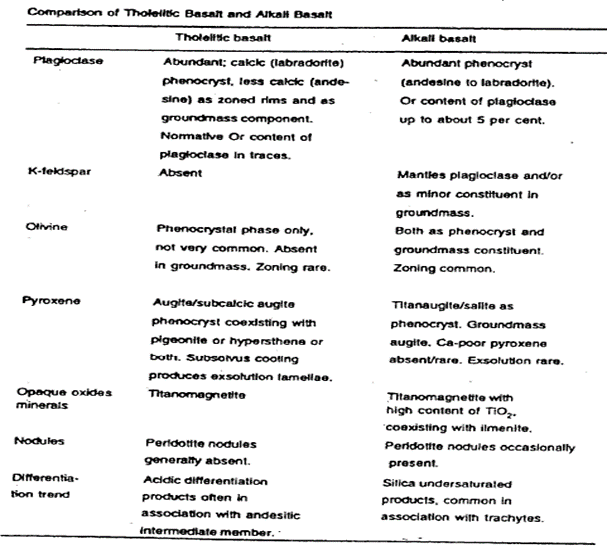
- Basalts vary in crystallinity from holohyaline to holocrystalline.
- Completely glassy variety is called trachylite.
- Basalts are commonly phaneric.
- On chemical basis some of these types are ultrabasics having silica less than forty five weight per cent.
- Basalts generally have a microscrystalline groundmass consisting of randomly oriented plagioclase microlites or fine laths and anhedral grains of augite.
- Where grains of augite are too small to separate the plagioclase laths or to enclose them, and occupy the polygonal spaces defined by the feldspar laths, the texture is said to be intergranular.
- If the growth rate of pyroxene is greater, coarser anhedral grains are formed and they can partly or wholly enclose the plagioclase laths, then respectively sub-ophitic and ophitic textures are produced.
- When very small scattered laths or microlites of plagioclase are completely enclosed in a coarse pyroxene grain as isolated islands then the term nesophitic texture may be used. This is a typical example of poikilitic texture.
- Ophitic texture is relatively more common in slowly cooled intrusive diabases.
- Diabases are fine to moderately medium grained basaltic rocks that occur as minor intrusions, particularly as dykes and sills.
- When such glassy mesostatis occur as discontinuous patches in the interstices of plagioclase tablets, the texture is described as intersertal.
- With increasing proportion of glass which engulf completely the plagioclase laths, the hyalophitic texture is formed.
- When abundant glass is mixed with unoriented minute microlites of feldspar, a hyalopilitic texture results.
Indian occurrences: Deccan basalts, Rajmahal traps, Sylhet traps
Gabbro
- Coarse-grained plutonic rock composed essentially of calcic plagioclase, pyroxene and iron oxides.
- Essentially, gabbro is the intrusive (plutonic) equivalent of basalt, but whereas basalt is often remarkably homogeneous in mineralogy and composition, gabbros are exceedingly variable.
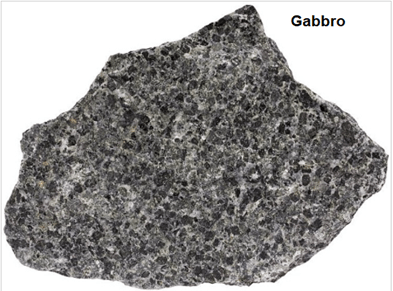

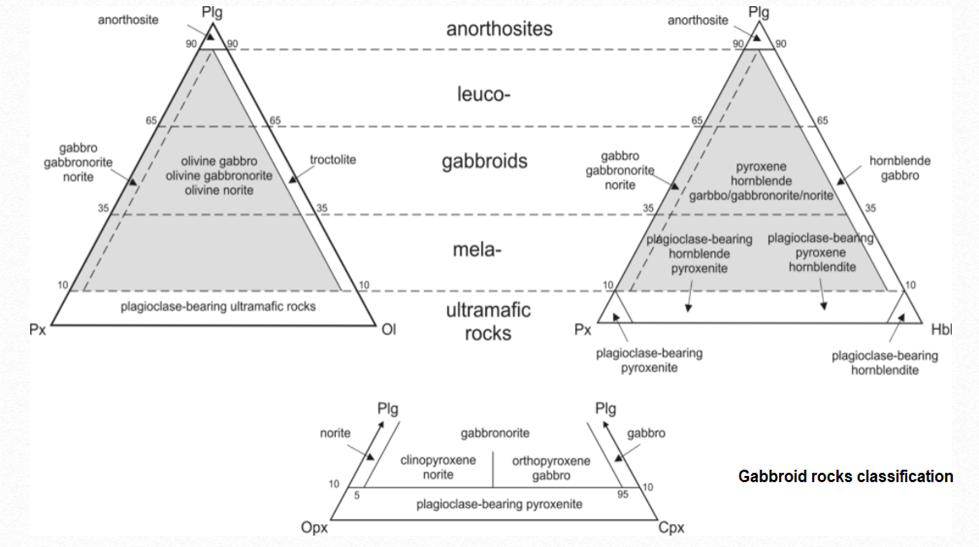
- The pyroxene content is mostly clinopyroxene, generally augite, but small amounts of orthopyroxene may also be present.
- If the amount of orthopyroxene is more than 95% of the total pyroxene content, then the rock is termed norite.
- Intermediate rocks are termed gabbronorite.
- Gabbroic rocks can grade into anorthosites and pyroxenites with increasing amount of plagioclase and pyroxene respectively.
- If more than 90% plagioclase is present, then the rock is an anorthosite.
- If the rock contains more than 90% pyroxenes (often both are present), it is termed pyroxenite.
- The main rocks type that are included under the term gabbro in the larger sense are:
- Gabbro (strict sense): augite, calcic plagioclase
- Olivine gabbro: augite, olivine, calcic plagioclase
- Troctolite: olivine, calcic plagioclase
- Norite: hypersthene, calcic plagioclase
- Anorthosite: calcic plagioclase
- Gabbro can be formed as a massive, uniform intrusion via in-situ crystallization of pyroxene and plagioclase, or as part of a layered intrusion as a cumulate formed by settling of pyroxene and plagioclase.
- Cumulate gabbros are more properly termed pyroxene-plagioclase orthocumulate.
- Gabbro is an essential part of the oceanic crust and can be found in many ophiolites.
- Long belts of gabbroic intrusions are typically formed at proto-rift zones and around ancient rift zone margins, intruding into the rift flanks.
Texture:
- Gabbroic rocks show coarse grained, hypidiomorphic granular texture but unlike many granitoids, they are usually free of phenocrysts.
- Normally the rocks are homophanous but occasionally, particularly near the margin of intrusions, the rocks may show directional structures.
- Plagioclase in the rocks is usually subhedral and occasionally anhedral with frequently developed lamellar twins.
- Zoning of plagioclase is much less common compared to that in volcanic and hypabyssal equivalents.
- The dominant mafic mineral in typical gabbro is augite which occasionally develops subophitic relation with plagioclase.
- Some gabbros develop striped intergrowth of clino- and ortho-pyroxene depending on the composition of the initial pyroxene.
- Olivine bearing gabbros/norites may develop coronas or reaction rims defined by orthopyroxene rims or ribbons around olivine.
- Norites usually have hypidiomorphic granular texture. Plagioclase (labradorite or bytownite) has subhedral to anhedral shape.
- The common accessories in gabbroic rocks are quartz, apatite, sphene, iron-titanium oxide minerals.
Theories on origin
- Some explanations of origin involve multiple injection of batches of identical magma which subsequently differentiate to produce each cycle.
- Similarities between bedding and grain fabric of clastic sedimentary bodies with the rhythmic layering and cumulus fabric of stratiform intrusions suggest simultaneous gravity induced crystal settling.
- Convection was responsible for the rhythmic layering, igneous layering cross bedding. Here the magma near the roof would begin to crystallize first become denser gravitationally unstable would like to sink along the walls of intrusion and spread horizontal along the floor.
- At several times in the earth history particularly during the Precambrian, conditions varied as continental rifting and meteoritic impact led to the development of enormous volumes of tholeiitic magma which on slowly cooling differentiated into remarkable suites of cumulates.
Indian occurrences:
Gabbros from Mayurbhanj, Orissa. Olivine gabbros of Girnar complex, Gujarat. Diorite and quartz diorite occuring in association with tonalite in Daltanganj.