
Petrography and Petrogenesis of Ultrabasic or Ultramafic Rock Groups
Petrography and Petrogenesis of Ultrabasic or Ultramafic Rock Groups
Ultrabasic or Ultramafic Rock Groups
- Ultrabasic or Ultramafic rocks are usually defined by their modal mineralogy. They have a color index greater than 90, where the term “color index” refers to the percentage of mafic minerals such as olivine and pyroxene present in the rock.
- In many cases, the terms ultramafic and ultrabasic (<45% silica) are synonymous, as ultramafic rocks such as dunites (containing more than 90% olivine) will have a chemical composition with < 45 wt% SiO2.

- However, this is not always true.
- In IUGS scheme of classification plutonic igneous rocks with M less than 90 per cent are classified primarily according to their light coloured constituents in QAPF double triangle.
- The ultramafic rocks with M = 90-100 are classified according to their mafic mineral content.
- M comprises the mafic minerals, both silicates and nonsilicates pyroxenes, amphiboles, micas, serpentine, garnets, sphene etc.
- Common ultramafic rocks are holocrystalline coarse to medium grained.
- Common ultramafic rocks are composed of olivine, (± pseudomorphous serpentines), clinopyroxene and orthopyroxene and can be classified as in fig.
- The term perknite has been used by some petrographers for ultramafic rocks devoid of olivine.
- They are represented by pyroxenites, hornblendites etc.
- The pyroxenites are classified on the basis of relative proportions of ortho-and clino-pyroxene as orthopyroxenites, websterite and clinopyroxenite.
- Hydrous ultramafic magmas under suitable condition of cooling can develop primary hornblende and some of these rocks may be described as hornblende websterite or websteritic hornblendeite etc.
Peridotites
- Peridotites are classified on relative proportions of olivine and pyroxenes as also on the type of pyroxene present in the rocks.
- Peridotites comprise the bulk of the Earth’s upper mantle and are present as xenoliths within a wide range of mantle-derived magmas and within the mantle sequences of ophiolites.
- The aluminuous phase present in mantle peridotite changes with pressure with plagioclase present at low pressure, spinel at intermediate pressure, and garnet at high pressure.
- Peridotites can also form as cumulates in layered intrusions.
- Cumulate peridotites often have cumulate textures and exhibit preferred crystal orientation.
- Peridotite is the source rock of basalt. Basaltic magma forms when peridotite is partially melted.
- Melting begins when upwelling mantle intersects the peridotites solidus.
- The amount of melting is limited by the heat available since the heat of fusion is large. Extent of melting can vary from ~1% to ~20%.
- The T, P and % melting determines the composition of the basaltic magma produced.
Dunite
- A dunite is an ultrabasic igneous rock dominated by essential olivine (>90% volume), often with accessory clinopyroxene, orthopyroxene, spinel, ilmenite, and magnetite.
- Dunite is usually coarse- to medium grained and is a peridotite.
- Dunite forms either as a cumulate within layered intrusions or as a residue after extraction of partial melt from a pre-existing ultrabasic rock in the mantle.
- Dunite cumulates and mantle rocks are found as xenoliths in a wide range of mantle derived magmas.
- Dunite is rarely found within continental rocks, but where it is found, it typically occurs at the base of ophiolite sequences where slabs of mantle rock from a subduction zone have been thrust onto continental crust by obduction during continental or island arc collisions.
Nature of Occurrence of the ultramafics
- The mode of occurrence of the ultramafics can be grouped as follows:
- Ultramafic zones in layered intrusions in a tectonic environment
- Ultramafic rocks in ocean floor in zones of crustal extension
- Ultramafic intrusions in orogenic belts and ophiolite suites within zones of plate convergence
- Alkaline ultramafic complexes, lamprophyre and dyke intrusions and kimberlite diatremes in a tectonic environment
- Ultramafic mantle xenoliths/ nodules
- Peridotitic komatiites and picrites in volcanic and subvolcanic associations
- Ultramafic iron meteorites
- Non-silicate ultramafics including carbonatites etc.
- Ultramafic rocks may occur in other associations, as minor intrusions within granite batholith, as a member of sheeted dyke system and as back-arc basin (marginal basin) ophiolites etc.
Ultramafics in Layered Intrusions
- Layered intrusive complexes are characterized by distinctive layers of different mineralogical compositions.
- Some major layered complexes show repetitive litho-layering.
- In such large layered bodies, the ultramafic rocks occur towards the base of the intrusion or as lowermost unit in each repetitive sequence.
- The ultramafic units or zones comprise, peridotites, pyroxenites, chromitites etc.
- It has been envisaged that such ultramafic layers evolve from basaltic magma through settling of early formed mafic crystals.
- Zonal distribution of rocks with ultramafic core and other concentric lithotypes in vertical subvolcanic plugs and pipes has also been observed.
- The zoning possibly results from segregation of heavier crystals away from the contact walls during ascent of the magma i.e. flowage differentiation.
Ultramafic Rocks in Ocean Floor
- Serpentinites and peridotites have been found in dredged cores from many sites in Atlantic and Indian oceans.
- Serpentines are secondary alteration products of olivine but sometimes retain the original textural character of the rocks.
- From petrographic and chemical studies the primary ultramafic rock constituents of the oceanic crust are envisaged to be peridotites (including dunites) and pyroxenites.
- Structure and lithology of mid-oceanic ridges appear to be like that of some orogenic ultramafic emplacements e.g., Alpine type ultramafic intrusions of continental setting.
- The interlayered gabbro-peridotite bodies in such areas of plate convergence are considered to be sections of oceanic crust carried passively against the continental plate margin where they become involved in intense tectonism.
Ultramafic Rocks of Orogenic Zones (Alpine type ultramafics)
- Commonest ultramafic rocks of the orogenic belts are the peridotites and serpentinites.
- They occur within intensely deformed but lowly metamorphosed terrains.
- The peridotites are locally crushed and olivine grains are flattened with preferred orientation.
- The origin of ultramafic bodies found in deformed orogenic belts has been interpreted in various ways.
- intrusion of primary ultrabasic magma
- intrusion of crystal aggregate or residue left after partial melting of mantle to produce basaltic magmas.
- diapiric rise or tectonic slicing (i.e. obduction) of solid mantle
- metasomatic or metamorphic transformation of mafic lavas and dolomites
- emplaced ophiolite suite originally developed in oceanic environment.
- The last noted mechanism is now accepted by majority of petrologists and interpreted in terms of plate tectonic concept.
Ophiolites
- Ophiolites are considered to represent oceanic crust.
- There has been a considerable debate regarding the complete succession of rocks in ophiolite suits because they are not preserved.
- An ideal ophiolite succession from base upwards comprises:
- Metamorphic peridotites or "mantle tectonites". They are serpentinised harzburgite (olivine + orthopyroxene + spinel)
- a succession of layered cumulate rocks i.e. rocks formed by settling of crystallised minerals. The lithounits in this layered sequence may be ultramafics (dunite/peridotite) at the base, grading upwards to cumulate gabbroic rocks with variants e.g. troctolite, anorthosite etc.
- a system of vertical, basic and intermediate dyke rocks or sheeted dyke complex. The frequency of dykes increases towards top.
- submarine pillow lavas interlayered with marine sediments.
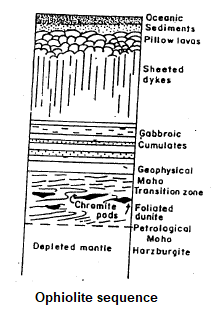
- There are some differences of opinion about the interrelations between the stratigraphic units in ophiolite sequence, about the status of basal metamorphosed peridotite (mantle tectonite) and of sheeted dyke etc.
- In the basal deformed peridotite (harzburgite) the foliation becomes parallel to layering in overlying rocks and gradually becomes olivine rich i.e., approaching dunite.
- There is a transition zone towards the overlying cumulate dunite.
- the upper limit of the dunite (basal member of layered cumulate unit) will mark the geophysical Moho.
- the boundary between the two ultramafic members dunite and deformed harzburgite define the petrological Moho.
- Although apparently related to underlying gabbros, the dykes are not derived from them (but from underlying mantle) because the dykes themselves may cut the gabbro unit and gradually pinch downward.
- The pillowed basalt at the top comprises albite and chlorite (altered primary mafic minerals).
- The rock was considered to be the product of crystallisation of Na-rich basalt magma and named spilite.
- Spilitisation process is akin to metamorphic process taking place on the ocean floor.
- Harzburgite is made up of more refractory minerals and may represent the residue left after mantle melting.
- The magma was produced by melting of primary mantle peridotite (lherzolite) and collected at the base of the crust where it formed the layered unit through progressive crystallisation.
- In other words, the crustal layered cumulate unit formed over the residual mantle (the present harzburgite) from which the basaltic magma had been extracted.
Peridotitic Komatiites
- Peridotitic komatiites are ultramafic members of komatiitic magmatic suite.
- The most distinctive chemical character of the komatiitic suite is its high MgO content accompanied by high MgO/FeO ratio.
- Rocks with MgO content ranging between 10-20 per cent have been termed basaltic komatiites and those above this limit termed peridotitic komatiite.
- Spinifex texture found in erupted komatiite magma.
- Different chemical parameters for definition of komatiite:
- MgO content from 10 wt. % to above 30 wt. percent.
- CaO/Al203 usually above 1.
- TiO2 content low and usually less than 1 wt. percent.
- Olivine in peridotitic komatiites is very rich in forsterite component (Fo85-Fo95) and is also chromiferous.
- Chromite is the common associate of the mafic silicates.
- The interstitial glass has slightly variable MgO contents and may be peridotitic komatiite or basaltic komatiite in composition.
- Petrologists are of the opinion that peridotitic komatiites are of mantle origin but one must account for the very high temperatures (considering the olivine rich composition) and very high degree of melting of mantle to produce the required magma.
- The degree of melting may range from 45 to 65 per cent depending on source composition i.e., whether garnet Iherzolite or harzburgite.
- Thus in course of melting, the magma must reside rather than to segregate out rapidly from the source so that the required degree of melting is reached.
- This unusual melting feature may be related to high density of komatiitic magma.
- It is also possible that in the ancient earth, during the Archaean, there was greater thermal upsurge within the mantle than today and greater amount of mantle material was melted at a time.
Picrites and Picrobasalts
- picrites are volcanic or subvolcanic high magnesia rocks.
- Typical picrites has been consider to be equivalent to feldspathic peridotite with low content (less than 10 per cent) of plagioclase hence is ultramafic.
- Some high-Mg volcanic rocks have higher proportion of plagioclase and pyroxene and correspondingly slightly lower olivine content than picrites. Such rocks are usually called picritic basalts or picrobasalts.
- Some such rocks might have formed by accumulation of early formed mafics from basaltic magma.
- Results of experimental studies are very instructive regarding the genesis of picritic primary magma by partial melting of mantle.
- Tholeiitic basalt magmas can be produced by moderate (ca. 20-30 per cent) partial melting of lherzolite mantle below 15-20 kb. pressure (corresponding to 50-60 km. depth).
- At higher pressures i.e., greater depths, picritic magmas are generated at similar degrees of partial melting.
- If, however, the degree of melting increases (greater than about 35 per cent) at all pressures, the partial melt products have komatiitic character.
- According to some, high MgO content of komatlites is not a function of degree of melting but a function of depth of melting.
- Many believe that picrites is a primary magma from which basaltic magmas have been derived. Thus, considering picrites to be parental to Deccan basalts.
Ultramafic Xenoliths
- Ultramafic xenoliths supposedly of mantle derivation are very common in most kimberlites.
- Kimberlites are supposed to originate at a depth of about 150 kms and on their way up, sample a wide variety of mantle materials. The most common of the xenoliths is garnet lherzolite.
- The other less common associates of garnet lherzolite xenoliths are garnet harzburgite, harzburgite and dunite.
- Harzburgite xenoliths are chiefly composed of olivine and orthopyroxene. The. pyroxenes are aluminous indicating derivation from high pressure environment.
- In fact P-T conditions In the mantle can be quantified applying the techniques of geothermobarometry to coexisting pyroxenes and garnet.
- Eclogites also occur as xenoliths in kimberlites but they are less abundant than peridotites. Eclogites are composed essentially of pinkish magnesian garnet (almandine-pyrope) and pale green omphacite (Intermediate between diopside and jadeite).
- Kyanite is the third constituent in order of abundance when present.
- Though ultramafic in mineral composition; eclogite is chemically equivalent to basalt/gabbro. So, eclogite has a relatively restricted composition.
- Eclogite comprises high density minerals (viz. omphacite, garnet) and is a product of transformation of a low-density assemblage (pyroxene, plagioclase ± hornblende).
Lamprophyres and Lamproites
- Lamprophyres are melanocratic, porphyritic, hypabyssal rocks.
- In megascopic character, we see abundance of mafic mineral phenocrysts.
- Lamprophyres have typical panidiomorphic granular texture defined by euhedral mafic minerals e.g., biotite, augite, hornblende, etc.

- The rocks are classified based on mafic mineralogy and relative proportions of alkali feldspar and plagioclase.
- Traditionally they have been distinguished on the basis of the following characteristics:
- They normally occur as dikes and are not simply textural varieties of common plutonic or volcanic rocks
- They are porphyritic, with M’ (modal% mafics) typically 35-90%, but rarely >90%
- Feldspars and/or feldspathoids, when present, are restricted to the groundmass.
- They usually contain essential biotite and/or amphibole and sometimes clinopyroxene.
- Hydrothermal alteration of olivine, pyroxene, biotite, and plagioclase (when present) is common.
- Calcite, zeolites, and other hydrothermal minerals may appear as primary phases.
- They tend to have contents of K2O and/or Na2O, H2O, CO2, S, P2O5, and Ba that are relatively high compared to other rocks of similar composition.
Classification
- Since, they have a varied composition in terms of nature of feldspar, QAPF system is not suitable for their classification.
- Lamprophyres have variable chemical compositions but in general they have high alkalis and low silica. They contain high volatile bearing minerals.
- An earlier IUSG classification classified lamprophyres into three broad categories: calc-alkaline lamprophyres, alkaline lamprophyres, and melilitic lamprophyres.
- Calc-alkaline lamprophyres occur in subduction zone environments, generally in association with calc-alkaline granitoid suites.
- Alkaline lamprophyres and melilitic rocks typically occur in intraplate and rift environments, accompanying other alkaline magmas, from mildly alkaline gabbros to highly alkaline carbonatite-alkaline silicate rock complexes.
- The classification and nomenclature of lamprophyres, and the mineral characteristics of each, as recommended by the IUGS in 2002, are given in Table.
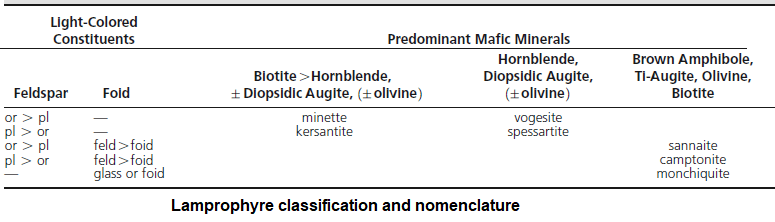
- Lamprophyres encompass a wide range of compositions, from ultramafic to silicic and with variable alkalinity and K/Na ratios. Thus, “lamprophyre” is best used only as a field term.
- Lamprophyres typically occur as minor hypabyssal intrusions (sills, dikes, stocks, pipes, or volcanic necks).
- The high volatile content (particularly H2O) and the resulting abundant mica–amphibole phenocrysts are the predominant uniting characteristics of the lamprophyre group.
- The implication is that lamprophyres develop as a consequence of volatile retention via crystallization at high pressure, or by prolonged normal differentiation processes.
- If so, many lamprophyres may be nothing more than the hydrous crystallization products of common magma types that occur under unusually H2O-rich conditions.
Lamproites
- The term is used for a group of lamprophyre like “hypabyssal” and extrusive igneous rocks that are rich in potassium and magnesium.
- It is ultrapotassic (K/Na >3) and peralkaline (K+Na/Al >1) and has high Mg.
- They are depleted in Ca, Na, and Al which indicates that the mantle source was depleted in these elements by earlier episodes of partial melting.
- Lamproites are characterized by widely varying amounts of the following primary phases: phenocryst and groundmass Ti-rich phlogopite, Ti- and K-rich amphibole, olivine, diopside, leucite, and sanidine.
- The hydrous nature of many phases indicates high H2O content.
- Once recognized, a lamproite may be further classified into a subgroup on the basis of petrography, as shown in figure.

- Lamproites are rare, having been described from only 30 to 40 localities. They are predominantly extrusive (both flows and pyroclastics).
- Occasional intrusive forms are generally hypabyssal (shallow) dikes, sills, and vent pipes.
- Lamproites are produced in a short magmatic episode and show few effects of differentiation.
- They occur strictly in continental-intraplate areas with thick crust and with thick lithosphere.
- virtually all lamproites occur in areas that overlie extinct subduction zones.
- the hydrous, incompatible element-enriched fluids released above these subduction zones are likely to play an important role in developing the unique geochemical composition and mineralogy of laproites.
- Mineralogy and chemistry of lamprophyres and lamproites indicate that they have crystallized from magmas rich in alkalis and volatiles, however degree of silica saturation varies.
- Presence of leucite indicates low pressure environment and extensive groundmass alteration indicates that magmatic volatiles are partly retained even after crystallization.
Model for the generation of lamproites:
- A depleted harzburgite is created, either by melt extraction within a rising asthenospheric plume or by long term depletion of the subcontinental lithospheric mantle (SCLM).
- Later enrichment adds incompatible elements to the harzburgite. This may occur in the form of subduction zone fluids rising from the dehydrating slab into the overlying SCLM or via melt infiltration.
- The depleted then enriched heterogeneous SCLM source is partially melted.
- This may be triggered by a new plume that supplies thermal energy and/or a sudden volatile influx, or it may result from collapse of an orogen and decompression melting of the rising asthenospheric welt.
- Given their concentration in areas above extinct subduction zones, the lithospheric source and subduction zone fluid enrichment is an attractive combination for the source of lamprophyres.
- It has been proposed that proposed that all other members of the lamproite clan are derived by fractionation and hybridization from the primitive phlogopite-lamproite that appears to be the parental magma in a number of provinces.
- Indian occurrences: lamprophyres in Gondwana basins, alkaline lamprophyre from Mt Girnar, Calc-alkali lamprophyre from Mundwara complex, Rajasthan
Kimberlites
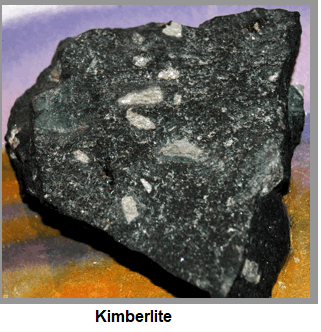
- They are K-rich, typically ultramafic hybrid rocks that occur in ancient cratons.
- They are volatile rich, tend to rise from mantle depths rapidly and are emplaced violently if they reach the near-surface environment.
- Many contain diamond and coesite, which indicate a fairly deep mantle origin.
Classification:
- Kimberlites are currently divided into two groups.
- Group 1 kimberlites are the typical ultramafic kimberlites, first described from Kimberly, South Africa, but known to occur on all continents.
- Group 2 kimberlites are micaceous kimberlites, the occurrence of which is presently limited to South Africa, where they are older.
Petrography of Kimberlites
- Group 1 kimberlites are volatile-rich (principally CO2) potassic ultramafic rocks. In addition to their xenolith content, they commonly exhibit a distinctively inequigranular texture caused by the presence of rounded, anhedral, and fragmented macrocrysts (a non-genetic term for 0.5 to 10 mm diameter crystals) and, in some cases, megacrysts (similar, yet larger, generally 1 to 20 cm) set in a fine-grained matrix.
- Olivine is generally predominant, but may be accompanied by ilmenite, pyrope, diopside, phlogopite, enstatite, and chromite.
- Large crystals of subhedral to euhedral habit are considered to be true phenocrysts, and are so named when properly identified.
- The matrix typically contains a second generation of fine euhedral to subhedral olivine, plus one or more of the primary minerals: monticellite, phlo gopite, perovskite, spinel, and apatite.
- Carbonate and serpentine typically constitute a late groundmass.
- Many group 1 kimberlites contain a late poikilitic Ba-rich phlogopite.
- Nickeliferous sulfides and rutile are common accessory phases.
- Group 2 kimberlites, although texturally similar to those of group 1, are distinctive mineralogically and geochemically.
- They are ultrapotassic, peralkaline, and H2O-rich.
- Phlogopite is the dominant macrocryst and groundmass phase. Olivine is also common.
- Other characteristic primary phases include diopside (commonly rimmed by aegirine), spinel, perovskite, apatite, REE-rich phosphates, K-Ba-titanites, rutile, and ilmenite.
- The fine groundmass may contain calcite, dolomite, REE-carbonates, witherite, norsethite, zirconium silicates, and/or serpentine.
- Group 1 and 2 kimberlites are distinctive isotopically, so the two groups must represent different magma types.
- Mineralogically, group 2 kimberlites are similar to lamproites, but have sufficient petrological differences to warrant that they be considered separately from these rocks.
- Group 1 and group 2 are products of continental intraplate magmatism and are concentrated within ancient cratons.
- diamond-bearing kimberlites are essentially restricted to terranes underlain by rocks older than 2.5 Ga.
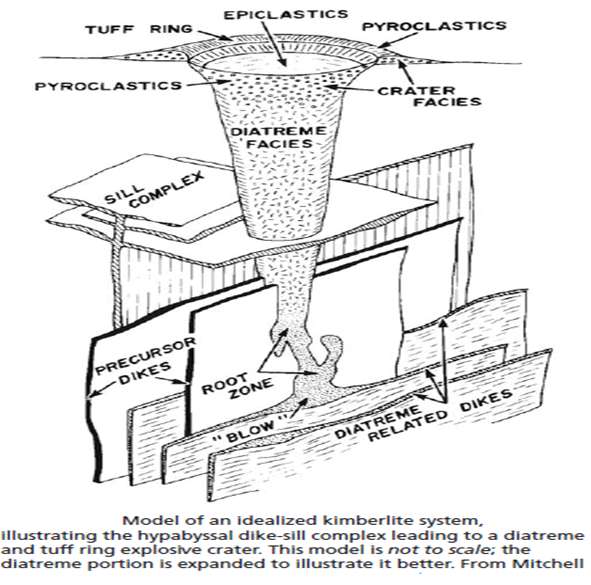
- Both groups can occur as hypabyssal dikes or sills, diatremes (see below), crater-fill, or pyroclastics, depending largely on the depth of erosion and exposure.
Petrogenesis of Kimberlites
- Introduction of CO2 and H2O lowers the solidus of the lherzolite to that shown in Figure. A rising plume of hydrous-carbonated asthenosphere, if it follows the geotherm, intersects the solidus and a small quantity of kimberlitic melt is produced.
- The partially melted mantle diapir continues to rise either along the geotherm or in a near-adiabatic fashion. The kimberlite magmas may stall upon meeting some mechanical resistance at the lithosphere–asthenosphere boundary or they may continue to rise into the lithosphere.
- Here, they should crystallize to a phlogopite–dolomite peridotite.
- The melts, in turn, release fluids that metasomatize the overlying mantle.
- An alternative melting mechanism is one in which metasomatism reduces the melting point of a refractory peridotite to the extent that it begins to melt at ambient conditions.
- In the former case, melting leads to metasomatism, whereas in the latter, metasomatism leads to melting.
- Multiple processes of magmatism, crystallization, metasomatism, upwelling, and heating may produce several generations of alkaline melts and metasomatism at progressively shallower levels.
- Such a veined and metasomatically enriched lithosphere is an attractive source for Gp 2 kimberlites.
- Kimberlites (group 1) are generated from volatile-enriched garnet lherzolites in upwelling portions of the asthenosphere.
- The similarity of kimberlites all over the world makes a convecting (homogenizing) asthenospheric (plume) source most likely.
- Kimberlite source rocks are probably a magnesite-phlogopite-garnet lherzolite with some added Ti, K, and Ba.
- They originate at depths less than 300 km.
- The hypabyssal kimberlites show evidence for magma mixing and interaction of numerous kimberlite magma batches.
- Later batches disaggregate the cumulates from earlier ones, resulting in complex hybrids of mixed magmas and a spectrum of partially resorbed cumulates.
- Olivine and minor phlogopite crystallize during kimberlite ascent and the hybrid assemblage of melt, xenocrysts, and phenocrysts is emplaced in the upper crust as the dike-sill complex and eventually diatreme.
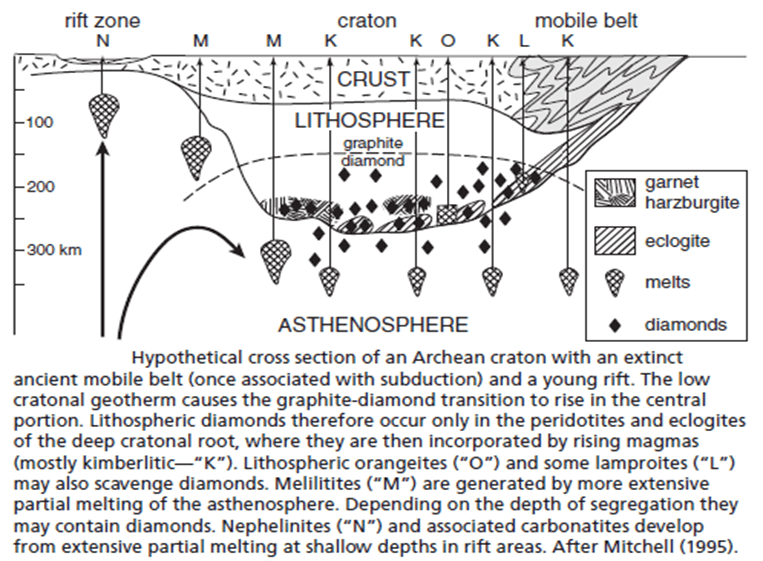
- Figure is a schematic cross section of an Archean craton with a marginal Proterozoic mobile belt and a modern rift.
- A remnant of subducted eclogite slab remains beneath the orogenic edge, and some eclogitized basaltic lithosphere underplates are also shown.
- Due to the lower geothermal gradient in the poorly radioactive cratonal areas, the diamond–graphite transition is elevated into the deep cratonal lithospheric mantle root.
- Diamonds thus concentrate in the lherzolites, depleted harzburgites– dunites, and eclogites of those roots, and not beneath the rifts or mobile belts.
- Figure suggests that any melt that traverses the deep diamond-bearing horizons of the cratonal roots may incorporate diamonds.
Indian Occurrences of kimberlites: Kimberlites of Wajrakarur occur as cluster of pipes, Majgaon pipe, Chelima dyke.
Indian occurrences
- Ultra mafic rocks as a distinct layered lithomembers have been described from several differentiated mafic igneous complexes in Precambrian terrains of India.
- Simlipal complex of Singhbhum crustal province is a volcanosedimentary basinal sequence. The middle part of this complex is occupied by the Amjori sill which develops ultramafic rocks at its base.
- Ultramafic bodies are emplaced within the Singhbhum granite batholith and associated supracrustal rocks of Singhbhum craton.
- Picrite or peridotitic lavas and tufts constitute the basal member of the Dalma volcanic sequence in Singhbhum crustal province.
- Naga hill ophiolites