
Petrography and Petrogenesis of Diorites
Petrography and Petrogenesis of Diorites
Diorites
- Diorite is a coarse-grained, intrusive igneous rock that is intermediate in composition between granite and gabbro.
- Diorite is composed primarily of plagioclase feldspar, amphibole, and pyroxene minerals with small amounts of biotite mica.
- It typically contains very little quartz. Zircon, apatite, sphene, magnetite, ilmenite and sulfides occur as accessory minerals.
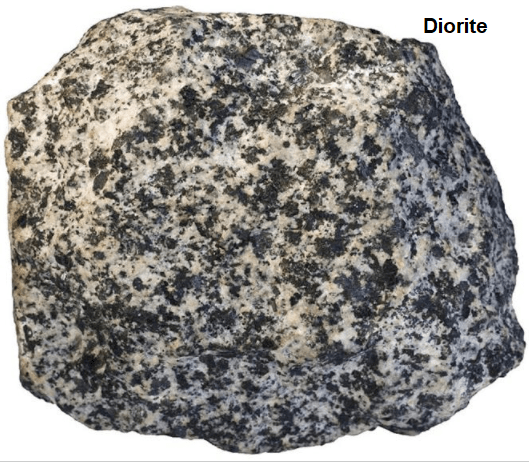

- Varieties deficient in hornblende and other dark minerals are called leucodiorite.
- When olivine and more iron-rich augite are present, the rock grades into ferrodiorite, which is transitional to gabbro.
- The presence of significant quartz makes the rock type quartz-diorite (>5% quartz) or tonalite (>20% quartz), and if orthoclase (potassium feldspar) is present at greater than ten percent the rock type grades into monzodiorite or granodiorite.
- Diorites may be associated with either granite or gabbro intrusions, into which they may subtly merge. Diorite results from partial melting of a mafic rock above a subduction zone.
- It is commonly produced in volcanic arcs, and in cordilleran mountain building such as in the Andes Mountains as large batholiths.
Formation of diorite
- Partial melting of the oceanic plate produces a basaltic magma that rises and intrudes the granitic rock of the continental plate.
- There, the basaltic magma mixes with granitic magmas or melts granitic rock as it ascends through the continental plate.
- This produces a melt that is intermediate in composition between basalt and granite. Diorite forms if this type of melt crystallizes below the surface.
