
Origin of the earth's Crust
Origin of the earth's Crust
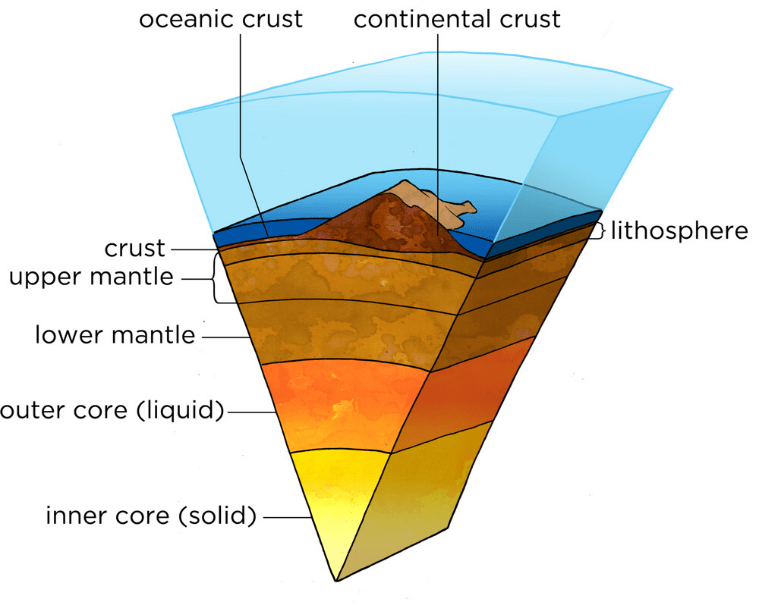
Crust
- Crust is the outermost solid cell of a rocky planet, dwarf planet, or natural satellite.
- It is distinguished from the underlying mantle by its chemical composition.
- Most terrestrial planets have uniform crusts. However, Earth has two distinct types: continental crust and oceanic crust.
Earth’s Crust
- “Earth’s crust is the top component of the lithosphere. It includes the crust and upper mantle.” – EC Robinson (2011) in "The Interior of the Earth".
- Earth crust is the thinnest and the most rudimentary layer that makes up the Earth. It contains 1% of earth's volume.
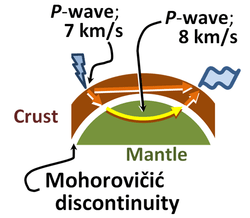

- The crust is a dynamic structure. The lithospheric crust is broken into tectonic plates.
- The boundary between the crust and mantle is known as the Mohorovicic discontinuity.
- The temperature of the crust increases with depth. It reaches to about 100 °C to 600 °C at the mantle boundary. – Robert Peele (1911).
Origin of crusts
- Formation of crust: The crusts of Earth, Mercury, Venus, Mars, Io, Moon and other planetary bodies is formed via igneous processes.
- Modification of crust: The crust is later modified by erosion, meteorite impact, sedimentation, volcanism etc.
Primary crust or Primordial crust
- It is a planet's original crust. It is formed by magma solidification at the end of planetary accretion.
- This crust is likely destroyed by large impacts and reformed many times during the Era of Heavy Bombardment. –Ross Taylor (1989). "Growth of planetary crusts".
- None of Earth's primary crust has survived till today.
- However, information about primary crust can be collected by studying the terrestrial planets. Eg. Mercury's highlands and anorthosite highlands of the Moon are primary crust.
Secondary Crust
- It is formed by partial melting of silicate materials in the mantle. Hence, it is usually basaltic.
- It is the most common type of crust in the Solar System.
- E.g., Mercury, Venus, Earth, Mars.
- On Earth, it is formed primarily at the mid-ocean ridges.
Tertiary crust
- It is the most chemically modified crust.
- It is formed by igneous processes, erosion and sedimentation.
- The only known example is the continental crust of the earth.
Theories about the formation of the crust
- Inhomogeneous or heterogeneous accretion model.
- Impact model and,
- Terrestrial model.
The Inhomogeneous Model or The Accretion Model
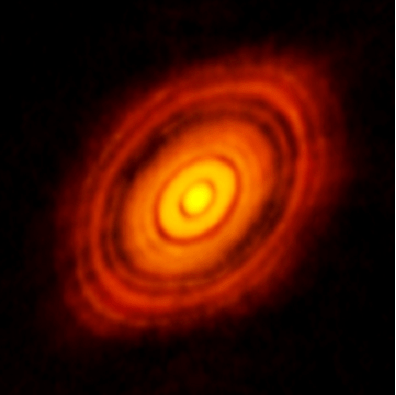
- The Earth’s crust was formed during the accretion of the planet.
- The lighter and volatile elements formed a thin layer on the primitive planet, which became the crust.
Criticism:
- This model suggests that non-volatile elements can only be found in the mantle.
- However, non-volatile elements such as uranium and thorium are found on the Earth’s crust.
- Hence, this theory is highly unlikely to be true.
The Impact Model
- The asteroids and other objects that impacted the Earth, were melted and formed the crust.
- The oceanic crust, which is mainly composed of basalt, is formed by a basalt asteroid impact.
Criticism:
- The basalts in lunar maria were not due to an asteroid collision.
- Furthermore, the number of basalts produced from an impact event was too insignificant to form crusts.
- A majority of the impact events on Earth happened after oceanic crusts were formed.
- Therefore, this theory is also unlikely as well.
The Terrestrial Model
- The crustal origin of the Earth was due to its internal processes.
- After the accretion, heat retained by the earth resulted in the complete melting of the upper mantle. It formed a magma ocean, which covered the surface of the earth.
- As the Earth cooled, the magma ocean crystallised to form a widespread crust.
- Another possible explanation was that the melted upper mantle rose up to form a crust.
Merits:
- The magma ocean could explain some properties of the earth’s crust.
- The uniform composition of the crust could be formed by a homogeneous magma ocean.
- The layered composition of earth’s crust may be due to the cooling of magma oceans over time.
- Thus, the terrestrial model most likely explains the formation of the earth’s crust.
Origin of the oceanic crust
- The oceanic crust was first generated along the ocean ridges.
- It was formed 4.5 billion years ago, earlier than the first appearance of the continental crust.
- The early oceanic crust is likely to be basalts in composition.
Origin of continental crust
- The oldest continental crust is about 4 billion years ago.
- Granite continental crust only appeared 3 billion years ago.
- Earth is the only planet in the solar system that has a continental crust, (mainly because it requires the presence of water and the subduction of crusts)
- The seawater cools the hot mantle at the subduction zones. It allows fractional crystallisation to take place to produce a granite crust.
Evaluation
- We cannot observe all geological evolutionary phenomena in the span of a human lifetime.
- The fragmentary geologic evidence provide the basis for hypothetical solutions to problems relating to the early Earth system.
- Only a combination of these theories creates both a framework of current understanding, and also a platform for future study.