
Evolution of Earth's Crust
Evolution of Earth's Crust
- The evolution of Earth's crust involves the formation, destruction and renewal of the rocky outer shell at its surface.

- The variation in composition of the Earth's crust is much greater than that of other terrestrial planets.
- Most terrestrial planets have uniform crusts. However, Earth has two distinct types: continental crust and oceanic crust. This unique property reflects the complex evolution processes throughout the history.
Stages of Evolution of Earth's Crust
Formation of Primitive Earth:
- Initially, Earth was a hot, molten mass with no distinct crust.
- Over time, cooling and solidification led to the formation of a thin, primitive crust.
- The Earth began to cool as planetary accretion slowed, and heat stored within the magma ocean was lost to space through radiation.
- The initiation of magma solidification leads to formation of a thin 'chill-crust' at the extreme surface.
Early Crustal Development:
- The early crust was primarily composed of basaltic rocks due to volcanic activity.
- Continual volcanic eruptions and tectonic processes contributed to crustal growth.
Formation of Continental Crust:
- As Earth's surface cooled further, differentiation occurred, leading to the formation of continental crust.
- Continental crust is less dense and thicker than oceanic crust, composed mainly of granite and sedimentary rocks.
Plate Tectonics and Crustal Evolution:
- Plate tectonics played a crucial role in shaping Earth's crust.
- Processes like subduction, collision, and seafloor spreading contributed to crustal changes, including the formation of mountain ranges, rift valleys, and ocean basins.
Supercontinent Cycles:
- The movement of tectonic plates resulted in the assembly and breakup of supercontinents over geological time scales.
- Supercontinent cycles, such as Pangaea and Rodinia, influenced crustal configurations and continental drift.
Impact of Climate and Erosion:
- Climate variations and erosion processes have continuously modified Earth's surface and crust.
- Glacial periods, weathering, and erosion shaped landscapes, deposited sediments, and altered crustal features.
How Plate Tectonics Theory Explains the Evolution of Earth’s Crust
- Continental crust transforms into oceanic crust in a cyclic and dynamic process.
- Old crust is destroyed at convergent boundaries, new crust is created at divergent boundaries.
- The Plate tectonics theory explains the major macro scale landforms and their crust on the present day earth.

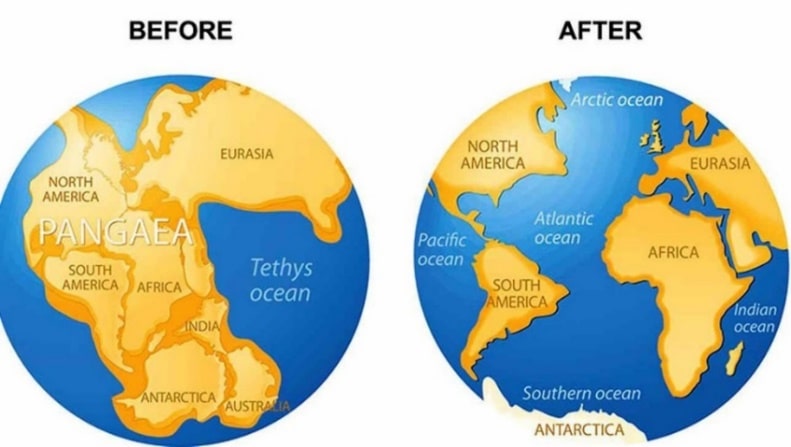
Subduction Zones:
- Subduction zones occur at convergent boundaries where denser oceanic plates sink beneath less dense continental plates.
- This process leads to the recycling of crustal material, affecting the composition and structure of the crust.
Volcanic Activity:
- Subduction zones and divergent boundaries often result in volcanic activity.
- Magma from the mantle rises to the surface, forming volcanoes and contributing to the formation of new crust.
Mountain Building:
- Convergent boundaries and continental collisions lead to mountain building processes.
- The compression and uplift of crustal rocks create mountain ranges, altering the topography of the Earth's surface.
Rift Zones and Rift Valleys:
- Divergent boundaries can form rift zones where the lithosphere stretches and thins, creating rift valleys.
- Rift valleys are often associated with new crust formation and can evolve into ocean basins over time.
Formation of Pseudo-Oceanic Crust:
- Subduction of the low-velocity zone in the upper part of the crust leads to the beginning of crustal attenuation.
- Intruding magma from the mantle modifies the intermediate and lower crustal layers.
- As the process continues, a “pseudo-oceanic” crust forms, which has an intermediate chemical composition.
Formation of New Oceanic Crust:
- First of all, the intermediate crust disappears
- Eruption from the mid oceanic ridge starts, hence the new oceanic crust is formed. It spreads out towards the subduction zone, where the crust is eventually destroyed.
- Components of the crust again returns to the upper crust in different forms such as igneous intrusions.
- Hence, the formation and destruction, and re-formation of the new continental crust continues in a cyclic manner.
Factors of Evolution of Earth’s Crust

a. Endogenous Factors of Evolution of Earth's Crust
Tectonic Plate Movements:
- Tectonic plates are large sections of Earth's lithosphere that move and interact with each other.
- Their movements, such as divergent, convergent, and transform boundaries, lead to various geological features like mountains, valleys, and earthquakes.
Volcanic Activity:
- Volcanic eruptions are a result of molten rock (magma) from Earth's mantle reaching the surface.
- They contribute to the formation of new landmasses, such as islands, and also release gases and minerals that influence the environment.
- It contributes to renewing the crust with new igneous rock and landforms.
- The composition and origin of the lava determine the type of crust
- More fluid mafic lava forms structures like shield volcanoes.
- More viscous felsic lava forms structures like stratovolcanoes.
- Exhumed crust: In cases where magma does not breach the surface, it may solidify to form intrusive or plutonic rocks. Over time, the surrounding softer rock erodes away, and it leads to formation of exhumed crust. It creates landforms like plutons, batholiths, dykes, sills, laccoliths and volcanic necks.
Earthquakes:
- Earthquakes are caused by the sudden release of energy in Earth's crust, often along fault lines.
- They can lead to the formation of fault-block mountains and changes in land elevation, affecting landscapes over time.
Geothermal Gradient:
- The geothermal gradient is the rate at which temperature increases with depth within Earth's crust.
- It influences processes like metamorphism, magma formation, and the movement of underground fluids, shaping the crust's evolution.
Plutonism and Intrusive Igneous Activity:
- Plutonism refers to the formation of igneous rocks from cooled magma beneath Earth's surface.
- Intrusive igneous activity, such as the formation of batholiths and dikes, contributes to the composition and structure of the crust.
Mountain Building Processes:
- Processes like orogeny (mountain-building events) result from tectonic plate interactions, leading to the uplift and deformation of Earth's crust.
- This can create mountain ranges, plateaus, and other topographical features.
Faulting and Folding:
- Faulting involves the movement of rocks along fractures (faults), while folding results from the bending and deformation of rock layers.
- These processes alter the landscape, creating geological formations like anticlines, synclines, and rift valleys.
b. Exogenetic Factors of Evolution of Earth's Crust
Extra-terrestrial Force:
- Impact Events: Meteorite impacts can cause significant changes to the Earth's crust, leading to crater formations and geological disturbances.
- The impacts are fairly infrequent in recent geological times. However, these were a major force of change during the late heavy bombardment period, as the orbital path of the earth was not fully cleared.
- Some examples are formation of impact craters by asteroids or meteoroids. It depends upon the size and structure of the impactor.
Climate:
- Temperature Variability: Fluctuations in temperature over time can affect the physical properties of rocks, leading to expansion, contraction, and eventual erosion.
- Precipitation Patterns: Rainfall patterns influence erosion rates and the formation of landscapes, such as valleys and river systems.
Weathering:
- Mechanical Weathering: Physical processes like freeze-thaw cycles and abrasion break down rocks into smaller particles.
- Chemical Weathering: Chemical reactions, such as oxidation and dissolution, alter the composition of rocks and minerals.
Erosion, Deposition, and Transportation Activities:
- Water Erosion: Rivers, glaciers, and coastal processes erode landforms and deposit sediments elsewhere, shaping the Earth's surface.
- Wind Erosion: Wind transports sediment and can create features like sand dunes and rock formations.
- Glacial Activity: Glaciers erode and transport massive amounts of material, shaping valleys and carving out fjords.
Soil Formation Processes:
- Weathering Contribution: Weathered rock material, combined with organic matter and microbial activity, leads to soil formation.
- Parent Material Influence: The type of underlying rock affects soil characteristics, such as texture, fertility, and drainage.
Biological Processes: Plants and Burrowing Animals:
- Root Activity: Plant roots can break apart rocks, contribute to soil formation, and stabilize slopes.
- Burrowing and Bioperturbation: Animals like earthworms and burrowing insects mix soil layers, enhancing soil fertility and aeration.
Anthropogenic Factors:
- Land Use Changes: Human activities such as deforestation, agriculture, mining, and urbanization alter landscapes and contribute to erosion and soil degradation.
- Pollution and Contamination: Industrial activities introduce pollutants into the environment, affecting soil quality and ecosystem health.
Crustal Growth Rates
- The figure shows the rate of continental crustal growth over time.

- The graph of crustal reworking represents the amount of formational alteration undergone by the crust.
- A sudden increase in crustal reworking and reduction in the crustal growth rate is observed at approximately 3.6 billion years ago. It represents the onset of subduction and plate tectonics.
- Crustal growth rates can be used to calculate estimates for the age of the continental crust.
What is Crustal Dichotomy?
- On Earth, it refers to the distinct contrast in composition and nature of the oceanic and continental plates.
- The crustal dichotomy of Mars describes the topographic division between the young plains in the northern hemisphere and the old terrain in the southern hemisphere.
Evaluation
- We cannot observe all geological evolutionary phenomena in the span of a human lifetime.
- The fragmentary geologic evidence provide the basis for hypothetical solutions to problems relating to the early Earth system.
- Only a combination of these theories creates both a framework of current understanding, and also a platform for future study.