
Physical Conditions of the Earth’s Interior (Interior of the Earth)
1. Interior Structure of the Earth:
The Earth's interior is divided into several distinct layers based on their physical properties and composition.
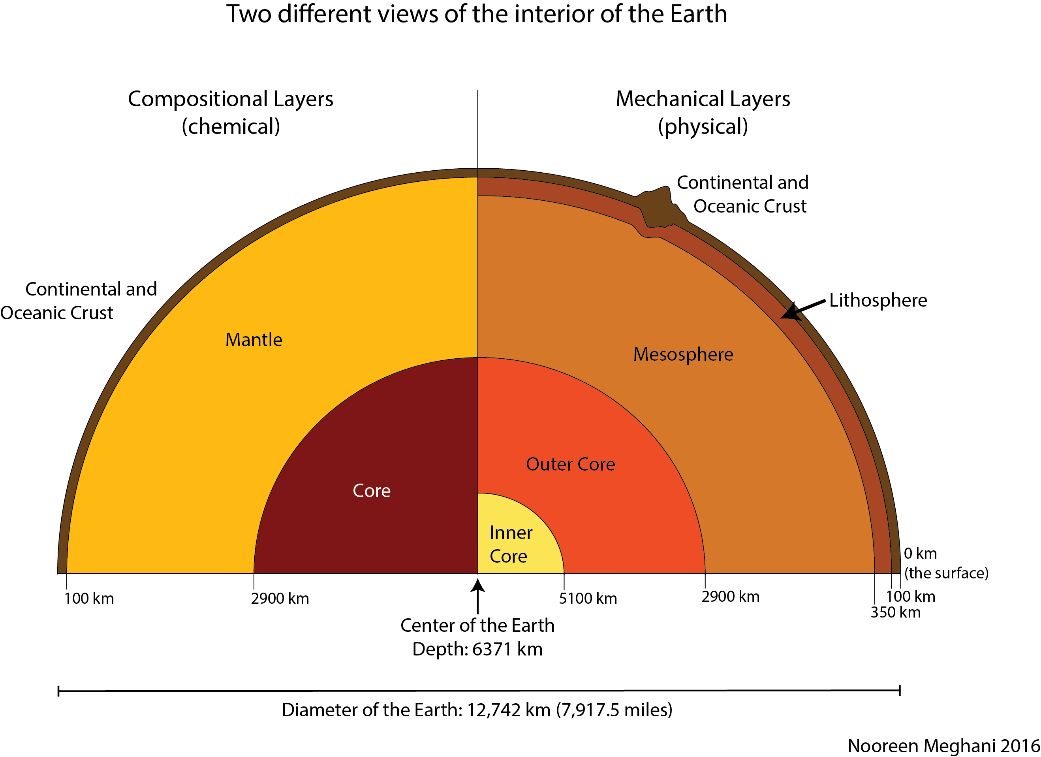
Layering of Earth
The layering of the Earth refers to the organization of the Earth's interior into distinct zones or layers based on various characteristics such as composition, physical properties, and behavior.
These layers are primarily divided into two main categories: the mechanical layering and the compositional layering.
Mechanical Layering of the Earth:
The mechanical layering of the Earth refers to the division of the Earth's interior based on the physical properties and behavior of the materials that make up its various layers. There are three main mechanical layers:
a. Lithosphere:
- The lithosphere is the rigid, outermost mechanical layer of the Earth.
- It includes the Earth's solid crust (both continental and oceanic) and the uppermost part of the mantle.
- The lithosphere behaves as a brittle material and is divided into tectonic plates that move and interact with each other along plate boundaries.
b. Asthenosphere:
- Below the lithosphere lies the asthenosphere, a semi-fluid layer of the upper mantle.
- The asthenosphere exhibits ductile behavior, meaning it can flow slowly over geological time scales.
- It plays a crucial role in the movement of tectonic plates and allows for the process of plate tectonics to occur.
c. Mesosphere or Mantle:
- Deeper within the Earth, beneath the asthenosphere, is the mesosphere or mantle. It is a solid, yet plastic, layer that extends to a depth of approximately 2,900 kilometers (1,800 miles).
- The mesosphere's properties are responsible for the convective currents that drive plate motion and heat transfer within the Earth.
Compositional Layering of the Earth:
Compositional layering refers to the division of the Earth's interior based on the chemical composition of the materials present in each layer. The Earth can be divided into the following compositional layers:
a. Crust:
- The Earth's outermost compositional layer is the crust. It is primarily composed of lighter, silicate-rich rocks.
- There are two main types of crust: continental crust, which forms the continents and is thicker but less dense, and oceanic crust, which underlies the ocean basins and is thinner but denser.
b. Mantle:
- Beneath the crust is the mantle, which extends to a depth of about 2,900 kilometers (1,800 miles). The mantle is predominantly composed of silicate minerals, such as olivine and pyroxenes.
- It is the source of the Earth's internal heat and undergoes convection, driving the movement of tectonic plates.
c. Core:
- The Earth's innermost compositional layer is the core. It is primarily composed of iron and nickel and is divided into two regions: the outer core and the inner core.
- The outer core is molten, while the inner core is solid due to the immense pressure at that depth. The core is responsible for generating the Earth's magnetic field through the geodynamo process.
Mechanical vs Compositional Layering of Earth
|
Aspect |
Mechanical Layering |
Compositional Layering |
|
Definition |
Based on physical properties and how materials respond to stress and strain. |
Based on the chemical composition of Earth's layers. |
|
Layers |
Divided into three main layers: Crust, Mantle, and Core. |
Divided into five main layers: Lithosphere, Asthenosphere, Mesosphere, Outer Core, and Inner Core. |
|
Properties |
Varies in terms of rigidity and deformation behavior. |
Varied in terms of the type of rock and materials found within each layer. |
|
Depth |
Crust is the outermost layer and varies in thickness (continental vs. oceanic). |
Varies in depth from the surface to the Earth's core. |
|
Geological Processes |
Mechanical layering influences tectonic plate movements and earthquakes. |
Compositional layering provides insights into the Earth's differentiation and heat distribution. |
|
Physical Characteristics |
Crust is solid and relatively thin. Mantle is semi-solid/plastic, and the Core is solid (inner) and liquid (outer). |
Layers differ in terms of temperature, pressure, and material state (solid, liquid, plastic). |
1. Crust:
- The Earth's crust is the outermost layer and is relatively thin compared to the other layers.
- It consists of solid rock that varies in thickness, with oceanic crust being thinner (around 5-10 kilometers) than continental crust (ranging from 20 to 70 kilometers).
- The crust is made up of various types of rocks, including granite and basalt.
- It is where all landforms, continents, and ocean basins are located.
Important Characteristics
- Thickness:
- Oceanic crust: 5-10 kilometers (3-6 miles).
- Continental crust: 30-50 kilometers (20-30 miles) on average but can be much thicker in mountainous regions.
- Temperature and Pressure:
- Temperature varies but is generally cooler than the underlying mantle.
- Pressure increases with depth.
- Formation Process:
- Formed primarily through volcanic processes.
- Oceanic crust forms at mid-ocean ridges through solidification of magma.
- Continental crust forms through a combination of volcanic and tectonic processes.
- Mineral Composition:
- Oceanic crust is predominantly basaltic (rich in basalt).
- Continental crust is composed of a wide variety of rocks, including granite and sedimentary rocks.
- Discontinuities: Mohorovicic discontinuity (Moho) separates the crust from the underlying mantle.
- Seismic Study:
- Provides valuable data about the thickness and composition of the crust.
- Seismic waves change velocity at the Moho, allowing its depth to be determined.
2. Mantle:
- The mantle lies beneath the Earth's crust and extends to a depth of about 2,900 kilometers.
- It is primarily composed of solid rock, although it can deform and flow over long periods of time due to high temperature and pressure, a process called mantle convection.
- The upper mantle is partially molten, which contributes to the movement of tectonic plates and the creation of volcanic activity.
- The mantle's composition is mainly peridotite, rich in iron and magnesium.
Important Characteristics
- Thickness: Extends from the base of the crust to about 2,900 kilometers (1,800 miles) below the Earth's surface.
- Temperature and Pressure:
- Temperatures increase with depth, reaching up to 3,700°C (6,700°F) in the lower mantle.
- Pressure increases significantly with depth.
- Formation Process:
- Composed of solid rock that has undergone partial melting.
- Magma from the mantle can erupt at the Earth's surface to form volcanic features.
- Mineral Composition: Rich in minerals such as peridotite and pyroxene.
- Discontinuities: The Gutenberg Discontinuity separates the mantle from the overlying core.
- Seismic Study:
- Seismic waves provide information about the properties and composition of the mantle.
- The transition zone within the mantle, known as the 410-kilometer and 660-kilometer discontinuities, is identified through seismic studies.
3. Outer Core:
- The outer core is a layer located beneath the mantle and extends from a depth of about 2,900 kilometers to about 5,150 kilometers.
- It is composed of liquid iron and nickel.
- The flow of molten material in the outer core generates the Earth's magnetic field through the geodynamo process, where convection currents generate electric currents.
Important Characteristics
- Thickness: Extends from about 2,900 kilometers (1,800 miles) to 5,150 kilometers (3,200 miles) beneath the Earth's surface.
- Temperature and Pressure:
- Temperatures range from approximately 4,000°C (7,200°F) to 5,700°C (10,300°F).
- High pressures are experienced in the outer core.
- Mineral Composition: Liquid iron and nickel.
- Discontinuities: The Bullen discontinuity separates the outer core from the inner core.
- Seismic Study:
- S-waves do not propagate through the outer core, which is evidence for its liquid state.
- P-waves travel at reduced velocities in the outer core.
4. Inner Core:
- The inner core is the Earth's deepest layer, starting at approximately 5,150 kilometers and extending to the center of the Earth at about 6,371 kilometers.
- Despite the immense pressure, the inner core is solid due to the extremely high temperature, which can reach up to 5,700 degrees Celsius.
- It consists mainly of iron and nickel, similar to the outer core, but is solid due to the intense pressure.
Important Characteristics
- Thickness: Extends from about 5,150 kilometers (3,200 miles) to the Earth's center at about 6,371 kilometers (3,959 miles).
- Temperature and Pressure:
- Extremely high temperatures, estimated to reach up to 6,000°C (10,800°F).
- Enormous pressures exist at the inner core boundary.
- Formation Process and Mineral Composition: Solid iron and nickel due to intense pressure, despite high temperatures.
- Discontinuities: The Lehmann discontinuity separates the inner core from the outer core.
- Seismic Study:
- Seismic waves reveal the presence of an inner core through their reflection and refraction patterns.
- P-wave velocities increase sharply upon entering the inner core.
Identification of Iron in the Earth's Core:
- Seismic Studies:
- Primary (P) and secondary (S) seismic waves behave differently when passing through different layers of the Earth.
- P-waves can travel through solids and liquids, while S-waves can only travel through solids.
- The absence of S-waves in the outer core suggests that it is liquid, while the presence of P-waves in the inner core indicates it is solid. This differentiation is consistent with the behavior of iron.
- Density Estimations:
- Observations of the Earth's overall density indicate that it must contain heavy materials in its core.
- Iron is one of the densest elements, making it a likely candidate for the core's composition.
- Magnetic Field:
- The Earth possesses a magnetic field that is generated by the movement of molten iron in the outer core.
- This phenomenon, known as the geodynamo, supports the idea that iron is a significant component of the core.
- Laboratory Experiments:
- High-pressure experiments conducted in laboratories have simulated the extreme conditions within the Earth's core.
- These confirm that iron and nickel are the most likely elements present under the intense pressures and temperatures found in the core.
- Meteorite Study:
- Meteorites, believed to be remnants of the early solar system, share a similar composition with the Earth's core, supporting the iron-nickel hypothesis.
Estimating the Age of Core Formation:
- The age of core formation is linked to the overall age of the Earth and the process of planetary differentiation.
- Radiometric dating techniques, such as uranium-lead dating and isotope analysis, are used to estimate the age of Earth's formation, which is approximately 4.5 billion years.
- The core formed early in Earth's history during a process called accretion, as heavier materials sank to the center due to gravitational differentiation.
- The age of core formation is inferred from the ages of the oldest rocks on Earth, which provides a minimum age for when the core began to differentiate.
- Numerical modeling and simulations of planetary formation also contribute to estimating the timing of core formation, providing a more detailed understanding of the Earth's internal history.
2. Composition of Earth's Interior
A. Mineralogical Composition:
- Crust:
- Composed mainly of silicate minerals such as feldspar, quartz, and mica.
- Continental crust has a more diverse mineral composition than oceanic crust.
- Mantle:
- Dominated by dense silicate minerals like olivine and pyroxene.
- Mantle minerals are subjected to high pressures and temperatures, resulting in solid-state flow known as mantle convection.
- Core:
- The outer core is primarily composed of liquid iron and nickel.
- The inner core consists of solid iron and nickel due to immense pressure, despite extremely high temperatures.
B. Chemical Composition:
- Crust:
- Primarily composed of oxygen, silicon, aluminum, iron, calcium, sodium, and potassium.
- Variations exist between continental and oceanic crust in terms of chemical composition.
- Mantle:
- Rich in iron, magnesium, and silicon.
- Contains lower concentrations of aluminum, calcium, and sodium compared to the crust.
- Mantle composition is relatively homogeneous with depth but may exhibit variations near the transition zone.
- Core:
- The outer core is predominantly composed of liquid iron and nickel.
- The inner core is solid and consists of iron and nickel, with traces of other elements like sulfur and oxygen.
C. Density Variations:
- Crust:
- Continental crust is less dense (2.7 g/cm³) than oceanic crust (3.0 g/cm³) due to differences in mineral composition.
- The density of the crust varies globally based on the thickness and composition of the rocks.
- Mantle:
- The mantle has a higher average density than the crust, with an approximate density of 3.3 g/cm³.
- Density increases with depth in the mantle due to the compression caused by overlying rock.
- Core:
- The outer core is less dense than the inner core due to its liquid state, with a density around 9-12 g/cm³.
- The inner core is the densest region of Earth, with densities exceeding 12 g/cm³ due to the solid-state and the immense pressure at its center.
D. Distribution of Elements in the Earth:
|
Layer |
Primary Elements |
Approximate Percentage Composition |
Common Minerals |
|
Crust |
Silicon, Oxygen |
Silicon (27.7%), Oxygen (46.6%), Aluminum (8.1%), Iron (5.0%), Calcium (3.6%), Sodium (2.8%), Potassium (2.6%) |
Quartz, Feldspar |
|
Mantle |
Silicon, Oxygen, Magnesium, Iron |
Oxygen (44.8%), Silicon (21.5%), Magnesium (22.8%), Iron (5.8%), Aluminum (2.3%) |
Olivine, Pyroxene |
|
Core |
Iron, Nickel, Others |
Iron (85%), Nickel (10%), Other elements (5%) |
Iron-Nickel Alloy |
Crustal Composition:
- The Earth's outermost layer is the crust, which primarily consists of lighter elements such as silicon and oxygen.
- Common elements in the crust include silicon, oxygen, aluminum, iron, calcium, sodium, and potassium.
- Silicate minerals, like quartz and feldspar, are abundant in the Earth's crust.
Mantle Composition:
- Beneath the crust lies the mantle, which consists mainly of silicate minerals rich in iron and magnesium.
- The upper mantle contains minerals like olivine and pyroxene, while the lower mantle consists of dense silicate minerals that can withstand high pressure.
Core Composition:
- The Earth's core is primarily composed of heavy elements like iron and nickel.
- It is divided into two layers: the outer core, which is liquid, and the inner core, which is solid.
- The presence of iron is inferred from seismic data and the Earth's magnetic field.
3. Physical Conditions of the Earth’s Interior
A. Temperature and Heat Flow
- Geothermal Gradient:
- The geothermal gradient is the rate at which temperature increases with depth beneath the Earth's surface.
- On average, the geothermal gradient is about 25-30°C per kilometer of depth.
- It varies globally due to geological factors but generally gets hotter as you go deeper.
- Heat Transfer Mechanisms:
- Conduction: Heat is transferred through the Earth's interior primarily by conduction, which is the movement of heat through a solid material.
- Convection: Convection also plays a role, especially in the uppermost mantle and crust, where molten rock (magma) rises and sinks, transferring heat.
- Heat Sources:
- Radioactive Decay: Radioactive isotopes within Earth's rocks, such as uranium, thorium, and potassium, undergo decay, releasing heat as a byproduct.
- Primordial Heat: This heat is residual from the formation of Earth and results from the gravitational compression of material during the planet's accretion.
B. Pressure in Earth's Interior
- Depth-Related Pressure Changes:
- Pressure increases with depth due to the weight of overlying rocks and materials.
- At the core-mantle boundary, pressures can reach several million times atmospheric pressure.
- Effects on Material Properties:
- High pressure can alter the properties of materials, causing them to behave differently.
- At great depths, materials may become more dense and undergo phase changes (e.g., from solid to more plastic or molten states).
C. Rheology and Deformation
- Rock Behavior Under Pressure and Temperature:
- Rocks can deform under the influence of high pressure and temperature.
- Factors such as mineral composition, grain size, and the presence of fluids influence how rocks deform.
- Plasticity vs. Elasticity:
- Elastic Deformation: At relatively low pressures and temperatures, rocks may deform elastically, meaning they return to their original shape when stress is removed.
- Plastic Deformation: At higher pressures and temperatures, rocks may deform plastically, meaning they undergo permanent changes in shape without breaking.
- Ductile vs. Brittle Deformation:
- Ductile Deformation: This occurs in response to high confining pressures and elevated temperatures, where rocks flow and deform without fracturing.
- Brittle Deformation: Rocks near the Earth's surface experience low confining pressures and are more likely to fracture (break) when stressed.
4. Seismic Studies of Earth's Interior
- Seismic studies play a crucial role in understanding the physical conditions of the Earth's interior from a geological perspective.
- Seismology is the scientific discipline that focuses on the study of seismic waves, which are vibrations or waves of energy that propagate through the Earth's interior and along its surface. Seismology plays a crucial role in understanding the Earth's internal structure, earthquake prediction, and assessing earthquake hazards.
- Seismic waves are the vibrations that propagate through the Earth's interior when an earthquake occurs or during controlled seismic surveys.
- They provide valuable information about the physical conditions of the Earth's interior.
Types of Seismic Waves
P-waves (Primary or Compressional Waves):
- P-waves are the fastest seismic waves and can travel through both solid and liquid portions of the Earth's interior.
- They are compressional waves, causing particles to move in the same direction as the wave's propagation.
- P-waves travel through the mantle and core and provide information about the density and elasticity of materials they encounter.
- Their ability to travel through liquids helps identify the presence of molten material in the outer core.
S-waves (Secondary or Shear Waves):
- S-waves are slower than P-waves and can only travel through solid materials.
- They are shear waves, causing particles to move perpendicular to the direction of wave propagation.
- The inability of S-waves to travel through the Earth's outer core indicates the core's liquid nature.
- S-wave shadow zones are used to infer the size and properties of the Earth's inner core.

Difference between Surface Waves and Body Waves
|
Aspect |
Surface Waves |
Body Waves (P-Waves and S-Waves) |
|
Nature of Propagation |
Travel along the Earth's surface |
Travel through the Earth's interior |
|
Types |
Love Waves and Rayleigh Waves |
Primary (P-Waves) and Secondary (S-Waves) |
|
Speed |
Slower than Body Waves |
Slower than P-Waves, but faster than S-Waves |
|
Particle Motion |
Complex elliptical motion |
Back-and-forth motion (S-Waves) and compression-extension (P-Waves) |
|
Amplitude |
Generally larger amplitudes |
Smaller amplitudes |
|
Frequency Range |
Lower frequency range |
Higher frequency range |
|
Damage Potential |
Can cause significant surface damage |
Can cause structural damage and are responsible for initial ground shaking |
|
Penetration Depth |
Shallow penetration, typically within the upper 10-20 km |
Can penetrate deeper into the Earth's interior |
|
Source of Generation |
Generated by the interaction of P-Waves and S-Waves at the Earth's surface |
Generated directly from the seismic source (e.g., earthquake) |
Difference between P-waves and S-waves
|
Characteristic |
Primary (P-waves) |
Secondary (S-waves) |
|
Type of Wave |
Compressional waves |
Shear waves |
|
Speed |
Faster than S-waves |
Slower than P-waves |
|
Propagation |
Travel through solids, liquids, and gases |
Only travel through solids |
|
Particle Motion |
Back-and-forth or push-pull motion |
Side-to-side or perpendicular motion |
|
Amplitude |
Generally smaller amplitudes |
Generally larger amplitudes |
|
Penetration into Earth |
Can penetrate deep into the Earth |
Do not penetrate as deeply |
|
Geologic Information |
Used to determine the Earth's interior structure and composition |
Used to determine the Earth's internal structure and composition, but with limitations due to their inability to pass through liquids and gases |
|
Earthquake Detection |
Detected first in seismic recordings |
Detected after P-waves, a time delay exists |
|
Damage to Structures |
Generally less damaging to buildings and structures |
Can cause more structural damage due to their shearing motion |
|
Application in Seismology |
Valuable for studying deep Earth processes |
Used to identify the epicenter and magnitude of earthquakes |
Nature of Seismic Waves
- Origins of Seismic Waves:
- Seismic waves primarily originate from the sudden release of energy due to natural processes, such as earthquakes, volcanic eruptions, or human activities like mining and explosions.
- Types of Seismic Waves:
- There are two main types of seismic waves: body waves and surface waves.
- Body Waves:
a. Primary Waves (P-waves):
- These are the fastest seismic waves and can travel through solids, liquids, and gases.
- P-waves are compressional waves, causing particles to move in the same direction as the wave.
b. Secondary Waves (S-waves):
- S-waves are slower than P-waves and can only travel through solids.
- They are shear waves, causing particles to move perpendicular to the wave direction.
- Surface Waves:
- Surface waves are slower than body waves and travel along the Earth's surface.
- They include Love waves and Rayleigh waves, which cause significant ground shaking during earthquakes.
Effects of Seismic Waves
- Ground Shaking:
- Seismic waves cause the ground to shake, which is the most noticeable and destructive effect during an earthquake.
- The intensity of shaking depends on the earthquake's magnitude, depth, and distance from the epicenter.
- Structural Damage:
- Buildings, bridges, and infrastructure are vulnerable to seismic waves.
- Prolonged shaking, especially from S-waves and surface waves, can lead to structural damage or collapse.
- Liquefaction:
- In areas with loose, water-saturated soils, seismic waves can induce liquefaction, causing the ground to behave like a liquid.
- This can lead to sinking buildings, infrastructure damage, and landslides.
- Tsunamis:
- Underwater earthquakes, often triggered by tectonic plate movements, generate large tsunami waves.
- These waves can inundate coastal areas, causing devastating damage.
- Aftershocks: Seismic events are often followed by aftershocks, which are smaller earthquakes that can further damage already weakened structures.
- Ground Rupture: Seismic waves can cause the Earth's surface to rupture, creating surface faulting or ground displacement.
- Elastic Rebound Theory:
- Seismic waves are associated with the release of stress accumulated along geological faults.
- The movement along these faults results in the sudden release of energy and the generation of seismic waves.
Q. Interior of the Earth Explained by Seismic Studies
Seismic studies have provided valuable insights into the interior structure of the Earth, allowing geologists to understand the composition, boundaries, and characteristics of the Earth's layers.
Explanation of Earth's Interior by Seismic Studies:
- Major Discontinuities:
- Seismic waves, including P-waves and S-waves, reveal the existence of major discontinuities within the Earth.
- The Conrad Discontinuity, located at around 11 kilometers depth, separates the upper continental crust (Sial) from the underlying lower continental crust (Sima).
- The Mohorovicic Discontinuity (Moho) is a first-order discontinuity, marking the boundary between the Earth's crust and mantle.
- Crust:
- Seismic studies indicate that the Earth's crust varies in thickness, with an average of about 33 kilometers.
- Oceanic crust is thinner (5-10 kilometers) compared to continental crust (35-70 kilometers), and even thicker in orogenic belts.
- The Conrad Discontinuity marks the boundary between the Sial (upper continental crust) and Sima (lower continental crust).
- Mantle:
- The mantle is separated from the crust by the Mohorovicic Discontinuity.
- Seismic data suggest that the mantle extends to a depth of approximately 2,865 kilometers.
- It constitutes a significant portion of the Earth's volume (83%) and mass (68%).
- The mantle is composed of materials such as olivine and pyroxene in a solid state.
- Second-order discontinuities within the mantle, like density and gravity breaks, provide information about variations in composition and properties.
- Core:
- The core is separated from the mantle by the Guttenberg Weichert Discontinuity.
- It consists of three parts: the outer core, middle core, and inner core.
- The outer core extends from 2,900 to 4,982 kilometers and is believed to be a homogeneous fluid.
- It does not transmit S-waves, which has led to the inference that it is in a liquid state.
- The middle core, located from 4,982 to 5,121 kilometers, represents a transition zone with semi-fluid material.
- The inner core, found at the Earth's center, is thought to be solid and composed of metallic nickel and iron (often referred to as 'nife') with a density of approximately 18 g/cm³ and a thickness of about 1,250 kilometers.
- Minor Discontinuities:
- Seismic studies also reveal the presence of minor discontinuities within the Earth's interior, which may be due to changes in chemical composition, density, state of materials (solid, liquid, or viscous), or physical properties of minerals.
Conclusion
Seismic studies have significantly contributed to our understanding of the Earth's layered structure and have provided crucial evidence for the existence and characteristics of major geological boundaries and layers within the planet's interior.
Seismic Discontinuities:
Seismic discontinuities are boundaries within the Earth's interior where seismic waves exhibit abrupt changes in velocity, indicating variations in material composition and physical properties.

1. Mohorovicic Discontinuity (Moho):
- The Moho is the boundary separating the Earth's crust from the underlying mantle.
- P-waves increase in velocity below the Moho, suggesting a change in rock composition and density.
- The depth of the Moho can vary from around 5 to 70 kilometers beneath the Earth's surface, depending on the location and geological setting.
- Petrological Explanation: Marks the boundary between the Earth's rigid crust and the underlying mantle. It represents a change in rock composition from less dense crustal rocks to denser mantle rocks, primarily composed of peridotite.
2. Repiti Discontinuity (Lithosphere-Asthenosphere Boundary)
- It lies– between the upper and lower mantle
- Depth: Beneath the lithosphere (up to 100-200 kilometers).
- Petrological Explanation: The lithosphere is composed of rigid, cooler, and more brittle rock, while the asthenosphere beneath it is partially molten and exhibits plastic deformation due to higher temperatures and pressure. This boundary reflects the transition from rigid lithospheric rocks to partially molten asthenospheric material.
3. Gutenberg Discontinuity:
- The Gutenberg Discontinuity marks the boundary between the mantle and the outer core.
- S-waves cannot penetrate the outer core, leading to a dramatic drop in seismic wave velocities at this depth.
- It is crucial for understanding the composition and state of the outer core, which is believed to be molten iron and nickel.
- Petrological Explanation: Represents the boundary between the Earth's mantle and the outer core. The discontinuity is associated with the abrupt increase in density due to the transition from solid mantle rock to the liquid outer core, primarily composed of iron and nickel.
4. Lehmann Discontinuity:
- The Lehmann Discontinuity separates the outer core from the inner core.
- P-wave velocities increase again as they pass through the Lehmann Discontinuity, indicating a solid inner core.
- This boundary helps in determining the depth and properties of the Earth's solid inner core, which consists primarily of iron and nickel.
- Petrological Explanation: Marks the boundary between the Earth's liquid outer core and the solid inner core. The inner core consists mainly of iron and nickel, but it is solid due to the extremely high pressure despite the elevated temperature.
5. Conrad Discontinuity:
- The Conrad Discontinuity is a minor boundary within the continental crust, indicating a change in rock density and composition.
- It is used to distinguish between the upper and lower parts of the continental crust.
- Petrological Explanation: This discontinuity is associated with the transition from less dense sedimentary and metamorphic rocks to denser granitic or basaltic rocks within the continental crust.
Q. Discuss various rules governing distribution of trace elements in the earth's crust.
Introduction:
The distribution of trace elements in the Earth's crust is governed by various geological processes and principles. These trace elements, present in small concentrations, play a significant role in understanding Earth's composition and its evolution.
Rules Governing Distribution of Trace Elements in the Earth's Crust:
- Compatibility vs. Incompatibility:
- Compatible elements tend to concentrate in minerals that are chemically similar to them, leading to even distribution.
- Incompatible elements preferentially concentrate in minerals that are chemically dissimilar, causing uneven distribution.
- Magmatic Differentiation:
- During the crystallization of molten rock (magmas), trace elements may become concentrated or depleted in specific minerals or rock types.
- Fractional crystallization leads to the separation of trace elements based on their compatibility with different minerals.
- Volcanic and Hydrothermal Processes:
- Volcanic eruptions and hydrothermal systems can release trace elements, redistributing them in the Earth's crust.
- Hydrothermal fluids can transport and deposit trace elements, forming ore deposits.
- Sedimentary Processes:
- Sedimentary rocks may accumulate trace elements through the precipitation of minerals or the incorporation of organic matter.
- Weathering of existing rocks can release and transport trace elements into sediments.
- Metamorphism and Metasomatism:
- Metamorphic processes can alter the distribution of trace elements by recrystallizing minerals or causing chemical reactions.
- Metasomatism involves the introduction of new elements into rocks through hydrothermal or other fluid interactions.
- Tectonic Plate Movements:
- Plate tectonics can lead to the subduction of oceanic crust, recycling trace elements into the mantle and subsequently re-extracting them in volcanic arcs.
- Continental collisions can deform rocks, influencing their trace element content.
- Primary vs. Secondary Enrichment:
- Primary enrichment occurs during the initial formation of rocks, while secondary enrichment takes place later through processes like weathering, leaching, and redeposition.
Conclusion:
The distribution of trace elements in the Earth's crust is a complex interplay of geological processes that involve the crystallization of molten rock, weathering, sedimentation, metamorphism, and tectonic movements. Understanding these rules governing the distribution of trace elements is crucial for geological research, resource exploration, and comprehending the Earth's geological history. The distribution of these elements provides valuable insights into the dynamic and ever-changing nature of our planet's crust.