
Origin of the Earth
1. Introduction
In general, temperatures increase with depth within Earth along curves referred to as geotherms. The specific shape of the geotherm beneath any location on Earth is a function of its corresponding local tectonic regime. Metamorphism can occur either when a rock moves from one position to another along a single geotherm or when the geotherm itself changes form.
- Evolutionary theories:
- Planets formed during evolution of the sun.
- E.g. Nebular hypothesis.
- Catastrophic theories:
- Planets are formed by accident or catastrophe.
- E.g. Planetesimal, gaseous tide hypothesis.
2. Nebular Hypothesis
- Proposed by Kant (1755) and Laplace (1796).
- Nebula is described as a vast cloud of hot gas.
The Theory
1. Rotating Nebula: Initially, there was a large, hot, gaseous nebula that was rotating.
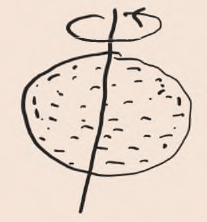
2. Energy Loss and Contraction (Gas Lost energy by radiation)
- The gas lost energy through radiation, leading to cooling and contraction inward.
- This contraction increased the speed of rotation to conserve angular momentum.
- The nebula bulged out in the equatorial zone due to centrifugal force.
3. Development of Rings:
- Formation of Rings: Centrifugal force became greater than gravitational force, leading to the formation of a ring.
- Successive Rings: This process continued, forming successive rings.

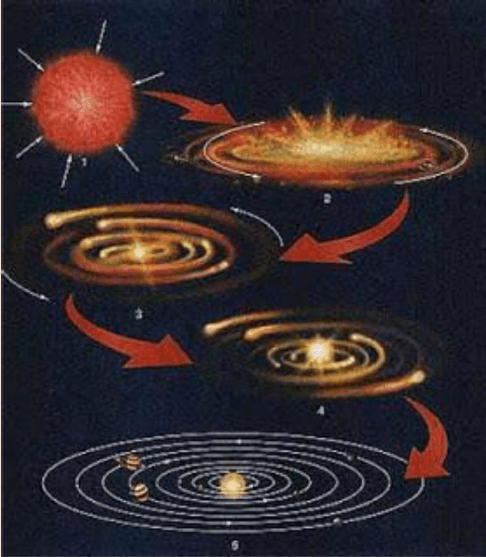
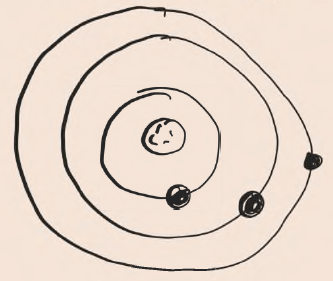
- Formation of Planets:
- The rings condensed and accelerated, eventually forming planets.
- The central mass continued to shrink, leading to the formation of the Sun.
Criticism
- Energy and Angular Momentum Distribution: The hypothesis struggles to explain the distribution of energy and angular momentum, with a significant portion (98%) ending up in planets rather than the central body.
- Insufficient Mass in Rings: There's not enough mass in the rings to generate sufficient gravitational attraction to condense into planets, raising questions about the feasibility of this process.
3. Planetesimal Hypothesis
- Originators: Chamberlin and Moulton (1904).
Theory
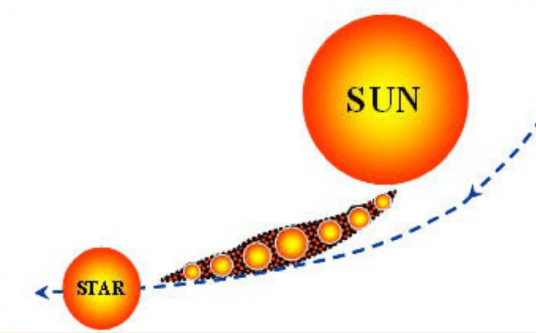
- Pre-existing Sun: The hypothesis posits that the Sun existed before the formation of planets.
- Large Passing Star (Large gravity): A large passing star with significant gravity passed close to the Sun, causing gravitational disruptions.
- Disruption of Solar Mass: The gravitational pull of the passing star caused the disruption of a part of the solar mass, resulting in the formation of a giant gas mass.
- Formation of Planetesimals: Within this giant gas mass, solid particles called planetesimals began to form and revolve around the Sun due to gravitational forces.
Positive Aspects
- Meteorite Formation Explanation: The hypothesis provides a plausible explanation for the formation of meteorites from these planetesimals during the early stages of the solar system.
- Angular Momentum Contribution: It suggests that the passing star contributed angular momentum to the planets, aiding in their rotational motion.
Negative Aspects
- Material Ejection and Condensation: The material ejected from the Sun due to the passing star's effect would be hot and likely to disperse rather than condense into solid planetesimals.
- Insufficient Angular Momentum: Despite the proposed contribution of angular momentum, it may still be insufficient to explain the angular momentum observed in the planets' orbits.
- Low Probability Event: The occurrence of such a specific event involving a large passing star and the disruption of solar mass is deemed to have a low probability, raising questions about the hypothesis' feasibility.
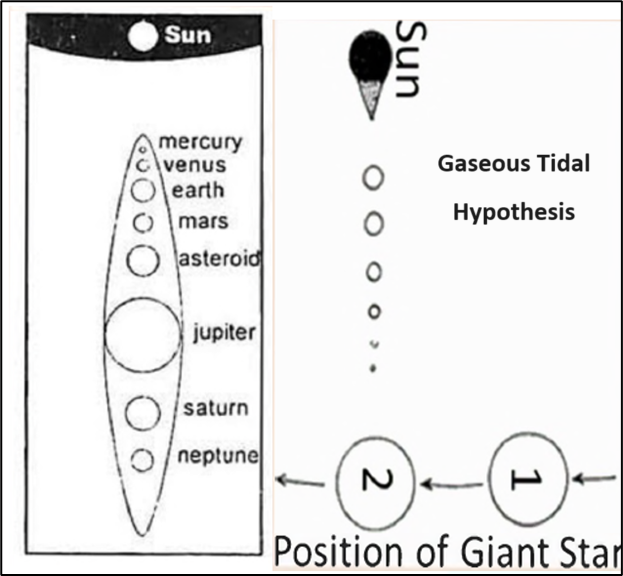
4. Gaseous Tidal Hypothesis
- Proposed by Jeans and Jeffreys- 1925
- Formation of a Gaseous Disk: According to this hypothesis, the early solar system originated from a rotating cloud of gas and dust called the solar nebula.
- Accretion of Matter: Over time, the solar nebula began to condense due to gravitational forces, forming clumps of matter called planetesimals.
- Formation of Protoplanets: These planetesimals continued to collide and merge, forming larger bodies known as protoplanets.
- Differentiation and Core Formation: As protoplanets grew, they underwent differentiation, with heavier materials sinking to form cores and lighter materials rising to form mantles and crusts.
- Formation of Earth: Eventually, one of these protoplanets evolved into Earth through a process of accretion and differentiation.

5. Binary Star Hypothesis
- Given by Lyttleton – 1938.
- Binary Star System Formation: This hypothesis suggests that the Sun was initially part of a binary star system, where two stars orbited around a common center of mass.
- Close Encounter with Another Star: During the early stages of the solar system's formation, the Sun had a close encounter with another star.
- Capture of Material: As a result of this encounter, the Sun captured material from the other star's protoplanetary disk, leading to the formation of planets, including Earth.
- Tidal Forces and Disk Evolution: The gravitational interactions between the Sun and the other star, along with tidal forces, influenced the evolution of the protoplanetary disk around the Sun.
- Formation of Earth: Within this evolving disk, planetesimals and protoplanets formed, eventually coalescing to form Earth and the other planets of the solar system.
6. Modern View – “Proto planet theory” (Cloud-dust hypothesis)
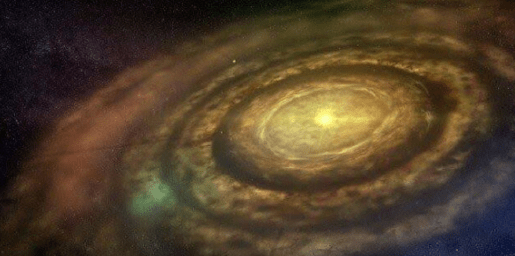
It's a modern iteration of the Laplacian model, focusing on the aggregation of materials in a disc-shaped cloud around the Sun.
Theory
Initiation and Mechanism:
- Cloud-Dust Formation: Initially, there was a disc-shaped cloud of gas and dust surrounding the young Sun.
- Formation of Planets: Planets formed through the aggregation of these materials over time.
Formation of Inner Planets:
- Materials with high melting points, such as metals and rocks, condensed closer to the Sun.
- This led to the formation of the inner planets, characterized by higher density due to their composition.
Formation of Outer Planets:
- Volatile materials, which have lower melting points, condensed farther from the Sun.
- These materials contributed to the formation of the outer planets, which are characterized by lower density compared to the inner planets.
Formation of Primitive Sun:
- The early Sun had significant magnetic fields, which played a role in accelerating hydrogen ions.
- This acceleration caused gas to move outwards from the Sun, contributing to the overall dynamics of the solar system's formation.