
Classification of Meteorites
Genetic classification:
- A genetic relationship exists between similar meteorite specimens.
- They have a common origin from the same astronomical object or parent body. such as a planet, asteroid, or moon.
Traditional classification:
- Three types:
- Stony meteorites: rocky material.
- Iron meteorites: metallic material.
- Stony–iron meteorites: mixtures.
- Most meteorites are stony meteorites. 5% of meteorites are iron meteorites, 1% are stony-iron meteorites.
- These categories but do not have much genetic significance; they are simply a traditional and convenient way of grouping specimens.
- In fact, the term stony iron is a misnomer. One group of chondrites (CB) has over 50% metal.
Modern classification:
- Done based on the composition, chemical and isotopic structure and mineralogy.
- Micrometeorites: Meteorites smaller than 2 mm.
- Extra terrestial meteorites: Objects that have affected other celestial bodies.
1. Stony meteorites
- Made up of rock-forming (silicate) minerals + iron content (small amount).
- Most abundant.
- Divided into- Chondrites and Achondrites.
Chondrites
- About 86% of the meteorites are chondrites.
- It is a stony (non-metallic) meteorite that has not been modified, by either melting or differentiation of the parent body.
- Formed when dust and small grains in the early Solar System accreted to form primitive asteroids.
- One of the oldest and most primitive solid materials within the Solar System.
- Considered to be "the building blocks of the planets".
- Important to understand the initial development of the planetary system.
Composition:
- Composed mostly of silicate minerals.
- Some chondrites also contain small amounts of organic matter. E.g. amino acids, presolar grains.
- Low iron and nickel content.
Example:
- The largest individual stone ever recovered was part of the Jilin meteorite shower of 1976.
- Holbrook fall of 1912: 14,000 stones grounded in Arizona.
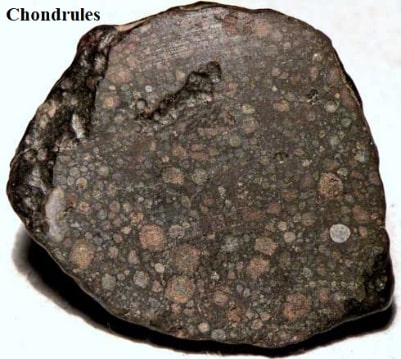
Chondrules:
- Greek- grain.
- A chondrule is a round grain found in a chondrite.
- The chondrules are composed mostly of silicate minerals.
- These are molten or partially molten droplets in space before being accreted to their parent asteroids.
Achondrites
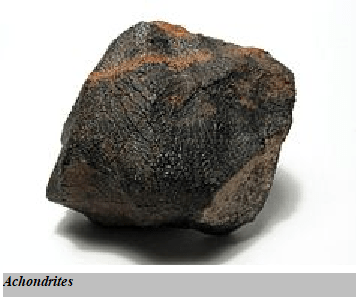
- Accounts for 8% of overall meteorites.
- They do not contain chondrules.
- Contain minerals which has been altered and change during their formation.
- Much younger than chondrites.
- Similar composition as terrestrial igneous rocks.
- It consists of material similar to terrestrial basalts, gabbro or plutonic rocks.
- Differentiated and reprocessed due to melting and recrystallization on or within meteorite parent bodies.
- As a result, these have distinct textures and mineralogies indicative of igneous processes.
2. Iron meteorites
- About 5% of meteorites. Also known as siderites or ferrous meteorites.
- Consist mainly of an iron–nickel alloy known as meteoric iron that usually consists of two mineral phases: kamacite and taenite.
- Some impurities like graphite and troilite.

Occurrence and characteristics:
- There is low abundance in collection areas such as Antarctica, where most of the meteoric material that has fallen can be recovered.
- The abundance of iron meteorites in total Antarctic finds is 0.4%.
- Denser than stony meteorites, hence account for almost 90% of the mass of all known meteorites.
- All the largest known meteorites are of this type. Largest is the Hoba meteorite.
- Highly resistance to weathering.
- They are easily recognized even by laymen, as opposed to stony meteorites.
- They are much more resistant to weathering.
- More likely to survive atmospheric entry.
- More resistant to ablation.
- Hence, more likely to be found as large pieces.
- Modern-day searches for meteorites in deserts and Antarctica yield a much more representative sample of meteorites overall.
- Buried iron meteorites can be found by use of metal detecting equipment.
Origin:
- Considered to come from the cores of planetesimals that were once molten.
- Even in the Earth, the denser metal separated from silicate material and sank toward the center of the planetesimal, forming its core.
Widmanstatten patterns:
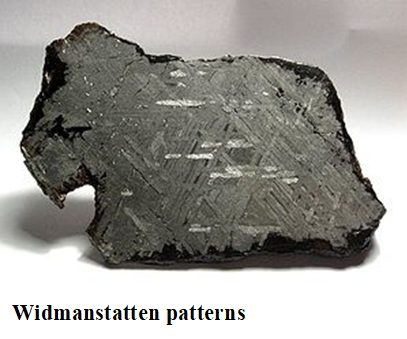
- Also known as Thomson structures.
- Banded patterns on the exposed surface.
- They consist of a fine interleaving of kamacite and taenite bands or ribbons called
- In gaps between lamellae, a fine-grained mixture of kamacite and taenite called plessite is found.
Classification of iron meteorites
- A chemical classification scheme is based on the proportions of the trace elements in ppm. Eg. Gallium (Ga-31), Germanium (Ge- 32), Iridium (Ir- 77)
- This classification is based on diagrams that plot nickel content against different trace elements (e.g. Ga, Ge and Ir).
- The different iron meteorite groups appear as data point clusters.
a. Magmatic iron meteorite groups:
- Magma is the molten or semi-molten natural material from which all igneous rocks are formed. E.g.
- IIC: Plessitic octahedrites, 9–12% Ni.
- IID: Fine to medium octahedrites, 10–11%Ni.
b. Non-magmatic or primitive iron meteorite groups:
E.g. IAB and IIE
- IA: Medium and coarse octahedrites, 6-9% Ni.
- IB: A taxites and medium octahedrites, 9–25% Ni.
- IIE: octahedrites of various coarseness, 7.5–10% Ni.
3. Stony-iron meteorites
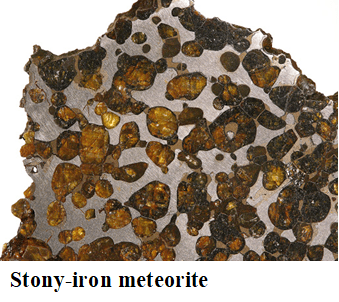
- Also known as siderolites. Extremely rare: only 1%.
- Consist of nearly equal parts of meteoric iron and silicates.
- Formed by mixing between metal cores and the rocky magmas within asteroids.
- These are all differentiated, meaning that they show signs of alteration. They are therefore achondrites.
- They are in the top rank of all Meteorite classification schemes, usually known as "Type".
Mineralogy
- Metal: The meteoric iron of stony-irons is similar to that of iron meteorites, consisting mostly of kamacite and taenite.
- Stone: The silicates are dominated by olivine.
- Accessory minerals include non-silicates. Eg. troilite, feldspar, graphite, ilmenite, chromite, carlsbergite, cohenite, daubréelite, merrillite, low-calcium pyroxene, schreibersite, and tridymite.
Classification
- Pallasites: have a matrix of meteoric iron with embedded silicates (most of it olivine).
- Mesosiderites: These are breccias which show signs of metamorphism. The meteoric iron occurs in clasts instead of a matrix.
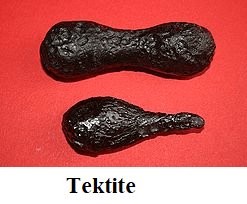
4. Tektites
(Greek- molten).
- These are not themselves meteorites, but are rather natural glass objects formed by the impacts of large meteorites on Earth's surface.
- Up to a few centimeters in size.
Characteristics
- Fairly homogeneous composition.
- Abundance of lechatelierite.
- A general lack of microscopic crystals microlites.
- Extremely low water and other volatiles content.
- Chemically related to local bedrock or local sediments.
- Their distribution within geographically extensive strewn fields.
Classification
- Land tektites: three types.
- Splash-form (normal) tektites.
- Aerodynamically shaped tektites.
- Muong Nong-type (layered) tektites.
- Deep-sea sediment tektites- Microtektites.
Origin
Terrestrial source theory:
- Mostly accepted theory.
- Tektites consist of terrestrial debris that was ejected during the formation of an impact crater.
- Mechanism:
- Hypervelocity meteorite impact.
- Near-surface terrestrial sediments and rocks were either melted or vaporized
- Ejected from an impact crater.
- The material formed millimeter- to centimeter-sized bodies of molten material.
- As they re-entered the atmosphere, rapidly cooled to form tektites
- Fell to Earth to create a layer of distal ejecta hundreds or thousands of kilometers away from the impact site.
Extraterrestrial source theories:
- Suggested in 1897 by the Dutch geologist Marius Verbeek.
- They fell to Earth from the Moon.
- They consist of material ejected from the Moon by major hydrogen-driven lunar volcanic eruptions and then drifted through space to later fall to Earth as tektites.
5. Fossil meteorite
- These are deep weathering remains of meteorites, which were preserved in sediment deposits.
- Can give idea about the history of the solar system.
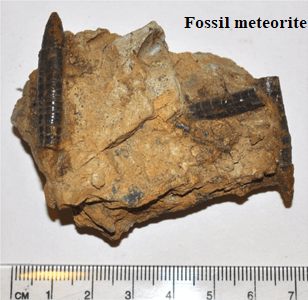
Example: Thorsberg quarry, Sweden:
- Marine limestone quarry from Ordovician age.
- Produced hundreds of fossil meteorites.
- One of our fossil meteorites has a composition that does not resemble any of the 50,000 documented meteorites that have fallen on Earth in recent times.
- This meteorite, named Österplana 065, likely represents a fragment of the smaller body that hit and broke up the large L-chondrite parent body.
- Most are all deeply weathered L-chondrites that are still like the original meteorite under a petrographic microscope.
- But their original material was almost entirely replaced by terrestrial secondary mineralization.
6. Classification of chondrites
Enstatite chondrite (E-type chondrites)
- High in the mineral enstatite (MgSiO3).
- These are among the most chemically reduced rocks. Most of their iron is in the form of metal or sulfide rather than as an oxide.
- This suggests that they were formed in an area that lacked oxygen, probably within the orbit of Mercury.
- Comprise about 2% of the chondrites that fall to Earth. Only about 200 E-Type chondrites are currently known.
- Mostly recovered in Antarctica or collected by the American National Weather Association.
- Eg. Saint Sauveur enstatite chondrite.
Ordinary chondrites (O chondrites)
- Most common type of meteorite to fall to Earth. About 80% of all meteorites and over 90% of chondrites are ordinary chondrites. Hence, known as "ordinary".
- Originated from parent asteroids.
- Composition: abundant chondrules, sparse matrix (10–15% of the rock), few refractory inclusions, variable amounts of Fe-Ni metal and troilite (FeS).
- Most of them have experienced significant degrees of metamorphism.
Identification:
- Depleted in refractory lithophile elements relative to Si. Eg. Ca, Al, Ti, and rare earths.
- Isotopically unusually high O17/O16 ratios, relative to O18/O16 compared to Earth rocks.
Classification:
- H chondrites.
- High total iron and high metal (15–20% Fe-Ni).
- Lower iron oxide (Fa) in the silicates.
- Have bronzite, olivine, pyroxene, plagioclase etc.
- Smaller chondrules than L and LL chondrites.
- L chondrites.
- Lower total iron, lower metal (7–10% Fe-Ni).
- higher iron oxide (Fa) in the silicates.
- The most common type of meteorite to fall on Earth. (approx. 45-50%)
- LL chondrites.
- Low total iron and Low metal
- Highest iron oxide content (Fa) in the silicates.
- LL chondrites have Low total iron and Low metal (3–5% Fe-Ni).
- Also contain bronzite, oligoclase and olivine.
- Only 1 in 10 ordinary chondrite falls belong to this group.
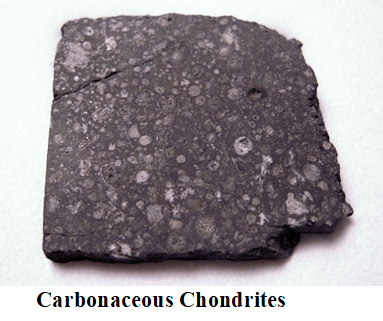
Carbonaceous Chondrites (C type chondrites)
- Less than 5% of the chondrites that fall on Earth.
- Characterized by the presence of carbon compounds, including amino acids.
- Formed the farthest from the sun of any of the chondrites, as they have the highest proportion of volatile compounds.
- Presence of water or of minerals that are altered by the presence of water.
- Formed in oxygen-rich regions of the early solar system: so that most of the metal is not found in its free form, but as silicates, oxides, or sulfides.
- Unaltered by heating.
Identification:
- Enriched in refractory lithophile elements relative to Si.
- Isotopically unusually low O17/O16 ratios, relative to O18/O16 compared to Earth rocks.
Classification:
- CI (Ivuna type) chondrites entirely lack chondrules and refractory inclusions.
- CO (Ornans type) and CM (Mighei type) chondrites contain very small chondrules.
- CR (Renazzo type), CB (Bencubbin type), and CH (high metal) are All are rich in metallic Fe-Ni.
- CV (Vigarano type) chondrites are characterized by mm-sized chondrules.
- CK (Karoonda type) chondrites are chemically and texturally similar to CV chondrites. However, they contain far fewer refractory inclusions than CV.
- Ungrouped carbonaceous chondrites: do not fit into any of the above groups.
Kakangari chondrites (K type)
- Characterized by large amounts of dusty matrix.
- Oxygen isotope similar to carbonaceous chondrites.
- Highly reduced mineral compositions and high metal abundances (6% to 10%): that are most like enstatite chondrites.
- Refractory lithophile elements are like ordinary chondrites.
Rumuruti chondrites (R type)
- Very rare group: only one documented fall.
- Many properties are similar to ordinary chondrites: eg. similar types of chondrules, few refractory inclusions, similar chemical composition for most elements.
- Differences from ordinary chondrites: R chondrites have more dusty matrix (50% of the rock); more oxidized, little metallic Fe-Ni.
- O17/O16 ratios are anomalously high compared to Earth rocks.
- Nearly all the metal is oxidized or in the form of sulfides.
- They have fewer chondrules than the E chondrites and appear to come from an asteroid's regolith.
- Also contain Olivine, Pyroxenes, Plagioclase, Sulfides.
Petrologic types
A chondrite's group is determined by its primary chemical, mineralogical, and isotopic characteristics.
The degree to which it has been affected by the secondary processes of thermal metamorphism and aqueous alteration on the parent asteroid is indicated by its petrologic type.
It appears as a number following the group name (e.g., an LL5 chondrite belongs to the LL group and has a petrologic type of 5).
Schemes for describing petrologic types
The current scheme for describing petrologic types was devised by Van Schmus and Wood in 1967.
Petrologic scheme by Van Schmus describes aqueous alteration.
Both Type 1 and 2 chondrites are unequilibrated.
- Type 1 chondrites:
- Experienced extensive aqueous alteration, to the point that most of their olivine and pyroxene have been altered to hydrous phases.
- The alteration took place at temperatures of 50 to 150 °C, but not hot enough to experience thermal metamorphism.
- Type 2 chondrites:
- Experienced extensive aqueous alteration.
- But still contain recognizable chondrules as well as primary, unaltered olivine and/or pyroxene.
- The alteration probably occurred at temperatures below 20 °C, and these meteorites are not thermally metamorphosed.
Petrologic scheme by Wood describes thermal metamorphism
- Type 3 chondrites:
- Show low degrees of metamorphism.
- Often referred to as unequilibrated chondrites because minerals such as olivine and pyroxene show a wide range of compositions, reflecting formation under a wide variety of conditions in the solar nebula.
- Types 4, 5, and 6 chondrites:
- Have been increasingly altered by thermal metamorphism.
- These are equilibrated chondrites, in which the compositions of most minerals is quite homogeneous due to high temperatures.
- As metamorphism proceeds, many minerals coarsen and new, metamorphic minerals such as feldspar form.
Note: All ordinary and enstatite chondrites, R and CK chondrites, show the complete metamorphic range from type 3 to 6.
7. Classification of achondrites
Primitive achondrites (PAC group)
- Their chemical composition is primitive and is similar to the composition of chondrites.
- Their texture is igneous, indicative of melting processes.
Examples:
- Acapulcoites: named after the meteorite Acapulco, Mexico.
- Lodranites: named after the meteorite Lodran.
- Winonaites: named after the meteorite Winona.
- Ureilites: named after the meteorite Novy Ureii, Russia.
- Brachinites: named after the meteorite Brachina.
Asteroidal achondrites
- Also called evolved achondrites, because they have been differentiated on a parent body.
- Their mineralogical and chemical composition was changed by melting and crystallization processes.
Examples:
- HED meteorites (Vesta): might have originated on the asteroid 4 Vesta, because their reflection spectra are very similar. Eg. Howardites, Eucrites, Diogenites.
- Angrites: named for the Angra dos Reis meteorite. Rare group of achondrites consisting mostly of the mineral augite.
- Aubrites: named for the meteorites Aubres, France.
Lunar meteorites
- Originated from the Moon.
- Includes rocks similar to those brought back to Earth by Apollo and Luna programs.
Martian meteorites
- Originated from Mars.
- Examples: Shergottites, Nakhlites, Chassignites, OPX martian meteorites, Regolith/Soil samples.