
Meteorites
Background
- Historically, considered as act of God in animism and primitive religions.
- German physicist Ernest Chlani is the father of meteorites.
- He published in modern Western thought (in 1794) that meteorites are rocks from space.
Introduction
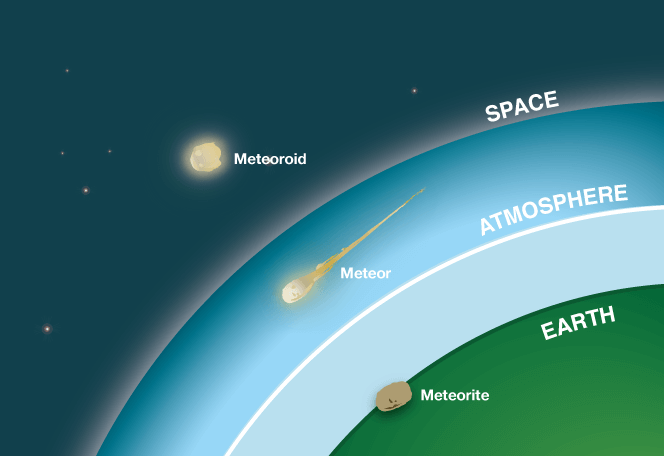
- It is an object like a meteoroid, comet, or asteroid, which survived its passage through the atmosphere to reach the surface of a planet.
- When the original object enters the atmosphere, it heats up and radiates energy.
- It first becomes a meteor.
- Once it settles on the planet’s surface, the meteor becomes a meteorite.
- Meteorites help scientists in investigating the nature of the material from which the solar system was formed.

- For geologists, a bolide is a meteorite large enough to create an impact crater.
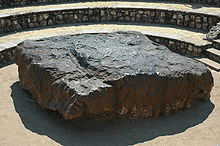
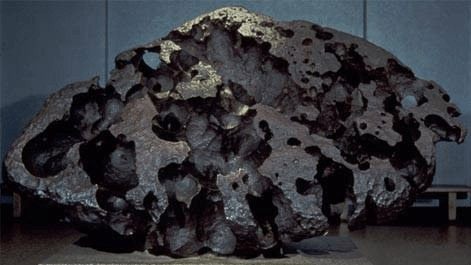
- An impact event is a collision between astronomical objects causing measurable effects. Hoba meteorite in Namibia: the largest known impact meteorite.
- On a stony body, such as the moon or Mars, which has little or no atmosphere, they leave permanent pits.
- Few meteorites are large enough to create large impact craters.
- Typically, they arrive at the surface at terminal velocity and, at most, create a small pit.
- A very bright meteor is called a fireball.
Factors affecting the meteorites to enter the earth’s atmosphere-
- Friction.
- Pressure.
- Chemical interaction with atmospheric gases.
Journey of a Meteorite
- Most meteoroids disintegrate while entering the Earth's atmosphere.
- Usually, five to ten a year are observed fall, and are subsequently recovered.
- Large meteoroids strike the earth with the escape velocity, and creates a hypervelocity impact crater.
- Factors of Crater type: impactor size, composition, degree of fragmentation, incoming angle.
- When the path of a meteoroid intersects with Earth's orbit, it enters the atmosphere at high velocity causing a meteor or shooting star.
Iron meteoroids
- These create the most frequent hypervelocity cratering events.
- These pass through the atmosphere easily.
- E.g. Barringer Meteor Crater, Odessa Meteor Crater, Wabar craters, and Wolfe Creek crater
Stony or icy meteoroids
- These are disrupted in the atmosphere.
- Very large and heavy stony objects can reach the surface.
- These make large craters but are very rare.
- The event is so energetic that the impactor is destroyed, leaving no meteorites.
- Morokweng crater in South Africa: First reported stony meteorite in association with a large impact crater.
Differences Between Iron Meteoroids and Stony Meteoroids:
|
Characteristic |
Iron Meteoroids |
Stony Meteoroids |
|
Composition |
Mostly composed of iron and nickel alloys. |
Composed of silicate minerals and rock-like materials. |
|
Appearance |
Often appear metallic and may have a shiny surface. |
Typically have a non-metallic appearance with a dull surface. |
|
Density |
Higher density, usually denser than stony meteoroids. |
Lower density compared to iron meteoroids. |
|
Color |
Can be silver, gray, or metallic in color. |
Varied colors, often earthy tones or shades of gray. |
|
Magnetic Properties |
Attracted to magnets due to iron content. |
Typically, not strongly attracted to magnets. |
|
Formation |
Thought to originate from the cores of larger asteroids. |
Formed from the outer layers or crust of asteroids or parent bodies. |
|
Rarity |
Less common compared to stony meteoroids. |
More common and make up the majority of meteoroids observed. |
|
Impact Craters |
Tend to create deeper impact craters due to higher density. |
Create shallower impact craters due to lower density. |
|
Entry Characteristics |
Tend to create bright fireballs during atmospheric entry. |
May produce less dramatic fireballs during entry. |
|
Compositional Variability |
Less variability in composition among iron meteoroids. |
Greater variability in composition among stony meteoroids. |
Strewn field
- Meteoroids that disrupt in the atmosphere may fall as meteorite showers.
- The area of a meteorite shower falls is known as its strewn field.
- Strewn fields are mostly elliptical.
- The major axis is parallel to the direction of flight.
Ablation
- It means loss of a part by melting or vaporization. It removes material from the surface.
- Meteoroids are heated during atmospheric entry.
- The surfaces melt and experience ablation.
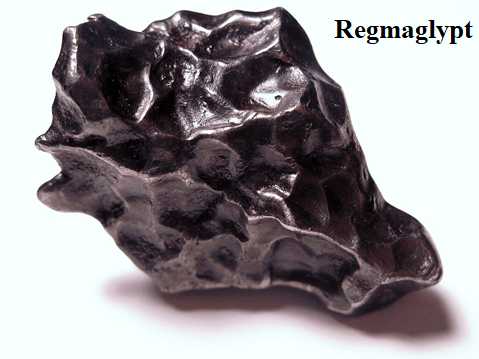
- This ablation can produce regmaglypts.
- If the meteoroid maintains a fixed orientation for some time, it may develop a conical nose cone or heat shield shape.
- With deceleration, the molten layer solidifies into a thin fusion crust.
- In stony meteorites, the heat-affected zone is at most a few mm deep.
- Iron meteorites are thermally conductive. These may be "burning hot to the touch" upon landing.
- The surface melting by ablation in their flight will soften the edges and rounds, and sculpts them.
Oriented meteorite
- It is formed when it's passage through the atmosphere is in a stable orientation without tumbling.
- It receives the ablation features on one surface.
- Most of the time the piece of meteoroid will tumble during flight and they will be uniformly melted on all sides.
Regmaglypts
- These are the thumbprints (pits) on the surface where material has been ablated away.
- Regmaglypts are shallow, thumbprint-like or concave impressions or depressions on the surface of a meteorite, that are formed by ablation of material.
- Regmaglypts are typically more prominent on stony meteorites than on metallic ones.
- This process helps in meteorite identification: the exterior features of space rocks are different from that of Earth rocks.
- Regmaglypts serve as a visual indicator of a meteorite's authenticity. Genuine meteorites should display these unique surface features, distinguishing them from terrestrial rocks.
Formation:
- Regmaglypts form during a meteorite's descent through Earth's atmosphere. As the meteorite travels at high speeds, it experiences intense heating due to air resistance, which causes the surface to melt and ablate.
- During this process, molten material is swept away, creating depressions or cavities on the meteorite's surface.
Characteristics:
- Regmaglypts are typically small, ranging from millimeters to a few centimeters in size.
- They are often irregular in shape, resembling thumbprints or small craters.
- The depth and size of regmaglypts can vary depending on the meteorite's size, composition, and the conditions it experienced during its atmospheric entry.
Significance:
- Regmaglypts are a distinctive and fascinating aspect of meteorites, contributing to their scientific and collector's appeal.
- The study of regmaglypts can provide insights into the meteorite's journey through the atmosphere, including its angle of entry, speed, and ablation process.
- They are one of many features that help scientists classify and study meteorites, shedding light on the origins of these extraterrestrial objects.
Meteorite Falls vs Find Meteorites
Meteorite falls are events where a meteoroid enters Earth's atmosphere, creates a fireball, and lands as meteorites. They are witnessed and can provide valuable scientific data. Found meteorites are those that were not witnessed during entry and are discovered on Earth's surface, sometimes even years after landing. They are valuable but may lack contextual information.
|
Meteorite Falls |
Find Meteorites |
|
|
Origin |
Enter Earth's atmosphere. These are collected after falling, by people or automated devices. |
Meteorites that people found, but whose fall was not seen. |
|
Discovery |
Witnessed event |
Typically, accidental |
|
Weathering |
Not subjected to terrestrial weathering: a better candidate for scientific studies. |
Subject to different amounts of weathering. |
|
Timing |
Sudden and unexpected |
Can be found at any time |
|
Observation |
Often seen as a fireball |
No prior observation |
|
Impact location |
Varies widely |
Usually concentrated |
|
Scientific value |
Provides context |
Often lacks context |
|
Classification |
More information available |
May require analysis |
|
Frequency |
Relatively rare. There are about 1,200 documented falls. (Meteor Bulletin Database) |
More common. Finds about 60,000 well-documented meteorites. |
|
Examples |
Tunguska (1908), Chelyabinsk (2013) |
Canyon Diablo, Campo del Cielo |
|
Study opportunities |
Immediate collection |
May remain undiscovered |
Impact Craters
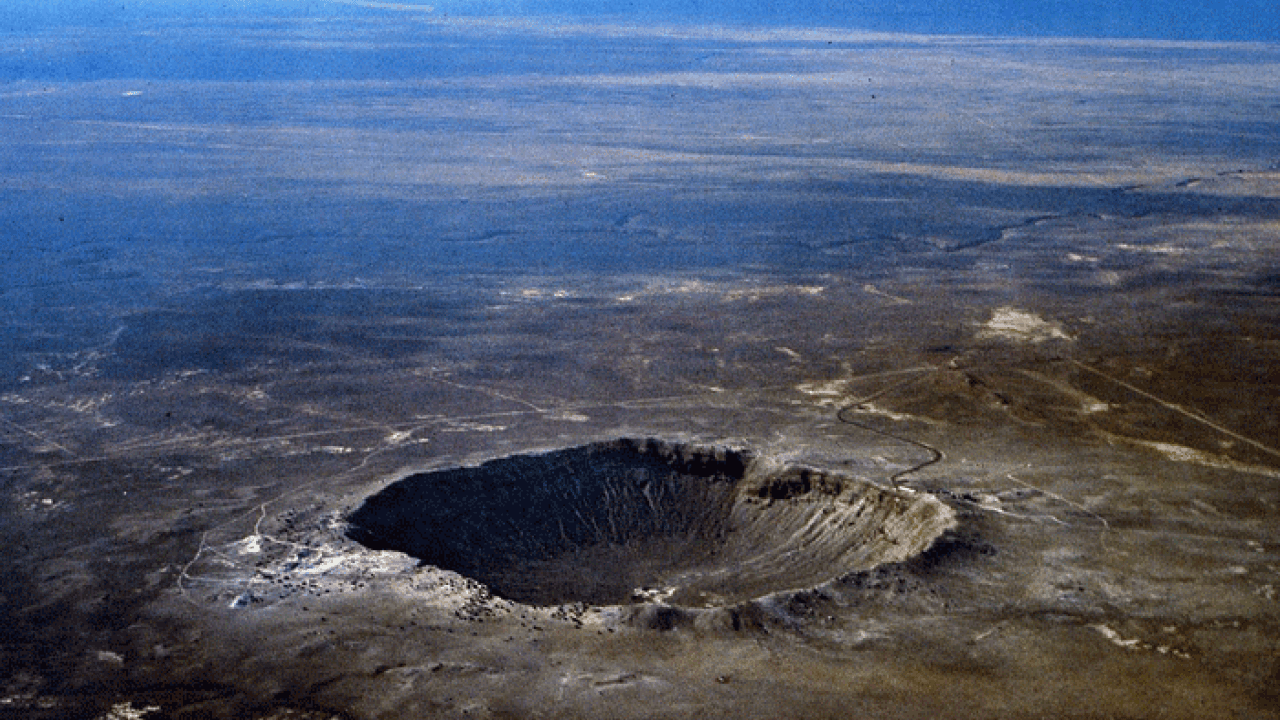
- Large meteoroids rarely reach the ground with enough velocity and mass to form an impact crater.
- It is a circular depression in the surface of a solid body in the universe, formed by the hypervelocity impact of a smaller body.
- These are dominant geographic features on many solid small moons and asteroids, Moon, Mercury, Callisto, Ganymede etc.
- These are less common on those bodies that have more active surface geological processes.
- They have eroded, buried or transformed by tectonics over time.
- Eg. Earth, Venus, Mars, Europa, Io and Titan.
- They have raised rims and floors that are lower in elevation than the surrounding terrain.
- Impact craters are not to be confused with similar landforms. E.g. calderas, sinkholes, glacial cirques etc.
- Although Earth's active surface processes quickly destroy the impact record, about 200 terrestrial impact craters are identified.
- Age: from recent times to more than two billion years.
- Most are less than 500 million years old because geological processes obliterate them.
- Some undersea craters are also discovered.
- EXAMPLE- Barringer Meteorite Crater in Arizona, about 1 kilometer size.
- Formed by the impact of a 50 meters iron–nickel metal.
- The best preserved impact crater.
- The Moon's craters were formed by large asteroid impacts. - GK Gilbert, 1893
- The Moon's craters were mostly of impact origin. - Ralph Baldwin, 1949
Impactite:
- A type of rock associated with impact structures and craters.
- A glassy rock, also called crater glass.
- Formed by melting of native rocks during the impact of asteroids.
Tektites:
- It is another natural glass object formed by the melting of native rocks during asteroid impacts.
- It is less understood.
Meteorite Weathering
- The terrestrial alteration of meteorites is called weathering.
- Most meteorites date from the oldest times in the Solar System.
- These are by far the oldest material available on our planet.
- Despite their age, they are vulnerable to the terrestrial environment.
- Terrestrial environment eg. water, salt, and oxygen attack them as soon they reach the ground.
Weathering scale:
- Used for ordinary chondrites
- From W0 (pristine state) to W6 (heavy alteration).
- W0: no visible oxidation of metal or troilite. Usually recently fallen meteorites are of this grade.
- W6: heavy replacement of silicates by clay minerals and oxides.
Significance of Meteorites
- Origin of the Solar System:
- Meteorites hold clues about how the solar system formed.
- They are remnants of the early solar system's material.
- Primitive Materials:
- Meteorites contain untouched materials from the early solar system.
- They help us study the composition and conditions of its infancy.
- Chemical Composition:
- Meteorites have diverse chemical compositions.
- They reveal unique elements and isotopes not common on Earth.
- Insights into Earth's History:
- Meteorites provide insights into Earth's geological past.
- They aid in dating Earth's age and major events like moon formation.
- Impact Events:
- Meteorite impacts have shaped Earth's history.
- They're crucial for studying past extinction events.
- Cosmic Evolution:
- Meteorites offer a glimpse into cosmic evolution.
- They preserve a history of the universe over billions of years.
- Planetary Science:
- Meteorites help understand other planets and moons.
- Comparing their compositions aids planetary science.
- Asteroid and Comet Research:
- Meteorites originate from asteroids and, occasionally, comets.
- They provide insights into these celestial bodies.
- Space Resource Exploration:
- Some meteorites contain valuable metals and minerals.
- They have potential economic importance for future space resource use.
- Preservation of Organic Compounds:
- Certain meteorites contain organic compounds, including amino acids.
- They hint at the possibility of extraterrestrial life.
- Scientific Education:
- Meteorites inspire public interest in astronomy and space science.
- They serve as educational tools and encourage future scientists.
Role of Meteorites to understand the origin of life
- Complex organic compounds found in DNA and RNA, including uracil, cytosine, and thymine, are formed in the laboratory under outer space conditions.
- Used starting chemicals, such as pyrimidine, found in meteorites. - NASA, 2015.
- Pyrimidine and polycyclic aromatic hydrocarbons (PAHs) may have been formed in red giants or in interstellar dust and gas clouds.
- 4.5-billion-year-old meteorites found on Earth contained liquid water along with prebiotic complex organic substances that may be ingredients for life.
- In 2019, Sugar molecules in meteorites reported for the first time, including ribose.
- Suggesting that chemical processes on asteroids can produce some organic compounds fundamental to life.
- It supported the notion of an RNA world prior to a DNA-based origin of life on Earth.