
Facies of Regional and Contact Metamorphism
Facies of Regional and Contact Metamorphism
Regional Metamorphic Facies
- The regional metamorphism is associated with major tectonic events on earth.
- Regional metamorphic rocks are associated with the collision of plates, where crust has been exposed at extensional faults, mountain orogeny.

Fig: Cross section of island-arc resembling different facies
The facies associated with regional metamorphism are-
- Low pressure facies: Zeolite facies, Prehnite-pumpellyite facies.
- Medium-Low pressure facies: Greenschist facies, Amphibolite facies, Granulite facies.
- High pressure facies: Blueschist facies, Eclogite facies.
Zeolite facies
- These facies consist of minerals which are exposed to low pressure and temperature (~150- 3000C; <3-4 Kb), and responds to first major burial.
- It is the regional metamorphism of basic igneous rocks and greywacke.
- The facies belongs to burial metamorphism.
- Metamorphic reactions are incomplete here which makes the poor developed fabrics in the rocks.
- Mineral assemblages: Zeolites (laumonite, wairakite, analcime), quartz, clayey minerals.
- It is characterized by stabilization of Zeolite group of minerals + quartz + albite + clay minerals.
- The Zeolites are hydrated Ca-Na- Al silicate and include minerals Analcime, Laumontite, Heulandite, Stilbite, Wairakite, Lawsonite.
- Zeolite facies is untraceable in pelitic bulk because of lack of Ca in it.
- The characteristic zeolite facies mineral assemblage develops in metabasic bulk in presence of little or no deviatoric stress during burial metamorphism. It is free from any foliation.
Prehnite-Pumpellyite facies
- The facies exhibit higher pressure and temperature than zeolite facies but lower than greenschist and blueschist facies.
- It is mainly found in greywacke type sediments.
- The replacement of zeolite mineral by prehnite and pumpellyite minerals take place here.
- The facies is characterized by the presence of prehnite + pumpellyite with chlorite, calcite +/- zeolite.
- Prehnite is a Ca-Al silicate. Wairakite and laumontite of Zeolite facies breaks down to form prehnite around 3 Kb at 300-4000C to mark the onset of Prehnite-pumpellyite facies in basic bulk.
- Pumpeyllite is s It contains some Fe, Mg along with Ca, and Al.
- This facies is also not traceable in pelitic bulk composition.
- This is a sub-greenschist facies assemblage beside zeolite that encountered in meta-basic rock of Burial metamorphism.
Mineral assemblage of this facies:
- Metapelite rocks: These are characterized by an assemblage of chlorite, muscovite, albite and quartz
- Greywackes and meta-igneous rocks: These are characterized by an assemblage of prehnite, pumpellyite, chlorite + albite, quartz, epidote, muscovite.
Greenschist Facies
- The facies exhibits metamorphic mineral assemblage existing in low pressure and temperature.
- The facies named ‘green’ due to the assemblage of green coloured minerals such as chlorite, epidote and actinolite type minerals.
- The rocks formed in these facies consist of highly developed foliation such as schist.
- The transition from Prehnite-pumpellyite facies to Greenschist facies is marked by the breakdown of prehnie +/- zeolite to zoisite.at ~ 4000C.
Mineral assemblage of this facies:
- In meta greywacke: albite + epidote + muscovite + chlorite + quartz +/- biotite
- In meta basic rock: chlorite + albite + zoisite + quartz + actinolite + epidote +/- calcite +/- sphene +/- ilmenite.
- In meta pelites: chlorite + muscovite + biotite +/- albite +/- chloritoid +/- Al2SiO5
- In calc-silicate rock: dolomite + quartz + talc +/- tremolite + calcite
Amphibolite Facies
- This metamorphic facies marks some characteristic changes in rocks of different bulk composition at medium pressure and high temperature (~ 5500C).
- Rocks found in this facies consist of high foliation and schistose structure.
Mineral assemblages:
a. In metabasic rock:
- Plagioclase composition becomes more anorthitic.
- In greenschist facies at 4750C plagioclase is approximately An5 whereas in the amphibolites facies around 5500C plagioclase is ~ An45 (andesine).
- Hornblend is the stable amphibole, Garnet may appear while epidote becomes insignificant.
- Assemblage: hornblende + andesine +/- garnet +/- epidote.
b. In pelitic bulk: Staurolite + Al2SiO5 polymorph ( kyanite / sillimanite) make their appearance. Chlorite disappears. Assemblage: staurolite + garnet + muscovite + biotite + kyanite/sillimanite + quartz + albite.
c. In calc-silicate bulk: dolomite + diopside + quartz +/- forsterite +/- grossular garnet
Granulite Facies
- It is the high grade facies existing in medium pressure conditions occur in depth.
- The rocks consist of anhydrous minerals which are formed due to dehydration of amphibolites at high temperature.
- Rocks of the facies show granular texture with weak schistosity.
- Characteristic mineral:
Mineral assemblages:
- In Metabasites: orthopyroxene, clinopyroxene, hornblende, plagioclase, biotite, quartz, garnet.
- In Metapelites: garnet, cordierite, sillimanite, K-feldspar, quartz, biotite
Blueschist Facies
- This is the only high-pressure-low temperature metamorphic facies of regional metamorphism.
- The facies represent deep metamorphism and found in subduction zones.
- The name of the facies comes with the appearance of blue amphibole glaucophane and lawsonite.
Mineral assemblages:
- Metagreywacks: quartz, jadeite, lawsonite, glaucophane, chlorite
- Metabasites: glaucophane, lawsonite, chlorite, sphene, epidote
- Metapelites: phengite, paragonite, carpholite, chlorite, quartz
- Carbonate rocks: aragonite
Eclogite Facies
- The facies are found at high temperature and pressure.
- The name of the facies formed after the occurrence of mineral eclogite.
- Characteristic minerals: garnet (pyrope-grossular rich) + omphactic pyroxene association in metabasic bulk and complete absence of plagioclase of any composition.
- Other minerals: kyanite, quartz and rutile.
- In metasediments: talc + kyanite + phengitic muscovite (whiteschist).
- In high pressure-moderate temperature eclogite facies lawsonite and epidote are stable along with glaucophenic amphibole + garnet. This assemblage marks the transition from Blueschist to Eclogite.
- In high pressure-high temperature eclogite facies omphacite + pyrope rich garnet are the major minerals in metabasic rock. This assemblage is typical of Granulite to Eclogite facies transition.
Contact Metamorphism Facies
- Facies of contact metamorphism take place at high temperature and low pressure conditions.
- Xenoliths picked up by the magma may be metamorphosed to the Sanidinite Facies, but such rocks are relatively rare.
- The facies are-
- Albite - Epidote Hornfels Facies
- Hornblende Hornfels Facies
- Pyroxene Hornfels Facies
- Sanidinite facies
Albite - Epidote Hornfels Facies
- The facies is generally take place at low pressure and low temperature conditions.
- The rock forms here is hornfels.
- Characteristic minerals: albite and epidote.
Mineral assemblages:
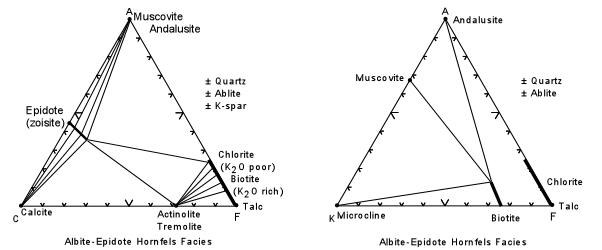
- Metabasites: albite, epidote, actinolite, chlorite and quartz
- Metapelites: quartz, muscovite, biotite, chlorite
- Calcareous rocks: Calcite, epidote and tremolite, with possibly quartz.
- Quartzo-feldspathic rocks: microcline, quartz, muscovite, albite, and biotite.
Hornblende-Hornfels Facies
- The facies take place in low pressure but higher temperature as compare to albite-epidote hornfels facies.
- Characteristic mineral:
Mineral assemblages:
- Metabasites: hornblende , plagioclase , diopside, anthophyllite, quartz. Note the absence of epidote and actinolite.
- Metapelites: muscovite , biotite , andalusite , cordierite , quartz. Note the absence of epidote and chlorite in these assemblages.
- Silica rich dolostone: Calcite, quartz, dolomite
- Meta-igneous rocks: cordierite, anthophyllite , biotite , plagioclase ,quartz.

Pyroxene-Hornfels Facies
- The facies resemble granulite facies of regional metamorphism and exists in high temperature.
- Characteristic mineral: orthopyroxene
Mineral assemblages:
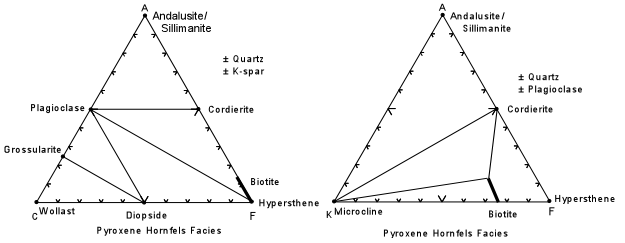
- Metabasites: orthoyroxene, clinoyroxene, olivine, plagioclase, quartz
- Metapelites: characterized by an assemblage of quartz, plagioclase, K-spar, andalusite or sillimanite, and cordierite. Note the absence of muscovite.
- Carbonate rocks: calcite, diopside, wollastonite, grossular, diopside
- Quartzo-feldspathic rocks will be characterized by an assemblage of K-spar, quartz, plagioclase and biotite. Note the absence of muscovite
- Calcareous rocks will consist of plagioclase, grossularite, and diopside and possibly quartz, or wollastonite, diopside, and grossularite with possibly quartz. Note the absence of calcite and tremolite in these assemblages.
Sanidinite Facies
- It is the rare facies and exists in high pressure and high temperature conditions.
- It is relatively rare facies. It represents the highest conditions of temperature.
- The facies is characterized by the absence of hydrous minerals, particularly micas.
- The rocks formed here resemble partial melting and glassy texture.
- Characteristic mineral: sanidine
- Basic rocks of the sanidinite facies are more common, and are often found along the conduit walls of dikes.
- Several assemblages have been reported augite, hypersthene, calcic plagioclase, brookite, and tridymite olivine, augite, plagioclase, magnetite, and ilmenite (similar to an igneous mineral assemblage)
Mineral assemblages:
- Metapelites: sanidine , mullite , cordierite , glass
- Carbonate rocks: anorthite, diopside, wollastonite, calcite, diopside
Skarns
- Sometimes when a siliceous magma intrudes carbonate rocks like limestone and dolostone, significant chemical exchange (metasomatism) takes place between the magma and the carbonate rock. Such a metasomatized rock is referred to as skarn.
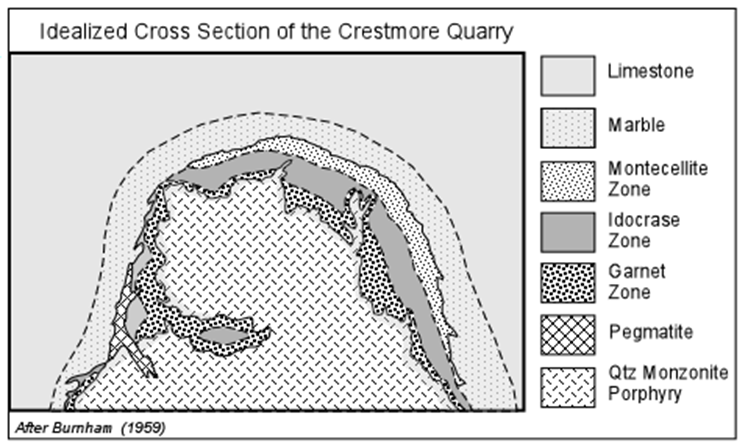
- Here, quartz monzonite intruded an Mg-rich limestone. Metamorphism and metasomatism produced four zones near the contact.
- The outer zone consists of calcite marble or calcite - brucite [MgOH2] marble, showing little metasomatism.
- Closer to the contact is the montecellite zone. This zone consists of calcite, montecellite [Ca(Mg,Fe)SiO4] and one or more of the minerals clinohumite [Mg(OH,F)2.4Mg2SiO4], forsterite, mellilite, spurrite [2Ca2SiO4.CaCO3], tilleyite [Ca3Si2O7.2CaCO3], and merwinite [Ca3MgSi2O8]
- Interior to the montecellite zone is the idocrase zone, consisting of idocrase [Ca19(Al,Fe)10(Mg,Fe)3Si18O68(OH,F)10] in association with calcite, diopside, wollastonite, phlogopite (Mg-rich biotite), montecellite, and xanthophyllite.
- Next to the contact is the garnet zone consisting of grossularite garnet, diopside, wollastonite, and miner calcite and quartz.
- A thin zone along the contact shows evidence of assimilation of the limestone by the magma.
- The ratio of Si to Ca and the concentration of Al all increase toward the contact, indicating that the limestone received these components from the magma