
Metamorphic Facies
Metamorphic Facies
- A metamorphic facies is a set of mineral assemblages in metamorphic rocks formed under similar pressures and temperatures.
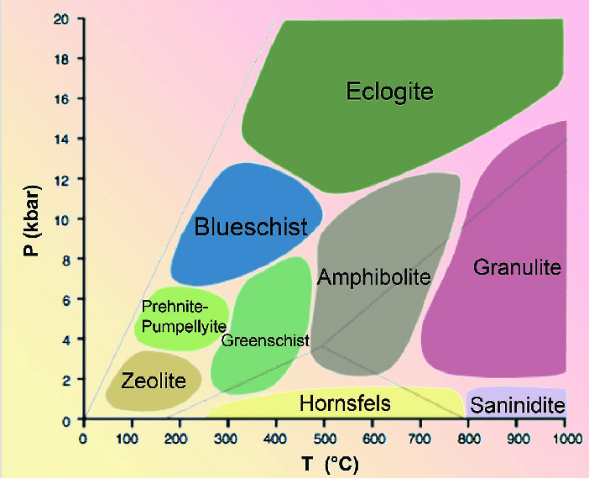
- Rocks which contain certain minerals can be linked to certain tectonic settings, times and the geological history. The boundaries between facies, and the corresponding areas on the above P/T graph are wide, because they are gradational and approximate.
- The bottom left corner of the graph represents the Earth's surface, at nominal P/T = 0/0.
- The area on the graph corresponding to the lowest values of temperature and pressure is the range of formation of sedimentary rocks. As opposed to metamorphic rocks, it occurs in a process called diagenesis.
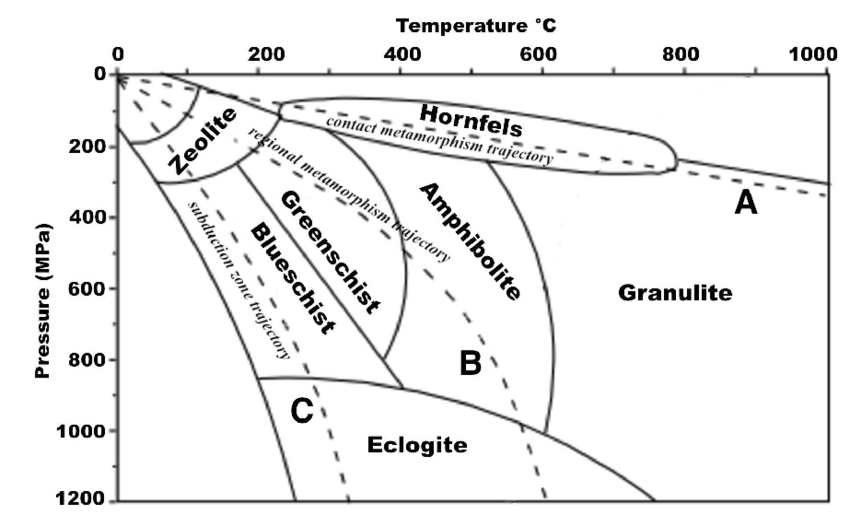
Fig. Metamorphic facies (after Nelson 2011).
- Three trajectories along different geothermal gradients (the Earth gets hotter with depth) are indicated by A, B, and C. these occur in specific tectonic contexts: A in shallow contact metamorphism, B in regional burial where nephrite normally occurs, and C in deep subduction zones where jadeite is usually formed.
- The facies concept is based on observation. In a single outcrop, for instance, layers of different chemical composition will display different mineral assemblages despite having all experienced the same pressure and temperature history.
- A pelitic layer (that is, a layer made up of mud or clay particles) might contain the assemblage garnet + chlorite + biotite + muscovite + quartz, whereas a basaltic horizon a few centimetres away would contain the assemblage chlorite + actinolite + albite. Both of these rocks belong to the same facies, meaning that, in another region, a geologist who observed the assemblage chlorite + actinolite + albite in a metabasalt could predict that associated pelitic rocks would contain the garnet + chlorite + biotite + muscovite + quartz assemblage.
- Goldschmidt was the first to formally note that the equilibrium mineral assemblage of a metamorphic rock (at a particular metamorphic grade) could be related directly to its bulk composition.
- On the basis of the predictable relationship between rock composition and mineral assemblage, Eskola (1915) developed the concept of metamorphic facies.
- There is a dual basis for the facies concept.
- First is the purely descriptive basis: the relationship between the composition of a rock and its mineralogy. By this definition, a metamorphic facies is a set of repeatedly associated metamorphic mineral assemblages.
- The second basis is interpretive: the range of temperature and pressure conditions represented by each facies.
- Eskola (1920) proposed five original metamorphic facies, which he named greenschist, amphibolite, hornfels, sanidinite, and eclogite
- Each of these facies was easily defined on the basis of distinctive mineral assemblages that develop in mafic rocks.
- The mafic assemblages are clearly reflected in the facies names, most of which correspond to characteristic metamorphic mafic rock types.
- Eskola (1939) added the granulite, epidote–amphibolite, and glaucophane– schist facies, and he changed the name of the hornfels facies to the pyroxene hornfels
- Since then, several additional facies types have been proposed. Most notable are the zeolite and prehnite–pumpellyite facies, albite–epidote hornfels and hornblende hornfels
- Each metamorphic facies consist of some index minerals in them by which the facies is said to be recognised and study.
- Index Minerals: Minerals found in the metamorphic rocks used to indicate the intensity of metamorphic grade.
- The change in the facies is seen as the temperature and pressure changes and so the mineralogy.
- The minerals which are stable at one facies may or may not become unstable at another facies.
- The assemblage of minerals found in the particular metamorphic rock is also depends upon the protolith/source rock.
- The metamorphic facies and their generally accepted temperature and pressure limits, are shown in Figure.

- The boundaries between metamorphic facies represent T-P conditions in which key minerals in mafic rocks are either introduced or lost, thus changing the mineral assemblages observed.
- Facies are thus separated by mineral reaction isograds.
- The facies limits are approximate and gradational because the reactions vary with rock composition and the nature and composition of the intergranular fluid phase.

Metamorphic facies groups
It is convenient to consider metamorphic facies in 4 groups:
Facies of high pressure
- The blueschist and eclogite facies: low molar volume phases under conditions of high pressure.
- Blueschist facies- areas of low T/P gradients: subduction zones
- Eclogites: stable under normal geothermal conditions. Deep crustal chambers or dikes, sub-crustal magmatic underplates, subducted crust that is redistributed into the mantle.
Facies of medium pressure
- Most exposed metamorphic rocks belong to the greenschist, amphibolite, or granulite facies.
- The greenschist and amphibolite facies conform to the “typical” geothermal continental gradient.
- Granulite facies rocks occur predominantly in deeply eroded continental cratons of Precambrian age.
Facies of low pressure
- The albite–epidote hornfels, hornblende hornfels, and pyroxene hornfels facies are typically developed in contact metamorphic terranes.
- The sanidinite facies is rare and limited to xenoliths in basic magmas and the innermost portions of some contact aureoles adjacent to hot basic intrusives.
Facies of low grades
- Rocks commonly fail to recrystallize thoroughly at very low grades, and equilibrium mineral assemblages not always attained.
- zeolite and prehnite–pumpellyite facies may not always be represented, and the greenschist facies is the lowest grade developed in many regional terranes.
- These facies are best developed where the protolith is immature and susceptible to metamorphism and where there are a high geothermal gradient and abundant hydrous fluids.
- As a result, they are most common in areas of burial or hydrothermal metamorphism affecting immature volcanics.
Facies series
- A traverse across a typical metamorphic terrane typically reveals a sequence of zones and facies that developed in response to gradients in temperature and pressure.
- Miyashiro propose facies series. According to the facies series concept, any large-scale traverse up grade through a metamorphic terrane should follow one of several possible metamorphic field gradients, and, if extensive enough, cross through a sequence of facies.
- The contrast between Miyashiro’s higher-T-lower-P Ryoke-Abukuma belt and the classical Barrovian sequence also led him to suggest that more than one type of facies series was probable. initially proposed five facies series, The series were:
- Contact facies series (very low P)
- Buchan or Abukuma facies series (low P regional)
- Barrovian facies series (medium P regional)
- Sanbagawa facies series (high P, moderate T)
- Franciscan facies series (high P, low T)
- Metamorphic field gradients are highly variable, even in the same orogenic belt, and transitional series abound. Miyashiro chose to limit the number instead to the three broad major types of facies series (also called “baric types”) illustrated in figure.
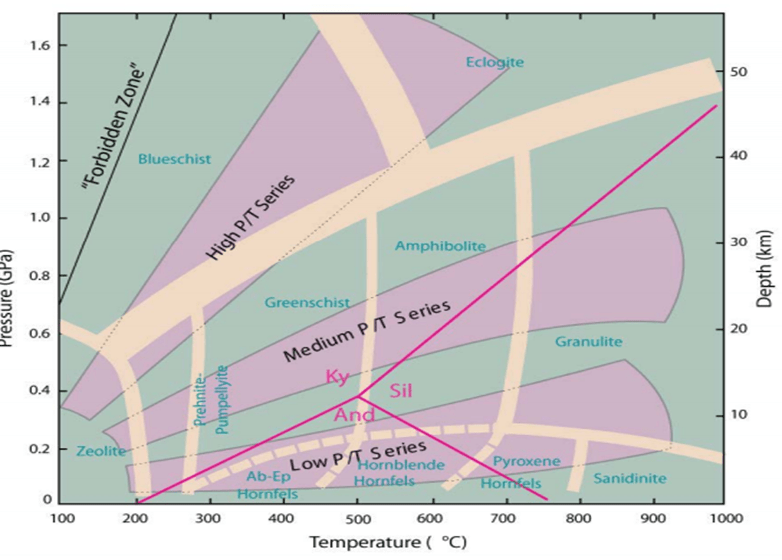
- Each series is representative of a different type of tectonic environment. The high P/T series is characteristic of subduction zones, medium P/T of continental regional metamorphism, and low P/T of high heat-flow orogens, rift areas, and contact metamorphism.
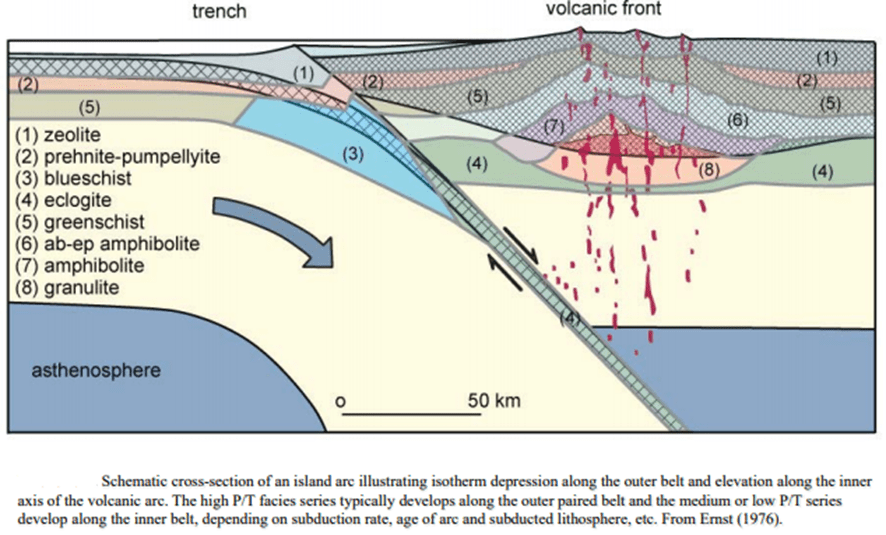
- The figure below is a generalized diagram showing relation between facies and facies series with plate tectonics.
- Such a diagram provides a useful framework for conceptualizing the development of metamorphic facies in one common setting, but nature is far more complex and variable, and metamorphic rocks develop in a wider variety of situations.
Classification of Metamorphic Facies:
Considering all modifications since inception of facies concept the contact and regional metamorphism can be classified into 11 different facies segments in P-T space.
The hornfelsic rocks of contact metamorphism can be classified into:
- Albite-epidote hornfelsic Facies
- Hornblende hornfelsic Facies
- Pyroxene hornfelsic Facies, and
- Sanidinite Facies
Facies of regional metamorphism includes:
- Zeolite Facies
- Prehnite-Pumpelleyite Facies
- Greenschist Facies
- Amphibolite Facies
- Granulite Facies
- Blueschist Facies
- Eclogite Facies.