
Evolutionary Trend in Equidae (Horse)
Evolutionary Trend in Equidae (Horse)
Introduction
- Horses are the mammals come under the family
- Horses are placed in the suborder Hippomorpha, superfamily Equidae under order Perissodactyla.
- It is claimed that origin and evolutionary history of Horse is known most clearly and completely. The reason behind this are as follows:
- In North America, their entire evolutionary sequence is recorded in the form of fossils within some undisturbed and uninterrupted series of sedimentary deposits, ranging in age from early eocene to recent.
- Because of their grazing habit, their adaptation to life on Savannas and plains, and their tendency to live in large herds, fossils of horse are found in great numbers wherever they are preserved.
- The evolutionary history of horse is a classic example of Orthogenesise Straight course of evolution.
- The horses show the Orthogenesis from Lower Eocene-Upper Oligocene.
The trend of evolutionary change
The trend of evolutionary change take place with:
- Increase in size
- Increase in length of legs and feet
- Reduction of lateral toes
- Increase in complexity of brain.
- Strengthening and stiffening of the back.
- Adaptive modifications of structure of horse foot, change of foot posture.
- Reduction and deepening of the front portion of the skull and lower jaws.
Evolutionary changes
- The geological history of horses covers ~50 mya.

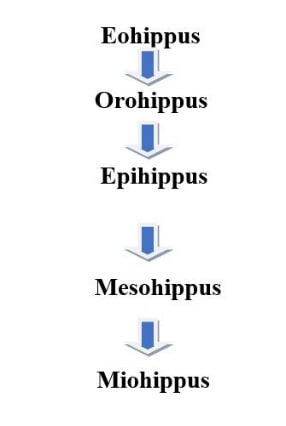
- During the course of evolution horses have undergone certain changes initiated in Eocene times and continued to the end of Cenozoic era.
- The evolution has taken place from ancient small sized forest dwelling Eohippus to modern and large sized horses.
- Eohippus or Hyracotherium is the first known horse which belongs to early Eocene.
Horses of Eocene
Eocene was a time of warm and moist climate during which period North America was covered with a rich vegetation of evergreen and deciduous trees, grassy plains and many lakes.
During this period the following horses were came into existence:
Genus Eohippus
- It is the earliest fossil remains of horse in equine evolution, and was known as Dawn horse.
- They consist of four toes and dated back ~53 mya in Early Eocene
- They resemble the size of the fox with short head and arched back.
- They consist of 44 low crowned teeth, long limbs and consider as browsing mammals.
Genus Orohippus
- It represented the second stage in evolution and was known as Mountain horse.
- They showed some advancements over Eohippus.
- The body of this species consist of smooth type with slim forelimbs and long hind legs which makes them a better jumper.
- The teeth are consisting of dwarf premolar and make them a better grinder for food.
- The size of eohippus was 30cm high whereas the size of orohippus increased to 33cm.
- Fore limbs retained only four digits and hind limb had three toes.
Genus Epihippus
- It represented third stage in evolution. Here digits of fore limbs were still four while that if hind limbs were three.
- The fossils are dated back to 47 mya in Mid-Eocene times.
- The efficiency of grinding teeth in this species has increased.
Horses of Oligocene
- Aridity increased during oligocene due to continental uplift and consequent drying of streams and lakes.
- Some of equine disappeared in the struggle for existence.
- Oligocene horses are generally of two genus Mesohippus and Miohippus, directly derived from Epihippus of Eocene.
Mesohippus
- These species are dated back to Late Eocene to Early Oligocene time (32-24 mya).
- They are resides in grassland habitat and are three-toed animal.
Miohippus
- They are dated back ~36 mya and emerged from Mesohippus.
- Their body is larger than others ancestral species with face is broader and consist of equine teeth.
Horses of Miocene
- Miocene was a time of great continental elevation and witnessed a wide expansion of western prairies and further dimination of forest covered areas.
- As a consequence, many browsing animals could not endure the change and perished but grazing type of horses survived.
Six genera are represented in this epoch. They are:
- Anchitherium which arose from Miohippus in N. America. It was flourished during early Miocene. It gave rise to Browsing horse in America.
- Second genus was
- It is the transitional form between Miohippus and Merychippus.
- They have their ancestral Miohippus living in steppes type of habitat.
- These species belong to Miocene time and consist of prolonged skull and resemble the face of modern horses.
- They consist of sharp incisors and consist of third toe which is stronger.
- Third genus was It had broad low crowned teeth, hind limbs were three toed. Though it had attained the size of a pony it did not continue to exist for long .
- The fourth genus, Merychippus, is one of the most remarkable instance of Ontogenic evidence of evolution observed among horses.
- Their body is short and toes consist of small hooves.
- These are dated back to middle Miocene times and are consider as grazing animals.
- They consist of hard molar which helps them for crushing the grasses.
- The fifth Genus Protohippus derived from merychippus in late Miocene.
- The sixth genus of Miocene was
- Hipparion was a great traveler and it migrated from new world to old word by way of Alaska and Siberia.
- In India, Hipparion was represented in Chingi, Dhok pathan and Tatrot formation of Siwalik.
- They are dated back to middle Miocene time and consist of slim body with three toes equipped with small hooves.
Horses of Pliocene
- Two groups of horses were emerged out from Merychippus of Miocene in the Pliocene.
- Genus Pliohippus and Plesihippus were Pliocene horses.
- Pliohippus
- They are dated back to middle Miocene time(~12 mya)
- They are somewhat similar to Equus.
- They consist of long and slim limbs wit extra toes on both side of hoof.
Upper Pliocene
- From Pliohippus, in the mainline appeared the Modern horse Equus in upper Pliocene.
- The Modern living horses belong to These are represented by such forms like Horses, wild ass, zebras.
- Equus first appeared in North America, survived there for the entire Pleistocene but became extinct a few thousand years ago towards the close of ice age.
- Equus that migrated into South America met the same fate. What was the exact cause of extinction of Pleistocene horses is still unknown.
- These fossils dated back to 5 mya in Pleistocene age.
- It is the genus of all equines and has developed long cheek teeth.
- They have originated from Middle East and spread to all world.
- They consist of single toe and long neck which makes them herbivores and distinct eyes for long vision.