Evolutionary Trend in Proboscidae
Evolutionary Trend in Proboscidae
Introduction
- Elephants are the terrestrial animals with special body feature known as trunk.
- Taxonomy is Kingdom: Animalia, Phylum: Chordata, Class: Mammalia, Order:
- Elephants belong to the order Probiscidea within the class Mammalia.
- Although, surviving in considerable numbers in Asia and Africa, elephants are now representing the last members of a dying group.
- At present, they are represented by only two genera each with a single species; one is African elephant Loxodonta africanus and the other is the Asiatic elephant, Elephas maximus.
- However, fossil evidence have proved that various types of elephants, some exhibiting gigantic forms inhabited the world quite abundantly at least during middle and upper part of Cenozoic era.
- Unfortunately, all, but two, failed to cross the Pleistocene-Holocene boundary.
Trends of evolution
Starting ancestral Proboscidean form, evolution proceeded along different lines of adaptive radiation. Although each line shows independent and varied development, some dominant trends running through the wide range of proboscidean forms can be traced out as follows;
- Increase of size
- Lengthening and thickening of limbs with the development broad feet
- Extraordinary increase of skull size .
- Shortening of neck for keeping a balance between bulky body and heavy skull.
- Gradual elongation of lower jaw , although secondary shortening may be found .
- Growth of trunk by elongation of upper lip and nose.
- Over-increase of the second pair of incisors to form the tusks used for drilling ground and also in defence
- Specialization of cheek teeth in various ways as adaptation for better chewing and grinding plant foods
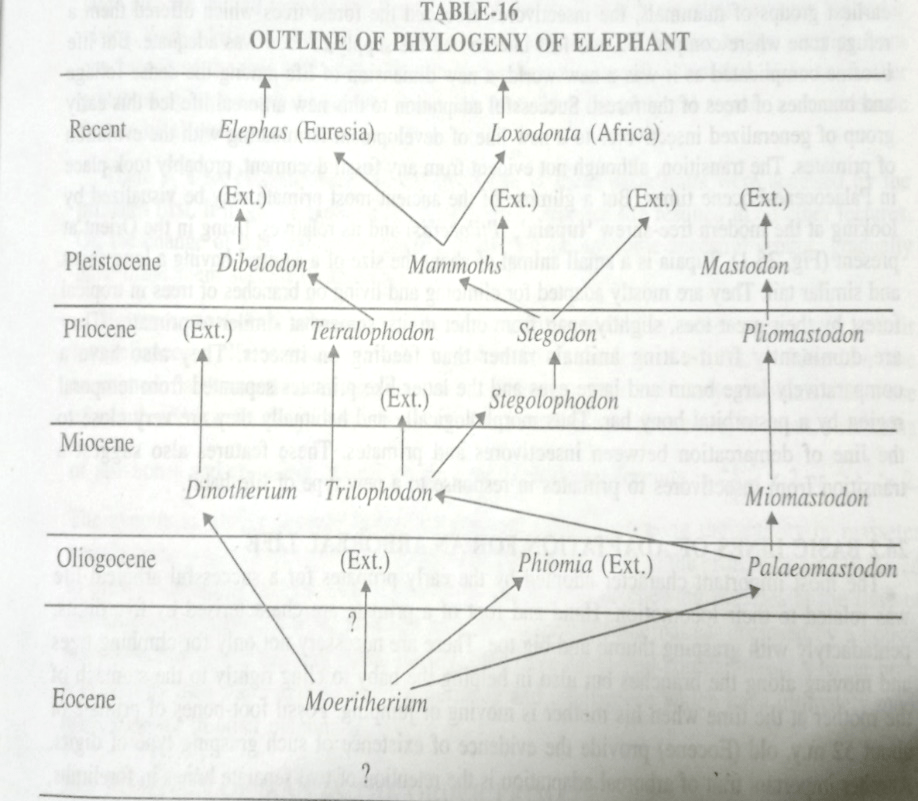
- The evolution of elephants take place as-
|
Time Period |
Evolution |
|
Eocene |
Moeritherium |
|
Oligocene |
Paleomastodon |
|
Miocene |
Bunomastodon |
|
Pliocene |
Tetralophodon Steglophodon Stegodon |
|
Pleistocene |
Mastodon |
|
Recent |
Mammoth Loxodonta Elephas |

All the different forms of elephants living or extinct probably arose from a common ancestral stock often called Moeritheres. Their fossils are obtained from middle to late Eocene rocks of North Africa. The descendants spread out from Africa all over the world except Australia by Miocene – Pleistocene times.
Moeritherium
- They are resemble as the size of the pig and has no proboscis.
- They are swamp dweller and has elongated body with lower incisor small at first side and second incisor large thus suggesting the beginning of tusks in later stages of development.
- Moeritheres were represented by several forms but the most well-known one was Moeritherium whose fossils are found from late Eocene rocks of Egypt.
- Genus Moeritherium was taper sized with skull elongated from back to front, swamp dwelling animal.
- The dental formula was almost complete 3133/2033.
- In India fossils of this genus are recorded from Lower siwalik of India. Genus Barytherium from Eocene rocks of Egypt was similar to Moeritherium except the difference in Jaw.
Palaeomastodon
- They have been dated back to Oligocene times and consist of short proboscis.
- They consist of elongated upper tusk and lower tusk smaller.
- Genera Phiomia and Paleomastodon were next to appear . It is believed that Plaeomastodon gave rise to Mastodon americanus , while Phiomia gave rise to Shovel Tuskers.
Bunomastodon
- They consist of long proboscis and consist of tusk at both the jaws.
Tetralophodon
- They consist of proboscis resembling modern elephants.
- These species have four tusks and highly crowned molar teeth.
Steglophodon
- Their early fossil records have been estimated in Japan during Pliocene time.
- They only consist of upper tusk.
Stegodon
- They consist of short skull and short mandible with long proboscis.
- They have huge tusk and teeth are highly crowned.
Mammoth
- They consist of strong curved and twist tusks.
- They live in cold climatic conditions such as alpine type.
- The N.America, Europe, Asia, and Africa Mastodon with long, dense, and saggy hairs all over the body was known as A drastic change in plant life may have been responsible for the sudden demise of woolly mammoth and other large mammals of the tundra 10,000 years ago.
- On the cold, dry tundra, there were plenty of mammoth, woolly rhinoceros, steppe bison, horse, musk, ox.
- Abrupt warming, that closely resembles the rapid man-made climate change of today, is to blame for the disappearance of Mammoth during the last ice age.
Modern Elephants / True Elephants
- Consist of two genera- African elephant (Loxodonta) and Asian elephant (Elephas)
- The present day elephants like Elephas maximus of India (Asiatic) and Loxodonta Africana of Africa might have evolved independently.
- The South Indian Upper Miocene Stegomastodon latidens is the oldest known representative of Elephas.
- Genus Plaeomastodon had low crowned narrow molars with comparatively few ridges of crecentric shape.
- Ex- P. namadicus from Narmada Alluvium of Central India living during Pleistocene age.
- Genus Elephas: It is the present day Indian form with upper incisors without enamel. Each jaw has two functional cheek teeth. The dental formula is (2-2).0.0.(6-6)/(0-0).0.0.(6-6) .
- Genus Laxodonta: The African form of L. Aftricana is bigger in size with large ears, lower forehead and larger tusks.