
Evolutionary Trend in Hominidea
Evolutionary Trend in Hominidea
Introduction
- Homo means humans and their close relatives which got extinct. It consists of members of hominids and comes under the order primates. It consists of members of both humans and great apes (chimpanzees, gorillas, bonobos, orangutans).
- They are categorized on the basis of their intellectual abilities and social behaviors.
- The genus Homo (Man) is placed under family Hominidae and suborder Anthropoidea of the order
- Taxonomy is Kingdom: Animalia, Phylum: Chordata, Class: Mammalia, Order: Primates, Family: Homonidea, Genus: Homo, Species:
- Humans shared the common ancestors with Chimpanzee and bononos near around 6 mya estimated by the fossil records and by studying their DNA synthesis.
- Evolution of humans takes place in Miocene epoch.
- The origin of human evolution took place in Central Asia from ape like primates which appeared some 4 million years ago during Eocene on the following lines.
- Assumption of erect posture and bipedalism
- Shortening of arms
- Reduction in size and number of teeth (44 to 32)
- Loss of jaw power
- Development of prominent chin
- Increase in skull capacity
- Increase in size and complexity of brain
- Diminution of brow-ridges
- Diminution in strength of zygomatic arch or temporal arch
- Development of articulate speech
- Perfection of thumb opposability
- Perfection of heel and toe walking
- Obtaining omnivorous diet

The Human Lineage
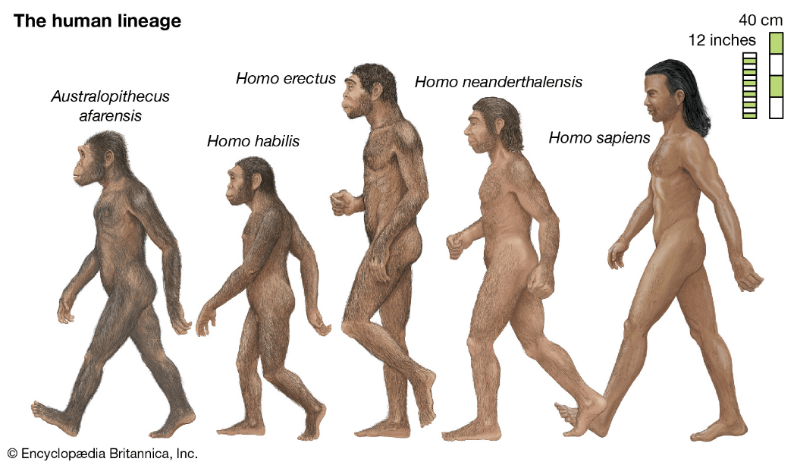
Australopithecus afarensis
- Fossils records found in Ethiopia and Tanzania of East Africa dated 3.9-2.9 mya.
- Skeletal of this fossil resembles ‘Lucy’.
- These species consist of long face and jaws extended outwards and robust in nature.
- The brain capacity of Lucy is 365-417 cc.
Homo habilis
- These species of early Pleistocene is ~700 cubic cms in height.
- The face is shortened, sutured body structure and has reduced teeth in size.
- These are recognized dated 2.3-1.65 mya in East and South Africa and replaced by Homo eratus.
- The brain capacity of Lucy is 500-900 cc.
Homo eratus
- These species consist of most robust skeleton.
- They consist of cranial capacity of 850-100 cc with teeth are reduced.
- These species consist of somewhat humanlike body and the first species of human displaying flat face and sparsely distributed hairs all over the body.
- They are ~2 mya old from Pleistocene time.
Homo neanderthalensis
- These are archaic Homo sapiens lived in Europe and Southeast Asia.
- Exist between 70,000-30,000 years ago.
- They are short and heavy body than modern humans.
- They are characterized by prominent brow ridges and strong anterior teeth.
- The brain capacity ranges from 1600 cc in males to 1300 cc in females.
Homo sapiens
- These are the modern humans(terrestrial animals).
- They are dated back ~100000 years ago in Africa.
- These species invaded Europe in 30,000-40,000 years back.
- They have replaced Neanderthals with minimum interbreeding.
- They have brain capacity of about 1350 cc.
Trends of Evolution
- The process of human evolution started as early as from Oligocene with the appearance of the first ancestral ape from the Old World monkey.
- The evolutionary development of human being cannot be treated as an event of great magnitude; it was rather a matter of perfection of some structures and related habits attained by their ancestral apes from the very beginning of their appearance.
- Erect posture, free fore limbs coupled with continued increase of brain size (increase of mental ability) and changing food habit have caused all shorts of structural modifications leading to the evolution of modern Homo Sapiens .
The major trends of evolution of man may be as follows :
Trend 1
- Bipedalism, leading to upright posture is the result of an anatomical restructuring of the pelvis and lower limbs.
- Consistent bipedalism characterised by erect posture with straightened-knees is found only in man.
- Bipedal walking was common in ancestral ape with bent knee gait but the modern man have straight knee gait , which is a matter of amusement among different scientists.
- Washburn explained it as follows :
- The structural change in lower limb include an elongation of femurbone and a reconstructing of foot including its digits. The essential points are that the body weight is borne on the great toes and that while walking foot-toes lie parallel to one another.
- The pelvis of the human and ape can be distinguished. Pelvis is essentially composed of three bones ischium, ilium, pubis. The structural basis of bipedalism involves a reorganization of the pelvic bones. This is caused by a shortening and broadening of ilium has allowed the trunk to be held vertically. It is followed by a rotation of sacral vertebra which is compensated by a S-shaped curving of the spinal cord.
- Bipedalism was an adaptation to an early human pattern of scavenging meat . Bipedalism also increases the area of vision caused by elevation of head thereby , improving the ability to locate items at distance .Bipedalism with agile climbing ability made the early form like Australopithecus afarensis further to improve the opportunities to exploit the environment .
Trend 2
- There has been a trend towards increase in brain size and its complexity during the course of Human evolution.
- Brain capacity of Australopithecus and Homo habilis is around 300-650cc. For H .erectus 800-1200cc and for Sapiens it is 1200-2000cc.
- The rate of change of increase in brain size was not consistent throughout the geological time.
- It was more precise during the later period of Homo erectus to Homo sapiens.
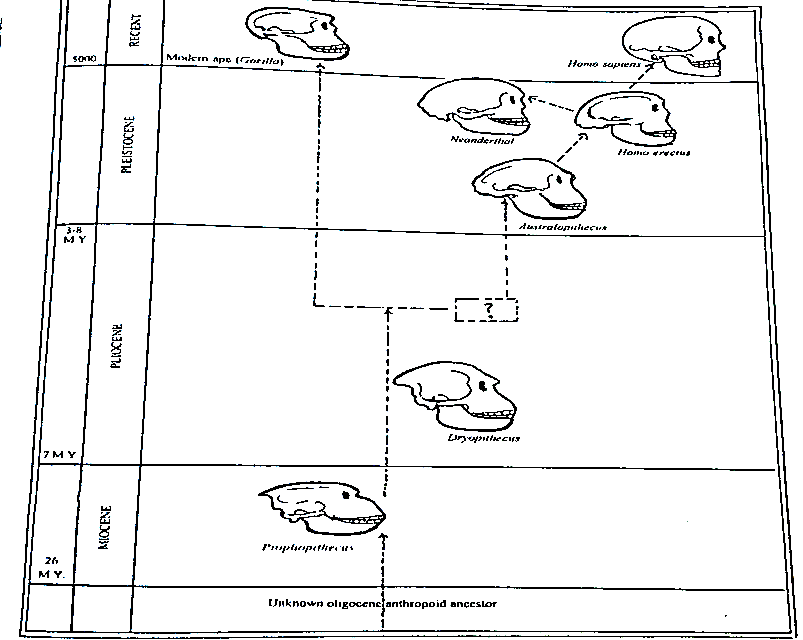
Fig- change of skull pattern in Hominid Evolution
Trend 3
- Behavioural adjustment with the change of habitat from ancestral aboreal to terrestrial.
- Division of labour came in between the sexes where adventurous wandering males become hunters and food searchers while females became less mobile acting the role of infant feeders.
- Tool use and terrestriality probably placed a premium on the development of an effective signalling system.
Trend 4
- Extensive manipulatory behaviour of human was facilitated by his hands made freed of locomotive function, perfect stereoscopic binocular vision, increasing brain size and a more effective hand eye co-ordinaton . Increase in tool- use was in turn related to increasing problems for survival.
Trend 5
- Consistent meat eating had caused changes in dentition and jaw – musculature.
- Sometimes analysis of upper surface of tooth can tell the role of certain food in an animals diet.
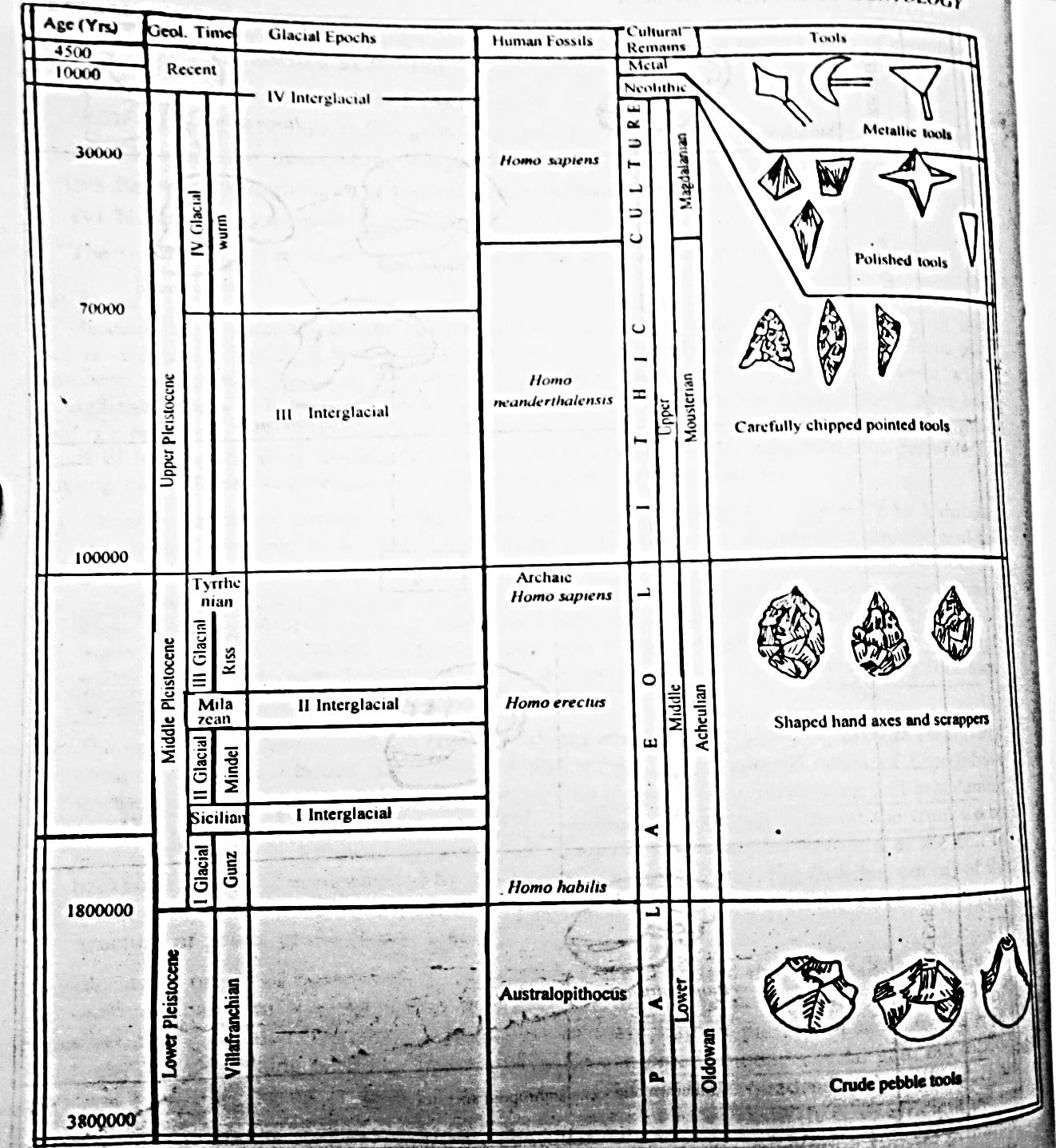
Fig – Human fossils and Cultural Evolution