
Distribution and Classification of Precambrian rocks of India
- Age: The Precambrian geologic history of peninsular India covers nearly 3.0 billion years of time.
- Pre-Cambrian "formations occur throughout the length of the Himalaya but only a few regions have so far been studied- Kashmir-Hazara, Simla-Garhwal, Sikkim Bhutan and parts of Burma.
- The Indian shield represents a vast repository of the Precambrian geological record.
- The Precambrian sedimentary basins were developed on four major Archaean nuclei (Dharwar, Bastar, Singhbhum and Aravalli–Bundelkhand. Some of the Indian basinal successions and contain valuable economic resources.
Fig. Geological Time scale
Classification
- Archaean Rock System (Pre-Cambrian Rocks)
- Archaean Gneisses and Schists [4 Billion Years]
- Dharwar System [4 – 1 Billion Years]
- Purana Rock System (1400 – 600 Million Years)
- Cuddapah System (~1400 Ma)
- Vindhyan System (1300-600 million years)
Sketch map showing four Archaean nuclei in India. Note Proterozoic sedimentary basins (dark grey patches) and the large Deccan basaltic province.
SGT, Southern Granulite Terrain; NFB, Nallamalai fold belt; CITZ, Central Indian Tectonic Zone; PG, Pranhita Godavari Valley; Ab, Abujhmar Basin; Am, Ampani Basin; Bh, Bhima Basin; Ch, Chattisgarh Basin; Idv, Indravati Basin; Kal, Kaladgi Basin; Suk, Sukma Basin; Ban, Bangalore; Cd, Cuddapah; Hyd, Hyderabad; K, Kurnool; Kh, Khariar; Nel, Nellore; Ong, Ongole; Vij, Vijaywada (after Saha & Mazumder 2012).

Fig. Geological Time scale
Classification

- Archaean Rock System (Pre-Cambrian Rocks)
- Archaean Gneisses and Schists [4 Billion Years]
- Dharwar System [4 – 1 Billion Years]
- Purana Rock System (1400 – 600 Million Years)
- Cuddapah System (~1400 Ma)
- Vindhyan System (1300-600 million years)
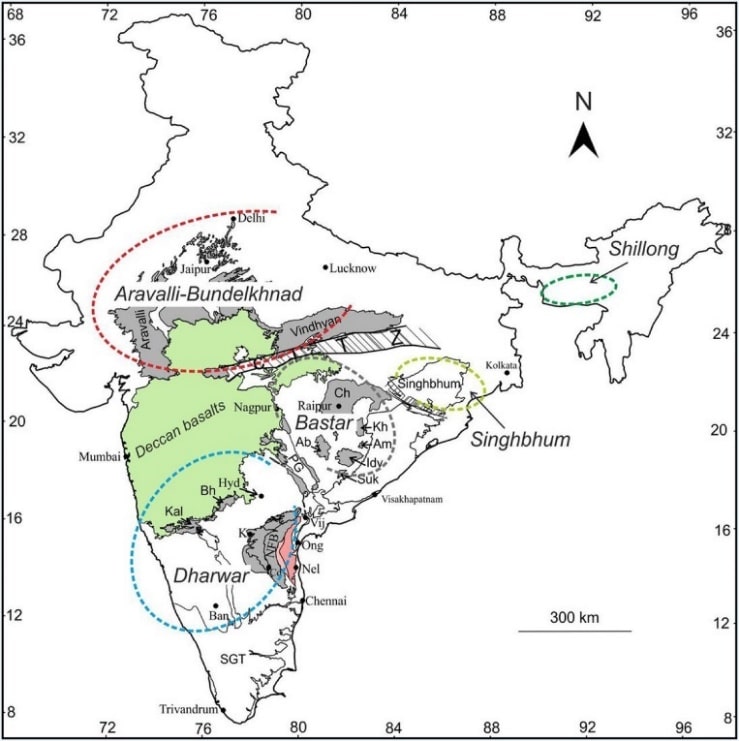
Sketch map showing four Archaean nuclei in India. Note Proterozoic sedimentary basins (dark grey patches) and the large Deccan basaltic province.
- SGT, Southern Granulite Terrain; NFB, Nallamalai fold belt; CITZ, Central Indian Tectonic Zone; PG, Pranhita Godavari Valley; Ab, Abujhmar Basin; Am, Ampani Basin; Bh, Bhima Basin; Ch, Chattisgarh Basin; Idv, Indravati Basin; Kal, Kaladgi Basin; Suk, Sukma Basin; Ban, Bangalore; Cd, Cuddapah; Hyd, Hyderabad; K, Kurnool; Kh, Khariar; Nel, Nellore; Ong, Ongole; Vij, Vijaywada (after Saha & Mazumder 2012).

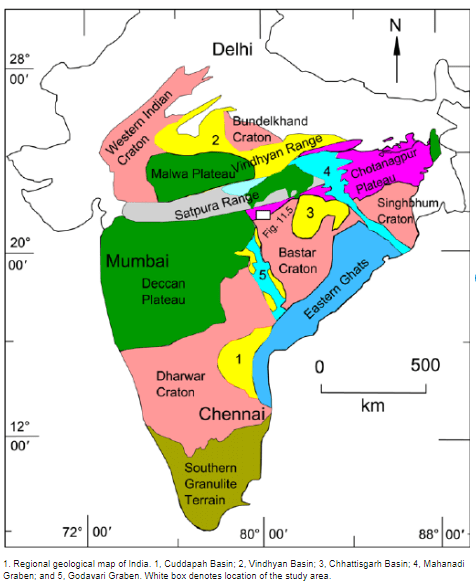
Archean System
- Archaean Gneisses and Schists(pre 2500 million years).
- The Archean period covers 86.7% of Total geological history time of earth and therefore is very significant. This period marks the development of first photosynthesis, the life support atmosphere.
- Azoic or unfossiliferous.
- The Archaean rocks cover two-thirds of the peninsular India. They also occur in roots of the mountain peaks all along the Greater Himalayas, trans-Himalayan ranges of Zaskar, Ladakh and Karakoram.
- The Archean System contains the first formed rocks of the earth.
- The rocks are primarily gneisses and granites, having no marks of fossils.
- They often underlie the strata formed subsequently and the system is generally known as the basement complex or fundamental gneisses.
Rocks of the Archaean System
- These rocks have been termed as a result of the hot-molten earth becoming cold. These are the oldest and primary rocks.
- Their original form has been destroyed because of too much metamorphosis.
- There are no fossils found in them.
- Gneiss is formed because of the metamorphosis of the igneous rocks. The Bundelkhand gneiss is the oldest one.
- The rocks of the Archaean system are found mainly in Karnataka, Tamil Nadu, Andhra Pradesh, Madhya Pradesh, Orissa, Chotanagpur plateau in Jharkhand and the southern-eastern part of Rajasthan.
- Gneiss = Mineral composition varies from granite to gabbro.
Schists = mostly crystalline, include mica, talc, hornblende, chlorite, etc.
- The Archean or Purana rock system in India is found in Aravalli mountains, 2/3rd of the Deccan peninsula and some parts of north east. These rocks have abundant metallic and non-metallic minerals such as iron, copper, manganese, bauxite, lead, zinc, gold, silver, tin, tungsten, mica, asbestos, graphite, etc.
Dharwar System
- AGE- (2500-1800 million years ago)
- The weathering of the Archaean rocks yielded the earliest sediments and formed the oldest sedimentary strata, the Dharwar system.
- Highly metamorphosed sedimentary rock-system. (formed due to metamorphosis of sediments of Archaean gneisses and schists) and do not contain fossils.
- These rocks occur in scattered patches in parts of Karnataka, Tamil Nadu, central and eastern parts of Chotanagpur plateau, Meghalaya plateau, Aravalis, Himalayan region etc as shown on the map.
Rocks of Dharwar System
- These rocks have been formed as a result of the erosion and sedimentation of the rocks of the Archaean system.
- These are the oldest sedimentary rocks.
- No fossil is found here. It is so because either there was no origin of species during their formation or the forms of the fossils got destroyed with the passage of time.
- The Aravalli mountain range which is the oldest fold mountain of the world has been made with these rocks.
- The rocks of this system are found in the districts of Dharwar and Shimoga in Karnataka.
- The rocks of this system are found in the southern Deccan region from Karnataka to the Kaveri valley, districts of Bellary, Shimoga, Sasar mountain range in Jabalpur and Nagpur and the Champaner mountain range in Gujarat.
- In north India the rocks of this system are found in the Himalayan ranges of Ladakh, Zaskar, Garhwal and Kumaon, and the long range of Assam plateau.
- The rocks of this system are economically very important. All prominent metallic minerals (iron, gold, manganese etc) are found in these rocks.
Economic Minerals
- Economically the most important rocksbecause they possess valuable minerals like high grade iron-ore, manganese, copper, lead, gold, etc.
- The rocks of the Dharwar system are mainly sedimentary in origin, and occur in narrow elongated synclines resting on the gneisses found in Bellarydistrict, Mysore and the Aravalis of Rajputana. These rocks are enriched in manganese and iron ore which represents a significant resource of these metals.
- They are also extensively mineralised with gold most notably the Kolar gold mineslocated in Kolar. In the north and west of India, the Vaikrita system, which occurs in Hundes, Kumaon and Spiti areas, the Dailing series in Sikkim and the Shillong series in Assam are believed to be of the same age as the Dharwar system.
- The Dharwar rocks are rich in iron ore, manganese, lead, zinc, gold, silver etc.
- The other series of Dharwar system are as follows: Champaner series that is found nenear Baroda. This is source of a lush green variety of marble.
- Closepet series that is found in Balaghat and Chhindwara of Madhya Pradesh. It is richCopper ores. Chilpi Series that is found in and around the Closepet series in Balaghat and Chhindwara.
- Iron-Ore series that is located in Singhbhum, Mayurbnhanj and Keonjhar rangaes
Purana Rock System (1400 – 600 Million Years)
- The Cuddapah and Vindhyan rock systems are together known as the Purana rock system.
- They are formed by the erosion and deposition of Archean and Dharwar rocks, the process is believed to have taken place between 1400-600 million years ago.
- They are mostly sedimentary in nature.
Cuddapah System (~ 1400 Ma)
- Unfossiliferous clay, slates, sandstones and limestones was deposited in synclinal basins, depression between two folds (Folded Mountains).
- Outcrops best observed in Cuddapah district of Andhra Pradesh.
- These rocks contain ores of iron, manganese, copper, cobalt, nickel, etc.
- They contain large deposits of cement grade limestones.
- These rocks have been formed as a result of erosion and sedimentation of the rocks of Dharwar system. These are also sedimentary rocks.
- The rocks have been named after the district of Cuddapah in Andhra Pradesh where these are semi-circular in expansion.
- These are famous for sandstone, limestone, and marble, asbestos.
- The Cuddapah rocks are also found in Rajasthan.
- Mainly found in the Cuddapah region of Andhra Pradesh, they are also found in Delhi, Rajasthan, Chhattisgarh, the lesser Himalayas etc.
- They were formed when sedimentary rocks like sandstone, limestone etc., and clay were deposited in synclinal folds (between two mountain ranges)
- They are rich in metamorphic rocks such as shale, slate, quartzite etc. Even though metallic minerals like iron ore were found, they were of poor quality.
- These rocks are generally without fossils
- These formations, named after the Cuddapah district in Andhra Pradesh are sedimentary metamorphic formations.
- These are found in Andhra Pradesh, southern Chhattisgarh, Odisha and along the main axis of Aravallis.
- The metallic content in ores of Cuddapah rocks is low and at places uneconomical for extraction.
Vindhyan System (1300-600 million years)
- This system derives its name from the great Vindhyan mountains.
- The system comprises of ancient sedimentary rocks (4000 m thick) superimposed on the Archaean base.
- Mostly Unfossiliferous.
- Large area of this belt is covered by the Deccan trap.
- The Vindhayan system have diamond bearing regions from which Panna and Golconda diamonds have been mined.
- The evidences of fossils of micro-organisms are found in this structure.
- These rocks are found in the Vindhyas, e.g. the Malwa plateau, the Semari range in the Son valley, Bundelkhand etc.
Economic Minerals
- It is devoid of metalliferous minerals but provides large quantities of durable stones, ornamental stones, limestone, pure glass making sand etc.
- These have been formed after the cuddapah rocks by the deposition of silt of river valleys and shallow oceans. Thus, these rocks are also sedimentary rocks.
- This structure is famous for house-building rocks. The Sanchi Stupa, the Red Fort, the Jama Masjid etc. are built with the red sandstone of this structure. Besides, limestone, china clay, dolomite etc. are also found in this structure.
- The diamond mines of Golconda in Karnataka and Panna in Madhya Pradesh are found in this structure.
- Comprises of very old sedimentary rocks, hence are devoid of metallic minerals.
- Though they are devoid of metallic minerals, they are abundant in building materials such as red sandstone, limestone, glass making sand etc.
- This rock system is well known for red sandstone, sandstone, durable stones, ornamental stones, raw materials for lime, glass, cement and chemical industries.