
Study of stratigraphic distribution and lithology of Phanerozoic rocks of India with reference to fauna, flora and economic importance
Study of stratigraphic distribution and lithology of Phanerozoic rocks of India with reference to fauna, flora and economic importance
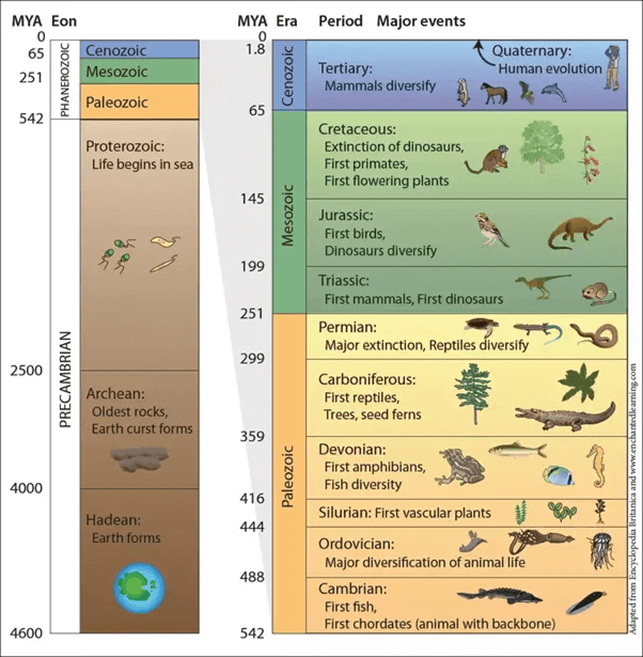
- The PhanerozoicEon is the current geologic eon in the geologic time scale, and the one during which abundant animal and plant life has existed.
- It covers 541 million years to the present, and began with the Cambrian Period when animals first developed hard shells preserved in the fossil record.
- The time span of the Phanerozoic starts with the sudden appearance of fossilized evidence of a number of animal phyla; the evolutionof those phyla into diverse forms; the emergence and development of complex plants; the evolution of fish; the emergence of insects and tetrapods; and the development of modern fauna.
- Plant life on land appeared in the early Phanerozoic eon.
- Tectonic forcescaused the continents to move and eventually collect into a single landmass known as Pangaea (the most recent supercontinent), which then separated into the current continental landmasses.
- The Phanerozoic is divided into three eras: the Paleozoic, Mesozoic, and Cenozoic, which are further subdivided into 12 periods.
- The Paleozoic features the rise of fish, amphibians and reptiles.
- The Mesozoic is ruled by the reptiles, and features the evolution of mammals, and more famously, dinosaurs, including birds.
- The Cenozoic is the time of the mammals, and more recently, humans.
Phanerozoic Rocks of Indian Subcontinent
- Phanerozoic sedimentation in the Indian subcontinent in the backdrop of long geodynamic history.
- Basins with varying tectonic affinity opened and evolved.
- The Andaman-Nicobar outer arc tectonic prism formed on the leading edge of subducting Indian plate.
- Quaternary deposits in Indian subcontinent offer scope to assess role of tectonics and climate.
- The Paleozoic formations of India belong to the period from 570 to 245 million years. These are called as Dravidian systems, in India.
- Most of them are distributed over the Extra-Peninsular region, and are very little in the Peninsular shield.
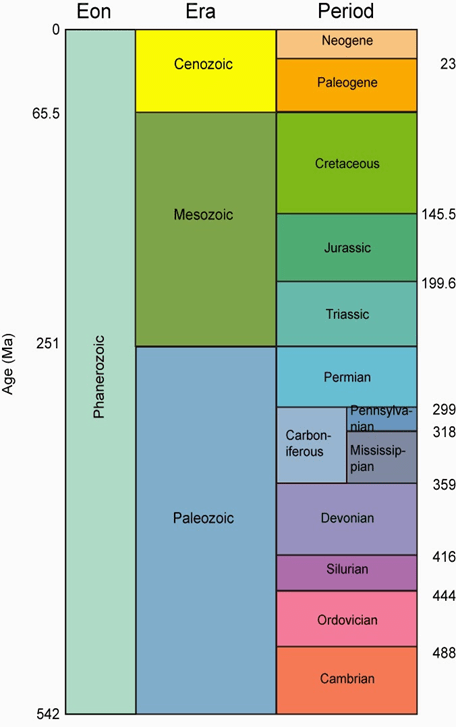

Cambrian System
- The Cambrian System of India consists of the following formations:
- The Salt Range containing the Salt Marl and Saline Series
- The Spiti area containing the Haimanta System
- The formations of Kashmir Valley.
- The Cambrian period is the period in which plenty of fossil evidences have been obtained in India.
- These are seen in all geological formations from this period.
- Corals, Foraminifers, sponges, echinoderms, worms, gastropods, pelecypods, trilobites and brachiopods are the notable fossil assemblages found in these beds.
- They also indicated marine conditions in these Palaeozoic rocks in India. Salt marl, purple sandstone, shales, slates, dolomites and quartzites, are the notable rocks of this system.
Ordovician System
- The Ordovician system is exposed in the Northern Kumaon-Shimla regions containing mainly shales.
- The Ordovician rocks of in Kashmir is exposed in the Lidar valley.
Silurian System
- The Silurian rocks are seen in Spiti region.
- They containg Red Crinoidal limestone of Griesbach and Zanskar Range.
- The Silurian rocks of Kashmir are exposed in the Lidar valley.
Devonian System
- The Devonian system of rocks are represented by the Muth Quartzites of Spiti, Kumaon and Kashmir.
- Limestones with brachiopods and corals that are exposed in these rocks.
Carboniferous System
- The Carboniferous system of rocks in India are distributed only in a few places in the Himalayan region in Kashmir. They contain fossiliferous limstones and shales. They are called as Lipak and PO Series.
Gondwana System
- The Gondwana System [derives its name Gonds, the most primitive people of Telangana and Andhra Pradesh.
- They are deposits laid down in synclinal troughs on ancient plateau surface.
- As the sediments accumulated, the loaded troughs subsided.
- Fresh water and sediments accumulated in these trough and terrestrial plants and animals thrived.
- This happened since Permian period (250 million years ago).
- The notable coal deposits observed are:
- Barakar Series
- Jharia coal fields
- Raniganj series
- Panchet series
- Mahadeva series
- Rajmahal series and
- Jabalpur series.
- The upper carboniferous and Permian systems of India contain unique fauna and flora.
- They are exposed in Spiti, Kumaon, Mount Everest Region, Assam Himalaya, Kashmir-Panjal Volcanic Series, Simla-Garhwal-Krol series and in Eastern Himalayan regions like Sikkim
- These are followed by the geological formations of Mesozoic era.
Mesozoic Era
- The Mesozoic geological formations belong to the period between 245 million years and 66 million years.
- It encompasses the formations of the Triassic, Jurassic and Cretaceous ages.
- The formations are:
- The Triassic System
- The Jurassic System
- The Cretaceous System and
- The Deccan Traps.
- The Triassic System is the earliest of all these systems in the Mesozoic era.
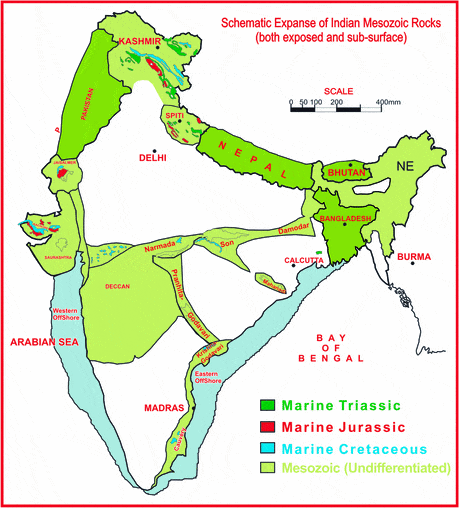
- This period has shown a very rich and varied fauna and flora.
- Numerous invertebrate fossils, including ceratites, ammonoids, brachiopods, Crinoids, echinoids and pelecypods have been observed in the rocks of this age. Amongst the vertebrates, fishes are quite abundant.
- In India, they are exposed as
- The Lilang system in Spiti
- Northern Kumaon
- The Chocolate Series
- The Kalapani limstone
- The Kuti shales and The Kioto limestone.
- The Jurassic System is exposed as Spiti Shales, Laptal Series of Kumaon, Mount Everest Region, sub-Himalaya of Garhwal, Kutch and Rajasthan areas.
- The Jurassic and Cretaceous Systems are known for their marine transgression.
- Forminifera play an important part in Cretaceous stratigraphy. The rocks contain limestones, sandstones and shales.
Deccan Trap
- Volcanic outburst over a vast area of the Peninsular India from the end of the Cretaceous till the beginning of the Eocene gave rise to Deccan Traps.
- Basaltic lava flowed out of fissures covering a vast area of about ten lakh sq km.
- These volcanic deposits have flat top and steep sides and therefore called ‘trap’ meaning a ‘stair’ or ‘step’ in Swedish.
- The process of weathering and erosion (denudation) since millions of years has reduced the Deccan Trap to almost half of its original size.
- Present Deccan Trap covers about 5 lakh sq km mainly in parts of Kuchchh, Saurashtra, Maharashtra, the Malwa plateau and northern Karnataka.
- Thickness of the Deccan Traps is 3,000 metres along the west which is reduced to 600-800 metres towards the south, 800 metres in Kuchchh and only 150 metres at the eastern limit.
- The weathering of these rocks for a long time has given birth to black cotton soil known as ‘regur’.
- Valuable resources of Quartz minerals, amethyst, agate, Onyx and many good gemstones occur in these volcanic rocks
The Cenozoic Era
- The Cenozoic era of geological formations in India belong to the period from 66 million years to the present day.
- The formations belonging to this age are:
- The Tertiary Systems
- The Eocene System
- The Oligocene System
- The Lower and the Middle Miocene
- The Pliocene System and
- The Pleistocene System.
- The Tertiaries in India are called as Marine Tertiaries.
- In the Tertiary period, in India, the Himalayan orogenic movements began.
- It is also observed that the volcanism associated with the Deccan Traps has continued.
- The rocks of this era have shown much valuable resources of petroleum and coal.
- They are found in the Salt Range, Potwar Plateau, outer Himalayan regions of Jammu and Punjab, Assam, Sind and Baluchistan.
- The Eocene System includes the rocks found in Sind and Baluchistan regions.
- It includes the following unique geologic series of formations:
- Ranikot Series,
- Laki Series,
- Kirthar Series,
- Kashmir ranges,
- Eocene Formations of Simla, Rajasthan, Kutch, Assam, Gujarat region
- The Eocene beds of Cauvery Basin and Bengal Basin.
- Oligocene and lower Miocene systems are exposed in the Cauvery Basin, Kutch and Rajasthan, Sind and Baluchistan, Potwar Plateau, Jammu, Simla Himalaya and Assam.
- A lot of coal and petroleum resources of India are found in most of these formations.
- The Miocene to Pleistocene formations are exposed as several unique systems and series.
- The mammalian fauna are represented by many fossil
- The fossil man appeared in the Pleistocene period only.
- They geological formation of this period are :
- The Siwalik System in north western India.
- The Manchhar Series in Sindh
- The Tipam and Dihing Series in Assam
- The Dwarka Beds in Kathiawar
- The Khar series in Kutch
- The Varkala Beds in Coastal Kerala
- The Cuddalore Sandstones in Tamil Nadu and
- The Rajamahendri Sandstones in Andhra Pradesh.
- Lignite, fire clays, ball clays, terra cotta clay, sandstones, shell-limestone, Kaolin and petroleum are the major economic natural resources of these formations.
- The alluvium which is found in the Indo-Gangetic plain are all belonging to this era..
- Human culture and global diversity in faunal and floral assemblages happened during the Pleistocene period.
- Five major episodes of glaciation happened during the last 1 million years. The post glacial environment has indicated the development of Mesolithic human culture, in India, approximately about 20,000 years Before Christ.