
Clastic Rocks and Their Classification
Clastic Rocks and Their Classification
Basis of Classification
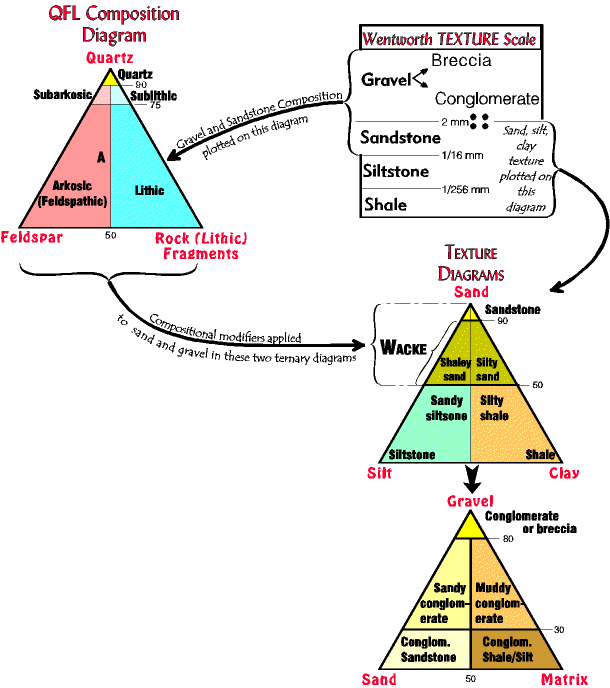
Clastic rocks (sandstones, shales, etc.) are classified on two criteria - texture (grain size), and composition (that is, QFL).
Based on texture
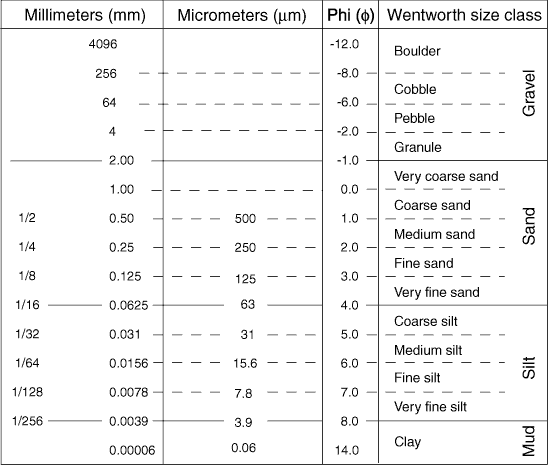
- Clastic particles are divided into size categories based on the Wentworth scale.
Based on Composition (QFL Diagram)
- Any full rock name must specify both texture and composition.

- Thus, an arkose sandstone is a rock of sand sized particles, with a high percentage of those particles being feldspar.
- A composition classification could become very complicated if all of these different particles were considered.
- But in most cases rock composition can be defined by four compositional components:
- Quartz
- Feldspar
- Lithic fragments (including rock fragments and mineral grains other than quartz)
- Matrix (the silt and clay grains that cannot be easily seen by eye).
- A QFL diagram or QFL triangle is a type of ternary diagram that shows compositional data from sandstones and modern sands, point counted using the Gazzi-Dickinson method.
- The abbreviations used are as follows: Q – quartz, F – feldspar, L - lithic fragments.

- Since Quartz, for all practical purposes, does not weather, and will survive after everything else is weathered or sorted out, it is one of the most important of the four components of sedimentary rock composition.
- Pure quartz sandstones are rare. Usually, quartz is mixed with one or more of the remaining three components.
- Feldspars are one of the most abundant minerals in the earth's crust. With only a few exceptions, all igneous rocks have large amounts of feldspar. E.g. Calcium Plagioclase in Gabbro, and Sodium Plagioclase and Orthoclase in Granite. Medium to high grade metamorphic rocks also have large amounts of feldspar.
- Generally, if a siliciclastic particle is not quartz or feldspar, it is classified a lithic fragment. Lithic means "rock".
- The apexes are sand, silt, and clay. Where QFL apexes remain constant, texture apexes commonly change for different uses. Always check the apexes. Later we will use some different apexes to explore some ideas.
- But the shaly sand and silty sand fields, in practice, are difficult or impossible to distinguish from each other, even under a good microscope
- If a rock has gravel sized particles then we need a ternary diagram with gravel at one apex, as to the right. The fields have also changed boundary conditions.
- The sand has moved to another apex, and that silt and clay have been combined into one category i.e. Matrix.
Based on grain size
- Particle size is an important textural parameter of clastic rocks because it supplies information on the conditions of transportation, sorting, and deposition of the sediment and provides some clues to the history of events that occurred at the depositional site prior to final induration.
- Udden-Wentworth, scale is a geometric grain-size scale since there is a constant ratio between class limits.
- Such a scheme is well suited for the description of sediments because it gives equal significance to size ratios, whether they relate to gravel, sand, silt, or clay.
Udden-Wentworth grade scale
Depending upon the grain size: Argillaceous, Lutaceous, and Rudaceous
- A sedimentary rock composed of clay-grade particles; i.e., composed of minute mineral fragments and crystals less than 0.002 mm in diameter; containing much colloidal-size material.
- In addition to finely divided detrital matter, argillaceous rocks consist essentially of illite, montmorillonite, kaolinite, gibbsite, and diaspore.
- Lutite is old terminology, which is not widely used, by Earth scientists in field descriptions for fine-grained, sedimentary rocks, which are composed of silt-size sediment, clay-size sediment, or a mixture of both.
- Rudite is a general name used for a sedimentary rock that are composed of rounded or angular detrital grains, i.e. granules, pebbles, cobbles, and boulders, which are coarser than sand in size.Rudites include sedimentary rocks composed of both siliciclastic, i.e. conglomerate and breccia, and carbonate grains, i.e. calcirudite and rudstone.

Components of siliciclastic sedimentary rock composition
- Quartz: Since Quartz, for all practical purposes, does not weather into anything else, and will remain after everything else is weathered or sorted out, it is one of the most important of the four components of sedimentary rock composition.
- Pure quartz sandstones are rare.
- Usually, quartz is mixed with one or more of the remaining three components.
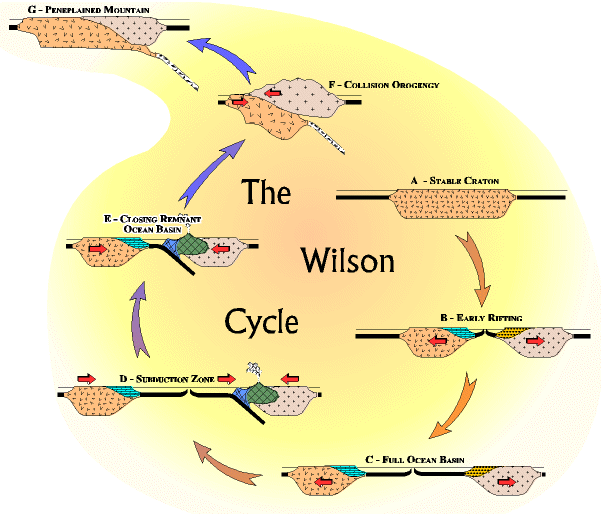
- Pure quartz sandstones form only under great tectonic stability when the land is not high enough for rocks to be exposed to weathering, such as during Wilson Cycle Stage A.
- Feldspar: Feldspars are some of the most abundant minerals in the earth's crust.
- With only a few exceptions all igneous rocks have large amounts of feldspar, e.g. Calcium Plagioclase in Gabbro, and Sodium Plagioclase and Orthoclase in Granite.
- Medium to high grade metamorphic rocks also have large amounts of feldspar.
- Sediments near high mountains frequently have large percentages of feldspar as batholiths and regional metamorphic rocks are uplifted and eroded (Wilson Cycle Stage F and Stage H).
- Rift systems (Stage B and Stage C) frequently also have large amounts of feldspar.
- Lithics: Very simply, if a siliciclastic particle is not quartz or feldspar, it is classified a lithic fragment.
- Lithic means "rock" and all mechanically weathered pieces of another rock, or non-feldspar minerals weathered from a rock, are included here.
- Frequently they are small, dark in color, and difficult or impossible to specifically identify in hand specimen.
- The exception to this is conglomerates and breccias.
- Lithic fragments are especially abundant in volcanic arc systems (Stage E) but are common in most collision mountain buildings (Stage F and Stage H- continent-continent collision).
- Matrix: Matrix is the finer material in which larger particles are embedded.
- So, in a sandstone the matrix is silt and clay.
- In a gravel the matrix may be a sand. However, since all minerals other than quartz will eventually weather into silt or clay sized particles, silt or clay is very common in sedimentary.

Conglomerate and Breccia
- Conglomerate (also called roundstone or puddingstone) is lithified gravel made up of rounded to subangular clasts whose diameters exceed 2 mm.
- Breccia (sharpstone) is lithified rubble made up of angular clasts coarser than 2 mm.
- Very coarse elastic rocks are collectively referred to as rudites or rudaceous sedimentary rocks.
Composition
- Most clasts in conglomerate and breccia are fragments of rocks and minerals produced by the disintegration of bedrock.
- These occur both as coarser-grained framework and finer-grained matrix (filling the space between framework grains).
- Composition is analyzed in two ways.Framework grains are identified by pebble counts done in the field, and matrix (if sand or finer) is studied in thin section.
- Clasts are typically glued together by a small amount of siliceous, calcareous, or ferruginous cement.
- Three principal categories of coarser than sand-sized clasts are distinguished: (1) mineral fragments that occur as major components, (2) mineral fragments that occur as accessory constituents, and (3) fragments of rock.
- Mineral Fragments occurring as major components (5% or more): clasts of a single mineral such as quartz or feldspar tend to be less abundant in conglomerate and breccia than in sandstone because few igneous, metamorphic, or sedimentary rocks have original grains coarse enough to disintegrate into pebbles and coarser detritus.
- Quartz is the most abundant major mineral in conglomerate and breccia.
- It is harder than other rock-forming minerals, has no cleavage, and is practically insoluble.
- Large clasts of K-feldspar, plagioclase feldspar, and mica can also be abundant but seldom last as long as quartz because they corrode, disaggregate, and abrade with transport.
- Mineral Clasts Occurring as Accessory Constituents (Less Than 5%): Other fragments composed of single minerals occur as accessories in conglomerate and breccia.
- Their presence is incidental to the sedimentary rock type, much as garnet crystals are scattered through a granite.
- Minerals occur in accessory amounts either because their original abundance in source rocks is low or because they are easily destroyed by weathering.
- Rock Fragments Rock fragments are typically the most abundant component in very coarse-grained terrigenous rocks and are invariably the most interesting.
- Their composition provides direct information on provenance.
- Rock fragments can consist of almost any variety of igneous, metamorphic, or sedimentary rock, although smaller clast diameters are correlated with finer-grained varieties. Clasts of harder, less easily decomposed lithologies are more likely to survive weathering at the source and breakdown during transport.
Texture
- Conglomerate and breccia textures are studied at the outcrop using methods of quantitative grain size analysis that differ from those used for sandstone.
- Grain diameters of particles coarser than sand are visually assigned to individual size classes.
- Large clast size also permits fabric, grain surface features, grain shape, and grain roundness to be studied in the field the framework fraction consists of clasts whose grain diameters exceed sand size (>2 mm).
- The interstitial space between framework grains can be empty (pore spaces); filled with finer grained detrital matrix; or occupied by cement, fluid (water or oil), or natural gas.
- Two distinct varieties of conglomerates (and breccias) are defined on the basis of texture: orthoconglomerates and paraconglomerates.
- Orthoconglomerates (literally, "true" conglomerates) consist mainly of gravel-sized framework grains.
- The proportion of matrix (sand and finer material) is 15% or less.
- As a result, orthoconglomerates have an intact, grain-supported framework; that is, individual framework grains are in tangential contact and support one another.
- Paraconglomerates have a matrix of sand and finer clasts. The proportion of matrix is at least 15%; most have more than 50% matrix and are actually sandstone or mudrock in which pebbles, cobbles, and boulders are scattered.
- Paraconglomerates can have a grain-supported fabric, but those with high proportions of matrix have an unstable, nonintact, matrix-supported framework.
General Textural Characteristics
- Sorting and Modality breccia, these rocks are almost invariably less well sorted than finer-grained terrigenous rocks.
- Some are unimodal; that is, they contain a single modal size class abundance.
- Many are bimodal or polymodal; that is, they have two or more prominent size classes in addition to the modal class.
- Orthoconglomerates deposited by rivers tend to be bimodal because deposition mixes coarser bedload with finer suspended load.
- Paraconglomerates are less well sorted than orthoconglomerates and are almost rocks such as granite and marble generate equidimensional (equant) pebbles, cobbles, and boulders.
- The roundness of clasts that are coarser than sand is controlled by both rock type and abrasion history.
- The intensity of abrasion varies with transport distance and agent always at least bimodal; most are polymodal.
- These characteristics reflect the deposition of paraconglomerates by transport agents that rarely separate clast sizes: glaciers, mass wasting, and turbidity currents.
- Shape, Roundness, and Grain Surface
- These textural characteristics correlate with transporting agent and depositional setting history.
- Foliated metamorphic rocks such as schist and slate tend to disintegrate into elongate, flattened clasts.
- Massive clasts transported by streams with steep gradients.
- Surface indentations or pits on grain surfaces originate mainly by etching and differential solution and do not indicate a specific transporting agent or depositional setting.
- Fabric or Internal Organization
- Individual clasts usually nonequant, elongate rock and mineral fragments- are fabric elements.
- Some exhibit no preferred alignment; others show a systematic orientation termed imbrication.
Classification, Origin, and Occurrence
- Factors considered useful for classification include framework-to-matrix ratio, stability of the framework, clast lithology, clast size, and overall fabric.
- The flow diagram in Fig. 5.5 permits the classification to be used easily in the field or with hand specimens.
- The classification uses visible textural and compositional features.

- The classification scheme first separates framework and matrix, solely on the basis of size.
- Step 1. Extraformational and intraformational conglomerate and breccia are separated by comparing the composition of framework and matrix grains.
- Intraformational conglomerate and breccia have an interior (intrabasinal) source; that is, they are eroded from the samesedimentary rock unit of which they are a part, rather than being derived from rocks located outside the depositional basin.
- Consequently, intraformational conglomerate and breccia have framework grains identical in composition to those of the matrix.
- Only two principal types of intraformational conglomerate and breccia are common: shale pebble (or cobble, or boulder) (Fig. 5.6A) and limestone pebble (or cobble, or boulder).
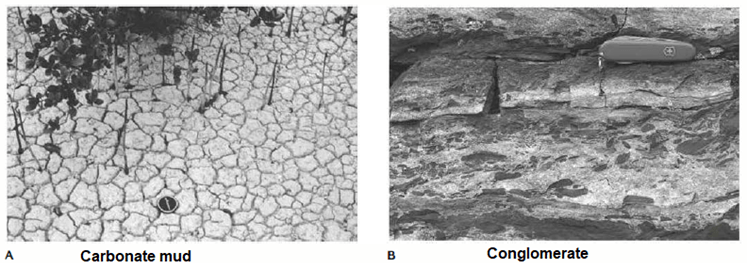
- Framework clasts in both types are flat, tabular disks with long axes aligned parallel or subparallel to stratification.
- Extraformational conglomerate and breccia are derived from source areas outside the depositional basin.
- Detritus weathered from external sources is carried away and deposited elsewhere.
- As a result, framework clasts differ markedly from matrix in composition.
- Framework material is exotic; that is, not derived by the erosion and redeposition of matrix material.
- Step 2. Orthoconglomerates (orthobreccias) and paraconglomerates (parabreccias) are separated by examining the proportion of matrix.
- Orthoconglomerates are matrix-poor (80% or more framework grains) and have an intact, stable, grain-supported fabric.
- Paraconglomerates are matrix- rich. Their fabric may be grain-supported, but most have an unstable, nonintact fabric that is supported by matrix grains.
- Removing the matrix would cause the framework to collapse. Orthoconglomerates are transported and deposited on a grain-by-grain basis .
- Step 3A. Conglomerates are further divided into oligomict and petromict varieties on the basis of framework grain composition.
- In oligomict (orthoquartzose) conglomerate or breccia, more than 90% of the framework clasts (granule and coarser grains) consist of fragments of only a few varieties of resistant rocks and minerals such as metaquartzite, vein quartz, and chert.
- The term petromict (or polymict) is used if clasts of many different kinds of metastable and unstable rocks are abundant; for example, basalt, slate, and limestone.
- Oligomict orthoconglomerates imply wholesale decomposition and disintegration of immense volumes of rock, reflecting climate and topography that promote chemical decomposition and physical disintegration of all but the most resistant components important.
- Many of these conglomerates may be streamflow deposits that fill stream channels as sheetlike gravel blankets or as bars developed transverse to the flow direction.
- Some occur as thin layers or lens-shaped bodies in fluvial sequences; these layers are generated after storms, when sheetlike surges of sediment-laden floodwater spread out on the perimeter of alluvial fans and glacial outwash fans.
- Petromict orthoconglomerates are much more abundant than oligomict orthoconglomerates.
- Coarse clasts of volcanic, metamorphic, and sedimentary rocks predominate.
- Petromict orthoconglomerates are mainly alluvium eroded from high-relief sources. They make up large portions of modern and ancient alluvial fans and are a common component in orogenic elastic wedges.
- Some are deposited in desert or glacial-periglacial regions, where even low-lying sources disintegrate physically rather than decompose chemically.
- Step 3B. Paraconglomerates (and parabreccias) are further subdivided on the basis of their inferred origin as well as the size and internal organization of their matrix.
- Paraconglomerates containing a matrix of delicately laminated mud rock in which coarser framework grains float are called laminated pebbly (or cobbly, or bouldery) mud rock.
- These rocks consist of widely scattered angular to subangular cobbles, pebbles, and boulders floating within laminated mud rock.
- Laminae are distorted above and below the larger clasts, bend down abruptly beneath clasts, and may be broken.
- These clasts are called dropstones because they have been sporadically dropped from above into the soft, muddy substrate.
- Post depositional compaction of the plastic matrix around the more resistant clasts produces the drape like pattern of overlying laminations.
- Paraconglomerates in which the matrix is disorganized and nonlaminated are either tillite (if a glacial origin can be inferred), or tilloid (deposited by mass movement). Sediment deposited by melting glaciers is till; lithified till is tillite.
- On alpine (valley) glaciers, large blocks of rock slump or free-fall onto the ice surface from steep valley walls; glaciers.
- All material incorporated on, within, and near the base of glacial ice settles slowly.
- The high viscosity and low velocity of moving ice permit no sorting and little abrasion, although grinding of the bedload against valley walls and floor can generate additional fine-grained clasts.
- Glacial loads are plastered onto the substrate as ground moraine or accumulate wherever there is a balance between the rates of ice flow and melting (this accumulation produces terminal and recessional moraines).
- In contrast to tillites, most tilloids are deposited by dry and wet gravity-driven mass wasting processes such as rockslides, debris flows, and turbidity currents.
- Gravity acts directly on the sediment, and any fluid that is present facilitates transport by reducing internal friction and providing grain support.
- Deposition is rapid, and there is little reworking or sorting.
- Subaerial debris flows occur on the surface of alluvial fans.
- They are produced when surges of water from heavy rainfall or the melting of snow and ice mobilize gravel-sized detritus and a cohesive matrix of finer material.
- Slurries move down even gentle slopes they deposit very poorly sorted, usually ungraded, internally disorganized material that is often mud-rich and matrix-supported.
- Tilloids deposited by turbidity currents may be either clast-supported or grain-supported.
Sandstone
- Sandstone is the indurated equivalent of unconsolidated sand.
- Sand includes clasts with diameters from 2 mm to 1/16 (0.0625) mm.
- Sandstones are also referred to as psammites (Greek) and arenites (Latin).
- Sand grains constitute the framework of sandstone, and the pore spaces between framework grains may be empty or partly or entirely filled.
- Pore filling can be any combination of (1) finer-grained primary or secondary elastic matrix, (2) cement (typically calcite, quartz, chert, or hematite), and (3) fluids such as gas, air, oil, and groundwater.
Composition
- Sandstone composition is analyzed using a petrographic microscope and thin sections.
Quartz
- Sand grains can consist of any mineral, but monocrystalline (single-crystal) quartz grains are by far the most abundant type of sandstone grain.
- When composite grains of multiple interlocking quartz crystals are defined as rock fragments, they are termed polycrystalline quartz.
- Quartz is a common constituent in
- rocks such as granite, gneiss, and schist, which make
- up much of Earth's crust. Because quartz resists disintegration
- and decomposition, there is more quartz
- than other rock-forming minerals in sediments.
- efforts have been made
- to discriminate varieties of quartz derived from a
- particular provenance.
- Monocrystalline quartz
- grains derived from hydrothermal veins often contain
- fluid-filled vacuoles. Undulatory extinction
- characterizes quartz derived from plutonic and highgrade
- metamorphic source rocks; nonundulatory
- extinction indicates volcanic rock sources or grains
- recycled from older sandstones.
Feldspars
- Feldspar is generally less abundant than quartz in sandstone, averaging between 10% and 15% of sandstone composition.
- Feldspars are more easily decomposed than quartz; they are not as hard and they cleave.
- High feldspar content in a sandstone carries specific implications about source area climate and topography.
- It means that chemical weathering is not extensive, probably because of climate and/ or high source relief.
- Low precipitation in an arid setting, or an arctic climate in which precipitation occurs as snow and ice rather than as rain, limits hydrolysis and produces feldspar-rich debris.
- Potassium feldspars are more prevalent because they are more common in continental crust and resist decomposition better.
Rock (Lithic) Fragments
- The overall abundance of rock fragments in sandstone varies greatly. Lithic fragments provide the most specific information about sandstone provenance.
- the survivability of a rock fragment is a function of mineralogy. Physically and chemically resistant minerals such as quartz (for example, a quartz siltstone or a bedded chert) survive weathering and erosion better than more easily decomposed materials such as limestone or basalt.
Accessory Minerals
- Accessory minerals typically have densities that exceed those of the common rock forming minerals quartz and feldspar.
- Examples include garnet, rutile, zircon, corundum, kyanite, olivine, and pyroxene.
Micas and Clay Minerals
- The major micas-biotite, muscovite, and chlorite-occur in sandstone as silt and sand. Because their flakelike or discoidal shape slows their settling, micas tend to be slightly coarser than the more equant quartz and feldspar grains with which they are associated.
- They are helpful in pinpointing specific sources. For example, chlorite suggests a low-grade metamorphic rock source.
- Clay minerals because of their fine grain size, are concentrated as matrix.
Texture
- The texture of a sandstone includes grain size, size variation, roundness, shape, surface features, and overall fabric (arrangement of the clasts in space).
- Texture is analyzed for many reasons, in addition to simple description.
- Often, stratigraphic units can be differentiated on the basis of mean grain size alone.
- Sandstone porosity (the ratio of the volume of empty space to that of solid material) and permeability (the degree to which pores are interconnected) are of practical importance in petroleum geology, hydrology, and waste disposal.
- Regional variations in texture allow inferences to be made about sediment dispersal.
- Textural studies allow for the identification of transporting agent and depositional setting.
Fabric
- The term fabric refers to the orientation or arrangement of grains in a sandstone, how they are packed together, and the type of grain contacts. Sandstone fabric controls porosity and permeability.
- An oriented fabric reflects the parallel alignment of elongate or disk-shaped grains. It is produced when sand is deposited by strong, directionally constant currents.
Textural Maturity
- Folk (1951, 1966) defined four stages of sandstone textural maturity. An evaluation of sandstone textural maturity is based on three criteria: (1) the proportion of "clay" clasts the sorting of the sand framework; and (3) the roundness of the sand grains.
- A sandstone is texturally immature if the proportion of clay-sized material exceeds 5%, regardless of the degree of sand grain sorting and rounding. Immature sandstones also tend to be high in feldspars and rock fragments.
- Texturally submature sandstones have a clay component of less than 5%.

Classification

- Figure 1 shows the petrographic sandstone classification most commonly used. This classification can be Classification scheme for terrigenous sandstones.
- The front panel shows arenites, the central panel wackes, and the rear panel mudrocks.
- The small panel at lower right allows more specific naming of lithic wackes and arenites on the basis of their rock fragments used for both unconsolidated modern sand and ancient sandstone.
- Two defining parameters are used to subdivide terrigenous sandstones:
- The percentage of matrix (regardless of origin) is defined as any elastic material finer than 30 mm (coarse silt).
- The composition of sand framework grains, specifically the percentages of quartz (Q), rock fragments (R or L), and feldspar (F).
- The petrologist counts points in a thin section and determines the amount of matrix and the percentage of sand grains of quartz, feldspar, and rock fragments.
- Using a 15% matrix content, two distinct groups of sandstone are distinguished: arenites and wackes (or graywackes).
- Specific varieties of each group occupy positions within the separate triangular panels for arenites and wackes that appear in Fig. 1.
- A third triangular panelrepresents mudrock, to portray the natural continuum that exists between sandstone and finer-grained elastic rocks.
- Arenites are texturally "clean," matrix-free (or at least matrix-poor) sandstones.
- They owe their cohesiveness to cement precipitated in what were originally empty intergranular pores.
- Wackes are argillaceous, matrix-rich, texturally immature, or "dirty" sandstones.
- Matrix originates in two principal ways.
- Primary detrital matrix is transported and deposited with the coarser sand-sized framework grains.
- Secondary matrix is produced by diagenesis: rock fragments are squashed and disaggregated, and feldspar decomposes to form clay.
- The percentage of quartz, feldspar, and rock fragments that occur as sand-sized grains allows arenite and wacke to be separated into subtypes.
- Other framework constituents such as the micas and heavy minerals are ignored.
- Three principal varieties of arenite and wacke are recognized based on the percentage of quartz, feldspar, and rock fragments.
- Quartz arenites and quartz wackes are sandstones with framework grains composed mainly of quartz (95% or more).
- Sandstones containing a lower percentage of quartz can be further categorizedby comparing the relative proportion of rock fragments and feldspar.
- The prefix lithic is used for arenites and wackes in which rock fragments exceed feldspar.
- Those in which feldspar exceeds rock fragments are called feldspathic or arkosic.
- The smaller panel at the lower right in Fig 1 is used to generate specific names for rock-fragment rich sandstones.
- Matrix-Rich Wacke Versus Matrix-Poor Arenite the fluidity Index most matrix-poor (typically 1 % to 2% matrix) sandstones (arenites) exhibit sedimentary structures, fossils, and other features consistent with transport and deposition by such fluids as water and wind.
- Arenites contain cement simply because they originally had empty pore space.
- Matrix-rich sandstones (wackes), on the other hand, tend to exhibit size grading, sole markings, and other features produced when transport and deposition are by quasi-liquid flows such as density currents and mass flows.
- What relationships connect sandstone texture and composition to origin?
- Matrix-Rich Wacke Versus Matrix-Poor Arenite
- the fluidity index.
- most matrix-poor (typically 1 % to 2% matrix) sandstones (arenites) exhibit sedimentary structures, fossils, and other features consistent with transport and deposition by such fluids as water and wind.
- Arenites contain cement simply because they originally had empty pore space. Matrix-rich sandstones (wackes), on the other hand, tend to exhibit size grading, sole markings, and other features produced when transport and deposition are by quasi-liquid flows such as density currents and mass flows.
- Ratio of Rock Fragments to Feldspar the proportion of feldspar to rock fragments is actually a reliable index of sandstone provenance.
- Sand sources are either supracrustal or subcrustal rocks. Supracrustal sources form at or very near Earth's surface; for the most part they are fine-grained (aphanitic) volcanic rocks, low-grade slate and phyllite, and such sedimentary rocks as chert and mud rock.
- These fine-grained rocks disintegrate into sand grains that are composite-that is, rock fragments-rather than clasts of single minerals.
- Subcrustal rocks form at depth and include such igneous rocks as granite and diorite and such higher-grade metamorphic rocks as schist and gneiss.
- Disintegration of these rocks generates sand grains of single minerals such as quartz and feldspar, not composite grains.
- Therefore, the ratio of feldspar to rock fragments ostensibly separates sandstone derived from two distinct provenances.
- Percentage of Quartz or Ratio of Quartz to Feldspar + Rock Fragments
- This ratio is an index of compositional maturity, reflecting the differences between sand with lots of soft, unstable, decomposable rock fragments and feldspar and sand composed of only the most physically resistant and chemically stable materials, mainly monocrystalline and polycrystalline quartz.
- This index is based on the premise that physical disintegration and chemical decomposition operate on soil and sediment over extremely long spans of time.
Characteristics, Significance, and Occurrence
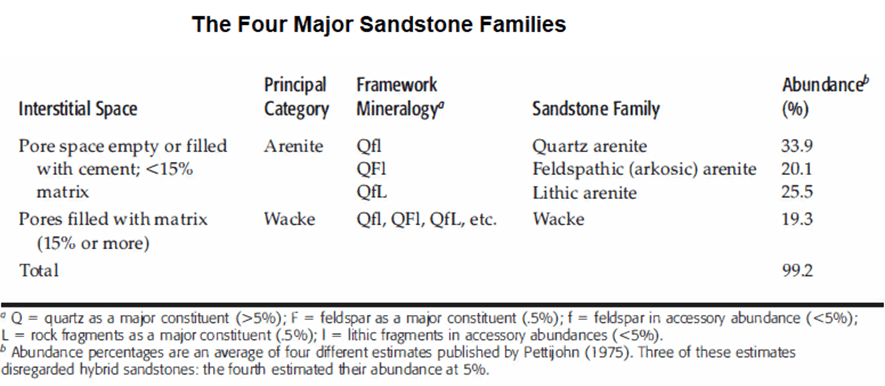
Table lists four major sandstone families and their estimated abundance summaries, arenites are separated into quartz arenites, feldspathic (arkosic) arenites, and lithic arenites; wackes are lumped together as a single family.
- Quartz Arenites (Orthoquartzites)
- Typically, quartz arenites are white to light gray sandstones, although they are often stained pink, brown, or red by iron oxide cement.
- They consist almost entirely of sand-sized monocrystalline quartz grains Resistant grains of chert, metaquartzite, and such "heavy" minerals as zircon, tourmaline, and rutile also can be present.
- Quartz arenites typically have a supermature texture and composition. They are usually well-bedded and can exhibit ripple marks; lamination; cross--lamination; and, in some cases, large-scale cross-bedding.
- Body fossils are rare.
- Most quartz arenites occur as regionally extensive blanket-shaped bodies.
- The thickness of individual sheets varies from a few meters to several hundred meters.
- They are commonly interbedded laterally and vertically with shallow marine mudrock, limestone, dolomite, and shoreline conglomerate. These bodies are generally deposited on unconformable surfaces.
- Many quartz arenites are shallow sands that accumulated along or near the shoreline as beach, shoreline dune, tidal flat, spit, barrier island, or longshore bar deposits.
- Repeated recycling of detritus weathered from stable, low-lying cratonic continental block sources probably played an important role in their genesis. Other quartz arenite bodies are subaerial windblown dune deposits.
- Their super mature texture and composition tightly constrain provenance, weathering, and depositional setting.
- Their absence from sequences of Archean and early Proterozoic age probably reflects the lack of abundant quartz-rich source rocks and/ or the absence of broad, tectonically stable continental cratons.
- Feldspathic (Arkosic) Arenites
- The major framework grains found in this sandstone type are monocrystalline quartz and feldspar.
- Feldspar content typically reaches 40% to 50%.
- Orthoclase and microcline exceed plagioclase when continental crust is the dominant source; where plagioclase predominates, a volcanic arc source is indicated.
- Other abundant framework grains are micas (muscovite and biotite) and rock fragments plagioclase.
- Feldspathic arenites are not as mature texturally or compositionally as quartz arenites.
- They are typically coarser; grains are less well sorted and less well rounded.
- It is compositionally immature but texturally super mature, consisting of well-sorted, well-rounded grains of monocrystalline quartz and feldspar.
- Bedding and internal organization are ordinarily less well developed than in quartz arenite.
- Body fossils of shallow marine or terrestrial organisms may be rare or common.
- Some feldspathic arenites are residual or "sedentary" arkoses, formed as local lenses and layers found at or near the base of transgressive quartz arenite sequences.
- Many arkoses are found in regionally restricted wedge-shaped nonmarine alluvial fan and fan delta deposits.
- They form as sheet-flow and debris flow sediments and accumulate on the surface of alluvial fans, within river channels and point bars, and on and along shorelines.
- Their high feldspar content indicates that coarse, feldspar rich rocks such as granite and gneiss are being eroded.
- Survival of feldspar, with little decomposition to clay minerals, signals a dry or arctic climate and/ or a steep mountainous topography.
- Lithic Arenites (and Sublitharenites)
- Clasts of monocrystalline quartz (30% to 80%) and rock fragments (5% to 50%) are the most important constituents in this sandstone family.
- The mix of lighter-colored quartz and feldspar clasts with darker- colored rock fragments gives these sandstones a speckled, salt-and-pepper appearance.
- Lithic arenites that accumulate as alluvial deposits are well bedded and exhibit tabular and trough cross-bedding, ripple marks, internal lamination, current lineation, scour-and-fill structures and fining-upward cycles.
- Fossils are uncommon.
- These deposits exhibit internal lamination, oscillation ripple marks, and well-developed bedding.
- Many lenticular sandbar deposits that interfinger with channel conglomerate and floodplain mudrock are lithic arenite.
- Sandstones found on many alluvial fans and river basins developed adjacent and in front of recently uplifted mountainous sources often belong in this category.
- Many orogenic elastic wedges consist largely of lithic arenite.
- Lithic arenites that accumulate as alluvial deposits are well bedded and exhibit tabular and trough cross-bedding, ripple marks, internal lamination, current lineation, scour-and-fill structures and fining-upward cycles. Fossils are uncommon.
- These deposits exhibit internal lamination, oscillation ripple marks, and well-developed bedding.
- Many lenticular sandbar deposits that interfinger with channel conglomerate and floodplain mudrock are lithic arenite.
- Sandstones found on many alluvial fans and river basins developed adjacent and in front of recently uplifted mountainous sources often belong in this category.
- Many orogenic elastic wedges consist largely of lithic arenite lithic arenites typically coincide temporally and spatially with subduction-related active magmatic arcs and collisional orogeny.
- Wacke (Graywacke)
- Wackes are physically hard, dark, enigmatic rocks. Clasts of monocrystalline quartz are often the most abundant framework com ponent (25% to 50%), although the proportion fluctuates.
- There are varieties of wacke that are equivalent in all respects except ratio of matrix to quartz arenite, feldspathic (arkosic) arenite, and lithic arenite (Fig. 5.24).
- Feldspar clasts are most often angular to subangular and can be twinned (dominantly sodic) plagioclase as well as K-feldspar.
- Grains of chert, mudrock, limestone, polycrystalline quartz, and volcanic rocks are also quite common.
- The Si02 content of wackes ranges from 50% to 70%, reflecting the moderate amount of quartz and feldspar.
- Because they contain abundant matrix rich in clay minerals and chlorite, they are also rich in Al203, MgO, and FeO + Fe203 they are immature.
- Many wackes were deposited by waning turbidity currents.
- They routinely display graded bedding, sole markings, and the systematic upward changes in sedimentary structures and grain size characteristic of turbidites.
- Deep-water abyssal and bathyal body fossils, pelagic fauna and flora, and retransported shallow-water organic remains are all found within wacke sandstone sequences.
- Some wackes were deposited within submarine fan complexes,
- Wackes are the dominant sandstone of the Archean, because the only emergent areas early in Earth's history were narrow, non-granitic volcanic arcs bordered by troughs.
Mud rocks
- CLAYS-WHICH ARE SHEET SILICATES THE SIZE OF COLLOIDAL PARTICLES, viruses, or the particles of smoke from a cigarette-are the most abundant minerals on the surface of the Earth. Clays cover about 75% of the land surface and blanket most of the deep seafloor in pelagic oozes.
- The term mudrock refers to all siliciclastic sedimentary rocks composed predominantly of silt-sized (1/16 to 1/256, or 0.0625 to 0.0039, mm) and clay-sized ( <1 /256, or <0.0039, mm) particles.
- Mudrock includes two lithologies in which one of these size ranges predominates-siltstone, with 50% or more silt-sized material, and claystone, with 50% or more clay-sized material-as well as lithologies that are a mix of the two.
- Mudstone is indurated mud, which is a mixture of silt with between one-third and two-thirds clay.
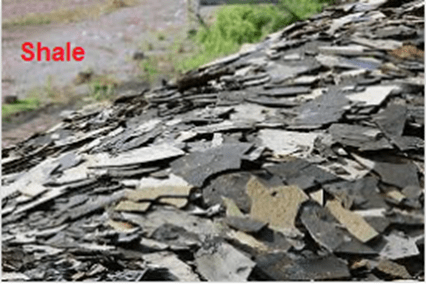
- Shale (Fig. 6.1) is any mudrock that exhibits lamination or fissility or both.
- Argillite is mudrock that has been subjected to low-grade metamorphism.
- Mudrocks are also referred to as petites, pelitic sedimentary rocks (from the Greek for mud), lutites (from the Latin for mud), and argillaceous sedimentary rocks.
- Typical mudrock ranges from 80% silt, 17% clay, and 3% sand to 2 parts silt and 1 part clay.
- In any case, there is less textural variation among mudrocks than among coarser-grained siliciclastics.
- Clasts in mudrocks tend to be more angular and less spherical than the clasts in other siliciclastic rocks.
- This is probably a consequence of both mineralogy and size. Silt, and especially clay-sized material, consists mainly of flaky fine micas and clay minerals, rather than quartz, feldspar, and rock fragments.
- Micas and clay minerals are carried by weak currents that cause little abrasion.
- Many mudrocks exhibit a preferred fabric caused by the parallel alignment of flat, flake-shaped micas and clays.
- This fabric is expressed as fissility: the tendency of mudrock to part or split along thin, closely spaced parallel surfaces.
- Shale is a general term used to refer to any mudrock possessing fissility.
- The bulk mineralogy of mudrocks resembles that of sandstone, except that few if any rock fragments are present.
- Quartz and feldspar are as important in mudrock as they are in sandstone.
- Fine-grained micas and clay minerals replace the rock fragment component.
Clay Mineralogy and Provenance
- Clay minerals can be produced by the weathering of igneous, metamorphic, or sedimentary rocks.
- Although igneous rocks initially contain no clay minerals, the feldspars that largely constitute them decompose to clay minerals, especially when the topography is low and the climate warm and humid.
- Metamorphic rocks also contain feldspars and micas that decompose easily to clay.
- Weathering of pre-existing sedimentary rocks, especially other mudrocks, generates detritus rich in clay.
- The particular clay mineral produced is dictated by the extent of decomposition.
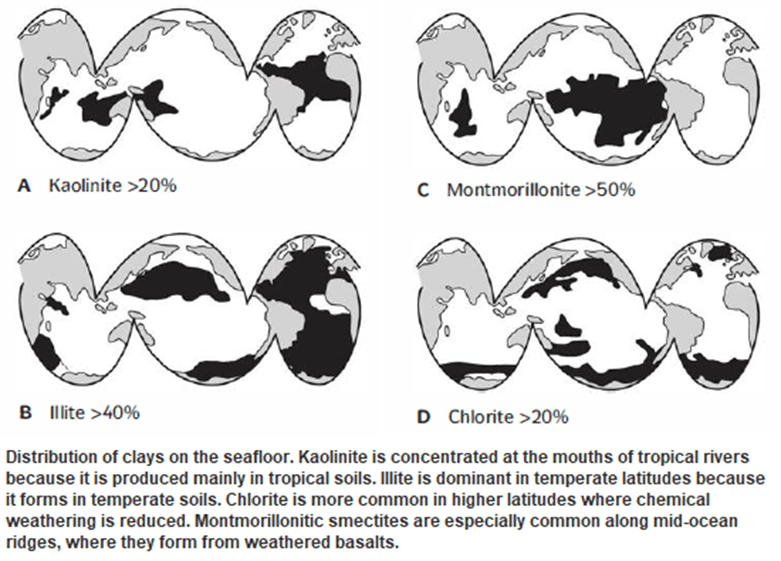
- In the modern environment, certain clay minerals are associated with specific conditions.
- Kaolinite is rich in aluminium but not in other cations.
- Consequently, it is abundant in areas of prolonged leaching, which concentrates aluminum, particularly if the parent material is also high in aluminum.
- Such leaching occurs most often in tropical soils with acid conditions and good drainage.
- The soils of the tropics are often so enriched in aluminum that they become a hard, crusty material known as laterite.
- The K-rich clay illite is by far the most abundant.
- Today, it is most often found in temperate environments, where there are alternate wet and dry conditions and the soil is neutral or slightly alkaline.
- Illites are also often produced by the weathering of pre-existing shales, and they are common in deeply buried muds and shales, where they are formed by the transformation of smectite.
- Montmorillonitic smectites are higher in Fe and Mg, so they are commonly found as weathering products of ferromagnesian rocks, such as basalts and gabbros.
Depositional Setting
- On the deep seafloor, where clays from the land eventually settle out, a predictable pattern can be seen.
- Kaolinites are most abundant in the tropical belts, especially adjacent to the mouths of major jungle rivers.
- Chlorites are most common in the high latitudes, especially in the North Pacific, North Atlantic, and Antarctic oceans.
- Montmorillonites are found throughout the sea bottom but especially in the areas along mid-ocean ridges and near island arcs, where they are produced by the weathering of basalts. The rest of the seafloor especially in temperate regions, is predominantly illite.
Classification
- Other than the consensus regarding the distinctions among mudrock, siltstone, claystone, shale, and argillite, no single system of mudrock classification and nomenclature has won widespread acceptance.
- Table lists various criteria used to classify mudrocks and the categories generated by each scheme.
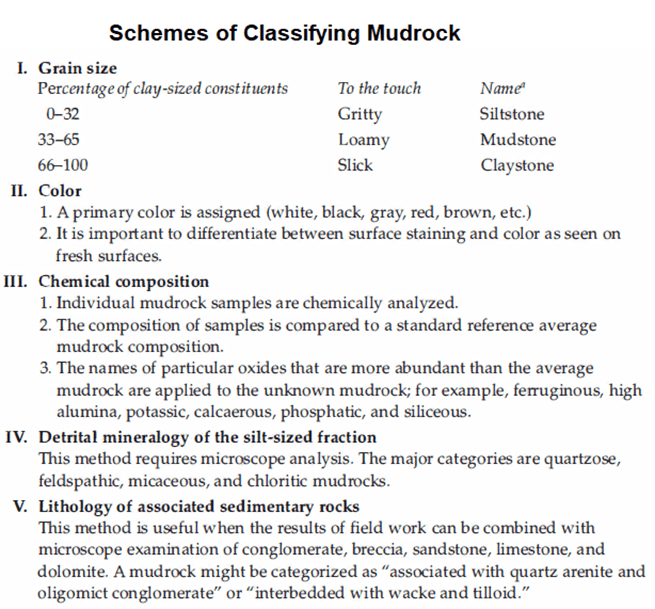
- Chemical composition is also used to distinguish mudrock types.
- First, the relative percentage of chemical constituents in the average mudrock must be known.
- The mineralogy of the silt-sized component in mudrock is also used for classification. In this method, specimens must be studied in thin section.
- Mudrock types are characterized as quartzose, feldspathic, chloritic, or micaceous.
- Mudrocks are also differentiated on the basis of the coarser siliciclastic materialswith which they are associated: sandstone, conglomerate, and breccia.
Origin and Occurrence
- Relatively weak transporting currents deposit mudrock.
- Isolating the site of mudrock accumulation temporally and/ or spatially from stronger currents is crucial to the deposition of thick, monotonous mudrock sequences.
- The depositional setting of a mudrock is not inferred from its texture or composition.
- Greater reliance is placed on fossil content, sedimentary structures, and the type and origin of sedimentary rocks interbedded with the mudrock.
- Mudrocks of marine origin include those deposited as abyssal plain sequences far from land.
- They consist of pelagic materials that slowly settled out of suspension, terrigenous materials transported far out into the ocean basins by weak density currents, and windblown materials from the continents.
- Some marine mudrocks are transported and deposited by contour currents.
- Other marine mudrocks are deposited nearer shore in the deeper, more protected parts of continents.
- Mudrocks of continental origin include lacustrine deposits and the thick, fine-grained siliciclastics found within meandering river systems.
- Rivers that flood periodically cause channelized flow to escape the confines of natural levees.
- The flow spreads quickly and then slows, depositing predominantly finer-grained material across the floodplains.
- Sediments deposited in the distal or deltaic portion of such systems can be predominantly silty or clayey.
- Finally, windstorms constantly entrain, transport, abrade, and redeposit fine-grained material as loess across wide portions of the globe.
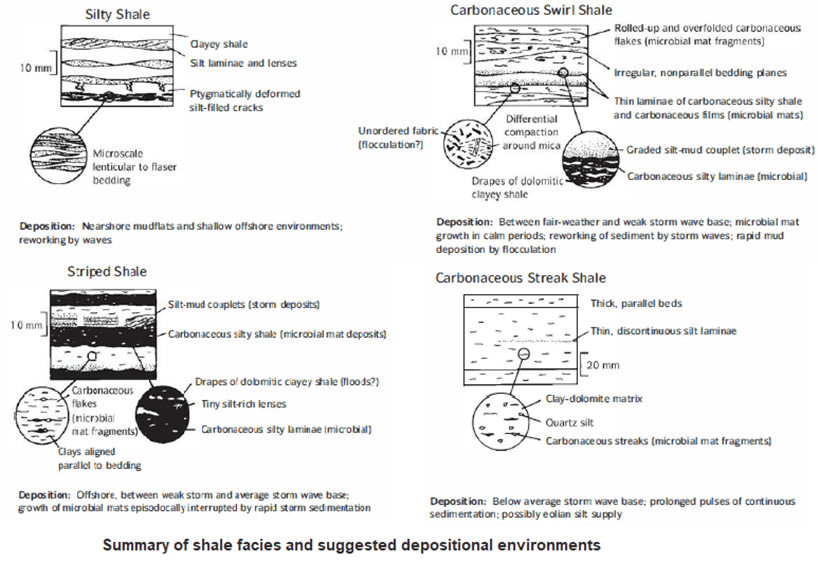
Black Shales
- One of the most distinctive and controversial of all sedimentary rock types is the black shales.
- Their black color is due to a very high content of unoxidized organic matter.
- They also contain reduced iron in the form of pyrite and are usually finely laminated, indicating little bioturbation or storm disturbance.
- Typically, they contain no bottom-dwelling marine organisms, but they may contain planktonic (floating) organisms, such as microfossils or graptolites, or nektonic (swimming) organisms, such as fish and marine reptiles, which sank to the bottom after they died.

- Occasionally, they contain extraordinary fossils in which even the organic films of the soft tissues are preserved.
- All these features show that black shales were deposited under reduced, low oxygen conditions.
- If they are anaerobic (less than 0.1 ml of oxygen per liter of seawater), only bacteria tolerant of low oxygen levels can live, and no bottom scavengers can break up the carcasses or stir up the mud.
- Under dysaerobic conditions (between 0.1 and 1.0 ml oxygen per liter of seawater), organic material accumulates as well, and only a few types of burrowing worms can live.