
Classification of Sedimentary Rocks
PYQs: Clastic and non-clastic rocks-their classification
- Give the classification of sandstone based on its detrital component and matrix. (IFS 2021, 15 Marks)
- Differentiate between: Clastic and Non-clastic sedimentary rocks (IFS 2021, 5 Marks)
- Give a brief account of Folk’s classification of limestones. (2021/10 marks)
- How are sedimentary rocks classified in general based on their process of formation? (2020)
- Classification of carbonate rocks based on textural components may be useful for interpretation of depositional environment. Justify the statement with reasons. (2020)
- Discuss the fabric, composition, and geological significance of arkose. 10-2019.
- Enumerate briefly on how the clastic rocks are classified on the basis of their gram-size. (2016)
- How are the clastic rocks classified on the basis of their grain-size? (2014)
- Explain in 200 words: Clastic-Sediments and their depositional environments (2007)
- Name some common non-clastic sedimentary rocks. Write in details about their occurrence, petrography, classification, and depositional environment (2003)
- Give brief account of: Classification and depositional environments of Clastic rocks of sediments (2001)
Introduction
Sedimentary rocks are classified based on their texture and composition. Detrital sediment has a clastic (broken) texture. Chemical and organic sediments have a non-clastic texture and are classified based solely on their composition.
Sedimentary rocks are generally divided into three main categories, siliciclastic (or simply, clastic) rocks, chemical rocks and biochemical rocks.
Clastic rocks are made from eroded fragments, hard. Non clastic rocks are made from sediments that weren't clasts of rock, smooth.
- Clastic Rocks: Mineral remnants of old rocks, Volcanic ash, Biogenic clasts.
- Non-Clastic Rocks: Organic material, Chemical deposits.

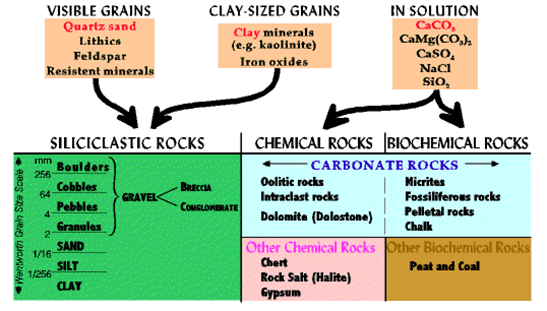
Siliciclastic rocks (Visible grains and clay sized grains)
- Their relationships to the three divisions from the simple ideal model are shown in the figure above.
- Siliciclastic rocks are composed of weathering products that did not dissolve into water, have silica (SiO2) as one of their major components, and are transported either by rolling along the bottom, or in suspension.
- Because of this the visible grain and clay sized grain weathering products tend to be mixed and deposited together. Hence, these are grouped together as SILICICLASTIC rocks.
Chemical Rocks and Biochemical Rocks
- Minerals IN SOLUTION tend to be deposited together and are not generally deposited in the presence of siliciclastic rocks.
- To deposit minerals that are in solution, they must somehow come out of solution and this happens in two ways.
- Either they precipitate directly from sea water (usually because it is evaporating and concentrating the salts) - CHEMICAL ROCKS.
- Or " plants" and " animals" extract the dissolved minerals from the sea water to make skeletons, their skeletons eventually becoming part of the sediment as BIOCHEMICAL ROCKS.
Clastic Sedimentary Rocks
- Clastic sedimentary rocks are composed of rock fragments that were cemented by silicate minerals.
- They are somewhat granular in nature.
- Minerology: Typically includes quartz, feldspar, rock (lithic) fragments, clay minerals, and mica; any type of mineral may be present, but they in general represent the minerals that exist locally.
- Composed of clasts + matrix + cement.
- Genesis: Clastic rocks forms from physical and chemical weathering of pre-existing rock. It is followed by erosion, transportation, deposition, lithification and diagenesis.
- Minerology: Typically includes quartz, feldspar, rock (lithic) fragments, clay minerals, and mica; any type of mineral may be present, but they in general represent the minerals that exist locally.
- Clastic rocks (sandstones, shales, etc.) are classified on two criteria - texture (grain size), and composition (that is, QFL).
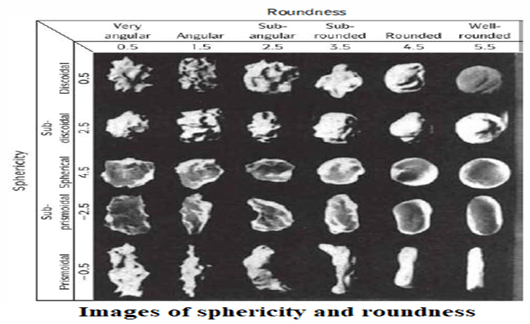
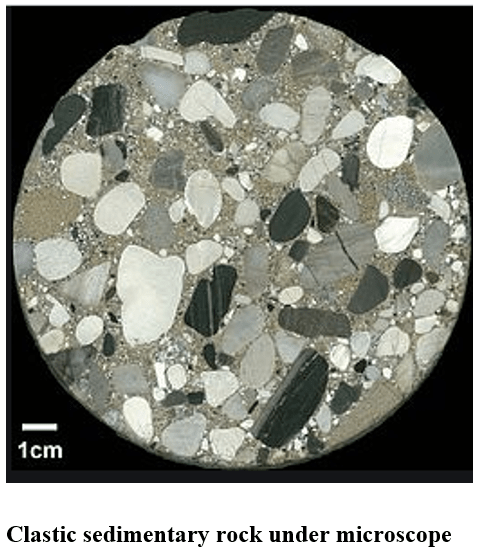
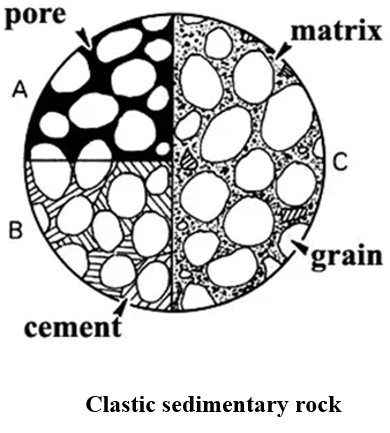
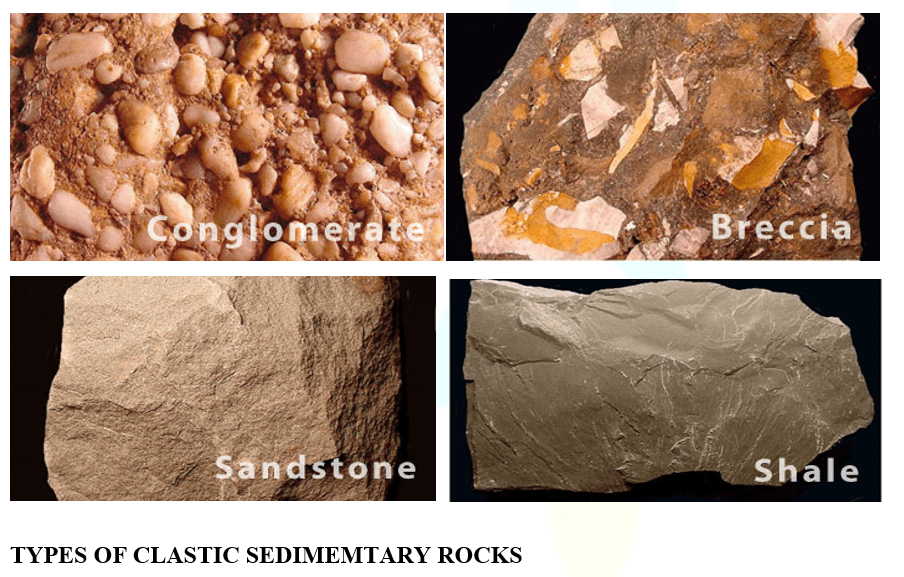
Siliciclastic rocks
- Siliciclastic rocks are clastic noncarbonate sedimentary rocks that are composed primarily of silicate minerals, such as quartz, feldspar or clay minerals.
- Because these deposits are derived from the erosion of detritus weathered from pre-existing rocks, they are also commonly described as detrital ("detached from"), epiclastic ("derived from the surface"), and terrigenous ("from the Earth). The individual clasts in such deposits form by both physical and chemical weathering.
- Three distinct groups are recognized based on clast diameter: (1) conglomerate and breccia, (2) sandstone, and (3) mudrock.

Non-Clastic Sedimentary Rocks
- These sedimentary rocks occur when minerals or mineraloids are precipitated directly from water or are concentrated by organic matter.
- Components have not been transported prior to deposition. No clasts are present.
Naming
- Non-clastic sedimentary rocks are named according to the mineral present.
- Limestone = composed of the mineral calcite, may contain marine fossils; formed by precipitation from water
- Rock salt = composed of the mineral halite (salt); formed by evaporation
- Rock gypsum = composed of the mineral gypsum; formed by evaporation
- Chert = composed of microscopic mineral grains of quartz; very hard with sharp edges.
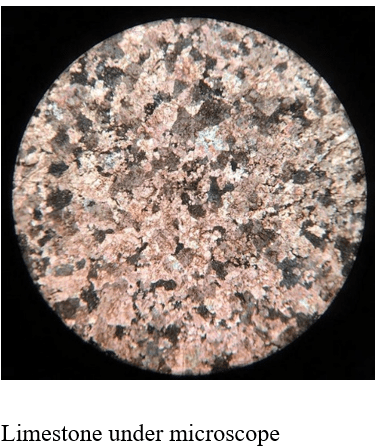
Types:
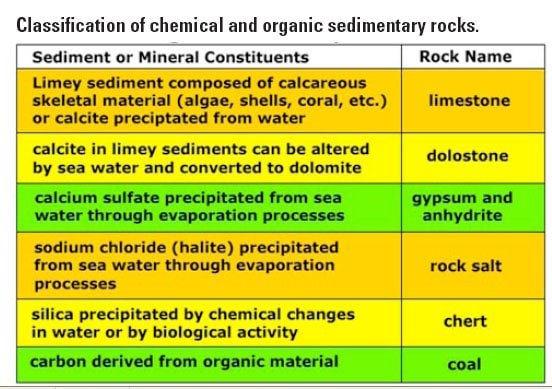
Chemical sedimentary rocks (Chemically formed):
- Non-clastic textures are found chiefly in rocks that have precipitated chemically from water (chemical sedimentary rocks).
- These are formed when the water components evaporate, leaving dissolved minerals behind. Sedimentary rocks of these kinds are very common in arid lands such as the deposits of salts and gypsum.
- Examples are rock salt, limestone, dolomite, flint, iron ore, chert etc.
Organic sedimentary rocks (biologically or organically formed):
- Other non-clastic sedimentary rocks include those formed by organisms (biochemical rocks), and those formed from organic material, such as coal.
- These are formed from the accumulation of animal or plant debris such as shells and bones. These debris have calcium minerals that pile on the sea floor over time to form organic sedimentary rocks.
- Examples are rocks such as coal, some limestone, and some dolomites.
Clastic and non-clastic rocks-their classification