
Cephalopoda: Morphology, Geological History and Evolutionary Trends
Cephalopoda: Morphology, Geological History and Evolutionary Trends
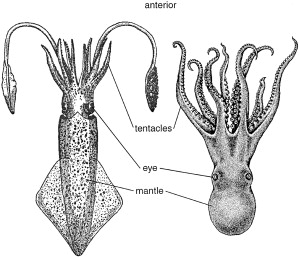
- These exclusively marine animals are characterized by bilateral body symmetry, a prominent head, and a set of arms or tentacles modified from the primitive molluscan foot.
- A cephalopod is any member of the molluscan class Cephalopoda such as a squid, octopus, cuttlefish, or nautilus.
- Cephalopods are the most intelligent, most mobile, and the largest of all molluscs.
Morphology
- The cephalopoda are exclusively marine which started their life in Cambrian. Well known present day forms include the cuttle fish ,the squids and Nautilus, while the extinct types are Belemnites, ammonites and Goniatites.
- The soft parts of animal possess bilateral symmetry. Head is encircled by arm like processes near the mouth.
- Two of these processes are extended to a greater length than other and are used for locomotion and seizing food. The soft part enclosed by a single fold of skin, known as
- The mantel is enclosed by the exoskeleton- the shell. However, the cephalopods have a univalve external or internal shell which can regress totally.
- The shell is conical tube like structure. Its pointed closed end is posterior, while open end is the anterior end it moves from the protoconch end to open wider apertural end.
- The shell may be straight [Belemnites, Orthoceras], slightly curved [Cyrtoceras] or coiled [Goniatites]. In most of the forms the coiling is in horizontal plane, i.e, discoidal [ Nautilus and Perisphinctes], but at times the coiling is in vertical plane, i.e, helicoidal.
- The interior of the shell is divided into a number of chambers by means of thin transverse partitions termed as Septa.
- To maintain the balance of the shell, all chambers expect the body chamber, are filled with air and therefore, they are known as air chambers.
- All the air chambers are traversed by a slender cord like Siphuncle passing either through the centre of Septa [as in Nautiloidea] or pass through the margin of septa [as in Ammonoidea].
- In Nautilus there are two oval muscular impression, one on each side, near the last septum and the inner side of the whorl.
- These impression marked by faint concentric lines are left by the muscle attached. The portion where the septum meets the external surface of the shell is termed as suture line, which is well preserved in casts.
- The suture line may be simple usually straight or undulating as in Nautiloidea or it may be complex as in Ammonoidea. The structure line is made up of ridges and depressions (grooves).
Suture lines may be of
- Simple straight suture line known as Orthoceratite or Nautiloid type e.g-Orthoceras
- Rounded saddle or angular lobe as in Goniatite typeg – Goniatites
- Smooth rounded saddle and finely divided lobes as in Ceratite type e.g- Ceratites
- Sutute line with highly divided saddles and lobes giving flower like appearance is known as Ammonoid type e.g – Phylloceras
Geological history of Cephalopoda
- Nautiloidea – first appeared in Upper carboniferous period and their number increased during Ordovician and Silurian periods . During Permian only few species remained. After Palaeozoic only Orthoceras and Nautilus continue to present day
- Dibranchia – numerous and more varied in the recent times than any other times. Though their range from Middle carboniferous to recent times
- Ammonoidea – this subclass is the largest and has wide geographical distribution and very short geological range from lower Devonian to upper cretaceous.
Evolutionary Trend
- Good index fossil as they possess very short geological range, wide geographical distribution and distinctive evolutionary trend.
- After origin of Ammonoid, they got diversified, underwent various types of Modification. Besides the various group Anarcestids, appeared a second minor group in late palaeozoic namely Clymenids with marginal siphuncle and Goniatitic suture.
- Anarcestids attained their climax at the permo-carboniferous period, but became extinct in late paleozoic. With the beginning of Triassic , the few Permian survivors gave rise to vastly successful ceratids exhibits complex shell ornamentation and sutural pattern.
- They remained dominant throughout the Triassic but ultimately failed to cross the Triassic-Jurassic boundary.
- In Mesozoic times, Iterative evolution is marked.
- Change of Coiling and shell form – From nearly straight uncoiled shell of earliest bactritid ammonoids to coiled shells belonging to goniatids and ceratids of late Devonian , carboniferous and Triassic period
- Suture pattern – Earliest ammonoids exhibited Nautilitic suture , where as suture lines compressed in later paleozoic goniatids . In Triassic goniatitic suture is replaced by ceratitic suture . In Jurassic – cretaceous Ammonitic suture appeared.
- Average size of ammonoids increases with time .Plaeozoic forms are of golf ball shaped where as in cretaceous Giagantic ammonoids of 2 meter in diameter appeared.