
Gondwana flora and fauna and its importance
Introduction
- Gondwana term was coined by B. Medlicolt.
- Based on ‘Gond tribe’ this is dominant in that area the name Gondwana has been suggested.
- Gondwana period is from Upper Carboniferous to lower Cretaceous.
- The Gondwanaland is the southern part of Pangea and separated from Laurasia during mid-Mesozoic era dated 200-180 Mya.
- These rocks represent one of the most important phases of Indian geology having dominance of coal formation.
- The Gondwana rock sequence represent almost 6 km thick succession of fluviatile (water body generated rock) and Lacustrine (Lake deposits), having a glacial deposited succession at the base.
- These rock sequences represent a long episode of continental sedimentation on which began in later Carboniferous and closed during early Cretaceous representing a total time of 180 my or more.
- The study of rock succession has revealed that the beginning of Gondwana sedimentation started with glacial phase having predominance of tillites.

Stratigraphy of Gondwana Supergroup
- The suturing of Gondwana has taken place in between 570 and 510 mya thus the east part of Gondwana joined with west Gondwana.
- The Gondwana sediments has overlying on the three tracts including-
- Koel-Damodar
- Son-Mahanadi
- Pranhita-Godavari Basins
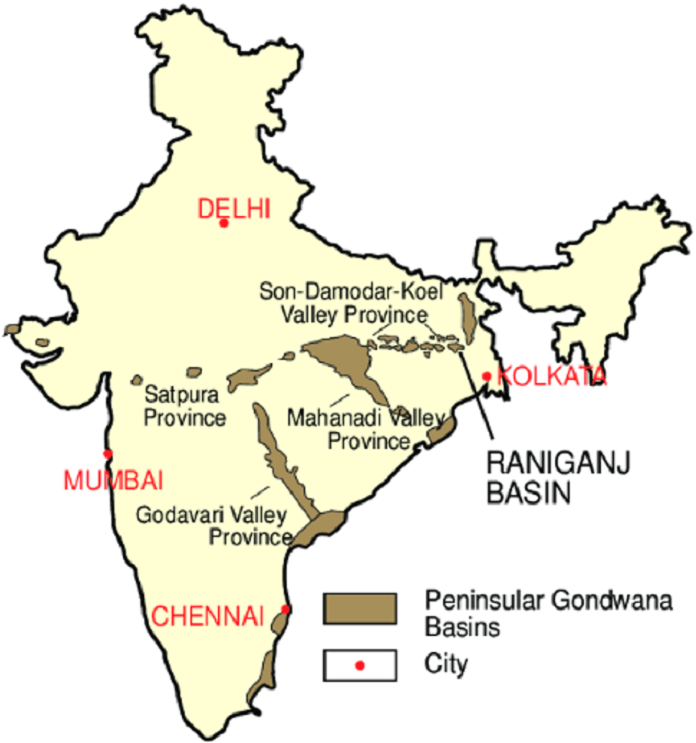
Distribution of Gondwana basin
The classification of Gondwana is of two type depends upon the difference in lithology and presence of fossils i.e. paleontological evidence such as-
- Two fold classification- This classification was given by Meddlicott and W.T Blanford. The classification was done by dividing Lower Gondwana from Upper Gondwana on the basis of presence of Glossopteris and Ptilophylum.
- Three fold classifications- The classification was given by Hughes and he had given the classification by identifying the mixed flora such as Dichroidium in between the beds of Glossopteris and Ptilophylum floras.
Two-Fold Classification System
|
Ages |
Stages |
Lithology |
|
|
Lower Cretaceous |
|
Umia Plant Bds |
Upper Gondwana |
|
Jurassic |
Upper Middle Lower |
Jabalpur Kota Rajmahal |
|
|
|
Rheatic |
Mahadeva Series |
|
|
Triassic |
Keuper Bunter |
Pachmarhi Panchet Series |
|
|
Permian |
Upper Middle Lower |
Raniganj Barren Meaures Barakar Series |
Lower Gondwana |
|
Upper Carboniferous |
|
Talchier Series (Glaciation) |
Three-Fold Classification System
|
Lower Cretaceous Upper Jurassic
Lias |
Umia Jabalpur Rajmahal Kota |
Upper Gondwana |
|
Keuper & Rhaetic Muschelkalk Bunter |
Maleri Mahadeva Panchet |
Middle Gondwana |
|
Upper Permian Lower Permian |
Damuda (Raniganj Barren Measure Barakar) |
Lower Gondwana |
|
Upper Carboniferous |
Talchier |
|
Talcher Formation
- The formation overlie unconformably on Archean schist and gneiss (Proterozoic age).
- The main lithology of the formation is
- Fossils of flora found here such as- Glossopteris indica and Gangamopteris cyclopteroides belongs to the category of seed ferns.
Karharbari Formation
- The lithology of this group is pebble beds, conglomerates, sandstone and siltstone with thin streak of coal beds.
- The characteristic fossil of this group is Gondwanidium burriada.
Barakar Formation
- The formation consist of approx 250 m thick sediments.
- The lithology consist of conglomerate, grits, sandstones and coal seams.
- China clay is of economic importance from this formation.
- Fossils: Glossopteris communis, G. Indica, Gangamopteris.
Barren Measure Formation
- The lithology of the group consist of alternating beds of ferrugineous sandstones, micaceous siltstone and ferrugineous shales.
- This formation of devoid of fossils.
Raniganj Formation
- The lithology of this group is sandstones, shale, coal seams.
- The coal of this group is very fine and of good quality.
- Fossils: Glossopteris flora reaches its acme.
Panchet Formation
- The lithology of this group consists of greenish-brownish type sandstone varieties with the presence of shales at its lower portion.
- The lower part of the formation is devoid of coal seams.
- Fossils: Various mega and micro-flora assemblages such as Pecopteris,Glossopteris, Schizoneura and also invertebrates living in fresh water such as thecodont, reptiles(Dicynodonts),amphibians(Gonioglyptus).
Mahadeva Formation
- The formation has divided into-
- Panchmarhi Sandstone- Coarse-grained and cross-bedded sandstones.
- Denwa Clays- Consist of fossils of Mastodonasaurus indicus.
- Bagra Conglomerate- Coarse ferruginous sandstones and conglomerate.
- Fossils: Vertebraria, Glossopteris, Pacopteris, Conifer seeds.
Rajmahal Hills
- These hills are the plateau basalts.
- Lithology- Fine-coarse dolerite with groundmass consist of pigeonite, labrodorite, augite.
- Fossils- Intertrappean beds consist of plant fossils such as Dictyozamites - Pterophyllum and species of fishes, cycads, pteridophytes and conifers.
Jabalpur Formation
- Lithology- white clays, massive sandstones, sandy conglomerate.
- Fossils- Pteridosperms, Gangamopteris, Vertebraria and mammalian fana, Amphibians and pisces.
Gondwana Flora and Fauna
- India was a member of the hypothetical supercontinent Gondwanaland existing toward the southern pole during Permo-Carboniferous- Lower cretaceous times.
- Gondwana flora of India is conventionally divided into two parts, Lower Gondwana flora or Glossopteris flora and Upper Gondwana flora or Ptillophyllum
Flora and Fauna of Gondwana Group
|
Formation |
Plant Fossils |
Vertebrates |
|
Upper Gondwana |
Gondwanidium, Pteridosperms, Gangamopteris, Vertebraria, Pecopteris, Pecopteris |
(Pisces) Ceratodontidae, Amphibian (Metoposauridae), Mammalia (Gondtherium Dattai, Indotherium Pranhitai) |
|
Middle Gondwana |
Lepidopteris-Dicrodium |
Dicynodon (Reptile), Ptychosiagum. |
|
Lower Gondwana |
Cycad, Homoxylon (Fossilwood), Spenopteris (Ferns), Williamsonia, Ptillophyllum |
Mastodonasaurus Indica, Plesiosaurus, Brachyops (Amphibians) |
Lower Gondwana flora
- Glossopteris flora is the purest of the contemporaneous Permian flora showing least admixture.
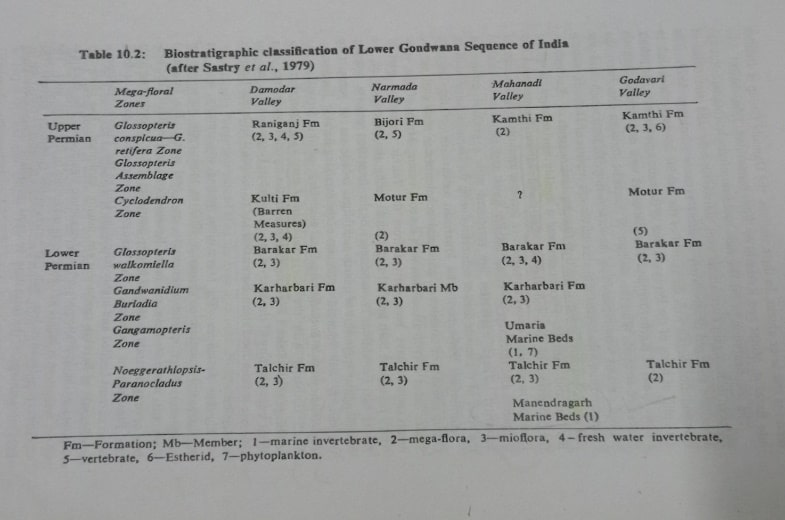
- The earliest members of this flora are Gangamopteris, Glossopteris, and Noeggerathiopsis, which are found within the shales above the glaciogene Talcher tillites of lowermost Permian age.
Origin and geographic distribution
- Evidently, Glossopteris flora grew as an indigenous product from the few plants. It was left at the end of the carboniferous glaciation that affected the entire Gondwanaland.
- Occurance of dissacate pollens and presence of poorly preserved stems with growth rings from glacial tillites of Talchir formation indicate, that its earlier members were co-existing with late carboniferous glaciation, but Glossopteris itself and other members of this flora are believed to be post-glacial.
- In India Glossopteris flora are found localized within the sedimentary rocks deposited along the Son-Damodar basins (covering MP, Bihar, West Bengal), the Pranhita –Godavari basins of Andhra Pradesh and Maharastra and the Mahanadi basins of Odisha .
Botanical affinity
- Floral elements mostly include Pteridosperms, however pteridophytes like lycopsids, sphenopsids and filicales are also found but in less abundance.
- Most of the fossils are carboniferous. Carbonized and petrified fossils are also found.
- Close association of the leaf fossils Glossopteris , stem fossil Vertebraria , Fructication Dictyopteridium and dissacate pollen within rocks may indicate that those may be the parts of the same plant.
Fossil components and Stratigraphic distribution
Upper Gondwana flora
- Rich in cycad-conifer plant assemblage occurring within the Mesozoic Gondwana sediments. As the cycad Genus Ptillophylum is the most abundant member of the flora, it is also known as Ptillophyllum Flora.
- Geographical occurrence: Chief occurrences of upper Gondwana flora are scattered all over the main Gondwana province of peninsular India.

Gondwana Fauna
- Vertebrate fossils are considerable variety in the Gondwana formations, particularly in the upper gondwana.
- A majority of the vertebrate fossils were found in the Upper Gondwana sediments of the Pranhita – Godavari valley, though some species have been described from some of the other basins as well.
- The interesting finds include Crutaceans , insects , ostracods ,coprolites .
- Kotatherium haldenii, a therian symmetridont from the kota formation is the first reported earliest mammal from India.
- Indochelys spatulata and the first ever record of flying reptile Campylognathoids indicus are both from this formation.
- Fossil reptile Lystrosaurus occurs in the panchet formation of Raniganj coalfield.
