
Trilobites / Trilobita: Morphology, Geological History and Evolutionary Trends, Stratigraphic utility of Trilobita
Trilobites / Trilobita: Morphology, Geological History and Evolutionary Trends, Stratigraphic utility of Trilobita
- The class trilobita includes extinct forms which were highly evolved invertebrates though their life span was restricted to Paleozoic era.
- They were benthic animals which crept or swimmed along the bottom and fed on small organisms and debris in the bottom mud.
Morphology
- Body is divided into three parts from posterior to anterior and hence the name.
- The transverse division of the body divided animal into three regions: Cephalon (head), Thorax (body) , Pygidium (tail segments).
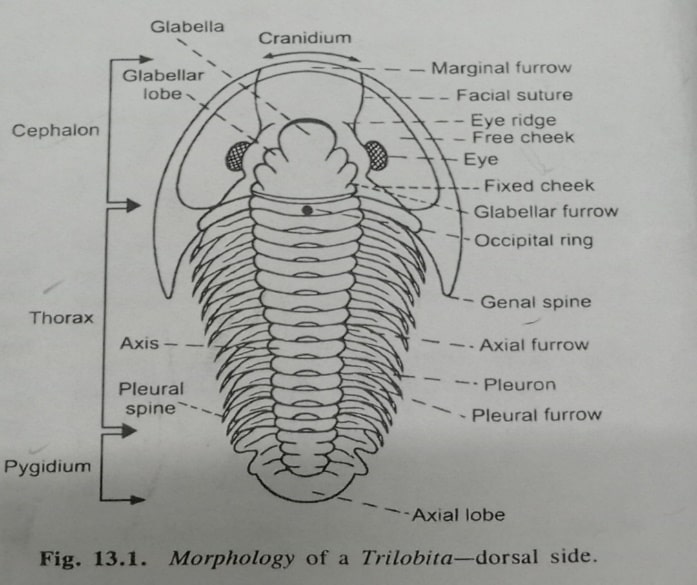
- Cephalon is made up of six fused segments. The median part of the cephalon is inflated and is termed as glabella and the lateral are the Cheeks.
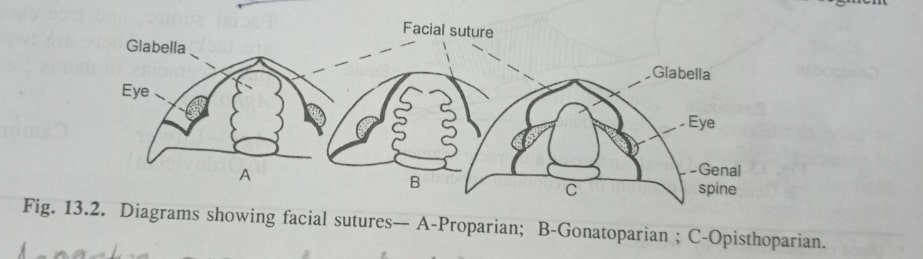
- The cheeks are triangular in shape and divided by Facial suture. The shape of facial suture vary in different forms. They are of following five types:
- Protoparian – suture is marginal . free and fixed cheeks . e.g – Agnostus
- Hypoparian – similar to above but eyes are absent e.g – Microdiscus
- Opiathoparian – suture commences on the posterior margin inside the genal angle and is present on top
- Proparian – The suture starts from posterior or lateral margin and end at anterior lateral margin . eg – Phacops
- Gonatoparian – facial suture is intermediate between opisthoparia and proparia
Geological History
- Trilobites appeared at the very beginning of Cambrian, and this causes difficulty for palaeontologist to make any suggestions about their origin and ancestry.
- Arising from some annelid ancestry , trilobite appeared for the first time in lower Cambrian marine beds and very soon become most dominant animal of that period.
- Cambrian- Ordovician is considered to be the climax of this animals.They become totally extinct at the end of Permian , possibly failed to compete with the incoming fishes and large cephalopods.
Evolutionary trend
- Structural changes in Glabella – All the furrows except the last glabella furrow disappeared and finally the last furrow also disappeared giving rise to smooth and furrowless glabella for easy burrowing . The general outline of the cephalon changes with the change in the shape of the glabella .
- Changes in Eyes – Modification in eyes were required for adaptation to differing requirements of sight which may be low light intensity in deep water condition , burrowing mode of life and intense light in shallow water conditions . The first two conditions lead to the loss of eyes by disintegration .
- Changes in facial suture – in early forms there were no facial suture , free cheeks and eyes . Gradually protoparian and hypoparian facial suture developed .
- Changes in Thorax –Trilobita have evolved from annelid group . thus the primitive trilobites have large number of thoracic segments
- Spine – Except in Agnostida generally all other forms including swimming and free floating forms possess the spines.
Stratigraphic Utility of Trilobita
- Trilobites are of considerable importance as regards the zonation of Cambrian-Ordovician rocks and are successfully used as a good zone fossils in many countries.
- Almost everywhere in marine sequence their first appearance usually marks the beginning of Lower Cambrian.