
Application of microfossils in correlation, petroleum exploration, paleoclimatic and paleoceanographic studies
Application of microfossils in correlation, petroleum exploration, paleoclimatic and paleoceanographic studies
Introduction
- Microfossils are majorly used in correlating different lithologies due to their rapid evolutionary rates.
- They help in constructing the better biostartigraphic correlations.
- They are either being in form of index fossils or zonal fossils.
- Index fossils: These fossils have wide geographic distribution but a short range through time.
- Zonal fossils: These fossils characterize the specific time period or zone in geological time range.
- Micro= small. So they are small in morphology as compare to macrofossils and this character makes them to be found in abundance quantity even in a small sample of sediment. This quality yields good quantity of data for bio-stratification and for stastical analysis.
- Microfossils can also contribute in dating age of the rock, their correlation on regional or global basis, temperature and nature of environment change.
- Micropaleontology- It is the separate branch of palaeontology which studies microfossils with the help of microscope.
- It is the major tool in the field of petroleum exploration for bio-stratification.
- The integration of bio-stratigraphy with seismic data and well logs provides the basis for developing depositional models.
10.1 Application in Bio Stratigraphic Correlation
- Biostratigraphy is the correlation of stratigraphic units based on fossil content, either through the use of index (guide) fossils or similarities in fossil assemblages.
- Being in small size but abundant in number, Foraminifera fossils are found widely distributed especially in rocks of Tertiary age, when they show maximum diversity and abundance.
- For this reason, marine tertiary rocks of various parts of the world are bio-stratigraphically zonated on the basis of various zone fossils of foraminifera.
- Many of the species show evolutionary changes of some morphologic character with time thus readily traceable within fossils helping in recognition of several lineage groups.
- Planktonic foraminifera, which yield a large number of index fossils since cretaceous, are successfully used in the inter-continental correlation of Mesozoic-lower tertiary
- Benthic foraminifera, although show somewhat restricted distribution, may be used for local and in some cases regional correlation of rocks.
- These studies coupled with radiometric dating have helped in establishing the concept of high resolution biostratigraphic zonation and correlation.
Palynomorphs
- Palynomorphs (dinoflagellates, acritarchs and tasmanites) can be used in Permian (approx. 260 myrs) to recent sediments and in most sediments types. Since their preparation includes the dissolution of the surrounding sediments, their use is more expensive than nannofossils. The possible stratigraphic resolution can be high. Recently, the use of organic grain size and shape as environmental indicators has been developed and is apparently useful, especially in sub-recent sediments.
Foraminifera
- Foraminifera can be used in all marine sediments which have not be leached of calcareous material, i.e. from shallow marine to middle bathyal. Their stratigraphic resolution can be high and their association with certain depositional environments makes them good environmental (water depth) indicators. Foraminifera can be found in sediments of Carboniferous (approx. 360 myrs)to recent age. Their preparation cost is lower than that of palynomorphs, unless thin-sections have to be used.
Siliceous microfossils
- In silica enriched sediments, siliceous microfossils such as diatoms and radiolarians can be of use. The stratigraphic resolution can be high, especially in the Tertiary (approx. 65 myrs), but schemes are still under development for other time frames. Their preparation cost is similar to that of foraminifera. It is good practice to always analyse at least two of these fossil groups per sample to provide a cross check. This reduces the chance of unexpected sedimentary circumstances leading to erroneous age and environmental estimates.
- The age estimates can be numeric if the fossils encountered in a sample can be related to the global zonation schemes which exist today.
Trilobite in Stratigraphic Correlation
- Range from lower Cambrian – Permian
- Specialists opine about expensive pre-Cambrian history.
- Trilobites used as zonal idices in Cambrian and Ordovician.
10.2 Application in Palaeoclimatic and palaeo-oceanographic studies
- Application of Microfossils and most importantly of Foraminifera in environmental (both climatic and oceanographic) interpretation are based on comparison of data collected from the study of recent foraminifera.
- For example, dramatic change of death, salinity, and climate may be traced during the Pleistocene time from the different studies on foraminifera from Pleistocene beach deposits.
- Fluctuation of palaeo-temperature during Pleistocene glaciation is also traced from the study of relative dominance of dextral and sinistral globigerinid tests from Pleistocene deposits.
- Palaeo-salinity of earliest periods may be traced from the ratio of textulariina, miliolina and rotalina as well from the diversity of foraminifera populations.
- The value of foraminifera as indicator of the depth of deposition has been outlined by Funnel (1967).
10.3 Application of Microfossils in Petroleum Exploration
- Most of the world’s petroleum deposits are located within marine tertiary rocks rich in foraminifera. Hence, in any petroleum exploration work, study of foraminifera becomes essential for establishing local and regional stratigraphy.
- First of all, the oil genesis that requires several physical-chemical–biological and temporal factors to be favourable resulting in transformation of organic debris to oil.
- Secondly, the oil accumulation which again requires several factors like rock properties, structure, facies change etc to be favourable for trapping the oil within the rocks.
- In a virgin area, the surface geology is first to be studied carefully. An attempt should be made to ascertain the age of different outcropping formation based on microfossils and mega fossils and radiometric data for purpose of general orientation.
- For this, each of the formations should be investigated in details and their respective distinctive micro palaentological features are established. This may help to establish the bio-stratigraphic sub divisions of the formation into several zones.
- The success of the exploration largely depends on the time spent on the fundamental study of horizontal and temporal distribution of microfauna within the rocks in the area of investigation.
- Microfossils have many application to Petroleum Geology.
- Three microfossil which are of particular importance to hydrocarbon exploration are: Foraminifera, Calcareous Nannofossils and Palynomorphs.
Foraminifera
- Foraminifera are used to interpret the ages and paleoenvironments of sedimentary strata in oil wells.
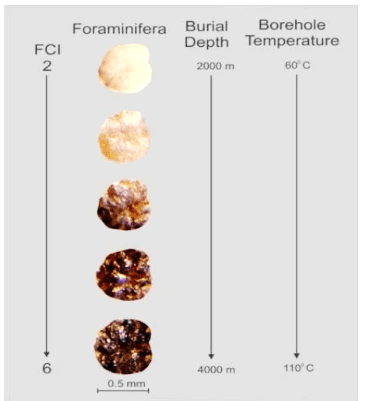
- Fossil Foraminifera buried deeply in sedimentary basins can be used to estimate thermal maturity, which is a key factor for petroleum generation.
- The Foraminiferal Coloration Index (FCI) is used to quantify color changes and estimate burial temperature. This data is useful in early stages of petroleum generation (~100°C).
Calcareous nanofossils
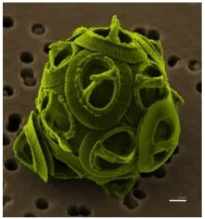
- These are extremely small objects produced by planktonic unicellular algae.
- The calcareous plates accumulate on the ocean floor, become buried beneath later layers, and are preserved as Nannofossils.
- These are used to interpret the ages and paleoenvironments of sedimentary strata in oil wells.
Palynomorphs
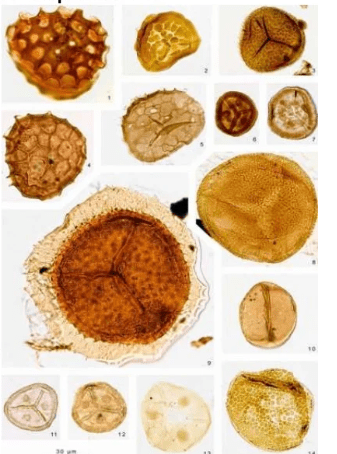
- Spores and Pollens are transported by wind and water and can travel long distances before final deposition.
- Organic chemicals comprising Palynomorphs get darker with increased heat.
- These help to assess the temperature to which a rock sequence was heated during burial. Hence, it is useful in predicting the occurrence of oil or gas.
Principal microfossils
- Microfossils useful in hydrocarbon exploration can be divided into five principal microfossil groups based on the composition of the shell (test) or hard parts. The table below shows the principal microfossil groups.
|
Composition |
Fossil Group |
|
Calcareous |
Foraminifera, ostracods, calcareous nannofossils |
|
Agglutinated |
Foraminifera. |
|
Siliceous |
Radiolarians, diatoms, silicoflagellates. |
|
Phosphatic |
Conodonts |
|
Organic walled |
Palynomorphs like chitinozoans, pollen, dinoflagellates. |
Use in analysis
On site use
- In the operational environment, microfossils can be examined shortly after being brought to the surface.
- Drill-site analysis permits identification of stratigraphic levels and drilling objectives, minimizing drilling time.
- Microfossils can also be used to accurately predict overpressured zones.
Offsite use
- In the labs, microfossil studies allow precise local, regional, and global time-stratigraphic correlations.
- These help in hydrocarbon prospect and trend delineation, regional stratigraphic and geologic studies, and exploitation evaluations.
Thermal Alteration Index
- The characteristics of microfossils have been changing throughout geological past. They are represented by Thermal Alteration Index (TAI)
|
TAI |
Color |
Maturity |
|
2 – 2.5 |
Pale yellow- yellowish brown |
Immature |
|
2.25 – 3.0 |
Yellowish brown – brown |
Mature |
|
3.0 – 3.5 |
Reddish brown - Dark brown |
Metamorphose |
|
3.5 – 4.5 |
Brown black – Black |
Metamorphose |
|
4.5 – 5.0 |
Black – Opaque |
Metamorphose |
- From this chart, it is reflected that the color of microfossil gradually changes with increased temperature condition.
- A particular TAI can be assigned to a particular microfossil in a sequence of strata on the basis of their color.
- Immature and metamorphose stages are not suitable for petroleum exploration. It is only the mature stage which reflect the probability of petroleum.