
Index fossils and their significance
Index fossils and their significance
Introduction
- Index fossils are also known as Guide fossils or Marker fossils or Indicator fossils.
- These are the fossils which help in correlating different lithology lying in different geological period.
- Certain animal or plant fossils are characteristic of certain geologic horizons.
Characteristics
- Index fossils are fossils used to define and identify geologic periods. Index fossils must have a short vertical range, wide geographic distribution and rapid evolutionary trends
- Short vertical geological range but wide geographical range or lateral distribution.
- The evolutionary rate of these fossils is very rapid and high.
- These fossils are of any origin such as animal or plant origin, but generally index fossils of plant origin are very less and rare.
- Index fossils are restricted to the particular geological horizon, due to which that horizon is identified by the presence of these fossils.
- Index fossils are easily diagnosable, preserve easily and also found in different depositional environments.
Types of Index Fossils
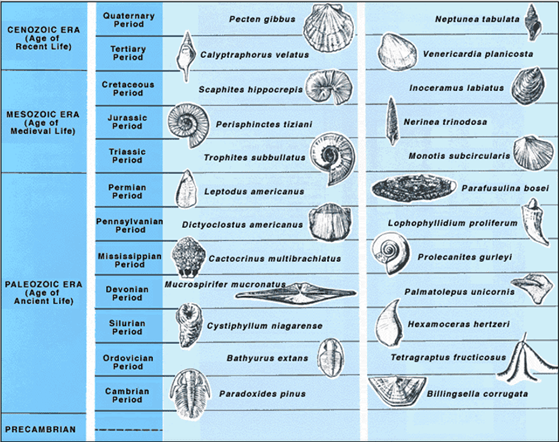
The index fossils are classified according to the era and period in which they found.
- Palaeozoic Era
- Mesozoic Era
- Cenozoic Era
Paleozoic Era
- The era has been classified into 6 periods:
- Permian
- Carboniferous
- Devonian
- Silurian
- Ordovician
- Cambrian
- Evolution of trilobites has taken place in early Cambrian period (540-245 mya). Nearly half of the fossils of Palaeozoic time were occupied by trilobites.
- Extinction occurred at late Permian ( 248 mya).
- Graptolites has also survived during the Cambrian period (540-505 mya) to mid-carboniferous period and they are considered as the extensive marine hemichordates.
- Brachiopods occur during Cambrian period and some of the species survived till recent.
Mesozoic Era
- The era has been classified into 3 period-
- Triassic
- Jurassic
- Cretaceous
- Common index fossil of Mesozoic Era is ammonites (245-65 mya). Extinction of the fossil occurs during K-T boundary.
- Nannofossils: Widely spread microfossils in different eras and consist of remains of nannoplanktons and coccolithophores). These fossils are widely distributed and time-specific having high evolutionary rate. Calcareous nannofossils first appeared during early Triassic. Their extinction occurred due to Triassic/Jurassic boundary.
Cenozoic Era
- The era is considered as the recent and latest era.
- Index fossils of this era are also known as recent fossils.
- Mostly fossils of mammalian fauna are recently used as index fossils.
- Fossils of woolly mammoths, cat like carnivores, rodents , horses were dominated during this era.
- Bivalves also served as the tertiary index fossils.
Plant Fossils
- The index fossils of plants are very rare in nature. Remains of fauna are predominant over the plants fossils.
- Species of flora generally lack the presence of hard parts, and consist of cellulose in their cell wall. Sometimes, some other biochemical such as lignin, cutin etc., which are not resistant in certain environment and during the death of decay tissues of plants. This is the reason geologist can’t get the perfectly preserved plant fossils sometimes.
- Pollen grains: Higher pants having these pollen grains which are consider as the hard part due to the presence of sporopollenin.
- Gondwana System consists of least plant fossils such as Dicroidium, Glossopteris, Ganganopteris.

Fig. Pollen Grains
Significance of Index Fossils
- Index fossils of any type such flora or fauna they can used for the dating purpose in determining the age of the rock in which they are found.
- Among all the index fossils, Ammonites are considered to be the most widely used index fossils for correlating strata as it fulfilled all the characters of the index fossil.
- These fossils play a major role in paleontological and geological studies as they help the geologists in order to find out the age of the fossil by examining the relationship of the specific fossil with another event of the specific period.
- Index fossils also give the evidence of paleoenvironment conditions of the particular regions.
- Study of Chronostratigraphy: Wiiliam Smith long ago discovered that each geologic time period is characterized by a distinctive group of animals and plants and the fossil remains of these assemblages, therefore, have value for determining stratigraphy position in the geologic coloumn.
- Study of Marine sediments: Marine sediments have several fossils species occurring in a particular sequence. Each species confined to one part of the succession only and representing the time when that species was living.
- Study of Biostratigraphy: In Biostratigraphy, the fossil contents of beds are used in interpreting the historical sequence. Certain fossils species are found to be particularly good stratigraphical markers.
- They characterise short sections of the geological succession known as Zones and the fossils known as Zone fossils. For example – In india tropites beds of Kashmir , Ophiceras beds of Triassis of Spiti.
- Assemblage zones are beds or groups of beds with natural assemblage of fossils.
- Range zone represents the total range of a particularly useful selected element in the fauna and flora.
- Acme or peak zone is a body strata in which the maximum abundance of a particular species is found.
- Interval zone is an interval between two distinct biostratigraphical horizons .
- Correlation of rocks: Index fossils are used in dating and identification of rocks. Moreover, such fossils are restricted to specific rock formation. The rocks having index fossils in the different parts of the world, can be correlated with each other. e.g Eohippus to Equus, Moeritherium to Elephas.
- Study of Plaeogeography: The adaptation of organisms are characteristic of particular environments, hence, those shown by fossils forms may indicate the extent and boundaries of former lands, water deltas, mountains, deserts, lakes, rivers, shore lines and the positions of deep and shallow seas.
