
Textures of Metamorphic Rocks
Introduction
- The term texture is used to refer to small-scale features in a rock that are penetrative, meaning that the texture occurs in virtually all of the rock body at the microscopic scale.
- Structures are larger-scale features that occur on the hand sample, outcrop, or regional scale.
- Textures describe the grains’ shape, size and orientation and their mutual relationship within the metamorphic rock.
Basic terminology
- The suffix -blast or -blastic indicates that a feature is of metamorphic origin.
- Thus, porphyroblastic means a porphyritic-like texture (large grains in a finer matrix) that is of metamorphic origin.
- The prefix blasto- meaning that a feature is not of metamorphic origin but is inherited from the parent rock.
- The term relict indicates that a feature is inherited from the protolith. relict bedding in metasediments, or relict porphyritic texture,
- Terms such as euhedral, subhedral, and anhedral (indicating progressively less-well-shaped crystals) have been replaced in some of the metamorphic literature with idioblastic, hybidioblastic, and xenoblastic, respectively.
Deformation mechanisms
The principal deformation mechanisms are listed below in the general order of increasing temperature and/or decreasing strain rate:
- Cataclastic flow is the mechanical fragmentation of a rock and the sliding and rotation of the fragments.
- Solution transfer also called pressure solution, requires intergranular fluid to be effective. The material at highly strained contacts dissolves more readily as a result of the higher energy and migrate to low activity places where the material precipitates.
- Intracrystalline deformation of a plastic type involves no loss of cohesion in the rock. Lattice defects play a role here.
- Recovery: Permanent strain in crystals depends largely on defects. The magnitude of the strain, unless somehow relieved, is proportional to the density of defects in a crystal. Stored strain energy decreases the stability of a mineral and can be lowered by migration of defects.
- Recrystallization is another way to reduce stored lattice strain energy. Recrystallization involves the movement of grain boundaries or the development of new boundaries, both of which produce a different configuration of grains.
Main Groups of Metamorphic Textures
- Relict Textures (inherited from parent rock and then survived metamorphism)
- Typomorphic textures (characterise the type of metamorphism)
- Superimposed textures (indicates post metamorphic events such weathering, erosion)
Relict /Palimpsest Texture
- If there is suffix with – blast or –blastic so the texture is of metamorphic origin. For example: Porphyroblastic.
- If there is a prefix with balsto- (not of metamorphic/igneous origin) inherited from parent rock. For example: Blastoporphyritic.
- Relict textures are the characteristic of low-grade metamorphic rocks.
These are-
- Blasto-Porphyritic (presence of large crystals)
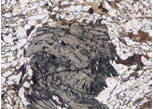
- Blato-Ophitic (laths of plagioclase embedded in pyroxene matrix)
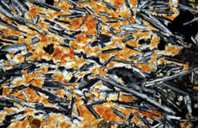
- Blasto-Intergranular (type of igneous relict texture in metamorphic rocks thus showing the interspaces between the minerals)
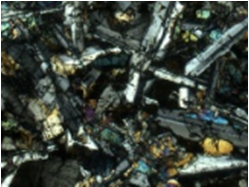
- Blasto-Amygdaloidal (if the intergranular spaces are filled with secondary minerals)
- Blasto-Spherulitic (minerals are fibrous in nature)

- Blasto-Variolitic (fine and radiating plagioclase crystals found in groundmass)
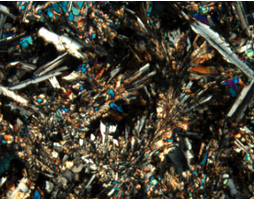
- Blasto-Pisolitic (concretionary grains more than 2mm in size)
- Blasto-oolitic (concentric layers of grains less than 1 mm in size)
Typomorphic Textures
1. Texture of Thermal Metamorphism
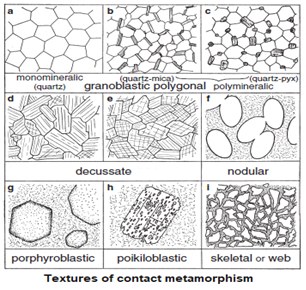
a. Granoblastic Polygonal: This texture arises due to well developed crystal faces of equidimensional grains which shows triple junctions between them.
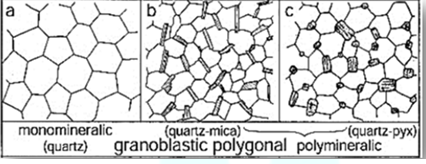
b. Granoblastic Interlobate: The texture arises due to irregular boundaries between the grains.
c. Granoblastic Amoeboid: The texture arises due to anhedral minerals and the grains consist of irregular outlines.
d. Granoblastic Decussate: The texture arises due to the elongated or prismatic crystals which are interlocking and random oriented thus showing triple junction between them.
e. Nodular:The texture arises due to the growth of porphyroblast which are oval in nature in random oriented minerals.

2. Textures of Dynamic Metamorphism:
a. Porphyroclastic: The texture arises due to the coarse grain porphyroclast embedded in fine grains fragments.
b. Mortar: The texture arises due to further crushing of smaller fragments to finer and finer sizes which hole the porphyroclasts in them.
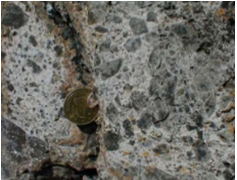
Fig: Mortar texture
c. Protomylonitic: The texture arises when the minerals start deforming in ductile manner thus showing the foliation or preferred orientation.
d. Orthomylonitic (mylonitic): Where the rocks develop a well defined foliation.
e. Ultramylonitic: The foliation is seen by micaceous or prismatic minerals and shows the advance stage of cataclastic
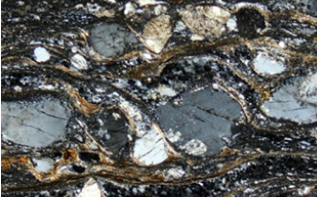
Fig: Mylonitic texture
3. Crystallization textures
a. Porphyroblastic textures: When the large crystal grain (porphyroblast) embedded in fine grained groundmass. Minerals such as garnet and staurolite forms porphyoblast and minerals such as mica and biotite forms fine grained crystals.

Fig: Porphyroblastic texture
b. Poikiloblastic textures: The inclusions of additional fine grained minerals are ssen inside the porphyroblast.
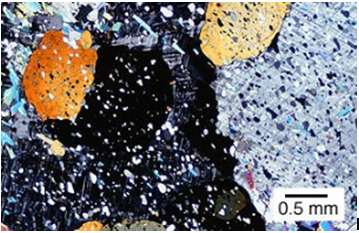
Fig.: Poikiloblastic texture
Superimposed Texture
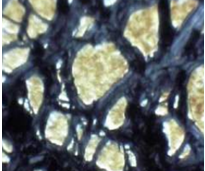
1. Mesh texture: The texture originates with the needle shaped minerals such as serpentine in the aggregates like mesh.
2. Kelyphitic texture: When the replacement of one mineral is taken place by the intergrowth of one or two minerals completely along its rim.

3. Reaction-rim texture: The replacement takes place when one mineral replace another mineral by leaving their contacts irregular in nature.

4. Corona texture: The older phase of minerals is encircled by various new layers of minerals in concentric form. This texture is the part of both prograde and retrograde metamorphism.

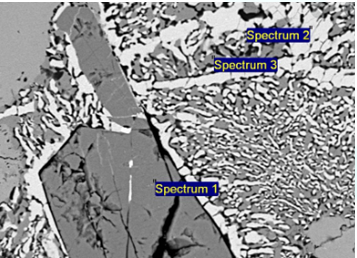
5. Symplectites: The intergrowth of fine grained minerals which didn’t undergone the complete reaction shows this type of texture which gives wormy appearance which occurs along the rim of reacting minerals.
Textures of contact metamorphism
- Contact metamorphism occurs in aureoles around intrusive bodies and is a response of cooler country rocks to the thermal metasomatic effects of the intrusion.
- The textures of contact metamorphism are typically developed at low pressures and thus under conditions of low deviatoric stress.
- The thermal maximum in a contact aureole should also occur much later than any stress imparted by forceful intrusion.
- Contact metamorphism is typically characterized by a lack of significant preferred mineral orientation.
- Many minerals are equidimensional, rather than elongated, and the elongated minerals that do form are orientated randomly.
- Relict textures are also common.
- Static recrystallization occurs after deformation ceases at elevated temperatures or when a thermal disturbance occurs in a low-stress environment.
- The textures that result typically depend on the minerals involved.
- In monomineralic aggregates of structurally isotropic minerals an equilibrium texture develops in which grains meet along straight boundaries.
- The texture is called granoblastic polygonal (or polygonal mosaic), and grains appear in two-dimensional thin sections as equidimensional polygons.
- Structurally anisotropic minerals, such as micas and amphiboles, have some crystallographic surfaces with much lower energy than others. This affects the shape of the grains.
- High surface energy boundaries grow faster, so that low- energy surfaces become larger. The result is called decussate
- Porphyroblasts are very common. The rocks are typically characterized by large porphyroblasts of biotite, andalusite, or cordierite.
- Poikiloblasts are porphyroblasts that incorporate numerous inclusions. This texture is common in garnet, staurolite, cordierite, and hornblende. Poikiloblastic texture is a high-energy texture.
- Skeletal texture an extreme example of poikiloblast formation in which the inclusions form the bulk of the rock and the enclosing mineral phase occurs almost as an intergranular, crystallographically continuous, network.
- Porphyroblasts typically form in minerals for which nucleation is impeded.
- Cordierite, biotite, and some other minerals commonly form ovoid porphyroblasts in contact aureoles, particularly when the matrix is very fine grained.
- The texture is called
- Rocks that in hand specimen contain small porphyroblasts in a fine matrix is spotted. If the matrix is non-foliated the rock is commonly called a spotted hornfels.
- The result for low grade regional metamorphic rocks is spotted slates or spotted phyllites.
High-strain metamorphic textures
- In shallow fault zones where the rocks are cooler and behavior is more brittle, the cataclastic processes dominate.
- Below this shallowest zone, confining pressure increases, and deformation is more pervasive.
- Cataclastic processes continue to be dominant at intermediate depths and affect the rock on a finer scale.
- The rocks are more coherent microbreccias and cataclasites.
- Undulose extinction is ubiquitous.
- Remnants of broken larger pre-deformational grains are called
- Larger initial grains or more resistant minerals may remain larger in a matrix of crushed material.
- These larger fragments are called
- Some porphyroclasts may be surrounded by a matrix of fine crushed material that is derived from them as they are rotated and ground down, a texture called mortar
- Pseudotachylite is produced by localized rapid fragmentation and melting due to shear heating, generally attributed to earthquake shock energy in dry rocks.
- Deformation occurs as a result of combined cataclastic, plastic intracrystalline deformation and recovery processes.
- Foliated mylonites are the predominant type of rock. Quartz may have the form of highly elongate
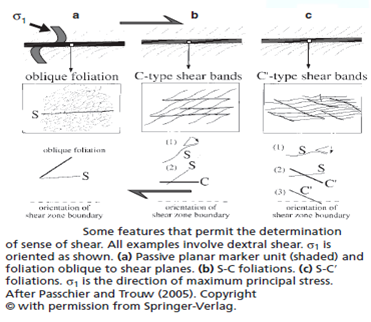
- Foliations are important in the interpretation of mylonites, especially in determining the sense of shear motion in the shear zone.
Regional orogenic metamorphic textures
- Also called dynamo-thermal textures because they occur in any situation where deformation and heat are combined.
- Such situations range from deep shear zones to strained contact aureoles.
- Orogenic belts are complex tectonic environments where plate convergence produces a number of deformational and thermal patterns.
- Orogenies are not continuous and an orogeny may comprise more than one tectonic event.
- Tectonic events, in turn, may consist of more than one deformation phase.
- A deformation phase, a distinct period of active deformation with a specific style and orientation.
- Deformation phases may be separated by periods of reduced or absent deformation.
- Metamorphism accompanies many of these deformational processes.
- Deformation tends to break minerals down to smaller grains and subgrains, whereas the heat of metamorphism tends to build them back up again.
- Such a complex set of processes allows for myriad interactions and overprints between metamorphic mineral growth and deformation, making the study of textures in orogenic rocks a challenge.
Tectonites, Foliations, and Lineations
Tectonite
- A tectonite is a deformed rock with a texture that records the deformation by developing a preferred mineral orientation of some sort.
- The fabric of a tectonite is the complete spatial and geometrical configuration of its textural and structural elements.
- Foliation is a general term for any planar textural element in a rock, whereas lineation similarly applies to linear elements.
- Foliations and lineations can be subdivided into primary (pre-deformational) ones, such as bedding, and secondary (deformational) ones.
Foliations:
- A number of features can define a secondary foliation, including platy minerals, linear minerals, layers, fractures, and flattened elements.
- Metamorphic foliations are divided into cleavages (fine penetrative foliations), schistosity (coarser penetrative foliations), and gneissose structure (poorly developed coarse foliations or segregated layers).

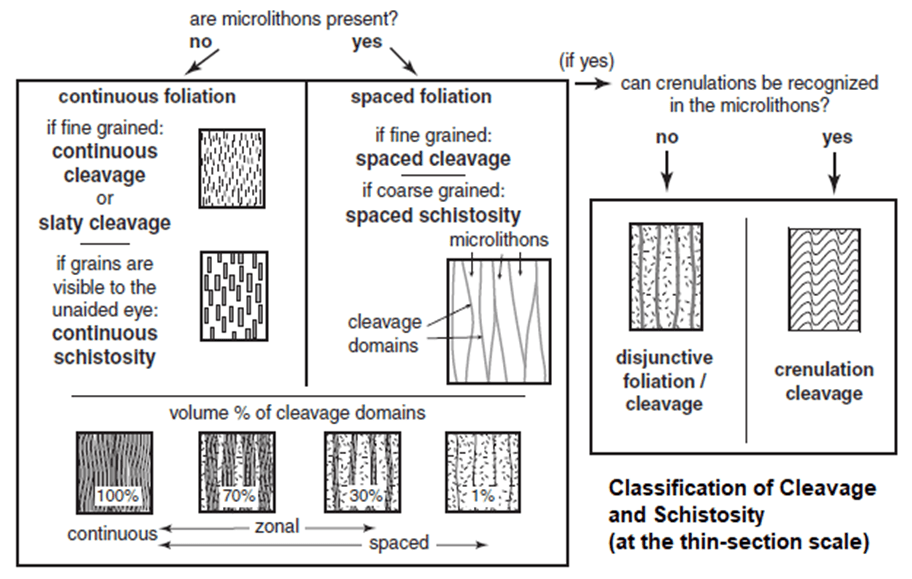

Lineations:
- Foliations generally occur when σ1>σ2≈ σ3 and lineations generally occur when σ1≈ σ2>σ3 there are also several types of lineations.
- They usually result from the elongation of minerals or mineral aggregates (stretching lineations).
- Stretched pebbles in deformed conglomerates is a common example.
- Lineations may also result from parallel growth of elongate minerals, fold axes, or intersecting planar elements.
Mechanisms of Tectonite Development

- Secondary (metamorphic) fabric elements in regionally metamorphosed rocks develop in response to deformation mineral growth.
- Various ways by which foliations occur:
-
- Mechanical rotation
- Mineral growth
- Ductile deformation
- Solution transfer
- Mimetic growth

Gneissose Structure and Layers
- Gneissose structure is either a secondary layering in a metamorphic rock or a poorly developed schistosity in which the platy minerals are dispersed. Gneissose structure can range from strongly planar to strongly linear.
- Several metamorphic rock types exhibit layers or lenses on the centimeter to several millimeter scale, and in gneisses it is practically characteristic.
- Such layering in fine-grained, low-grade rocks is generally relict bedding or igneous layering because secondary separation into contrasting layers requires diffusion,
- Layers in higher-grade schists and gneisses appear to develop in initially unlayered rocks, and the layering is original attributed to a poorly defined processes collectively called metamorphic differentiation.
- Various mechanisms for metamorphic differentiation have been proposed.
- They are solution transfer and redeposition via an aqueous phase (governed perhaps by local pressure gradients), local melt segregation, diffusion-controlled mineral development, and segregation of minerals as a result of their response to shear or stress differences.
- Another model suggests Quartz-Phyllosilicate layers to have unequal stress distribution which would be higher in the less competent “P-rich” layers, leading to creation of pressure gradient.
- The pressure gradients cause unequal pressure solution and migration of matter to the low stress (“Q-rich”) layers (solution transfer).
- The segregation of Q-P layers becomes enhanced with time.
Other Regional Metamorphic Textures
- Other textural and structural elements that may develop in deformed rocks and minerals are folds and kink bands.
- Boudinage is a process in which elements such as dikes or elongate minerals that are less ductile than their surroundings, stretch and separate into tablets or sausage shapes as the surroundings deform by ductile flow.
Deformation Versus Metamorphic Mineral Growth
- Foliated rocks are called S-tectonites, and we can refer to the foliations as S-surfaces.
- Linear elements are L-tectonites.
- If two or more geometric elements are present, we can add a numeric subscript to denote the chronological sequence in which they were developed and superimposed.
- S0 and L0 are reserved for primary structures, such as relict bedding or igneous layering, etc. S1, S2, S3, etc. are then subsequently developed foliations, whenever present.
- Similarly, L1, L2, and L3 are successive secondary linear elements.
- By using this notation we can conveniently describe the sequential development of fabric elements in a tectonite.
- D1, D2, D3, etc. can be used to refer to deformational phases, and M1, M2, M3, etc. to metamorphic events so that we can then relate fabric elements and the minerals involved to the events that created them.
- In order to interpret the metamorphic and deformational history of a rock, it is useful to be able to distinguish metamorphic mineral growth from deformational phases.
- Metamorphic mineral growth can be constrained based on the timing of growth with respect to deformation.
- Mineral growth may thus be characterized as pre-kinematic, syn-kinematic, or post-kinematic.
- Porphyroblasts are among the most useful tools for interpreting metamorphic-deformational histories for several reasons.
- First, porphyroblasts, being larger than the matrix around them, are mechanically more resistant to deformation, and can thus become porphyroclasts during later shearing, and be used as sense-of-shear indicators.
- Second, porphyroblasts may envelop and include some finer grains as they grow, thus becoming poikiloblasts.
- The nature and pattern of the inclusions may be very useful in interpreting deformation-mineral growth histories.
- Pre-kinematic crystals show the usual characteristics of minerals affected by later deformation.
- These include undulose extinction, cracked and broken crystals, deformation bands and twins, kink bands, pressure shadows, porphyroclasts with mortar texture or sheared mantles, etc.
- Pressure shadows occur when solution transfer dissolves a mineral (usually a matrix mineral) from high-stress areas and re-precipitates it in low stress areas adjacent to a porphyroblast.
- Post-kinematic crystallization either outlasted deformation or occurred in a distinct later thermal or contact event.
- Both the previous deformation and the later mineral growth or recrystallization must be apparent.
- Post-kinematic growth results in unstrained crystals.
- Pseudomorphs suggest that the replacement was post-kinematic.
- Syn-kinematic mineral growth is probably the most common type in orogenic metamorphism because metamorphism and deformation are believed to occur generally in unison.
- A continuous schistosity, probably generated by a process of dynamic (syn-kinematic) recrystallization.


- Proof of syn-kinematic growth is rare and the pattern of Si inclusions in a porphyroblast may provide unequivocal evidence for syn-kinematic porphyroblast growth.

- 2 (c) is syn-kinematic and shows a spiral pattern of the Si inclusions that is not found in the matrix foliation.
- The traditional interpretation of this spiral pattern is that the porphyroblast rotated as it grew progressively incorporating the external foliation.
- This spiral Si texture is particularly common in garnets.
- Some call the spiral texture rotated, or, if the rotation is extensive, snowball.
Replacement textures and reaction rims
- Replacement and reaction textures typically develop when reactions do not run to completion.
- They indicate the nature, direction, and progress of a reaction.
- These textures may provide clues to the nature of the protolith, or the history of rocks sampled.
- Replacement occurs when the reaction products replace a reacting mineral.
- Some degree of retrograde metamorphism typically occurs during the cooling of plutons because the rocks are maintained at metamorphic temperatures for extended periods.
- A wide range of retrograde reactions are possible in both igneous and metamorphic rocks.
- Perhaps the most common are hydration reactions.
- Retrograde metamorphism is less likely than prograde to reach equilibrium, commonly resulting in replacement textures.
- In many replacement reactions, a pseudomorph may develop, in which the reaction products retain the shape of the original mineral.
- Some reactions produce intimate, typically wormy-looking, intergrowths of two or more minerals, a texture called symplectite.
- Pseudomorphs may thus be either monomineralic or a symplectitic intergrowth.
- Reaction rims involve reaction between minerals where they meet at grain boundaries, resulting in the partial replacement of either or both minerals adjacent to their contact.
- If the reaction product forms a complete rim around a mineral, it is called a corona.
- Coronas can be either monomineralic or polymineralic. Polymineralic intergrowths of small elongate grains are called symplectitic coronas.
- Reaction rims occur when reactions did not reach completion and are thus frozen records of reactions caused by changes in metamorphic conditions.
- They may reflect retrograde alteration, polymorphic transformations, diffusion of material along grain boundaries, or solid-state reactions.
