
Study of climatic conditions, paleogeography and igneous activity in the Indian subcontinent in the geological past
Study of climatic conditions, paleogeography and igneous activity in the Indian subcontinent in the geological past
Climatic Condition of Indian Subcontinent
- Paleoclimatic studies use changes in climatically sensitive indicators to infer past changes in global climate on time scales ranging from decades to millions of years.
- Over the 4600 million years of its existence, the Earth has seen a large variety of climate states.
- During the evolution of our planet, its climate was differentiated by periods of enhanced climate variability or even swings and some more or less stable almost quiet – periods.
- Natural climate variability was the rule rather than an exception and the evolution of life on Earth was closely linked to climate and its change.
- Climate is a major component of earth system and has a direct control over the various physical, chemical and biological processes of the earth.
- There is increasing scientific evidence that natural processes combined with the anthropogenic activities are changing the Earth's climate.
- In the Earth’s history the Holocene is the recent part. Its description is given geologically and corresponds to the post-glacial warm period, beginning with the glacier retreat from the moraines in central Scandinavia. Its start is dated as 11,550 years ago.
- The term Holocene is also suitable to the sediments, processes, events, and environments of the epoch.
- A growing body of paleoenvironmental evidence offers significant environmental change took place during the late Holocene.
- The Indian summer monsoon (ISM) is part of the Asian summer monsoon (ASM) and provides 70% of India’s annual precipitation. Monsoon variability results in frequent floods and droughts that significantly affect livelihood and agriculture.
- The latter depends on the regularity of the ISM’s rainfall, intensity, seasonality, and timing of onset and retreat
- Yet, this variability and changes in rainfall seasonality remain poorly understood.
- Speleothems (mostly stalagmites) provide high-resolution, multi-proxy records, trace-element ratios, fluorescence, growth rates, and mineralogy) of ASM variability with increasingly tight age control.
- Late Quaternary researches, particularly, for the Holocene period is mainly focused on reconstructing the past climate dynamics, fluctuations in the intensity of the southwest monsoon (SWM) and applications of these datasets for predicting future trends.
- The Holocene period began approximately ~11500 yrs. ago and this period is marked by the evolution and decline of human cultures and establishing agriculture practices (Possehl, 1994).
- Relatively warm and cooler conditions during this period are also characterized by marine transgression and regression which has resulted in shifting of the coastlines world over impacting human settlements/ migrations.
- Such oscillations resulted in geomorphological changes, sedimentation patterns in coastal plains and inland areas, forming back waters, estuaries, formation of marine-terraces, spits, sand barriers, beach ridges and shifting of river courses (Wolf et al., 2008).
- Precession of the earth’s orbit around the sun has been attributed to cause significant changes in the seasonal distribution of surface heating during the Holocene period.
- In comparison, during the Holocene period, most part of the southern Indian peninsula was vulnerable even to the slightest rise in sea level in response to the natural short term extreme events.
- An increased understanding of the temperature record in the few past years through a multi-proxy studies have strengthened our confidence in assessing the middle Holocene warming trend associated with the rise in sea level to reduced precipitation/regression in shoreline which is primarily the result of human activities since the last 3000 to 2000 yr. BP.
Paleogeography Of Indian Subcontinent
- The paleogeography of the India–Asia collision system is the reconstructed geological and geomorphological evolution within the collision zone of the Himalayan orogenic belt.
- The continental collision between the Indian and Eurasian plate is one of the world's most renowned and most studied convergent systems.
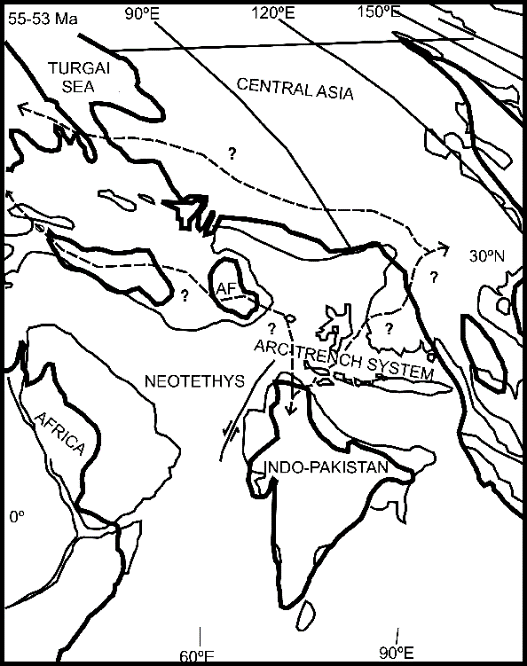
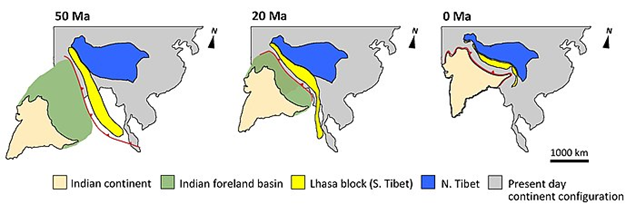
Paleogeography Of India-Asia Collison
Paleozoic versus Mesozoic Basins
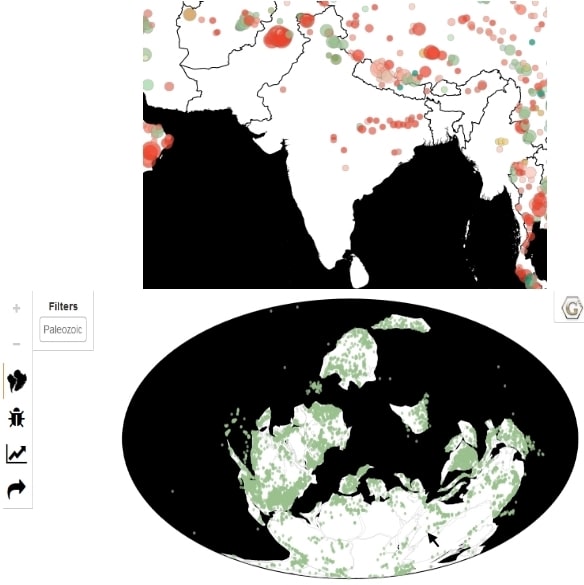
India is shown as it is today and in its Paleozoic geography
- Peninsular India occupies an interior location within Gondwanaland, far away from any ocean. Tectonic stability through most of the Paleozoic meant lack of crustal movements.
- During this time, peninsular India was an erosional landscape until the Permian basin formation in the east.
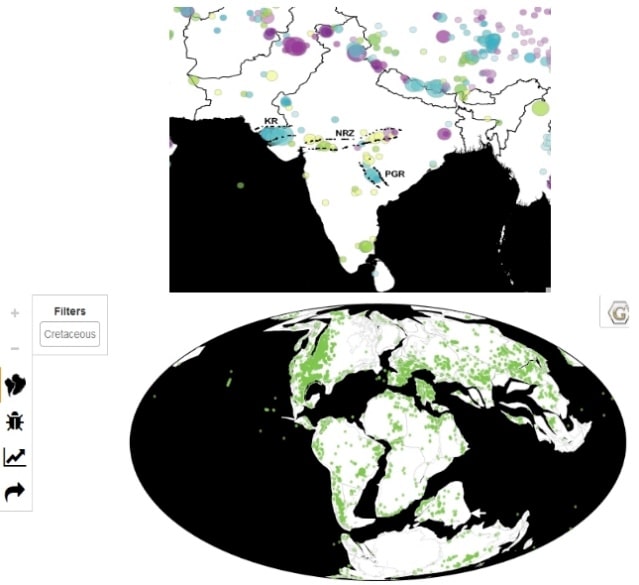
Mesozoic fossil locations and the Cretaceous paleogeography of India
- There is now a wide swath of fossil localities across Peninsular India. The dotted lines trace important linear depressions where sediments were deposited. The east west oriented Narmada rift zone (NRZ; Jurassic and Cretaceous) and the NW-SE oriented Pranhita Godavari zone (PGR; Triassic to Cretaceous) are important fossil repositories. The eastern India basins continued accumulating sediment. To the west are the basins which formed in Gujarat and Rajasthan (Jurassic and Cretaceous).
- All these basins ultimately owe their origin to the forces exerted on the crust as India pulled away (arrow) from Gondwanaland. Seaways formed along these rifts and crustal depressions.
- The Mesozoic, especially the Jurassic and Cretaceous, was a time of global high sea levels.
- The western margin saw marine incursions from the nascent Indian Ocean, while the eastern margin was submerged by the waters of the newly formed Bay of Bengal. River and lake systems also developed in more continental interior locations.
- The northern margin (Himalaya) was mostly a marine environment through the Mesozoic.
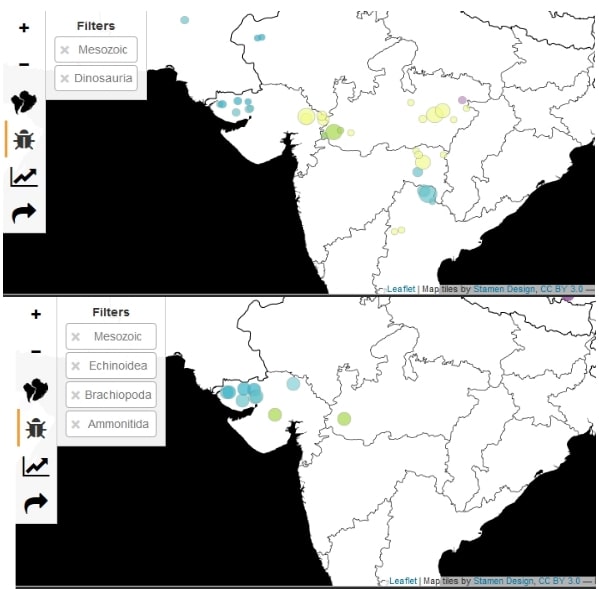
Marine versus Continental Interior Basins in Mesozoic Central India
- The distribution of terrestrial organisms versus marine organisms can tell us about the extent of marine flooding into Peninsular Central India in the Mesozoic.
Volcanic Activities in India Subcontinent
- The Indian subcontinent has witnessed several episodes of plutonism and volcanism in its geological past.
- In the Indian context, magmatism occurred since the Precambrian to Recent times and produced vast volcanic terrains such as the Archean komatiites, greenstone mafic volcanism, bimodal lavas of the Malani and the Dongargarh, the Pir Panjal Traps and related volcanics in the Himalayas, the classical continental flood basalt provinces of Deccan Traps and Rajmahals and the famous island arc volcanism at Narcondam and Barren Islands.
Archean-Proterozoic Volcanism
- Volcanoes that were active in the Archean eon (before approximately 2500 million years ago) in Precambrian time.
- No mountain belts of any notable topographical relief survive from this eon, so all surviving volcanic remnants are embedded in mostly-flat continental cratons, such as in greenstone belts or very large well-preserved supervolcanoes.
- Preceded by Hadean volcanism, which at first covered the entire planet.
- Succeeded by volcanoes in the Proterozoic eon.
- Iron was released then (as today) into the oceans from submarine volcanoes in oceanic ridges and during the creation of thick oceanic plateaus. This ferrous iron (Fe2+) combined with oxygen and was precipitated as ferric iron in hematite (Fe2O3), which produced banded-iron formations on the flanks of the volcanoes.
- Although volcanoes exhale much water vapour (H2O) and carbon dioxide (CO2), the amount of free oxygen (O2) emitted is very small. The inorganic breakdown (photodissociation) of volcanic-derived water vapour and carbon dioxide in the atmosphere would have produced only a small amount of free oxygen.
Late Mesozoic Deccan Traps and Associated Volcanism
- The Deccan Traps – an important continental flood basalt (CFB)
- Consist of multiple layers of solidified flood basalt.
- The release of volcanic gases, particularly sulfur dioxide, during the formation of the traps contributed to climate change.
- Within the Deccan Traps at least 95% of the lavas are tholeiitic basalts.
- Other rock types present include: alkali basalt, nephelinite, lamprophyre, and carbonatite.
- Mantle xenoliths have been described from Kachchh (northwestern India) and elsewhere in the western Deccan.

Map showing the approximate boundaries of the Precambrian cratons making up the Indian shield (e.g., Pandey & Agrawal, 1999; Naqvi & Rogers, 1987), the granulite terrain, the Precambrian structural trends (heavy broken lines), rift zones crossing peninsular India (e.g., Biswas, 1987), and the present outcrop areas of the Deccan and Rajmahal flood basalts
Paleoclimate Proxies
- The study of past climates prior to the instrument record.
- Scientists use indirect evidence (data) during past time periods to determine the climate at that time period.
- These climate imprints are referred to as proxies.
Why Study Past Climates?
- It may help us to understand natural climate changes.
- The study of past climates may give us information into future climate scenarios
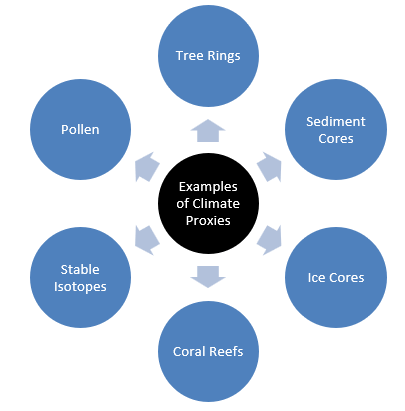
- Paleoclimate proxies are physical, chemical and biological materials preserved within the geologic record (in paleoclimate archives) that can be analyzed and correlated with climate or environmental parameters in the modern world.
- Scientists combine proxy-based paleoclimate reconstructions with instrumental records (such as thermometer and rain gauge readings) to expand our understanding of climate variability to times before humans began measuring these things.
- These reconstructions of past climate and environment span all timescales, from year-to-year variations to those that occurred over millions of years.
- These data help us understand how the Earth's climate system varied both before and after human alteration of the landscape.
Tools to Study Past Climate
Use of Proxies
- The use of a proxy to reconstruct past climate requires an understanding of how that proxy is related to some aspect of climate.
- For example, some proxies, such as atmospheric gases trapped in glacial ice (e.g., carbon dioxide and methane), provide a relatively direct measurement of atmospheric chemistry at the time the ice formed and was sealed off from the atmosphere.
- Other proxies are less direct, such as stable isotope measurements (e.g., oxygen and carbon) from shells of marine organisms.
- These indirect proxies require calibration studies in the modern system to establish relationship between climate process & proxy.
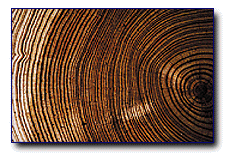
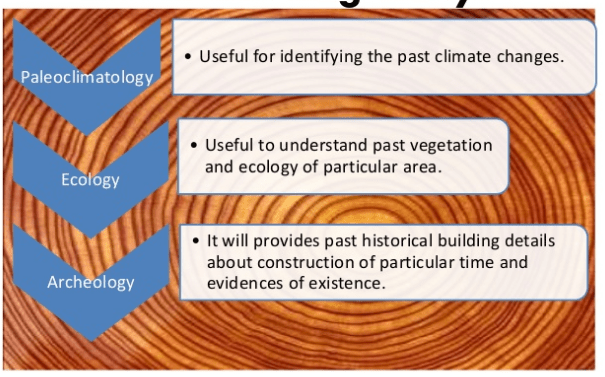
Tree Rings
- Tree growth is influenced by climate. These patterns can be seen in tree ring width and isotopic composition.
- Trees generally produce one ring each year.
- Trees ring records can extend back to the last 1000 years.
- The characteristics of the rings inside a tree can tell scientists how old a tree is and what the weather conditions were like during each year of that tree's life. Very old trees can offer clues about what the climate in an area was like long before measurements were recorded.
- Trees that depend heavily on moisture during the growing season will have wider rings during rainy periods and narrower rings during dry periods.
- By understanding the past climate using tree rings and other paleoclimate proxy data sources, scientists can more accurately predict future changes in the climate system
Sediment Cores
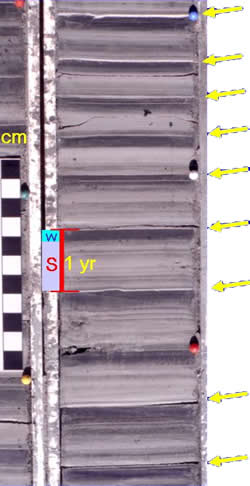
- Sediment cores can be taken from lakes, the shallow ocean, or the deep ocean.
- In some cases, the thickness of these layers can be used to infer past climate.
- In other cases, these layers are composed of organic material that can be analyzed for other climate proxies.
Ice Cores
- As snow and ice accumulate in polar glaciers a paleoclimate record accumulates of the environmental conditions of the time of formation.
- Ice cores can be analyzed using stable isotope approaches for water or air bubbles within the ice as a record of past atmospheric gas concentrations.
- Scientists drill through the deep ice to collect ice cores, which often have distinct layers in them. These layers contain dust, air bubbles, or isotopes of oxygen, differing from year to year based on the surrounding environment, that can be used to interpret the past climate of an area.
Coral Reefs
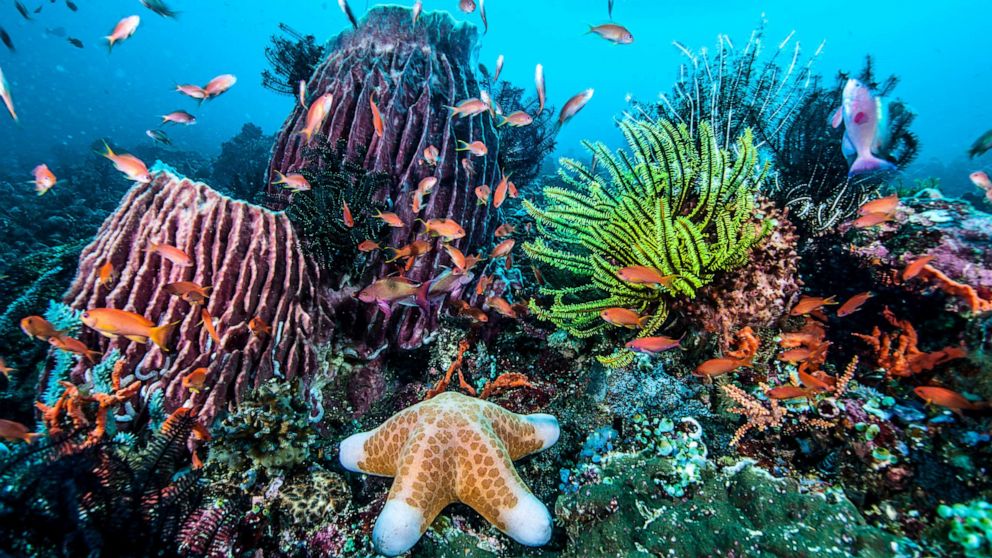
- Corals are composed of calcium carbonate.
- Coral reefs have been a part of the Earth's oceans for millions of years and are very sensitive to changes in climate.
- This carbonate contains isotopes of oxygen that can be used to determine the water temperature when and where the corals grew.
- Coral reefs are located in tropical oceans near the equator. The largest coral reef is the Great Barrier Reef in Australia.
Stable Isotopes
- The most common element used in climate studies is oxygen.
- The isotopes of oxygen are:
- O18 (rare)
- O17
- O16 (common)
- The ratio of O18 to O16 is affected by temperature and can be used as a climate proxy.
Pollen
- Pollen grains are well preserved in lake and ocean sediment.
- The analysis of each of these sediment layers provides information on the vegetation present at that time.
- Scientists can infer past climates (warm or cold) based on the distribution and changes in plant species.
- Pollen grains have a tough coat that has a form characteristic of the pollen-producing plant and which can still be recognized in some archaeological deposits.
- Pollen analysis is also known as Palynology.
- Used for analyze the plant pollen
- Pollen grains rang size 10 to 150
- In summer air is filled of pollens
- Palynologists collects core of sediment or pea date layer
- Pollen grains are well pressed in the sediment layer in pond lake and oceans
- Type of plants also identified
- pollen analysis to study long-term patterns of vegetation diversity.
- Prepared slide and add silicon oil, glycerol-jelly and observed in scanning electron microscopy. And they counts no. of grains of each pollen taxon.
Biomarkers
- Biomarkers are organic molecules that are unique to a specific organism or group of organisms.
- Biomarkers can be preserved in sediments and rocks after the organism itself has disintegrated, and measurements of their abundance can be used as a proxy for the past distribution and abundance of the source organisms.
- Some biomarkers can be used to reconstruct past physical parameters such as temperature.
- They persist in oil spills, refinery products and archaeological artifacts, and can be used to identify the origin, geological age and environmental conditions prevalent during their formation and alteration.